
Bunker Rules in Golf | The One Rule That Changes Everything
This post contains affiliate links. As an Amazon Associate, we earn from qualifying purchases.
This post contains affiliate links. As an Amazon Associate, we earn from qualifying purchases.
Bunker rules in golf are defined by Rule 12 from the R&A and USGA. You are in a bunker if any part of your ball touches sand inside its edge. Before a stroke, you cannot deliberately touch sand to test it or ground your club in the sand directly in front of or behind the ball. Removing loose impediments is allowed, but any action that improves your lie, stance, swing, or line of play incurs a two-stroke penalty.
That definition of “in a bunker” is where half the arguments start. A ball perched on a tuft of grass inside the lip is not in the bunker. A ball sitting on a pine cone that itself touches sand is in the bunker. The rule cares about the ball’s point of contact with the world, not where the ball visually appears.
What follows is the breakdown you need: the exact actions that trigger a penalty, the four relief options for an unplayable lie, and the three edge cases that even experienced players routinely miss.
Key Takeaways
- Your ball is only in the bunker if it touches sand or an object that touches sand. Grass or soil inside the edge doesn’t count.
- You get a two-stroke penalty for grounding your club in the sand near your ball, making a practice swing that touches sand, or deliberately testing the sand’s condition.
- For an unplayable ball, you have three one-stroke relief options inside the bunker and one two-stroke option to get out.
- You can remove loose impediments like leaves and stones, but if your method is deemed “unreasonable” and improves your lie, you still get penalized.
- If a committee marks an entire bunker as ground under repair, it’s no longer a bunker, you get free relief outside of it.
When Are You Actually in a Bunker?
The official definition from the R&A Rules of Golf Rule 12 is precise. A ball is in a bunker when any part of it touches sand on the ground inside the edge. It’s also in the bunker if it’s in or on a loose impediment, movable obstruction, abnormal course condition, or integral object that itself touches sand inside the edge.
A ball is in a bunker when any part of the ball touches sand on the ground inside the edge of the bunker, or is in or on a loose impediment, movable obstruction, abnormal course condition or integral object that touches sand in the bunker or is on ground where sand normally would be.
That second clause catches people. A ball sitting cleanly on a fallen branch is fine. If that branch is resting on sand, your ball is now in the bunker. The same logic applies to a drain cover, a rake, or a stone.
Where this goes sideways: Assuming you’re in the bunker because your feet are in it. The rule only cares about the ball’s contact. If your ball is on a patch of hardpan or grass inside the bunker’s edge, you’re in the general area. You can ground your club. This distinction changes your entire strategy for certain types of bunkers like sprawling waste areas.
| Ball Position | Touching Sand? | In the Bunker? | Can You Ground Club? |
|---|---|---|---|
| On sand | Yes | Yes | No |
| On grass inside edge | No | No | Yes |
| On a leaf resting on sand | Yes (via leaf) | Yes | No |
| On a rake | Yes (via rake) | Yes | No |
What You Absolutely Cannot Do (The Penalty Triggers)
Rule 12.2b is the core restriction. Before making a stroke at a ball in a bunker, you must not deliberately touch the sand with your hand, club, or anything else to test its condition. You also cannot touch the sand with your club in the area right in front of or right behind the ball, or during a practice swing or your backswing.
The penalty for breach is the general penalty: loss of hole in match play or two strokes in stroke play. This is the rule against grounding that everyone knows, but its details are specific.
You can:
- Dig in with your feet to take your stance.
- Place your clubs, bag, or a rake in the bunker.
- Lean on a club for balance, provided the club doesn’t touch sand near your ball.
- Strike the sand in frustration after your stroke.
You cannot:
- Press your clubhead down behind the ball to “feel” the sand.
- Make a practice swing that scrapes the sand, even if it’s a foot away from your ball.
- Let your club touch sand on your takeaway.
Common mistake: Taking a practice swing in the bunker to gauge depth. Any contact with sand is a penalty. The only legal way to test conditions is to probe for obstructions like a drain, and only if you don’t improve your lie in the process.
The USGA bunker rules overview confirms these acts are allowed only if they are incidental and don’t improve the conditions affecting your stroke. Smoothing sand to care for the course after you’ve played is always fine.
The Messy Exceptions: Loose Impediments and “Reasonable” Actions
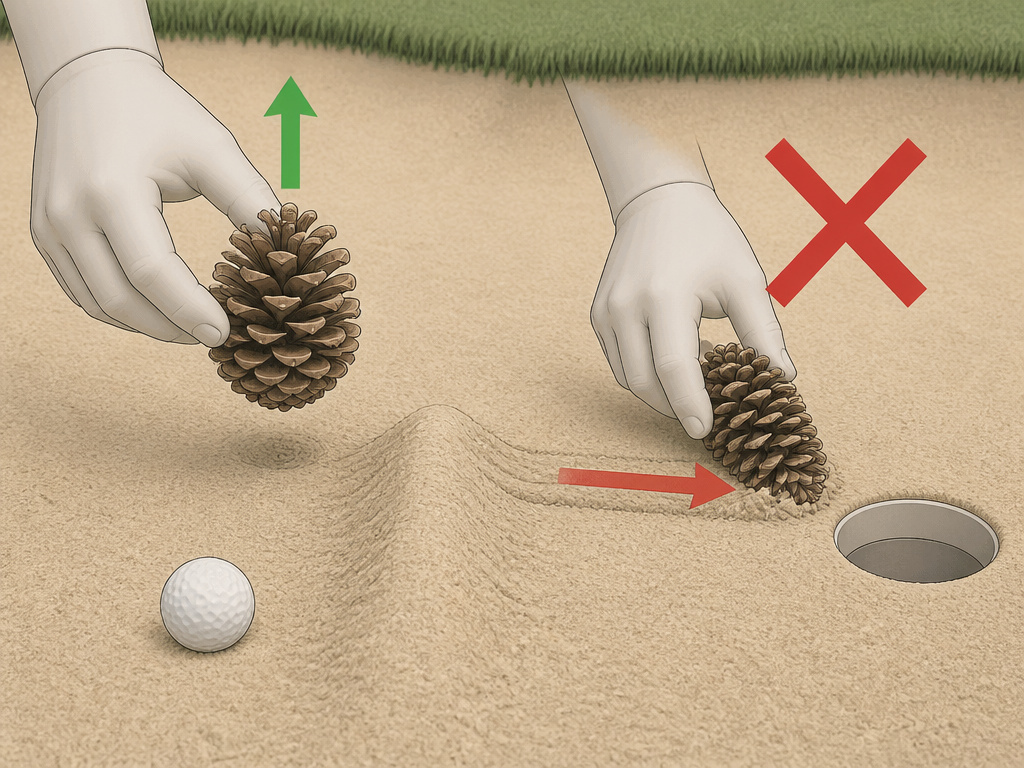
You are allowed to remove loose impediments (natural objects like leaves, stones, twigs) and movable obstructions (like a bottle or a rake). This is Rule 12.2a. Any reasonable touching or movement of the sand that happens while doing so is not penalized.
The key word is “reasonable.” This is a non-commodity edge case directly from the R&A Rule 12 clarifications.
Imagine your ball is behind a large pine cone. You could lift it straight out. Instead, you drag it toward you through the sand, flattening a mound between your ball and the hole. Your action improved your line of play. Even though removing the pine cone is allowed, your method was unreasonable. You get a two-stroke penalty under Rule 8.1a for improving conditions affecting the stroke.
The same logic applies to removing stones from a pot bunker. Raking them away is one thing. Kicking them to create a better stance is another.
Your 4 Escape Routes: Relief for an Unplayable Ball
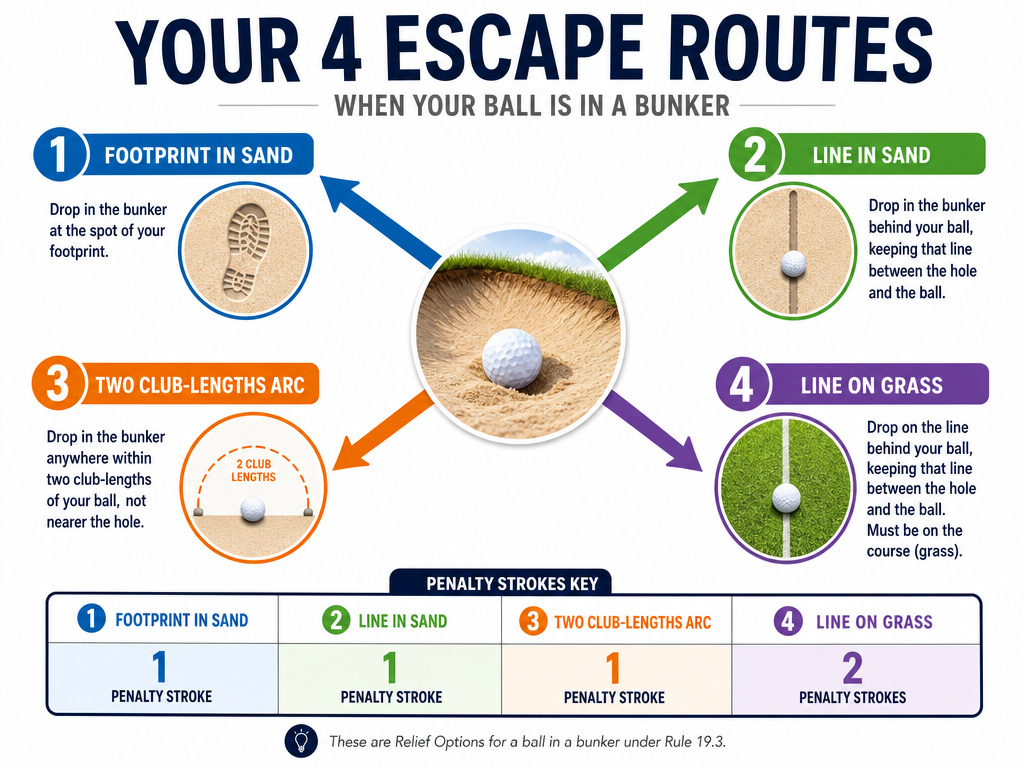
Declaring your ball unplayable in a bunker is a strategic decision. It gives you four options under Rule 19.3. Three cost one penalty stroke and keep you in the bunker. One costs two strokes but gets you out.
Here is the official breakdown from the USGA Player’s Edition bunker rules.
| Option | Procedure | Penalty Strokes | Where Ball is Dropped |
|---|---|---|---|
| 1. Stroke-and-Distance | Replay from your previous spot. | 1 | In the bunker (or teeing area if that was your last shot). |
| 2. Back-on-the-Line Relief | Drop on a line straight back from the hole through your ball’s spot. | 1 | Anywhere on that line inside the bunker. |
| 3. Lateral Relief | Drop within two club-lengths of your ball’s spot. | 1 | Anywhere inside the bunker, not nearer the hole. |
| 4. Back-on-the-Line Relief Outside Bunker | Drop on a line straight back from the hole through your ball’s spot. | 2 | Anywhere on that line outside the bunker. |
Option 4 is the emergency exit. It’s expensive but can be the only play from a deep pot bunker or a plugged lie under the lip. Remember, this is different from free relief from an abnormal course condition or a penalty area.
The critical lock-in period: If you lift your ball to take unplayable relief, the restrictions on touching sand STILL APPLY until you decide which option to use. You can’t pick up your ball, test the sand where you might drop, and then choose. That’s a penalty.
The Rare Free Pass: When a Bunker Isn’t a Bunker
Committees can declare any area ground under repair (GUR). If they mark an entire bunker as GUR, say it’s being renovated or is flooded, it loses its status as a bunker. It becomes part of the general area.
This is a powerful, rarely used rule. The R&A Players Rule Finder on GUR specifies the relief. You find the nearest point of complete relief outside the former bunker and drop within one club-length of that point, not nearer the hole.
You get this free relief even if your ball is sitting pretty in the middle of the sand. It’s a complete rule override. This is a different beast than a waste area, which is often part of the general area from the start.
How to Actually Play a Bunker Shot Legally
The rules frame the don’ts. Your pre-shot routine must work within them.
- Walk in carefully. You can dig your feet in for stance stability. This is explicitly allowed.
- Place your club outside the bunker. Don’t let it dangle into the sand.
- Take your practice swing outside the bunker. Completely. Not on the grass lip, not in a different patch of sand. On grass well away from the hazard.
- Address the ball without letting the clubhead touch the sand. Hover it. This is the discipline.
- Make your swing. Hit the sand behind the ball. The club will enter the sand during the stroke, that’s the point, and it’s legal.
For a fairway bunker shot, the rule is the same, but the technique changes. You need to pick the ball cleaner, so hovering the club is even more critical. Grounding it creates a penalty and often leads to a fat shot.
Frequently Asked Questions
Can you touch the sand in a bunker before a shot?
You can touch sand incidentally while taking your stance, placing equipment, or removing loose impediments. You cannot deliberately touch sand to test its condition, or let your club touch sand in the area of your ball or during a practice swing.
What is the penalty for grounding your club in a bunker?
The penalty is loss of hole in match play or two strokes in stroke play. This falls under the general penalty for breaching Rule 12.2b.
Can you remove a leaf or a rock from a bunker?
Yes. You may remove loose impediments (natural objects) and movable obstructions (artificial objects). Any reasonable movement of sand that occurs is not penalized. However, if your method of removal is deemed unreasonable and improves your lie, stance, swing, or line of play, you still get a two-stroke penalty.
Can you take an unplayable lie from a bunker and drop outside?
Yes, but it will cost you two penalty strokes (Rule 19.3b). You drop a ball on a line straight back from the hole through your ball’s original spot, keeping that spot between you and the hole. Your other one-stroke options require you to drop within the bunker.
Is a waste bunker governed by the same rules?
Not always. Many courses define waste areas as part of the general area, not as bunkers. In a waste area, you can usually ground your club and remove loose impediments freely. Always check the local rules on the scorecard.
Before You Go
Bunker rules exist to preserve the hazard’s intended challenge. The core is simple: don’t test the sand, don’t ground your club. The complexity lives in the edges, the definition of “in,” the reasonableness of removal, and the strategic cost of escape.
Memorize the unplayable ball options. One stroke to move a few feet, two strokes for freedom. Know that the rule’s grip on you doesn’t release the moment you lift your ball. And on the rare day you see a bunker marked as GUR, take your free relief without a second thought. That’s the rule working for you. Now go find your ball, and remember to rake.
