
How to Hit from a Fairway Bunker: A Complete Swing Guide
This post contains affiliate links. As an Amazon Associate, we earn from qualifying purchases.
This post contains affiliate links. As an Amazon Associate, we earn from qualifying purchases.
To hit from a fairway bunker, strike the ball first, then take a small divot of sand, exactly as you would from the fairway. This requires a narrow stance, ball positioned just left of center, and 60% of your weight on your lead foot at address. You must also choose a club with enough loft to clear the lip, test this by stepping on the club outside the bunker. If the shaft points above the lip, it’s safe. Club up one club for the distance you’ll lose from the stable, controlled swing.
The ball-first principle is the whole game. Greenside bunkers demand sand-first contact to splash the ball out softly. Fairway bunkers demand the opposite. Getting this wrong means the club digs, the ball goes nowhere, and you’re staring at the same shot again.
What follows is the five-part breakdown: the core swing thought that replaces a dangerous myth, the physical setup that locks your lower body, the loft-check that guarantees escape, the adjustments for common misses, and the tournament-proven swing thought from 1971 that still works.
Key Takeaways
- The advice to “pick the ball clean” is a myth that leads to topped shots. Hit ball first, then sand, like a normal iron.
- Use a simple loft check: step on your club outside the bunker. If the shaft points above the lip, you have enough loft to escape.
- Narrow your stance to limit lateral movement and promote a rotary turn. Widen it only if you consistently hit “fat.”
- Play the ball just left of center in your stance (for right-handed golfers) and preset 60% of your weight on your lead foot.
- Always take one more club than your usual distance. The controlled swing and stable lower body reduce power.
The Core Principle: Ball First, Then Sand
Forget everything you’ve heard about picking the ball cleanly off the sand. That thought makes you subconsciously raise the clubhead into the ball, resulting in a thin, skied shot that often doesn’t clear the lip. The reliable move is simpler.
Treat the fairway bunker shot like a normal iron shot from the grass. Your goal is to make ball-first contact, letting the club then brush through a shallow divot of sand on the target side of the ball. This preserves distance and ensures a predictable ball flight.
This changes your mental picture. You’re not hitting a “bunker shot.” You’re hitting a 7-iron, and the ball happens to be sitting on sand. The technique difference from a greenside bunker is absolute. There, you use a wedge with bounce, open the face, and strike sand first to explode the ball out. For any shot longer than your maximum greenside splash, say, beyond 45 yards with a gap wedge, you must switch to the fairway bunker technique.
Where this goes sideways: Trying to pick it clean. By avoiding the sand, you hit the ball on the upswing with the leading edge. The result is a low line drive that smacks the bunker face or a pop-up that travels half your intended distance.
The Setup: Your Physical Foundation
A proper setup eliminates the variables that cause poor contact. It’s about creating a stable platform that encourages a descending strike.
First, narrow your stance. Position your feet roughly shoulder-width apart, or even slightly inside. This limits how far your hips can slide laterally during the swing, forcing a more rotational turn. A wide stance invites a big weight shift, which often leads to hitting behind the ball.
Dig your feet in slightly for stability, but don’t bury them like you would in a greenside bunker. You want to feel grounded, not lowered. Gary Player’s timeless advice from a 1971 GOLF Magazine article emphasized rotating the feet inward to “dig in solidly” and prevent body sway, favoring the inside of the right foot.
| Setup Element | Fairway Bunker | Greenside Bunker | Why It Matters |
|---|---|---|---|
| Stance Width | Narrow (shoulder-width) | Wide | Limits lateral slide, promotes a rotational strike. |
| Foot Position | Dug in slightly, rotated in | Buried deeply | Provides stability without lowering the swing arc. |
| Ball Position | Just left of center | Forward in stance | Ensures ball is struck first in the descending blow. |
| Weight | 60% on lead foot at address | Evenly distributed or slight forward press | Keeps the low point of the swing ahead of the ball. |
Play the ball just left of the center of your stance (for a right-handed golfer). This positions it for contact just after the low point of your swing arc. Preset your weight, about 60% on your lead foot, and keep it there. This forward weight bias is non-negotiable; it’s the guard against falling back and hitting fat.
Club Selection: The Loft Test That Matters
Choosing the right club is a two-step process. First, ensure escape. Second, account for distance loss.
Step one is the loft check. Before you even think about the yardage to the flag, you must guarantee you can get the ball over the bunker’s front lip. Here’s the field test from MyGolfSpy:
- Take the club you’re considering and step just outside the bunker.
- Place the clubhead on the ground with the face pointing up toward the sky.
- Step on the clubhead to hold it in place.
- Look at the angle of the shaft. If it points above the lip of the bunker, you have enough loft. If it looks like it might catch the lip, grab a club with more loft.
This test removes all guesswork. A 4-iron might give you the distance, but its low trajectory could slam into the face. A 7-iron might be the smart play, even if it leaves you short of the green. Getting out is always priority one.
Step two is clubbing up. Once you’ve confirmed sufficient loft, factor in the swing. The narrow stance and quiet lower body will reduce your normal power. The ball will also fly slightly higher and land softer from the sand. The rule is to take one more club than you normally would for that distance. That 150-yard shot that’s usually an 8-iron? Hit a 7-iron.
The Swing: Quiet Power and a Committed Finish
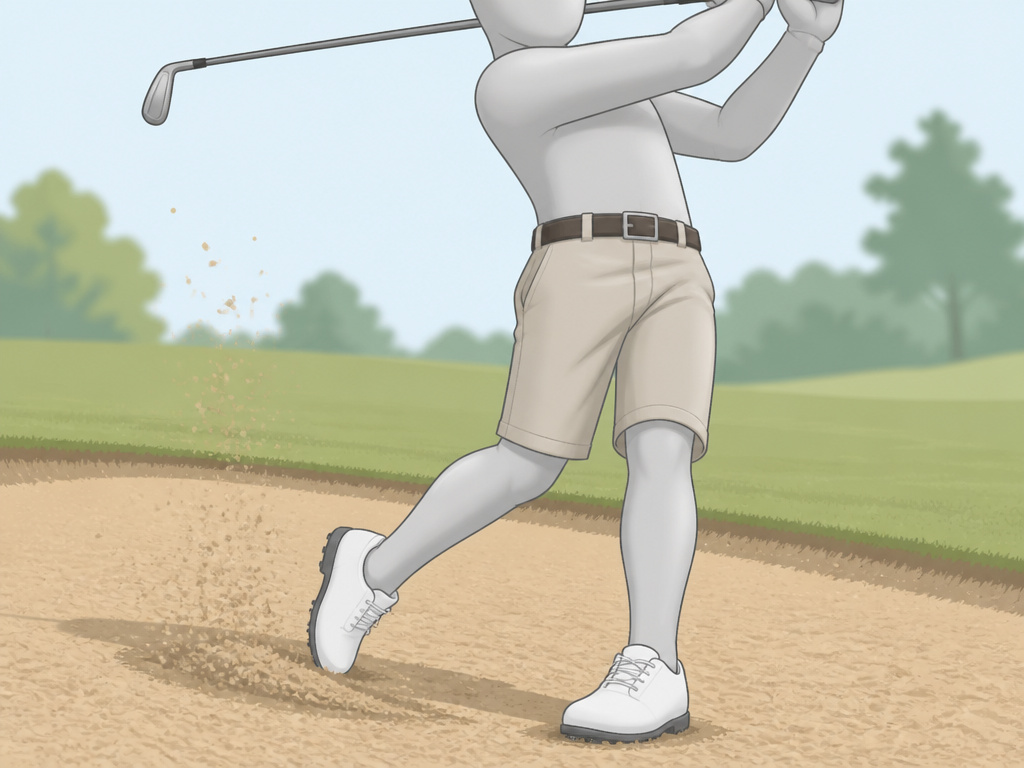
The swing thought is “controlled and compact.” You are not trying to generate maximum clubhead speed. You are executing a precision strike.
Make a three-quarter backswing. A full, loose turn risks losing your balance in the sand. Focus on turning your shoulders while keeping your hips relatively quiet. Your weight should stay planted on your lead side; there is no dramatic shift to your trail foot.
On the downswing, focus on rotating your chest through the ball. Your arms and hands are not the stars here, your core is. The goal is to strike the ball with a descending blow and then let the club continue low and through the sand for an inch or two.
Finish forward. Hold your finish with your weight fully committed over your front foot, your belt buckle facing the target, and your trail heel off the ground. Any tendency to fall back or “scoop” will ruin the contact.
This is where amateurs and pros diverge. An amateur sees a long shot and tries to muscle it, losing stability. A pro, like in the specific shot played at Torrey Pines’ 4th hole during the Farmers Insurance Open, takes a club more (a 7-iron for 170 yards), makes a shorter swing, and trusts the loft and contact to do the work.
Troubleshooting: Fixing Fat and Thin Contact
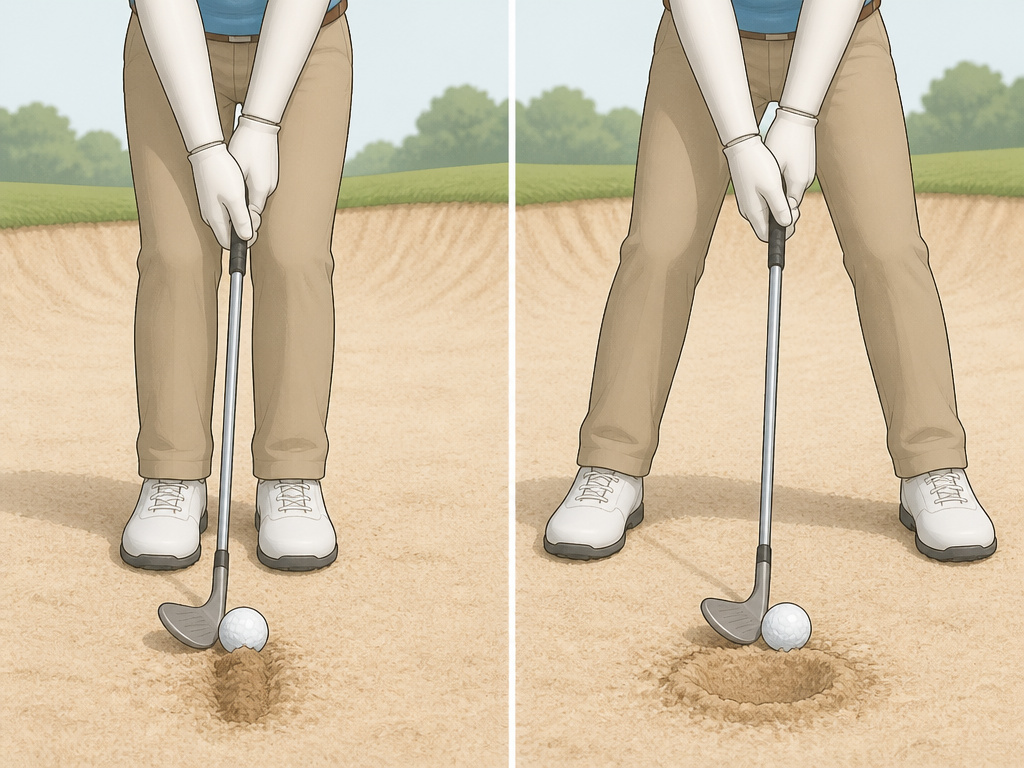
Even with a good plan, old habits creep in. Your miss tells you what to adjust.
If you constantly hit behind the ball (“fat”):
This means your low point is behind the ball. Widen your stance slightly for more stability. Grip down an inch on the club to effectively stand taller, which steepens your angle of attack. Consciously feel your sternum ahead of the ball at address and impact. These adjustments move the bottom of your swing arc forward.
If you top the ball or hit it thin:
You’re likely coming in too shallow or trying to help the ball into the air. Go back to the core principle: you must hit down to make it go up. Check that your weight is forward and that you’re not lifting your head. Make sure you’re not using a club with too little loft, forcing a scooping motion to get height.
For other challenging lies, the principles of stability and adaptation still apply. The adjustments you make for a sidehill lie or downhill lie on grass are magnified in the sand. The key is matching your shoulder plane to the slope.
Frequently Asked Questions
Do the same bunker rules apply in a fairway bunker?
Yes, the standard rules for bunkers apply. Your club cannot touch the sand before the swing (the grounding club in bunker rule), you cannot remove loose impediments, and you must play the ball as it lies. The penalty for grounding your club is still one stroke.
What’s the main difference between a greenside bunker shot and a fairway bunker shot?
The difference is in the point of contact. In a greenside bunker shot, you intentionally hit the sand 1-2 inches behind the ball to splash it out. In a fairway bunker, you must hit the ball first, then the sand, like a normal iron shot. The techniques, club selection, and setup are completely different.
Should I use a fairway woods from a fairway bunker?
Rarely. A fairway wood has very little loft and a wide sole, making it difficult to make clean ball-first contact from sand. It’s easy to skim under the ball or hit it fat. An iron or hybrid is almost always a safer, more consistent choice. Only consider a fairway wood if the ball is sitting perfectly on top of hard sand and the lip is very low.
How do I handle a deep pot bunker?
pot bunker presents a specific challenge with its steep faces. Your only objective is to get out, even if that means playing sideways or backwards. Use your most lofted club that can clear the lip (often a sand or lob wedge), and don’t even think about distance. Take your medicine, get the ball back in play, and avoid the big number.
The Bottom Line
Fairway bunkers stop being scary when you have a plan. The plan is not to pick it clean. It’s to strike the ball first with a quiet, controlled swing from a stable base. Check your loft, club up, and commit to your finish. This turns a hazard into just another lie. Master this, and you’ll save strokes immediately, no magic required, just better mechanics.
