
Fix Yardage Gaps with the Proven Clock System for Wedges
This post contains affiliate links. As an Amazon Associate, we earn from qualifying purchases.
This post contains affiliate links. As an Amazon Associate, we earn from qualifying purchases.
The clock system for wedge distances maps partial swing lengths to specific yardages by using the positions of a clock face. A 9 o’clock backswing (left arm parallel to ground) with a 56-degree wedge typically produces a 75-yard shot. The system fails when applied rigidly—fixed 15-yard gaps leave critical yardages like 115-130 yards uncovered, which is why blending it with feel and bounce selection is non-negotiable.
That gap between the textbook distance and the shot you actually face is where the whole short game lives. The clock system gives you a mechanical framework, but the turf, the lie, and the wedge in your hand dictate the final yardage.
What follows: a breakdown of the clock positions, the gear specs that change everything, and the on-course adjustments that turn a range drill into a saved par.
Key Takeaways
- The classic system creates predictable 10-15 yard gaps, but a rigid three-wedge set leaves uncovered yardages between 88 and 130 yards.
- Wedge bounce and sole grind decide whether a partial swing digs or glides; a high-bounce wedge in firm conditions will blade the ball every time at a 9 o’clock swing.
- Your most important wedge is the one you use for 50-75 yard shots; master its 9 o’clock and 10:30 positions before adding more clubs.
- Dial in distances with real golf balls on real grass; range balls fly 10% shorter and mat strikes hide fat-shot feedback.
- The system is a starting map, not a prison. Your best shots blend the mechanical checkpoint with a feel for the strike.
How the Clock System Actually Works (Step-by-Step)
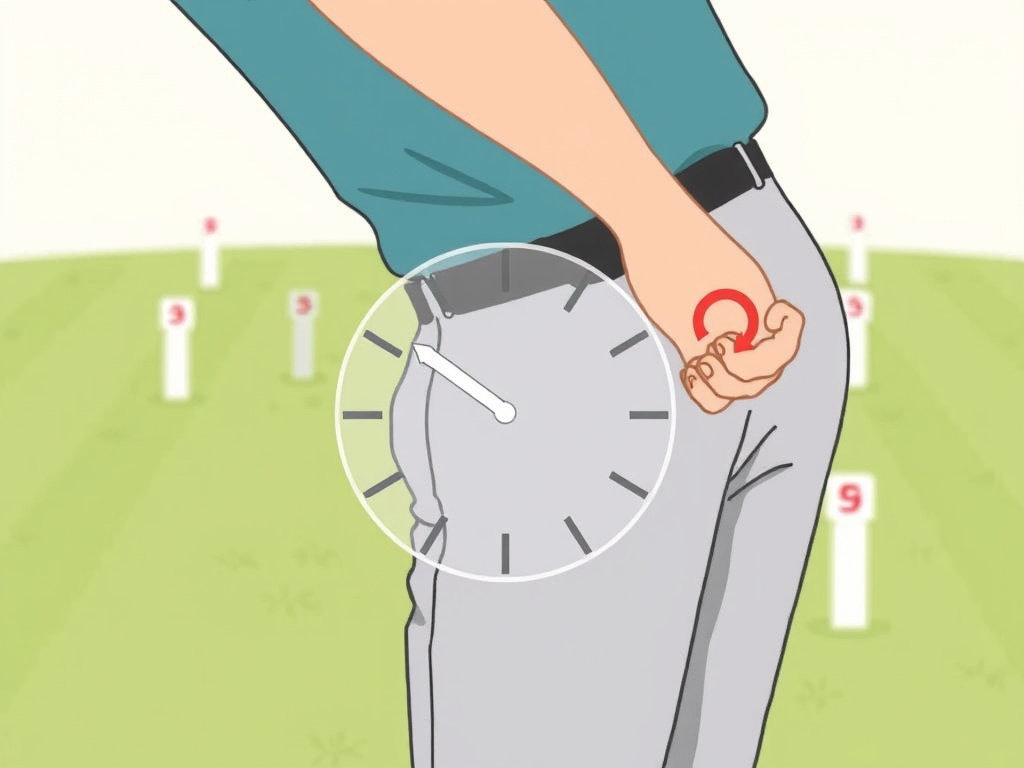
The clock system converts swing length into repeatable distance. It ignores swing speed and force. The only variable is how far back you take the club, measured by where your left arm points.
The Technical Snippet: The system uses the clock face as a visual reference for backswing length. The address position is 6 o’clock. A standard pitch shot finishes with the left arm parallel to the ground, which is 9 o’clock. A three-quarter swing reaches 10:30, and a full swing finishes at 12 o’clock. Each position, when matched with a consistent tempo and a specific wedge loft, produces a predictable carry distance.
Step 1: Find Your Baseline Wedge. Start with your most versatile wedge, usually a 54 or 56-degree sand wedge. This becomes your ruler. Go to a grass range with a laser rangefinder and real golf balls.
Step 2: Dial in the 9 O’Clock Shot. Make a backswing where your left arm is parallel to the ground and the clubshaft is roughly parallel to your toe line. Make a smooth, accelerating pass through the ball. Note the carry distance. Do this ten times. Ignore the longest and shortest, and average the rest. This is your 9 o’clock yardage.
Common mistake: Using range balls for calibration. They have harder cores and cut covers, which reduces spin and carry by about 10%. Your on-course 75-yard shot will fly 82 yards if you dial it in with range rocks.
Step 3: Move to 10:30 and 12 O’Clock. Repeat the process for a longer swing, where your left arm is at 10:30 (about halfway between parallel and full). Then hit full swings. You’ll now have three distances for one wedge.
Step 4: Apply the System to Your Other Wedges. Repeat Steps 2 and 3 for your gap wedge (e.g., 50-degree) and your lob wedge (e.g., 60-degree). This builds a distance matrix.
| Wedge Loft | 9 O’Clock Carry | 10:30 Carry | Full Swing Carry |
|---|---|---|---|
| 50° Gap Wedge | ~85 yards | ~100 yards | ~115 yards |
| 56° Sand Wedge | ~75 yards | ~90 yards | ~105 yards |
| 60° Lob Wedge | ~60 yards | ~75 yards | ~90 yards |
The table is a template. Your numbers will differ based on swing speed, strike quality, and the specific model of wedge you use. The goal is to know your own chart.
What happens if you skip the averaging? You’ll remember one perfect shot and one flub. The average of ten shots tells the truth about your strike. Without it, you’re guessing on the course.
The Yardage Gap Problem Nobody Talks About
A rigid three-wedge clock system creates a mathematical flaw. If your full-swing wedges go 115, 105, and 90 yards, you have a 15-yard gap between each. This seems fine on paper.
The problem lives between the clubs. What about 108 yards? That’s a slightly soft 50-degree or a hard 56-degree. Now you’re stuck between a mechanical 9 o’clock swing and a 10:30 swing, in a situation that demands a specific number. This is where amateurs decelerate and chunk it.
Where this goes sideways: Assuming 15-yard gaps are sufficient. On a 120-yard par 3 into wind, your 115-yard club comes up short. Your 130-yard club flies the green. The system didn’t provide a shot, so you invent one under pressure and miss the green.
This is why understanding wedge selection is more than just loft. It’s about filling the gaps your full swings create. Many better players carry four wedges (Pitching, Gap, Sand, Lob) precisely to shrink these intervals to 10-12 yards. For the average golfer, mastering partial swings with two wedges is often more effective than carrying four and being confused by them.
The fix isn’t more wedges. It’s more shots with the wedges you have. Your 56-degree sand wedge needs to be able to hit 70, 75, 80, 85, 90, 95, and 100 yards. That’s seven shots with one club. The clock system gives you two or three of them. You create the rest by blending the positions.
The Gear That Makes the System Sing
The clock system assumes a perfect, neutral lie and a standard wedge. Reality offers hardpan, fluffy lies, and twenty different sole grinds. Your equipment choices validate or break the technique.
Bounce is Your Launch Controller. Bounce is the angle between the leading edge and the lowest point of the sole. A high-bounce wedge (12+ degrees) has a rounded sole that resists digging in soft sand or lush turf. A low-bounce wedge (6-8 degrees) has a sharper leading edge for tight lies and firm conditions.
Worth knowing before you start: Using a high-bounce wedge from a tight fairway lie for a 9 o’clock shot is a recipe for a bladed skull. The bounce prevents the leading edge from engaging, so the club slides into the ball’s equator. Conversely, a low-bounce wedge in soft sand will dig to China.
Your wedge’s sole grind modifies the bounce. A “C” grind (like on a Vokey) relieves the heel and toe, allowing the face to open easily for flops without increasing the effective bounce. An “S” grind has a straighter sole for a square-face player who takes divots. If you don’t know your grind, you’re playing a different game than your wedge is designed for.
The Default Picks.
For the player who wants one answer and practices twice a month: the Cleveland CBX 2. It’s a cavity-back wedge with a forgiving, full sole. The bounce is built to be friendly, and it executes the clock system’s basic positions without demanding perfect ball-striking.
For the player who practices short game weekly and plays different grasses: the Titleist Vokey SM9. You must get fit for the correct grind (a D grind for steeper swings, an S for shallow). Once matched, it’s the most precise instrument for varying trajectory and spin on partial shots.
For the player who needs maximum forgiveness on partial swings: the Ping Glide 4.0. Its hydropearl chrome finish reduces friction on turf interaction, making the clubhead glide through the hitting zone more consistently—exactly what you want when repeating a 9 o’clock swing.
These aren’t just different best wedges; they are tools for different short-game philosophies. The CBX 2 helps you execute the system. The Vokey SM9 lets you deviate from it with control.
Integrating Feel with the Mechanics
The clock system is a map. Feel is the compass. Relying solely on arm position turns you into a robot, and robots can’t adjust for a downhill lie into the wind.
The Blending Drill. Hit ten 9 o’clock shots with your 56-degree to your known 75-yard flag. Then, without changing your swing length, try to hit the 70-yard flag. You can’t shorten the swing, so you must soften your hands, slow your tempo, or reduce your wrist hinge. This teaches distance control within a clock position.
Next, practice hitting the same 75-yard shot with two different clubs. Hit a soft 50-degree wedge and a firm 60-degree wedge. Notice the different trajectories and spin. The 50-degree will fly lower and run out. The 60-degree will fly higher and stop quicker. Now you have options, not just a single answer.
This is where mastering partial wedge shots pays the highest dividend. It’s the skill that fills the yardage gaps the pure clock system leaves open.
When to Abandon the Clock. In thick rough, the clock is useless. The grass will grab the hosel and slow the clubhead, killing distance. Here, you feel the shot. You make a more aggressive swing to shear through the grass, knowing the ball will come out dead. On hardpan, you use a less-bounced wedge and pick it cleanly—a shorter, crisper motion the clock doesn’t define.
Your pre-shot routine should include a mechanical checkpoint (“This is a 9 o’clock with the 56”) and a feel cue (“Smooth tempo, hold the finish”). The first gives you consistency. The second gives you adaptability.
Frequently Asked Questions
Is the clock system better than just judging by feel?
For most amateurs, yes—initially. Feel is unreliable without a foundation. The clock system provides that repeatable foundation. As you improve, feel naturally blends with the mechanics. The system stops you from making a huge, decelerating swing from 50 yards.
How do I stop hitting partial wedges fat?
You’re likely using a wedge with too much bounce for the conditions, or you’re failing to shift your weight forward. For a 9 o’clock shot, your weight must be 60-70% on your front foot at impact. A fat shot means your weight stayed back, causing the low point of the swing to be behind the ball. Practice with your feet together to feel the necessary weight transfer.
Should I use the clock system with my pitching wedge?
Absolutely. Your pitching wedge is often your 135-150 yard club. A 9 o’clock swing with it might produce a 110-yard shot, which is a crucial distance on many par 4s. It’s one of the most overlooked techniques for controlling wedge distances from longer range.
Why do my distances change from the range to the course?
Two reasons: surface and ball. Range mats allow you to hit slightly behind the ball without penalty, masking fat strikes. Real grass punishes them. Also, if you use range balls, they are designed for durability, not performance. They fly shorter. Always validate your distances with the same ball you play on course.
How does wedge bounce affect partial shots?
Dramatically. High bounce (10-14 degrees) is great for full swings from rough or sand, as it prevents digging. For the precise, nippy contact required for a 9 o’clock shot from a tight fairway lie, lower bounce (6-8 degrees) lets the leading edge engage cleanly. Understanding wedge bounce and grind is essential for consistency.
The Bottom Line
The clock system for wedge distances gives you a language for your short game. It turns “a little wedge” into “a 9 o’clock 56-degree, 75 yards.” That specificity builds confidence.
But don’t let the mechanics become a cage. The real art is knowing when a 10:30 swing with a 60-degree lob wedge is better than a full 56-degree, or how a wedge for generating spin can change your landing zone. Your goal isn’t to memorize a chart. It’s to develop a toolbox where the clock system is your most reliable wrench, and feel is the adjustable plier for everything else.
Start with one wedge. Dial in three distances. Then learn to hit five with it. That’s how you cover the gaps, save pars, and turn approach shots into birdie looks.
