
How to Hit Partial Wedge Shots: The Clock System Explained
This post contains affiliate links. As an Amazon Associate, we earn from qualifying purchases.
This post contains affiliate links. As an Amazon Associate, we earn from qualifying purchases.
To hit partial wedge shots, you match a specific backswing length, 7:30, 9:00, or 10:30 on a clock face, with each of your wedges. This creates 12 distinct, repeatable yardages. You then record those distances in a personal wedge matrix, so a 63-yard shot becomes “56-degree wedge at 9 o’clock,” not a guess. Grip down an inch to fine-tune, and maintain the same smooth tempo on every swing, regardless of length.
That 7:30, 9:00, 10:30 framework is Dave Pelz’s 3×4 system. It works because it replaces variable muscle effort with a repeatable physical position. Your brain knows where your arm is supposed to stop. The yardage that comes out is a product of your club speed and that fixed arc, not a last-second lunge or a decelerating stab.
What follows is how to build that system from scratch. We’ll map your wedges, lock in your tempo, and handle the lies and winds that break amateur swings. By the end, you’ll have a chart that turns the 40- to 100-yard zone from a scoring graveyard into a green-light opportunity.
Key Takeaways
- The clock system (7:30, 9:00, 10:30 backswings) creates predictable yardages by fixing swing length, not effort.
- You must build a personal wedge matrix, your distances are unique and guessing from a pro’s chart costs you three shots a round.
- Grip down 1-2 inches to subtract 3-8 yards cleanly, a better move than trying to manufacture a “feel” swing.
- Deceleration is the killer. A longer, smoother swing to a 10:30 finish always beats a short, quick jab to 9:00.
- On tight or soggy lies, focus on “quiet hands” and torso rotation, trying to help the ball up with your wrists leads to fat or thin contact.
What Is the Clock System for Partial Wedges?
The clock system is a distance-control framework. You visualize your lead arm as the hour hand of a clock. Three positions, 7:30, 9:00, and 10:30, define your backswing length for partial swings.
The 7:30 position has the lead arm angled down, with the club shaft near hip height. The 9:00 position has the lead arm parallel to the ground, shaft pointing skyward. The 10:30 position has the arm above parallel, short of a full swing. Each position, when paired with a specific wedge, produces a consistent carry distance.
This isn’t about swinging easier or harder. It’s about creating a mechanical stop sign. When you know your arm stops at 9:00, you can accelerate through the ball with the same tempo every time. The wedge clock system turns an abstract “half swing” into a measurable, repeatable motion. Without it, your 75-yard swing might be a 9:00 one day and a 10:30 the next, and your dispersion circle widens from 10 feet to 30.
Where this goes sideways: Players try to control distance by varying their downswing effort. They take a 9:00 backswing but then either lunge at it or quit on it. The result is inconsistent strike and a yardage spread that makes the system useless. The backswing length sets the distance; the downswing must be a consistent, accelerating release.
The Four Wedges and Their Jobs
Your wedge selection starts with knowing what each club is designed to do. The lofts gap down about four degrees, creating overlapping distance windows.
| Wedge Type | Typical Loft | Full-Swing Yardage | Primary Partial Role |
|---|---|---|---|
| Pitching Wedge (PW) | 44°–46° | 110–130 yds | The 10:30 three-quarter shot for 85-100 yards; lower flight, more roll. |
| Gap Wedge (GW) | 50°–52° | 95–110 yds | The workhorse for 60-85 yards; balances loft and distance. |
| Sand Wedge (SW) | 54°–56° | 80–95 yds | The 9:00 half-swing specialist for 50-75 yards; higher spin. |
| Lob Wedge (LW) | 58°–60° | 65–80 yds | The 7:30 quarter-swing tool for 30-55 yards; high, soft landing. |
These are typical lofts. Your specific set might vary, which is why guessing from a standard chart fails. A player with a strong-lofted 44-degree pitching wedge has a huge gap to a 52-degree gap wedge. That gap is where partial swings live.
The differences between wedge types aren’t just about distance. Bounce and grind affect how the sole interacts with the turf, which matters immensely on partial shots from tight lies. A high-bounce sand wedge can skip and blade a ball off hardpan; a low-bounce lob wedge can dig on a soft fairway. Your matrix must account for contact as much as carry.
Build Your Wedge Matrix (The Range Session That Saves Strokes)
Your personal wedge matrix is the single most valuable page in your yardage book. It takes one dedicated range session to create.
Go to the range with your four wedges, a laser rangefinder if you have one, and a notebook. Hit off grass, not a mat. Mats hide fat strikes, and fat strikes ruin your data.
- Start with your lob wedge. Hit five normal shots with a full swing to establish your baseline carry distance. Write it down.
- Switch to the clock. Hit five shots with a 7:30 backswing. Focus on a smooth, accelerating tempo. Note the average carry.
- Move up the clock. Repeat for the 9:00 and 10:30 positions. Record the carry for each.
- Repeat for every wedge. Work through your sand, gap, and pitching wedges. Your goal is 3-4 data points per club.
A completed matrix looks like this (your numbers will differ):
| Wedge | 7:30 Carry | 9:00 Carry | 10:30 Carry |
|---|---|---|---|
| 60° LW | 40 yds | 50 yds | 60 yds |
| 56° SW | 50 yds | 60 yds | 75 yds |
| 52° GW | 60 yds | 70 yds | 85 yds |
| 48° PW | 70 yds | 80 yds | 95 yds |
This chart makes decisions automatic. A 63-yard shot is your 56-degree sand wedge at 9 o’clock. No internal debate. This is how you achieve real wedge distance control.
Common mistake: Not using carry distance. Total distance includes roll, which changes with green firmness, slope, and spin. Carry distance is constant. Your matrix must be built on carry.
The Two Adjustments That Fine-Tune Any Yardage
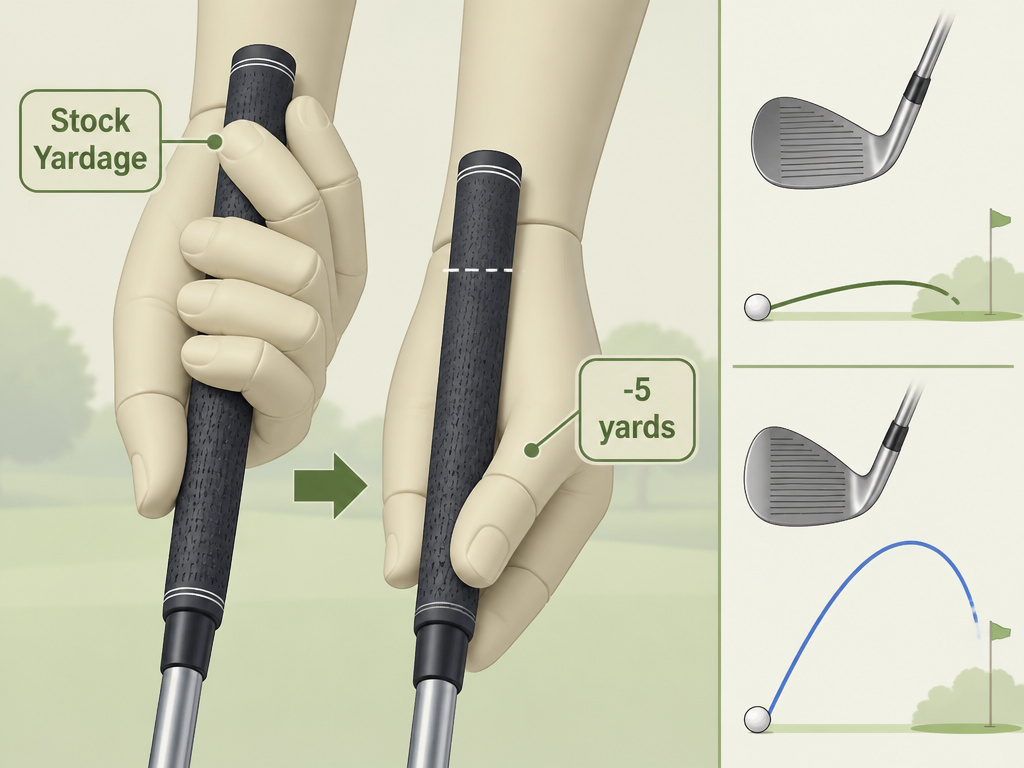
Your matrix gives you stock yardages. You now need two dials for in-between numbers: grip length and trajectory.
Grip Down: For every inch you choke down on the grip, you lose roughly 5 yards of carry. It’s a linear, predictable adjustment. If your stock 9:00 gap wedge goes 70 yards and you need 65, choke down an inch and make your normal 9:00 swing. This is far more reliable than trying to invent a “7:45” swing length.
Trajectory and Spin: A lower-lofted club (like a gap wedge) hit with a longer backswing (10:30) will produce a lower, more penetrating flight with less spin and more roll. A higher-lofted club (like a sand wedge) with a shorter backswing (9:00) flies higher, lands softer, and spins more. Use this to your advantage. Into wind, take more club and swing easier (e.g., gap wedge at 10:30 instead of sand wedge at 9:00). To a front pin, use the higher, spinnier option.
Tempo and Feel Drills You Can’t Skip

Distance control isn’t just length. It’s timing. These drills install the necessary tempo.
The One-Arm Drill: Hit twenty shots with only your lead arm on the club. Use your lob wedge and target 30-40 yards. This forces your torso to rotate and eliminates any wristy flick. You’ll learn the rhythm required for consistent contact.
The Three-Ball Ladder: Place three balls in a line. With one wedge, hit the first to a 7:30 length, the second to 9:00, the third to 10:30. Pay attention to the sound of the strike and the flight. The goal is to associate a specific feel, the weight of the club at the top of the backswing, with each distance. This builds the fundamentals of a pitch shot into your muscle memory.
The Metronome Check: Download a metronome app. Set it to 72 beats per minute. Practice making your backswing and downswing match a “tick-tock” rhythm, regardless of swing length. This cures deceleration.
How to Handle Real-Course Conditions
Your matrix is your baseline. Now you must adjust for the variables a course throws at you.
Wind: Into a strong wind, take one more club (e.g., gap wedge instead of sand wedge) and make your normal swing. Do not swing harder. Downwind, take one less club or expect more roll.
Elevation: For an uphill shot, add 5-10 yards to your required carry. The slope steals energy. For downhill, subtract 5-10 yards. The slope adds energy.
Tight or Soggy Lies: This is where technique overrides system. From a tight lie, the margin for error is zero. You must strike the ball first. The key is “quiet hands” and torso rotation. Make practice swings brushing the grass where the ball would be. Feel the clubface glide through. Any attempt to help the ball up leads to a bladed or fat wedge shot.
In-Between Yardages: You have a 67-yard shot. Your matrix says 60 yards for a 9:00 lob wedge and 70 yards for a 9:00 sand wedge. Do not try to manufacture a 67-yard swing. The rule is: take the longer club and make a smoother swing. So, take your sand wedge, make a pristine, smooth 9:00 swing, and accept a 70-yard result. It’s better than a mishit trying to be perfect.
Partial Wedge vs. Other Short Game Shots
When do you use a partial wedge versus another option? The decision tree is simple.
| Situation | Best Shot Choice | Why |
|---|---|---|
| 40-100 yards to the pin, no major obstacle | Partial Wedge | Maximum control over distance and landing spot. |
| Short-sided over a bunker to a tight pin | Flop Shot | Requires maximum height and minimal roll. |
| 10-30 yards from the green, plenty of green to work with | Bump and Run | Lower risk, uses the ground for consistency. |
| Buried in rough near the green | High-Lofted Wedge (Full Swing) | Need the loft to escape the grass; distance control is secondary. |
Understanding this bump and run vs flop shot decision saves more strokes than any single technique. A partial wedge is your stock shot from the fairway. When conditions demand something else, have that shot ready.
Why Your Partial Wedges Still Suck (And How to Fix It)
You built a matrix. You practice. Yet the shots still come up short or fly the green. Here are the likely culprits.
You’re decelerating. This is the number one fault. You take the club back to 9:00, then subconsciously slow down because you’re afraid of hitting it too far. The clubhead lags, you hit it fat or thin, and it comes up 20 yards short. The fix: commit to accelerating through the ball, even on the shortest swing. Think “low and slow” back, “accelerate through.”
You’re not accounting for lie. A ball sitting down in the rough will come out with less spin and more “jump.” It will fly longer. Your matrix is for perfect fairway lies. From rough, take one less club or grip down more.
You’re ignoring your wedge’s bounce. If you have a high-bounce wedge and the turf is firm, the sole can bounce into the ball, causing a thin or bladed shot. On hardpan, use your lowest-bounce wedge. Knowing wedge bounce and grind is non-negotiable for good players.
You’re changing your ball position. For partial wedges, ball position should be constant, just inside your left heel for a right-handed player. Moving it back encourages a steep, digging strike. Moving it forward can lead to a scoop. Find your spot and stick to it.
Frequently Asked Questions
What’s the easiest partial wedge to learn?
The 9:00 swing with your gap wedge is the most forgiving. The backswing length is easy to feel (arm parallel to ground), and the gap wedge’s loft is a good balance between height and distance. Start there, get consistent, then expand to other positions.
How far should I stand from the ball on a partial wedge?
Slightly closer than a full iron shot. You want your hands to hang directly under your shoulders, with a slight knee flex. If you’re reaching, you’ll lose control of the clubface. Stand close enough that you feel you can control the club with your torso, not just your arms.
Should I use a wrist hinge on partial wedges?
Little, but don’t force it. On a 7:30 swing, there’s minimal hinge. On a 10:30 swing, you’ll have a natural, gradual hinge as your arms swing back. The key is to not actively cock your wrists. Let the weight of the club create the hinge naturally.
How often should I update my wedge matrix?
Update it at the start of each season and anytime you change your wedge set, shaft, or golf ball. Changes in your physical condition or swing speed can also alter distances. A quick check every few months with a few sample shots is a good habit.
Can I use the clock system with my irons?
You can, but it’s less precise. The system works best with wedges because the higher loft and shorter shafts make distance more controllable through swing length. With longer irons, small changes in length produce bigger distance gaps that are harder to manage.
The Bottom Line
Stop trying to feel a 73-yard shot. Build the matrix. Write down that your 56-degree wedge at 9 o’clock carries 60 yards, and that gripping down an inch makes it 55. Then trust it. The clock system works because it’s mechanical, not mystical. It replaces hope with a number.
Your short game becomes a weapon when you know the answer before you pull the club. That confidence lets you swing smooth. And a smooth swing, to a known finish, is what sticks it close.
