
Master Wedge Distance Control by Abandoning the Clock Method
This post contains affiliate links. As an Amazon Associate, we earn from qualifying purchases.
This post contains affiliate links. As an Amazon Associate, we earn from qualifying purchases.
To control wedge distances, you must know your full-swing baseline for each club, then learn to dial it back using shoulder turn, grip length, and clubface angle. The common “clock method” of backswing positions is unreliable because it ignores tempo; a 9 o’clock swing can produce three different distances. Control comes from setting a repeatable shoulder turn going back, then making your normal accelerating swing through the ball.
That gap between a repeatable backswing and a variable outcome is where most amateurs lose five strokes a round. They pick a backswing length, then decelerate or lunge through impact trying to hit a number. The clubface twists, the strike goes thin, and the ball either flies the green or dies thirty yards short.
What follows is not another list of clock positions. It is the three physical levers you can actually set before the swing starts, shoulder rotation, hand position, and face angle, and how to combine them into a matrix that covers every yardage from 30 to 100. By the end, you will know why the pros’ wedge play looks like feel but is built on a simple, repeatable system.
Key Takeaways
- Your full-swing distance with each wedge is your only true baseline; everything else is a reduction from that number.
- Shoulder turn is the primary dial for distance because you can see and feel it, unlike wrist hinge or arm swing length.
- Gripping down two inches reduces distance by about 10 yards and is the easiest adjustment to make at address.
- Opening the clubface adds loft and cuts distance, but requires a compensating body alignment to avoid pushes.
- Consistent distance control requires matching your backswing set-up with a committed, accelerating downswing every time.
The Three Variables You Actually Control
Forget backswing positions. A “9 o’clock” arm position is meaningless if your torso is fully wound or completely still. The three things you can consciously set before you start your swing are shoulder rotation, grip length, and clubface orientation. These are your inputs. The output, ball flight and distance, is a product of those inputs combined with a consistent delivery.
Technical Snippet: Effective wedge distance control uses shoulder turn as a metronome. A full shoulder turn (lead shoulder under the chin) represents a 100% swing. A three-quarter turn (shoulder to chin) reduces distance by approximately 10-15%. This method is more reliable than monitoring arm position because the turn’s range is visible in peripheral vision and directly governs coil and swing length.
Shoulder turn is your main dial. Think of your lead shoulder. On a full wedge swing, it should finish under your chin. For a shot that needs to go 10 yards less, stop your turn when your shoulder is in line with your chin. You can see this without moving your head. This turn controls the width and coil of your swing far better than trying to stop your arms at an imaginary clock face.
Grip length is your fine-tuner. Choking down on the club shortens the lever and reduces clubhead speed. A standard rule is that gripping down two inches takes off about 10 yards. The benefit is that you make this change standing over the ball. The trade-off is you must stand slightly closer or bend more from the hips to maintain your posture and strike the center of the face.
Clubface angle is your trajectory modifier. Opening the face at address adds effective loft, which launches the ball higher with more spin and less distance. This is crucial for shots that need to stop quickly. The mistake is just twisting the face open after you’ve taken your grip. The correct sequence is to open the face first, then take your normal grip. Your body alignment must then adjust slightly left (for a right-handed golfer) to account for the face pointing right of the target.
Common mistake: Using only one adjustment method for all shots. If you always grip down for shorter yardages, you lose the ability to vary trajectory and spin. Mix the variables to build a versatile short game.
Why the “Clock System” Fails on the Course
You have read the articles: take your wedge back to 9 o’clock for a 50-yard shot, 10:30 for 75 yards. It is a clean, simple theory. It is also why you blade one over the green and chunk the next one short. The clock method assumes a constant tempo and acceleration. It does not account for the fact that you can make a “9 o’clock” backswing and then lunge at the ball, producing a 70-yard shot, or decelerate timidly for a 40-yard shot.
The discussion on GolfWRX forums highlights this exact disconnect. Observant golfers note that professionals almost never rehearse specific clock positions. Their control appears feel-based. The flaw in the clock method is using backswing length as a proxy for speed. Your body does not work that way under pressure.
The real problem is matching backswing length to downswing intent. If you set a short backswing, you must still commit to an accelerating strike. Most amateurs set a short backswing and then subconsciously slow everything down, resulting in weak, inconsistent contact. Distance control is not just about the backswing; it is about pairing a controlled backswing with a confident, aggressive move through the ball. That is the feel the pros have drilled into instinct.
Building Your Wedge Matrix: A Step-by-Step System
This is the practical work. You will build a personal chart that translates the three variables into predictable yardages. You need a launch monitor, a rangefinder, or a quiet practice green with known yardages. Use your gamer golf balls.
Step 1: Establish True Baselines.
Hit 10 full swings with your pitching wedge, gap wedge, sand wedge, and lob wedge. Throw out the longest and shortest two shots. Average the rest. This is your 100% distance for each club. Write it down. Michael Breed’s example from Australian Golf Digest uses a 46-degree wedge at 135 yards, a 53-degree at 110, and a 58-degree at 95. Your numbers will differ.
Step 2: Dial Back with Shoulder Turn.
Take your sand wedge. Hit five shots with your full shoulder turn (100%). Then hit five shots stopping your turn when your lead shoulder reaches your chin (roughly 75%). Note the average distance drop. For most, this is a 10-15 yard reduction. This gives you your first two data points for that club: a full swing and a three-quarter swing yardage.
Step 3: Add Grip Down.
Repeat the three-quarter shoulder turn swing, but now grip down two inches. Hit five shots. Note the further distance reduction, again, roughly 10 yards. You now have three distances for one club: full, three-quarter, three-quarter choked down.
Step 4: Map Your Entire Arsenal.
Create a simple table for your most-used wedge (e.g., 56-degree sand wedge). It will look like this:
| Shoulder Turn | Grip | Approx. Distance | Best Use Case |
|---|---|---|---|
| Full (100%) | Standard | 95 yards | Full shots to a back pin |
| 3/4 (Shoulder to chin) | Standard | 80-85 yards | Controlled full swing |
| 3/4 | Choked Down 2″ | 70-75 yards | Knock-down shots into wind |
| 1/2 (Shoulder to ear) | Standard | 65 yards | High, soft shots needing spin |
Step 5: Practice the Transitions.
The matrix is useless if you cannot recall it on the course. On the range, call out a random yardage between your wedge’s minimum and maximum. Then rehearse the shoulder turn and grip needed to hit it. Do not worry about pure accuracy at first; focus on producing the correct distance consistently.
The Equipment Variable: How Your Wedge Affects Distance
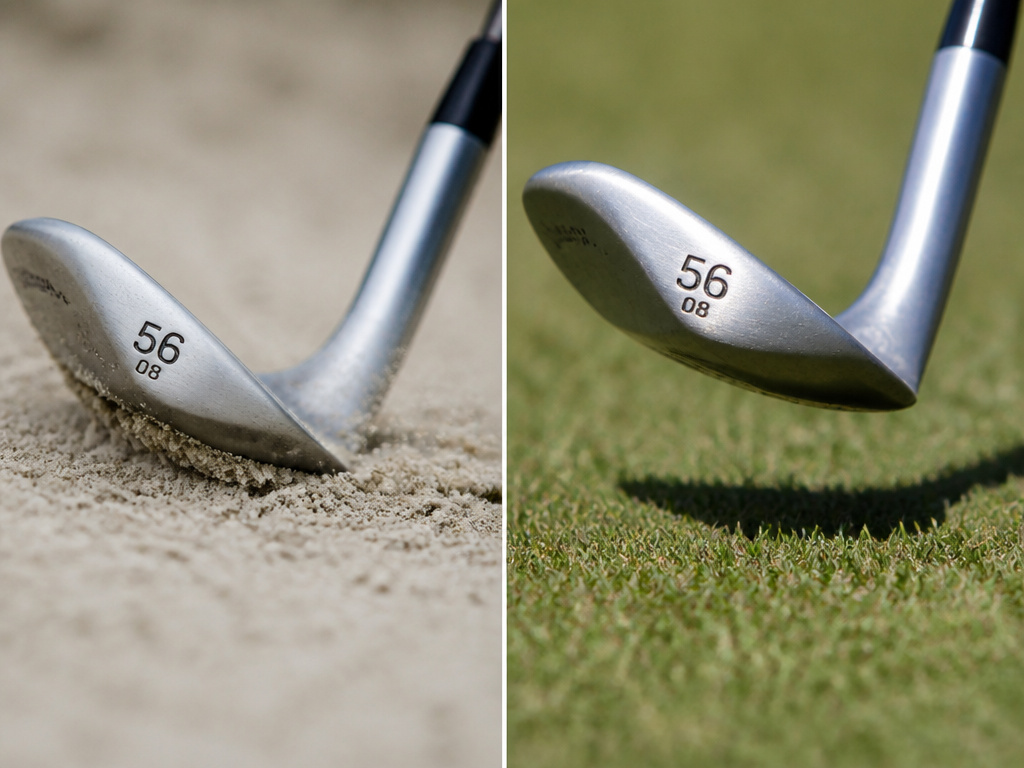 Not all wedges are created equal. The design of the sole, specifically the wedge bounce and grind, directly influences how the club interacts with the turf, which in turn affects consistency of strike and distance. A high-bounce wedge (12 degrees) will glide through soft turf or sand, promoting a solid strike. The same wedge on firm, tight lies can bounce into the ball, causing thin shots that fly too far.
Where this goes sideways: Using a high-bounce lob wedge from a tight lie. The leading edge sits up, making clean contact difficult. You catch the ball thin, and it rockets over the green.
For predictable distance control, your wedges must fit your typical conditions and swing. A versatile mid-bounce grind (like a Titleist Vokey S-Grind or a Cleveland RTX 6 Mid) is a safe starting point for most players. The best wedges for spin, like the Wilson Staff Model or the PING Glide 4.0, also help control distance by generating more stopping power, allowing you to take a more aggressive line to the flag.
When building your matrix, use the wedges you actually game. Do not test with a worn-out wedge and then expect a brand new high-spin wedge to perform identically. Fresh grooves create more friction and spin, which can knock a few yards off the total distance compared to a smoothed-out face.
Integrating Feel with System
 The matrix provides the framework, but golf is not played with a spreadsheet. The final layer is integrating feel, which is the professional’s secret. Feel is not guesswork; it is the calibrated experience of knowing what an 85-yard swing feels like versus a 78-yard swing.
You develop this by hitting thousands of wedge shots with intent. After you have your matrix numbers, close your eyes on the practice tee. Have a friend call out a yardage, or pick one yourself. Set up using your system (e.g., “that’s a three-quarter swing with my 56-degree”), then swing with your eyes closed, focusing solely on the sensation of the turn and the strike. Your brain will begin to associate the distance with a specific kinetic feeling.
This is why good wedge players make it look effortless. Their system has become subconscious. They have a technique for partial wedge shots that is repeatable, and they trust it enough to swing freely. The system builds the confidence that allows feel to flourish.
Frequently Asked Questions
How many wedges should I carry for good distance control?
Most players benefit from three wedges, typically a pitching wedge (46-48 degrees), a gap wedge (50-52 degrees), and a sand wedge (54-56 degrees). A fourth, a lob wedge (58-60 degrees), is useful for specialists. More wedges mean smaller gaps between your full-swing distances, simplifying your wedge selection. The trade-off is one less club at the top of your bag.
Why do my wedge shots always fly the same distance?
You are likely making the same swing every time, regardless of the shot required. This is a common fault with players who only practice full swings. You must practice the graduated swings in your matrix. If your full sand wedge goes 90 yards, you must learn the feel of the 80-yard and 70-yard swings with that same club.
Does ball position change for partial wedge shots?
Yes, but minimally. For standard partial shots, keep the ball centered in your stance. If you are opening the face to hit a high, soft shot, move the ball forward an inch or two to promote a steeper angle of attack and more loft. For a bump and run, play the ball back to ensure a downward strike and lower trajectory.
How does wind affect wedge distance control?
Wind affects wedge shots dramatically due to their high trajectory. Into a strong wind, take at least one more club (e.g., use a gap wedge instead of a sand wedge) and make a three-quarter swing. This produces a lower, more penetrating flight. Downwind, the ball will carry farther and release more; anticipate up to 10% more roll.
Can I use this system for pitch shots around the green?
Absolutely. The principles scale down. A 30-yard pitch shot is simply a very small version of your matrix swing, a slight shoulder turn, hands ahead, and a committed accelerating strike. The system teaches you that even the shortest shots require a backswing and downswing that match in intent.
The Bottom Line
Wedge distance control is not magic. It is a transferable skill built on a simple, personal system. Ditch the unreliable clock metaphors. Anchor your game in your known baseline distances, then learn to dial them back using the levers you can control before you swing: your shoulder turn, your grip, and your clubface. Map those combinations to yardages on the range until they become instinct.
The best wedge in your bag is the one you have practiced with until its distances are as familiar as your phone number. Whether it’s a Titleist Vokey SM9 or a Cleveland RTX 6, the tool only works if you know how to use it. Build your matrix, trust your system, and then swing with commitment. The up-and-downs will follow.
