
Collin Morikawa’s Precision Iron Play & The Cart Path Method
This post contains affiliate links. As an Amazon Associate, we earn from qualifying purchases.
This post contains affiliate links. As an Amazon Associate, we earn from qualifying purchases.
Collin Morikawa’s iron play precision is built on two essential pillars: a swing path engineered for a predictable fade and equipment meticulously matched to that delivery, down to testing irons on a cart path to verify sole interaction on firm turf before a major championship.**
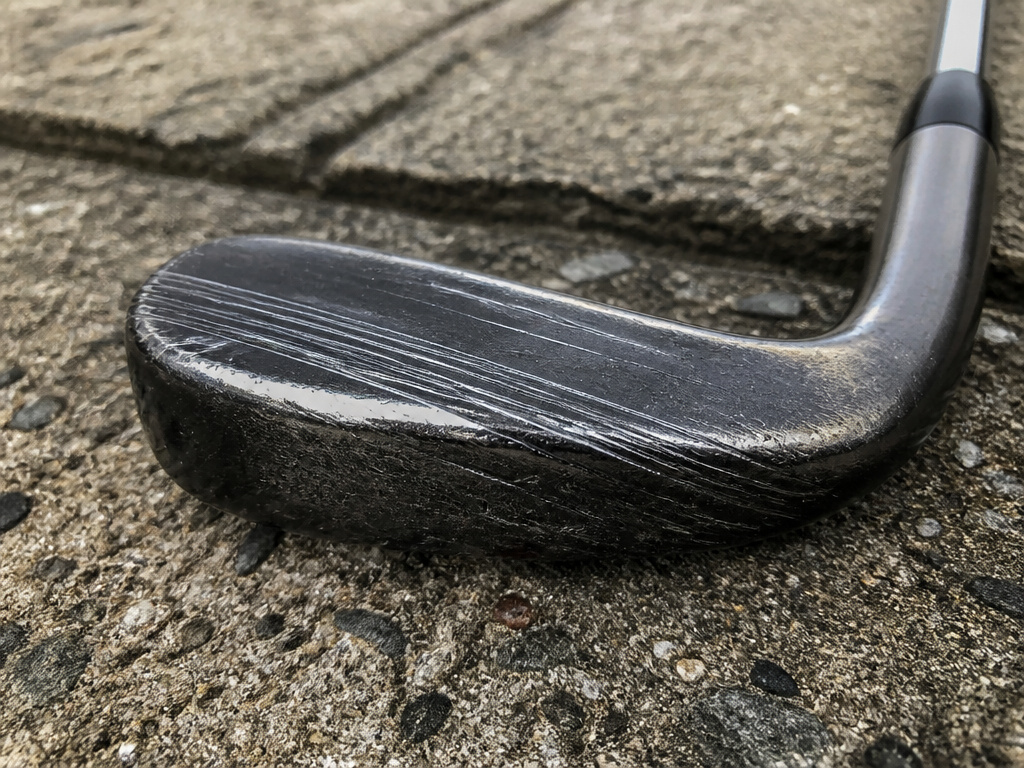
That last part isn’t a gimmick. For The Open at Royal Birkdale, Morikawa hit custom P7CB and P7MC irons off a concrete path at home. The marks on the soles showed which grind slid through hard ground cleanly. The P7MCs, with their narrower sole, produced fewer contact points and became his clubs for the week. This level of specificity is why his dispersion with a 6-iron in college matched other elite players with a pitching wedge.
What follows is a breakdown of that process: the swing mechanics that create the window, the equipment choices that fit inside it, and the practical reality that his precision is a system, not a single trick.
Key Takeaways
- Morikawa’s signature shot is a controlled, starting-left fade. His entire swing and equipment are built to produce this one predictable ball flight.
- He treats his iron and driver swings as two distinct motions. The iron swing is a steeper, more rotational move focused on downward compression; the driver swing is flatter and more about width.
- For links golf, he consistently switches from low-bounce blade short irons (like the P730) to cavity-back models with more bounce (P7CB, P7MC) to prevent digging on firm turf.
- His entire bag is reverse-engineered from his golf ball, the TaylorMade TP5x, to ensure every club produces a consistent spin axis for his fade.
- Precision is a product of a repeatable system, not raw talent. His testing on a cart path before The Open 2026 is the extreme proof.
The Two Pillars of Morikawa’s Iron Precision
His accuracy is architecture. You can’t build a consistent ball flight on a shifting foundation, so Morikawa’s team built two.
The first is his swing signature. Everything in his game is engineered to produce a reliable, starting-left fade. This isn’t just a preferred shot shape; it’s the entire objective. His club specs, from lie angle to shaft, are tuned to make this cut hold its line without over-curving or dropping out of the sky. The swing itself is a means to that single, repeatable end.
The second pillar is the physical equipment that accepts that delivery. This is where most amateurs get lost. They chase a swing fix when the club in their hands is fighting them. Morikawa’s relationship with his equipment is symbiotic. The club must perform its job predictably, which is why he tests with a specificity that borders on obsessive. As detailed in a Golfweek equipment testing report, hitting off a cart path provided a perfectly firm surface to “visually study how each grind, relief area and leading edge would engage the firm ground” of a links course.
A proper iron swing for a player like Morikawa is a steeper, more rotational motion designed to deliver the clubhead with a descending blow. The goal is crisp ball-turf contact, not a sweeping lift.
The Swing: Two Motions, One Objective
You don’t swing an iron like a driver. Morikawa embodies this. His iron swing and driver swing are separate mechanical events, each optimized for a different task.
His iron swing is built on rotation and a steeper plane. He sets up with the ball more centered in his stance, his weight favoring his lead side. The move down is a powerful turn through the ball, with his hands leading the clubhead. You hear a distinct “click-thump” sequence at impact, the crisp strike, then a shallow divot after the ball. This angle of attack compresses the ball against the turf, generating the spin and control he’s famous for.
His driver swing flattens out. The ball is off his front heel, his spine tilts away from the target, and the swing arc widens. Here, the goal is to sweep the ball off the tee with a slightly upward strike. Trying to swing a driver with an iron’s steepness is a recipe for weak, high slices or brutal tops. The difference is fundamental, and mastering it is the first step toward any kind of consistent ball flight control.
| Aspect | Iron Swing (7-Iron) | Driver Swing | Consequence of Mixing Them |
|---|---|---|---|
| Ball Position | Center of stance | Inside front heel | Irons get skulled; driver gets topped. |
| Angle of Attack | Downward (-4 to -6 degrees) | Slightly upward (+1 to +3 degrees) | Loss of distance, poor contact, inconsistent flight. |
| Primary Move | Body rotation through impact | Wide arc, chest clearing for speed | The body gets stuck, leading to arm-driven flips. |
| Sound/Feel | Crisp “click,” then a divot | Solid “crack,” no turf interaction | The feedback is confusing, halting improvement. |
Understanding these differences between iron and driver swings is non-negotiable. It’s the reason you can pure your irons and still spray your driver everywhere.
The Equipment: A Bag Built Backwards
Morikawa doesn’t just play clubs. He plays a system. Every component, from his ball to his 60-degree wedge, is selected and adjusted to harmonize with his fade.
It starts with the TaylorMade TP5x golf ball. His entire bag is reverse-engineered from this ball’s flight characteristics. The club specifications ensure the ball reacts identically whether he’s hitting a 4-iron or a 9-iron, providing the same visual feedback and predictable curvature.
His iron set is a meticulously crafted combo that maintains this flight as lofts change. For standard PGA Tour events, it often looks like this: * 4-Iron: TaylorMade P-DHY utility iron (set more upright to eliminate a right miss). * 5 & 6-Iron: TaylorMade P7CB cavity backs (for stability and optimal launch at lower lofts). * 7-PW: TaylorMade P730 blades (for feel and precision in his scoring clubs).
The shafts are a constant: True Temper Dynamic Gold Tour Issue X100. He switched to these from Project X 6.0 as he got stronger, seeking a stiffer profile that could handle his speed while maintaining his feel for trajectory control. The right iron shafts are the engine’s transmission; the wrong ones disconnect the player from the clubhead.
Common mistake: Choosing irons based only on looks or a pro’s bag. Morikawa’s P7CBs in the mid-irons provide a blend of stability and workability that a pure blade can’t offer at those lofts, while his P730 short irons give him the tactile feedback he demands.
The Cart Path Test: A Non-Commodity Insight
This is where commodity advice ends. Most articles will tell you to get fitted, which is correct, but Morikawa’s pre-Open ritual shows what fitting looks like at the outermost edge.
Before The Open Championship at Royal Birkdale in 2026, he skipped the Scottish Open. Instead, TaylorMade sent two iron sets to his home: custom P7CBs with a modified sole grind and a set of P7MCs. Links turf is firm and tight. The sole’s interaction with the ground becomes critical; too much bounce can cause the club to “skip” into the ball, leading to thin contact.
His testing surface? A concrete cart path.
By hitting shots off the pavement, he could see scratches on the sole marking every point of ground contact. The P7MC, with “one of the narrowest soles in the TaylorMade iron lineup,” according to tour rep Adrian Rietveld, produced fewer, cleaner marks. This visual proof showed it would glide through Royal Birkdale’s baked fairways with minimal resistance. He played the P7MCs (5-PW) and contended.
The lesson is that turf interaction is a fittable variable. For amateurs, this translates to paying attention to sole width and bounce, especially if you play on firm conditions or have a steeper angle of attack.A certified club fitter will use a lie board with impact tape to show you where your sole is striking.
Why He Changes Irons for Links Golf
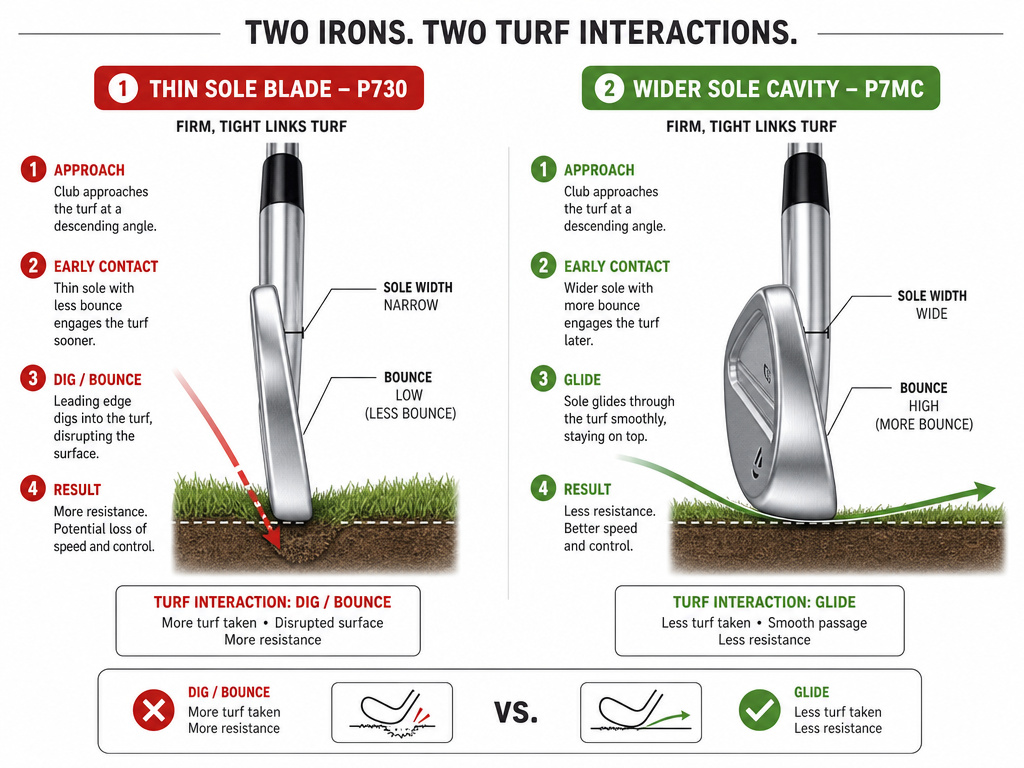
Morikawa has a specific gear trick for the British Isles. He swaps his low-bounce blade short irons (P730) for cavity-back irons with more bounce, like the P7CB or P7MC.
The reason is purely mechanical. On the firm, tight turf of links courses, a thin-soled blade with low bounce can easily dig or, conversely, bounce off the hard ground into the bottom of the ball. He’s admitted that with his blades, “I just catch it thin all the time” on that turf. The cavity-back designs have slightly wider soles and more effective bounce, helping the club glide through the impact zone without digging excessively or skidding.
This is a fundamental adaptation to environmental conditions. It underscores that even the best ball-strikers in the world don’t force one set of clubs to work everywhere.They understand that moving from game improvement to player’s irons is a spectrum, and they slide up and down it as needed.
| Condition | Typical Iron Setup | Links Golf Setup | Performance Goal |
|---|---|---|---|
| Turf Firmness | Soft / Average | Very Firm & Tight | Prevent “bounce” or “dig” |
| Short Irons | P730 Blades (Low Bounce) | P7MC or P7CB (More Bounce) | Consistent turf interaction, avoid thin contact |
| Result | Max feel & workability | Forgiveness on mis-hits, stability through turf | Keep ball flight predictable in challenging conditions |
Practical Drills to Steal His Precision
You can’t copy his DNA, but you can adopt his process. Precision is earned through repeatable practice, not hope.
First, own a shot shape. Stop trying to hit it straight. Straight is a myth. Morikawa’s entire world is built around his fade. Pick a shape, a gentle draw or fade, and build your proper iron swing to produce it 80% of the time. Practice hitting that same curve on the range with every iron. Consistency of curvature is the first step to accuracy.
Second, practice with a purpose, not just a bucket. One drill I give players struggling with contact is the “Divot Board” drill. Place a thin board or a folded towel just in front of the golf ball. The goal is to strike the ball cleanly without hitting the object. This trains the downward strike essential for iron play. If you hit the board, your angle of attack is too shallow or you’re swaying off the ball.
Where this goes sideways: Practicing your driver swing with the same thoughts as your iron swing. They are different skills. Dedicate separate buckets or time blocks to each, with distinct swing thoughts.
Finally, understand your equipment’s role. You don’t need a tour truck, but you should know if your iron setup is fighting you. Are your clubs too long, forcing you to stand too upright? Is the shaft too whippy, making timing impossible? A basic static fitting for length, lie, and grip size is accessible and transformative. Good golf should feel less complicated the more you understand it, and that starts with tools that fit.
Frequently Asked Questions
What irons does Collin Morikawa currently use?
His iron setup is fluid and changes based on course conditions. For standard PGA Tour events, he often uses a combo set: a TaylorMade P-DHY 4-iron, P7CBs in the 5 and 6-iron, and P730 blades from 7-iron through pitching wedge. For firm, links-style courses like The Open, he has switched to a full set of P7MC irons (5-PW) for their turf interaction.
What shaft does Collin Morikawa use in his irons?
He uses True Temper Dynamic Gold Tour Issue X100 shafts in all his irons. This is a heavy, stiff steel shaft favored by many elite ball-strikers for its consistent feel and low, penetrating ball flight.
Why is Collin Morikawa so accurate with his irons?
His accuracy stems from a combination of a technically sound, repeatable swing built around a predictable fade, and equipment that is meticulously fitted to that swing. Every club in his bag is tuned to produce the same ball flight. His legendary hand-eye coordination and practice discipline turn that system into results.
How can I improve my iron accuracy like Morikawa?
Focus on consistency over power. First, develop a reliable, repeatable shot shape. Second, ensure your equipment fits you, get a basic fitting for length, lie, and shaft flex. Third, practice with deliberate drills that improve strike quality, like the Divot Board drill, rather than mindlessly hitting balls.
Did Collin Morikawa really test irons on a cart path?
Yes. Before The Open Championship at Royal Birkdale in 2026, he tested custom P7CB and P7MC irons by hitting them off a concrete cart path at home. This unusual method provided a perfectly firm surface to visually analyze how each iron’s sole grind would interact with the hard links turf, leading him to choose the P7MCs.
Before You Go
Morikawa’s precision is a blueprint laid out in his choices. A swing committed to a single, repeatable shape.Equipment treated as a responsive partner, not a passive tool. A willingness to adapt that equipment to the ground in front of him, even if the test seems unorthodox.
For you, the takeaway is systemic. Stop searching for the one magic drill. Instead, audit your own system. Does your swing have a defined objective? Does your equipment help or hinder that goal? Does your practice have a purpose? His cart path test is the extreme end of a spectrum every golfer is on: the search for a predictable, repeatable outcome. Start building your system there, not with the latest swing tip.
