
Iron Set Progression Explained: How Specs Change Your Game
This post contains affiliate links. As an Amazon Associate, we earn from qualifying purchases.
This post contains affiliate links. As an Amazon Associate, we earn from qualifying purchases.
Iron set progression is the deliberate, measured change in clubhead specifications, loft, center of gravity (CG) location, blade length, and sole width, from the long irons to the short irons in a matched set. This engineering optimizes launch, forgiveness, and feel for each club’s specific job, turning a random collection of irons into a cohesive scoring system.
That definition is the what. The why is physics. A 4-iron and a pitching wedge solve completely different problems. The long iron must launch a ball high and far from a tight lie; the wedge must control spin and descent from rough or sand. Giving them the same head design guarantees one of them will fail at its task.
What follows: the three specs that actually change, the patent-backed numbers behind those changes, and how to spot progression (or the lack of it) in any set you’re considering. By the end, you’ll read a spec sheet in ten seconds and know whether the set fits your swing.
Key Takeaways
- Progression isn’t just loft. Real sets change the horizontal center of gravity (CG-Xfc) by at least 1 mm from long to short irons, moving weight toward the hosel in the scoring clubs to aid alignment and control.
- Blade length is often constant. Many modern progressive sets keep blade length within a 70-85 mm range (per patent US9427635B2) while altering CG and toe height to maintain a consistent look at address.
- The wrong progression hurts your gapping. If short irons have too little offset or too forward a CG, your well-struck 9-iron will fly the same distance as your 8-iron, collapsing your scoring window.
- Game-improvement irons exaggerate progression. Forgiving sets use extreme sole width changes and high offset in long irons to get the ball up, then strip it back in the wedges for precision.
- Your shaft must progress, too. A stiff, heavy shaft in a high-lofted wedge kills feel; a proper set will use lighter, more active shafts in the long irons and firmer handles in the short ones.
What Is Iron Set Progression? (The Short Answer)
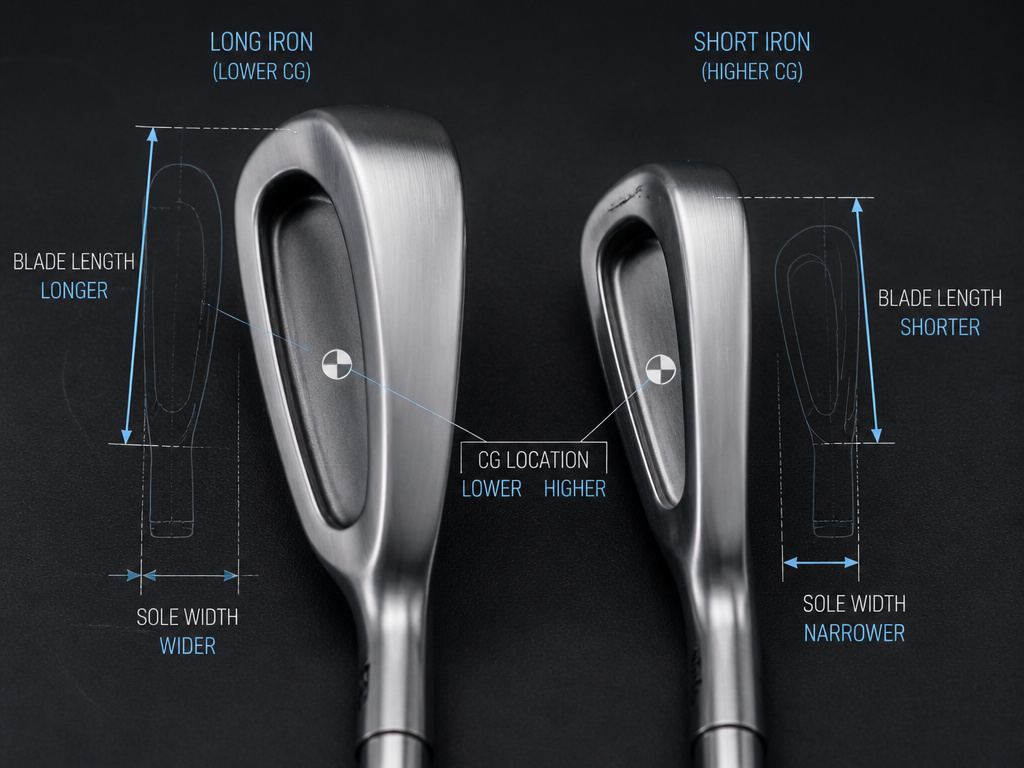
A progressive iron set shifts key design parameters, loft, center of gravity location, blade length, and sole geometry, in a calculated sequence from the longest club to the shortest. This isn’t cosmetic. Each adjustment targets a specific ball-flight outcome: higher launch in long irons, steeper descent in short irons, and consistent feel throughout the bag.
Forget marketing. The core idea is utility. A 4-iron exists to cover distance from the fairway. A 9-iron exists to hit a target. Giving them identical heads would make the 4-iron too hard to launch and the 9-iron too unpredictable on greens. Progression solves this by assigning a specialized head design to each loft range.
The concept is detailed in golf club patents, like US9427635B2, which specifies numeric tolerances for a “progressive center of gravity allocation.” This is the blueprint manufacturers use. When you hear a set described as “progressive,” it means the designer followed a similar blueprint, changing multiple specs in sync, not just slapping different lofts on the same head.
The Physical Changes Through the Set
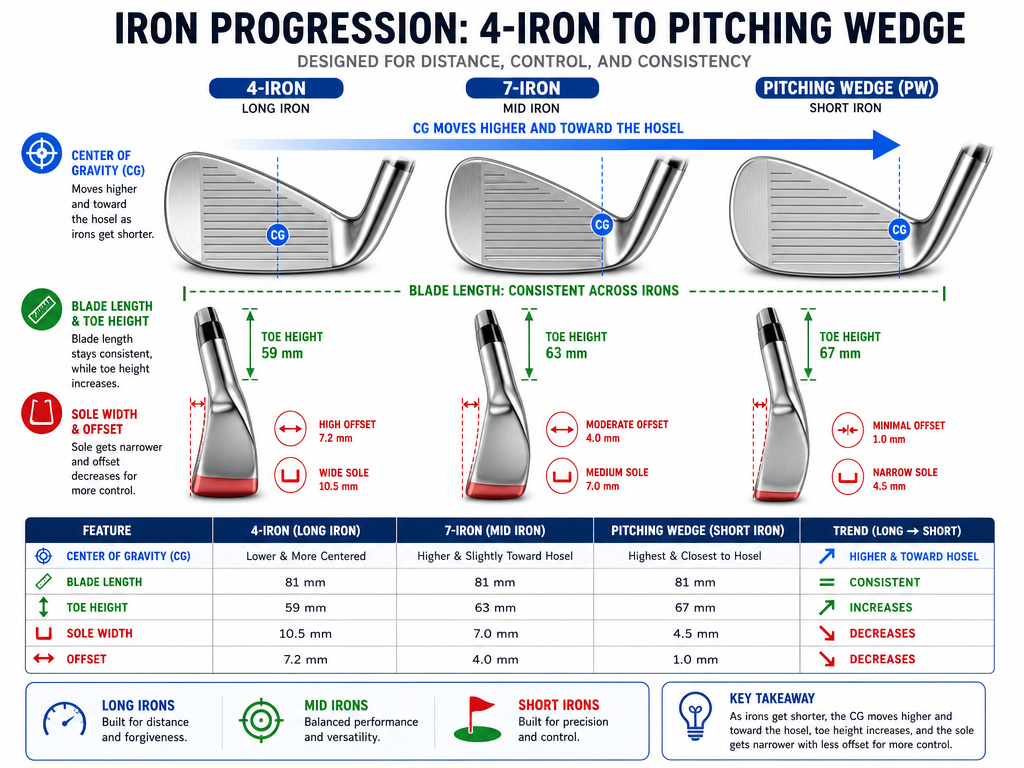
Three things change in a true progressive set: where the weight is, how the head looks at address, and how it interacts with the turf. Ignoring one breaks the system.
1. Center of Gravity (CG) Movement
The center of gravity is the head’s balance point. In a progressive set, it moves both vertically and horizontally.
- Vertical CG (Height): Gets higher from long irons to short irons. A higher CG in a wedge helps produce a lower, spin-heavy flight for stopping power. A lower CG in a 4-iron helps get the ball airborne.
- Horizontal CG (CG-Xfc): Moves toward the hosel. The patent states a long iron’s CG may be less than 2 mm from the face center, while a short iron’s CG shifts to about 3 mm toward the hosel. This subtle shift helps square the face at impact for the shorter, more controlled swings used with scoring clubs.
2. Blade Length & Toe Height
Many players assume blade length shortens in the short irons. In many modern sets, it doesn’t.
- Blade Length: Often kept constant between 70-85 mm (roughly 2.75 to 3.25 inches) for visual consistency. You shouldn’t feel like you’re looking at a completely different club at address.
- Toe Height: This does change. The patent specifies toe height progressively increases from less than 51 mm in long irons to greater than 55 mm in short irons. A taller toe in the wedges moves weight higher, aiding that lower flight, and makes the head look more stable behind the ball.
3. Sole Width & Offset
This is the most visible change and the one most tied to club category.
- Sole Width: Widens significantly in long irons for forgiveness and to prevent digging. It narrows in short irons for versatility, you can open the face in a bunker without the wide sole bouncing.
- Offset: The amount the leading edge lags behind the hosel. High offset in long irons helps slower swing speeds square the face and promotes a higher launch. Offset is reduced or eliminated in short irons for precise face control and a cleaner look.
| Iron Type | Primary Job | CG Location | Sole Width | Offset |
|---|---|---|---|---|
| Long (4-5) | Maximize distance & launch | Low, slightly forward | Widest | Most |
| Mid (6-7) | Blend distance & control | Mid-height, neutral | Moderate | Moderate |
| Short (8-PW) | Precision & stopping power | High, toward hosel | Narrowest | Least/None |
How Progression Affects Your Ball Flight and Consistency
The changes aren’t arbitrary. Each one directly alters impact physics.
A lower CG in the long irons places mass below the ball’s equator at impact. This decreases backspin and increases the dynamic loft, launching the ball higher with a shallower descent. It’s why modern 4-irons are easier to hit than older models.
Conversely, a higher CG in the short irons, combined with increased loft, creates more backspin. The ball climbs faster and falls steeper, stopping quicker on greens. The shifted horizontal CG toward the hosel also increases the club’s tendency to rotate closed, fighting the slice common in longer clubs and promoting a straighter flight with the scoring irons.
Where this goes sideways: Mixing irons from different model years or series. The progression specs won’t match. Your new 7-iron might have the CG location and offset of your old 5-iron. The result is inconsistent yardage gaps and a feeling that some clubs “hook” while others “fade” for no apparent reason.
Player’s vs. Game-Improvement: Two Different Progressions
All sets progress, but they take different paths. A player’s cavity-back and a super-game-improvement iron start from opposite ends of the design spectrum.
Game-Improvement Irons use aggressive progression as a primary aid tool. * Long Irons: Extreme offset, very wide soles, ultra-low CG. Often, the 4 and 5-iron are essentially hybrids in disguise. * Short Irons: Still forgiving, but with noticeably narrower soles and reduced offset to allow for shot-making. The transition is stark. * Goal: To make the hardest clubs (long irons) as easy as possible to hit, accepting some trade-off in looks and workability.
Player’s Irons feature subtle, refined progression. * Long Irons: Minimal offset, compact heads, only slightly wider soles. The CG is lower but not drastically so. * Short Irons: Compact, with minimal offset and thin soles. The progression in CG and blade dimensions is measured in millimeters, not leaps. * Goal: To provide consistent feel and feedback across the set, offering control with just enough help where needed.
The right choice depends on your miss. If you struggle with launch and slice, the exaggerated help in a game-improvement set’s long irons is worth it. If you prioritize feel and trajectory control, the subtlety of a player’s progression will serve you better.
Don’t Forget the Shafts
The head is only half the system. True progression extends to the shafts for irons.
A proper set uses a “flighted” or “descending weight” shaft design. Long iron shafts are often lighter or have a more active tip section to promote launch. As the clubs get shorter, the shafts get progressively heavier and stiffer in the tip to lower flight and increase control. Using the same shaft from 4-iron to wedge is a common factory shortcut that flattens performance.
This is especially critical when considering graphite shafts for irons. Modern graphite designs can be precisely tuned for progression, offering vibration damping in the long irons without losing feel in the scoring clubs.
How to Check Progression in a Set You’re Buying
You don’t need a patent lawyer. Use your eyes and ask the right questions.
- Line them up. Place the 4-iron through pitching wedge on a flat surface, soles down. Look at the offset progression from behind the hosel. It should smoothly decrease.
- Look at the soles. The long iron sole should be visibly wider than the wedge sole. The transition should be gradual.
- Ask about the shafts. Are they all the same model and weight, or is there a progressive shaft plan? Any reputable list of the best iron sets will detail this.
- Check the specs. The OEM’s website should list loft, lie, offset, and head weight for each club. The numbers should change in a logical sequence.
This due diligence prevents a common pitfall: buying a set where the 4 and 5-irons are un-hittable for you, while the 9 and PW are perfect. A well-progressed set should feel like a unified toolset.
Frequently Asked Questions
Do all iron sets have progression?
Yes, but the degree varies. All matched sets from major manufacturers have some level of progression in loft, offset, and sole design. The difference is between the stark, help-focused progression of game-improvement irons and the subtle, feel-focused progression of player’s irons.
Can you mix different iron models?
It’s risky without professional fitting. Models have different progression blueprints. Mixing a game-improvement 5-iron with player’s cavity-back 6-9 irons will likely create a huge yardage and feel gap at the 5/6 transition. It’s better to find a single, cohesive set or consider a dedicated hybrid iron set for the long irons.
How does progression relate to loft jacking?
They are different. Loft jacking (making clubs stronger) is about manipulating distance numbers. Progression is about optimizing launch conditions for each loft. A jacked-loft set can still be well-progressed, but the stronger lofts may simply shift the whole progression down one club (your new 7-iron has the loft of an old 6-iron).
Why do my short irons feel too heavy?
This is often a shaft progression issue. If the shafts are all the same weight, the shorter clubs will feel heavier because more weight is concentrated in your hands. A descending weight shaft set counteracts this, keeping swing weight consistent.
Is progression more important for beginners?
Absolutely. Irons for beginners rely on strong progression, especially wide soles and high offset in long irons, to build confidence and get the ball airborne. A player’s compact long iron would be a liability for a new golfer.
The Bottom Line
Iron set progression is the silent engineer in your bag. It’s the reason a 4-iron can be forgiving and a pitching wedge can be precise. Understanding it, the moving CG, the shifting sole, the tailored shaft, turns you from a passive consumer into an informed buyer.
Look for the progression. Feel it in the transition from one club to the next. When it’s done right, the set doesn’t feel like eight separate clubs. It feels like one instrument with eight perfectly tuned notes. That’s the real goal: not just a collection of irons, but a system designed to score.
