
How to Find the Correct Distance From Ball at Address
This post contains affiliate links. As an Amazon Associate, we earn from qualifying purchases.
This post contains affiliate links. As an Amazon Associate, we earn from qualifying purchases.
The correct distance from the ball at address is measured from the end of your grip to an alignment stick placed behind your heels. For a wedge, the grip end should be 5 inches from the stick. This distance shortens as clubs get longer: 3 inches for 7-9 irons, 2 inches for 4-6 irons, touching the stick for a hybrid, 1 inch past for a 3-wood, and 2-2.5 inches past for a driver.
That 5-inch measurement for a wedge is the anchor. It comes from a system developed by golf professional Herb Rubenstein, who built it by measuring males 5’9″ to 5’11” with normal arm length. It gives you a physical ruler to check what your eyes can’t judge reliably.
What follows is the full breakdown of that system, why those specific inches matter for clean contact, and how to adapt it if your arms aren’t “normal” length. By the end, you’ll know the exact number for each club in your bag and why getting it wrong is the root cause of topped shots and weak strikes.
Key Takeaways
- Use an alignment stick behind your heels as a fixed reference point; measure from the stick to the end of your grip, not your toes.
- The wedge benchmark is 5 inches. A 7-iron is 3 inches. A 4-iron is 2 inches. A hybrid touches the stick. A driver is 2-2.5 inches past it.
- Standing too far away forces an overextension, causing a steep, chopping downswing that tops the ball or hits it thin.
- Standing too close cramps your arm swing, promoting a flat, around-the-body swipe that results in shanks and heel strikes.
- Check your distance with this system once a month; posture drift is subtle but destructive to consistency.
Why Distance Matters More Than You Think
It’s not about comfort. It’s about geometry. Your distance from the ball sets the radius of your swing arc. Get it wrong, and your body makes compensations before the club is even in motion.
Where this goes sideways: Standing an inch too far away for a 7-iron. Your brain knows the club needs to reach the ball, so you subconsciously lock your right knee and tilt your spine away from the target. Now your swing center is behind the ball at impact, and the low point of your arc is several inches behind it. You either top it or take a deep divot behind the ball. Every time.
The correct radius lets your arms hang freely from your shoulders, creating a pendulum. That pendulum’s bottom is the ground. If your posture puts the ball at the bottom of that pendulum, you strike down and through it. If the ball is behind or in front of that bottom point, you hit the ground first or skim the top of the ball.
This is why generic advice like “stand at arm’s length” fails. Arm length varies. Club length varies even more. You need a method that accounts for both. The system that does this uses a simple external reference: an alignment stick placed behind your heels.
The Herb Rubenstein Stance Distance System
This method bypasses the unreliable cues of ball position relative to your feet. Instead, you use the end of your grip and a stick on the ground as a precise measuring tool.
Here’s how you set up the measurement:
- Take your address normally with the club you want to check.
- Place an alignment stick (or a spare club) on the ground so it touches the back of both heels.
- Keeping your feet planted, lay your address club on the ground with the clubhead centered behind the ball and the grip end pointing at the stick.
- Measure the distance from the stick to the very end of the grip.
Those measurements are not random. They were calibrated using standard-length clubs and golfers of average height and arm length. The numbers create a consistent framework.
| Club Type | Grip End Distance from Alignment Stick | Standard Club Length (approx.) | Visual Reference |
|---|---|---|---|
| Wedge | 5 inches away | 35 – 36 inches | Middle of your instep |
| 9, 8, 7 Irons | 3 inches away | 36.5 – 37.5 inches | Top third of your foot |
| 6, 5, 4 Irons | 2 inches away | 38 – 39 inches | Top quarter of your foot |
| Hybrid (19-21°) | Touching the stick | 40 – 41 inches | Directly on the line |
| 3-Wood | 1 inch past the stick | 43 inches | Just beyond the line |
| Driver | 2 to 2.5 inches past the stick | 45 inches | Well past the line |
This 50–60 word, third-person blockquote covers the core technical specification of the Herb Rubenstein stance system. For golfers 5’9″ to 5’11” with normal arm length using standard clubs, the distance from an alignment stick behind the heels to the grip end is 5 inches for wedges, scaling down to 2 inches for long irons, touching for a hybrid, and extending 1-2.5 inches past for woods and driver.
The hybrid is the checkpoint. If your hybrid’s grip end touches the stick, your setup is likely correct through the rest of the bag. But don’t rely on it alone. A golf alignment error in one club often points to a fundamental posture issue affecting all clubs.
How to Measure Yourself (The Right Way)
You need a partner, a tape measure, and ten minutes on a flat surface. Trying to do this alone while looking down will throw your posture off.
Step 1: Start with your most-lofted wedge. Address a pretend ball. Have your partner place the alignment stick firmly against the backs of your heels. Freeze your feet.
Step 2: Lay the wedge down. Your partner places the clubhead directly behind the “ball” spot, with the grip pointing at the stick. They measure from the stick to the grip’s very end. Write it down. Is it 5 inches? If it’s 7, you’re standing too far away. If it’s 3, you’re cramped.
Step 3: Work through the bag. Move to your 9-iron, 7-iron, 5-iron, hybrid, 3-wood, and driver. Record each measurement. The pattern should match the table: decreasing distance for irons, touching for the hybrid, increasing past the stick for woods.
Step 4: Find your baseline, then adjust. Don’t change anything during the measurement phase. Once you have your numbers, compare them to the system. If your wedge is 7 inches out, you now know you need to move 2 inches closer. This directly influences your weight distribution, as standing closer naturally shifts balance toward the balls of your feet.
Common mistake: Measuring from your toes to the ball. Your foot position changes with ball position, but your heel line is a constant. The alignment stick behind the heels is the only fixed reference that works for every club in the bag.
What if your numbers are way off? If you’re consistently 3-4 inches farther away than the chart, you’ve likely developed a posture of reaching for the ball. This collapses your spine angle and makes a consistent impact position impossible. The fix is conscious, incremental movement closer over several practice sessions.
The Topping vs. Shanking Trade-Off
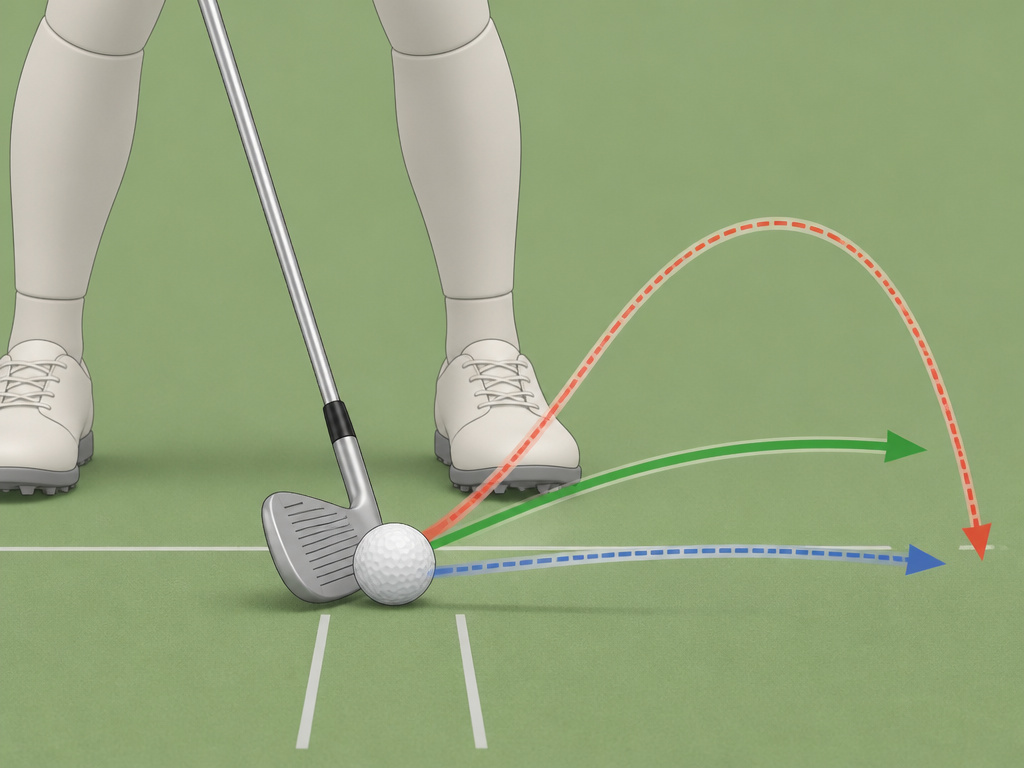
Get the distance wrong, and your miss tells you exactly which way you’re wrong. This isn’t theory; it’s cause and effect.
Standing Too Far Away (The Topping Machine)
Your body is stretched. Your arms are straight, but to create room for the swing, you must raise your hands and the clubhead higher in the backswing. This creates a steeper angle of attack. On the downswing, that steepness drives the clubhead into the ground before the ball unless you artificially “stand up” through impact to avoid the turf. Standing up raises the low point of your swing, and the bottom of the club brushes the top of the ball. This is the primary mechanical cause of topping the ball.
Standing Too Close (The Shank Factory)
Your arms are cramped, forced into a bent, uncomfortable position. The natural takeaway path is around your body in a flat, horizontal circle. The club gets stuck behind you. To deliver the club to the ball, your body must early-extend, thrusting your hips toward the ball. This moves your entire swing center forward, bringing the hosel of the club into the ball’s path. That’s a shank. Even if you avoid the hosel, contact will be weak and off the heel.
The correct distance neutralizes these extremes. It allows for a wide, on-plane arc where the clubhead approaches the ball from the inside and returns to a low point just in front of the ball. This is the geometry required to compress the ball with irons.
What If You Have Shorter or Longer Arms?
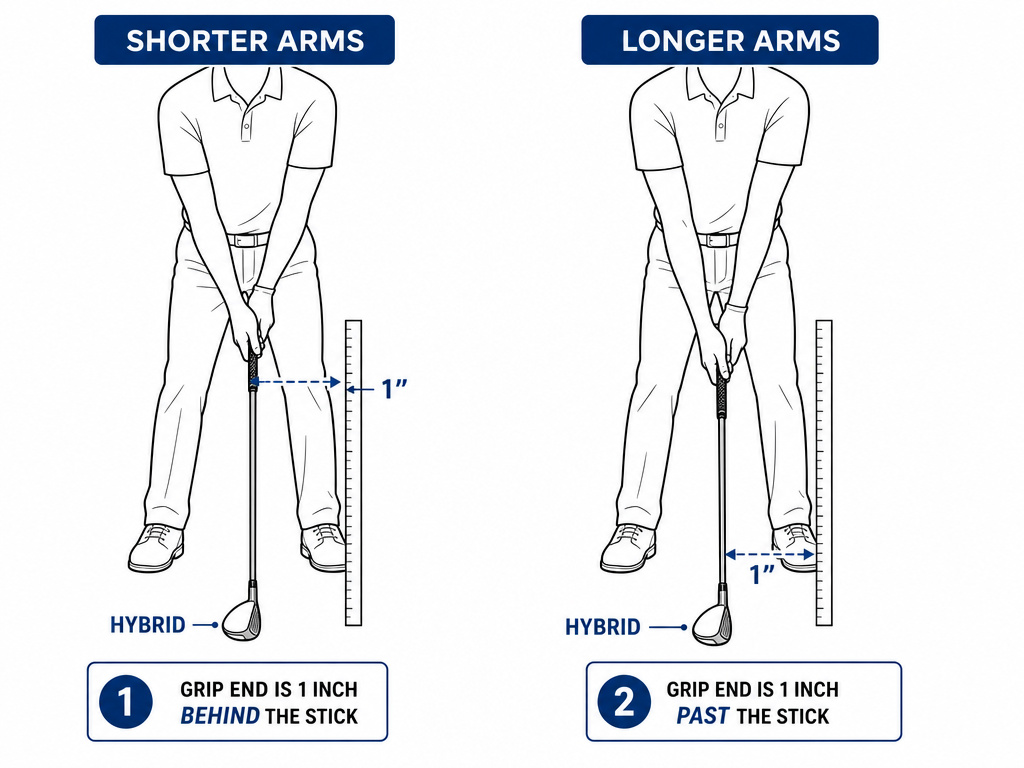
The Herb Rubenstein system is a baseline for “normal” arm length. You must adjust from there. The rule is simple: shorter arms stand a little closer; longer arms stand a little farther.
But how much is “a little”? Don’t guess. Use the hybrid checkpoint. For a person with shorter arms, even when they feel “right,” the hybrid’s grip end will likely be an inch away from the stick. For longer arms, it might be an inch past the stick while using a standard-length club.
The goal isn’t to match the chart’s inches exactly. The goal is to establish your own personal chart where the progression is consistent, wedges are farthest from the stick, driver is farthest past it, and where you can make clean contact. If you consistently pure your 7-iron when your measurement is 4 inches instead of 3, then 4 inches is your number. Write it down. The system’s value is giving you a repeatable measurement, not a universal dogma.
This personalization is a form of fine-tuning your distance control. A consistent radius promotes a consistent swing length, which is the first step toward predictable yardages.
How Equipment Rules Frame the “Why”
The science of how far a ball can fly is governed by strict rules. The USGA and R&A’s Overall Distance Standard (ODS) limits golf balls to 317 yards (+3 yard tolerance) under specific test conditions. A key factor in that distance is the coefficient of restitution (CoR), the energy transfer between clubface and ball.
Worth knowing before you start: According to an R&A equipment distance study, increasing the CoR by 0.01 yields about 1.7 extra yards. But that efficient transfer only happens with a centered strike.
Your distance from the ball is the primary determinant of strike quality. Stand too far away, and you toe-strike it. Stand too close, and you heel-strike it. Both miss the sweet spot, reducing the effective CoR and robbing you of distance and accuracy. The rules limit the potential energy transfer; your setup dictates how much of that potential you actually use. This is why understanding ball flight laws starts with setup, face and path are irrelevant if you don’t strike the center of the face.
Furthermore, the upcoming 2028 rule change increases the test clubhead speed to 127 mph. This acknowledges that modern players swing faster. The principle for you is the same: faster swings are less forgiving of a flawed radius. A small setup error is magnified by speed. Getting your distance locked in is how you ensure your speed produces power, not wild misses.
Driver & Woods: The Special Case
With the driver, you want a sweeping, upward strike. This requires a different setup, but the measurement principle remains. Using the alignment stick system, your driver’s grip end should be 2 to 2.5 inches past the stick.
This extra distance accomplishes two things. First, it encourages the slight spine tilt away from the target that promotes an inside-out path. Second, it sets the ball position forward, opposite your left heel, which is necessary for an upward attack angle. This ties directly into finding the correct tee height for a driver. If you’re the correct distance away, a tee height that places half the ball above the crown of your driver will produce the optimal launch.
A common fault is standing too close to the driver, which forces a more vertical, chopping swing. This leads to low, spinny drives or skyballs. If your driver measurement is less than 2 inches past the stick, experiment with moving back an inch. Feel the space your arms need to swing freely across your chest.
Troubleshooting Your Current Distance
You don’t need a full measurement session to diagnose a problem. Your ball flight and common miss are clear indicators.
If you frequently:
- Top the ball or hit it thin: You are almost certainly too far away. Your swing’s low point is behind the ball.
- Shank or hit off the heel: You are almost certainly too close. Your swing center is moving toward the ball.
- Lack power and feel cramped: Your arms are bent too much at address. You need more space.
- Sway off the ball in the backswing: You may be too close, forcing your body to move laterally to create room for the arm swing.
The fix is always incremental. Make a small adjustment, move an inch closer or farther, and hit ten balls. Pay attention to the quality of contact, not just where the ball goes. Better sound and feel are your guides. This process of incremental adjustment is the same one used to dial in a pitch shot, where millimeter changes in stance width and ball position have large effects.
Frequently Asked Questions
How often should I check my distance from the ball?
Check it once a month. Posture drift is subtle. Over weeks, you might inch farther away without noticing. A monthly check with the alignment stick system resets your baseline and prevents a major flaw from developing. It takes five minutes.
Does this system work for taller or shorter golfers?
The inch measurements are a baseline for average height (5’9″-5’11”). Taller golfers will naturally be farther from the stick; shorter golfers will be closer. Use the system to find your numbers for each club, not to match the chart exactly. The consistent progression is what matters.
What if I play with the ball off my left heel for every club, like Jack Nicklaus did?
The Herb Rubenstein system acknowledges this method works for some. However, it changes the measurement. If the ball is always forward, your feet are positioned differently for each club, so the “heel line” reference shifts. The alignment stick method still works, you’ll just get a different set of numbers. The key is consistency in whatever method you choose.
Can I use a club instead of an alignment stick?
Yes. Any straight object, a spare club, a driveway marker, a broom handle, placed firmly against the backs of both heels will work as the reference line. The alignment stick is just the most convenient tool.
My arms are very long. Do I still use the same measurements?
No. With longer arms, you will be farther from the stick for every club. Your hybrid might be an inch past the stick, not touching it. Your wedge measurement might be 6 or 7 inches. Find the distance where your arms hang naturally straight down from your shoulders, not reaching. That’s your starting point.
Before You Go
The correct distance from the ball isn’t a mystery or a feeling. It’s a measurable spec. The Herb Rubenstein system gives you that spec: 5 inches from the stick for a wedge, scaling predictably through the bag. Grab an alignment stick, get a friend to measure, and write down your numbers. If you’re constantly fighting tops or shanks, this is your fix. It sets the radius for everything that follows. A good swing built on a bad radius will always break down. Build on the right one first.
