
Understanding How Golf Ball Dimples Work for Better Flight
This post contains affiliate links. As an Amazon Associate, we earn from qualifying purchases.
This post contains affiliate links. As an Amazon Associate, we earn from qualifying purchases.
Golf ball dimples work by creating a thin, turbulent layer of air around the ball. This turbulent boundary layer sticks to the ball’s surface longer than smooth, laminar flow would, which dramatically reduces the size of the low-pressure wake behind the ball. The result is up to 50% less aerodynamic drag, allowing the ball to fly much farther. The dimples also interact with backspin to generate lift, keeping the ball in the air.
That specific Reynolds number, around 200,000 for a driver shot, is the sweet spot. It’s the range of speeds where a dimpled ball experiences its “drag crisis,” a sudden drop in air resistance that a smooth ball never achieves. This isn’t a minor tweak. It’s the difference between a 150-yard drive and a 300-yard bomb.
The rest breaks down the physics of that turbulent layer, how dimple count and shape are engineered, and what the USGA’s symmetry rule means for your game. By the end, you’ll read a spec sheet and know exactly what those 332 dimples on a Callaway Chrome Soft are actually doing.
Key Takeaways
- Dimples trigger a turbulent boundary layer that clings to the ball, shrinking the low-pressure wake and cutting drag by as much as half.
- The effect only works within a specific Reynolds number range (roughly 2 x 10^5), which matches the speed of a well-struck drive.
- The USGA’s symmetry rule forces manufacturers to design dimple patterns that fly the same regardless of orientation, often by balancing total dimple volume across hemispheres.
- Dimple count is a balance, too few and drag increases; too many and the surface acts nearly smooth again. Most premium balls use 300–400 dimples.
- Backspin makes the dimples on the bottom of the ball travel faster through the air relative to the top, creating a pressure differential that generates aerodynamic lift.
The Drag Crisis: Why Smooth is Slow
Forget everything you think you know about aerodynamics. In the world of low-speed spheres, smooth is a liability.
A smooth ball moving through air creates a wide, messy wake of low pressure directly behind it. This wake is a drag anchor. The physics behind it involves something called the Reynolds number, a dimensionless value that predicts flow patterns. For a golf ball launched at 160 mph, the Reynolds number hits about 2 x 10^5.
At a Reynolds number of 2 x 10^5, a smooth sphere experiences a large, separated laminar flow and a high drag coefficient. A dimpled sphere at the same Reynolds number trips the boundary layer into turbulence earlier, delaying flow separation and reducing the drag coefficient by approximately 50%.
This is the “drag crisis.” A dimpled surface trips the airflow into turbulence right at the front of the ball. This turbulent layer is energetic and stubborn. It sticks to the curved surface much further around the ball before finally peeling away. The result is a dramatically smaller wake. Less low-pressure suction behind the ball means far less drag holding it back.
The dimples don’t make the ball more slippery. They make it aerodynamically rougher in a very specific, beneficial way. It’s a controlled disruption.
Where this goes sideways: A ball with too many shallow dimples can approach a hydraulically smooth surface. The airflow doesn’t trip into turbulence effectively, the boundary layer separates early, and drag shoots back up. That’s why more dimples isn’t always better.
From Backspin to Lift: The Dimple’s Second Job
Reducing drag is only half the story. Dimples are also essential for generating lift, and they do it in concert with your swing’s backspin.
Imagine the ball rotating backwards as it flies. The dimples on the bottom of the ball are spinning into the oncoming air, increasing their relative speed. The dimples on top are spinning with the airflow, decreasing their relative speed. This speed difference, manipulated by the dimples, creates a pressure imbalance.
The faster-moving air under the ball has lower pressure (Bernoulli’s principle). The slower-moving air above has higher pressure. This pressure differential pushes the ball upward. It’s the same principle as an airplane wing, but inverted and wrapped into a sphere.
This lift force fights gravity, extending hang time and carry distance. A smooth ball with backspin generates negligible lift. Its boundary layer separates too cleanly and too early to sustain the pressure difference. The dimpled turbulent layer is what allows the spin to translate into a stable, lifting force.
Your choice in low spin vs high spin golf balls directly plays into this system. A high-spin ball will exaggerate this lift effect, which can be great for approach shots but might balloon drives in a headwind.
How Many Dimples Are on a Golf Ball?
There is no official rule. The USGA regulates minimum size (1.68 inches), maximum weight (1.62 ounces), and symmetry, but it sets no limit on dimple count. The number is a careful engineering compromise between reducing drag and maintaining a consistent, stable flight.
Most modern premium balls settle between 300 and 400 dimples. The pattern must be symmetrical to pass the USGA’s overall distance and symmetry test, which ensures the ball flies the same way no matter how it’s oriented on the tee. This often leads to patterns with an even number of dimples or those designed with volumetric equivalence between hemispheres, a concept detailed in patents like US 11794077.
| Ball Model | Dimple Count | Notes |
|---|---|---|
| Titleist Pro V1 | 388 | A high-count pattern designed for a penetrating trajectory and consistent flight. |
| TaylorMade TP5 | 322 | Uses a 5-layer construction and a dimple pattern aimed at maximizing carry distance. |
| Callaway Chrome Soft | 332 | Features a hexagonal “Hex Aerodynamics” pattern for reduced drag. |
The pattern itself matters as much as the count. Brands invest millions in computational fluid dynamics (CFD) software to test thousands of dimple shapes, depths, and arrangements. The goal is to optimize the ball flight laws for a range of swing speeds and launch conditions. You can see the result of this evolution when you look at the history of the golf ball, from smooth gutties to today’s aerodynamically complex spheres.
Common mistake: Choosing a ball based solely on its dimple count. The depth, shape, and overall pattern have a far greater impact on performance than the raw number. A 332-dimple ball isn’t inherently better than a 388-dimple ball, it’s tuned for a different set of aerodynamic priorities.
Dimple Design: Shape, Depth, and the Patent Wars
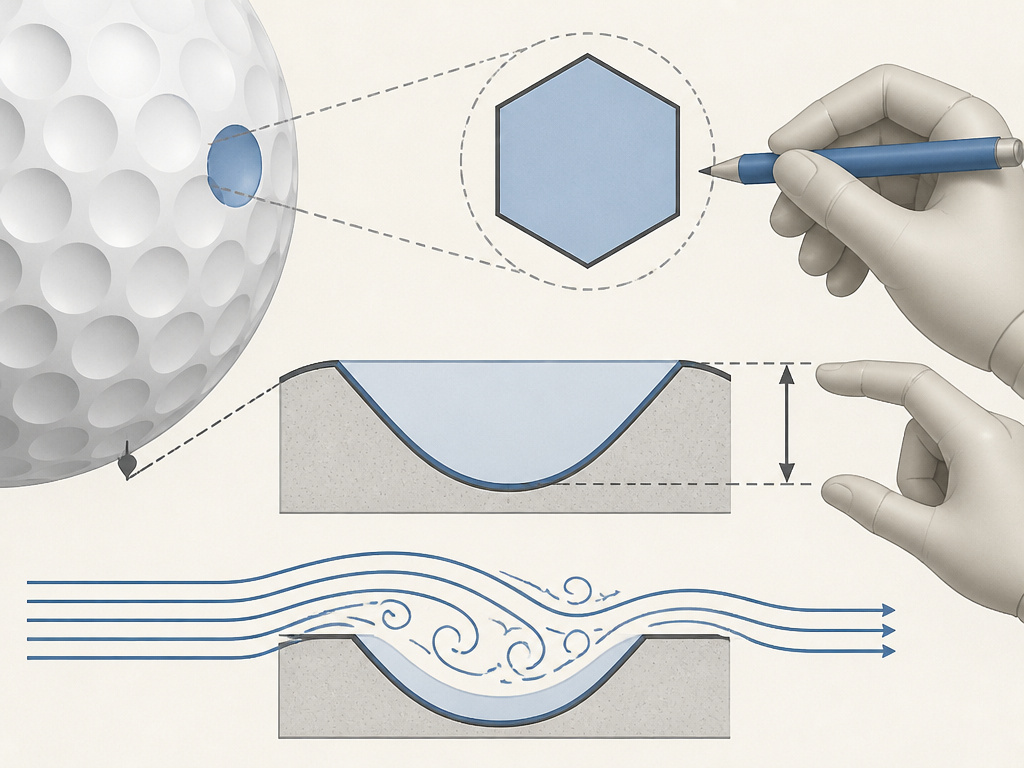
The classic dimple is a spherical crater. That’s old news. Today’s dimples are sophisticated aerodynamic devices, and their exact profiles are fiercely guarded intellectual property.
The key parameters engineers manipulate are: * Plan Shape: The outline of the dimple as viewed from above. While many are circular, patents protect non-circular shapes (hexagons, pentagons, tear-drops) defined by complex periodic functions. These shapes can further disrupt airflow. * Cross-Sectional Profile: The side-view shape of the dimple wall. Modern profiles often combine a conical top section with a curved bottom, defined by precise edge angles and saucer ratios to control how the airflow enters and exits the depression. * Depth: Typically between 0.005 and 0.020 inches. Depth works with diameter to create the right amount of surface roughness to trip the boundary layer at the intended ball speed.
Companies like Acushnet Company (Titleist) file dozens of patents for these features. The legal language is about “volumetric equivalence on opposing hemispheres” and “dimple patterns contributing to a non-straight flight trajectory.” In plain English, they’re finding ways to make the ball curve predictably for skilled players while still flying straight for everyone else, all within the strict USGA symmetry rules.
This granular design directly interacts with the golf ball construction. The dimples are molded into the cover, so the cover material’s hardness and resilience, like in the urethane vs Surlyn debate, affect how well the dimple edges maintain their shape after repeated impacts.
The USGA Symmetry Rule and Your Game
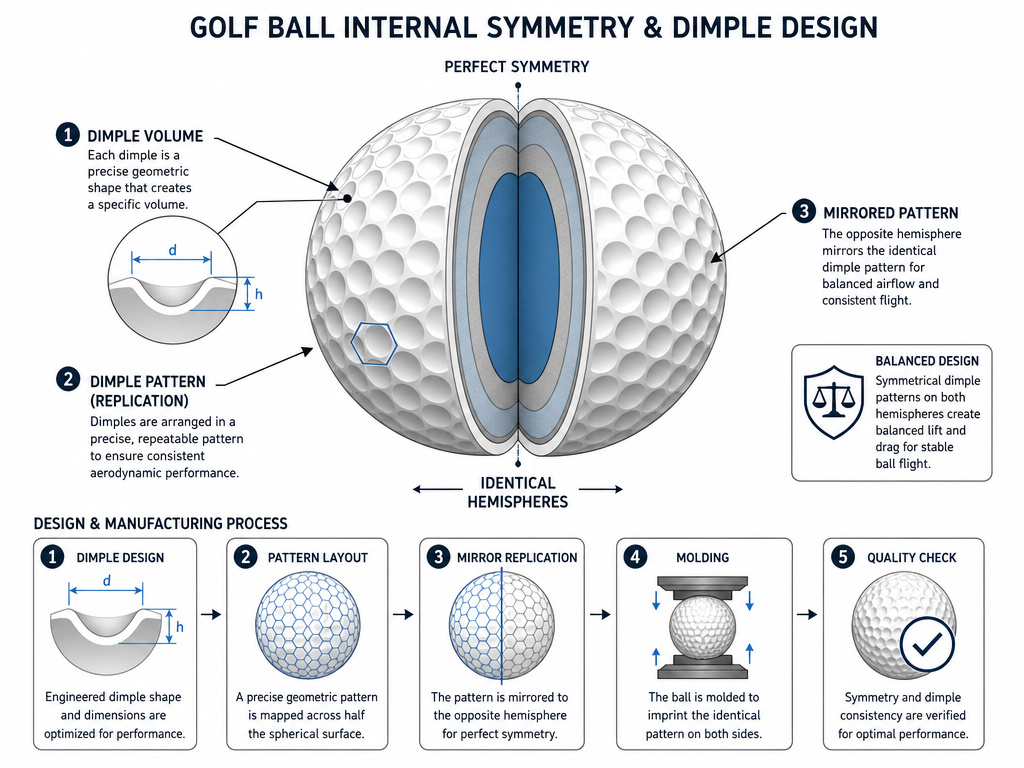
Every conforming golf ball must pass a symmetry test. The rule states a ball must not be designed to fly differently depending on how it’s placed on the tee. There is no “upside down” for a golf ball.
This forces extreme precision in dimple patterning. You can’t just scatter dimples randomly. Manufacturers often divide the ball’s surface into geometric regions (like projecting a polyhedron onto the sphere) and replicate patterns within each region. The total volume of the dimples on one hemisphere must be nearly identical to the volume on the opposite hemisphere.
Why does this matter to you? Consistency. When you pure a drive, you can trust that the ball will react the same way every time, regardless of its random orientation. This rule is the reason that understanding golf ball aerodynamics isn’t just theoretical, it’s baked into the equipment you use. A ball that flunked this test could hook or slice based on pure luck, not swing flaw.
The quest for symmetry within performance limits is a core challenge in golf ball design. It’s why you see such specific dimple counts like 336 or 388, they are solutions to a complex geometric and aerodynamic puzzle.
How External Conditions Change the Equation
Dimples work within the atmosphere, and the atmosphere changes. Two major environmental factors alter their effectiveness: temperature and altitude.
Cold weather thickens the air. The denser air increases drag for any object moving through it, including a golf ball. However, the cold also makes the ball’s core and cover materials less elastic, reducing initial velocity and spin. The net effect is less distance. The dimples are still doing their job, but they’re fighting a tougher battle against thicker air and a ball that doesn’t spring off the clubface as well. The specifics of how temperature affects flight are crucial for winter play.
High altitude has the opposite effect. The air is thinner, so drag is significantly reduced. A ball will fly farther in Denver than at sea level, even with the same swing. The dimples still create a turbulent boundary layer, but the force they’re overcoming is smaller. This is why understanding the effect of altitude is key for planning a golf trip to the mountains, you’ll need to club down.
| Condition | Effect on Air Density | Impact on Dimple Performance & Distance |
|---|---|---|
| Cold | Increases | Dimples work harder against more drag, but ball speed is lower. Net distance loss. |
| Hot | Decreases | Dimples work in thinner air, and ball speed is higher. Net distance gain. |
| High Altitude | Decreases significantly | Dramatically reduced drag. Dimples have less resistance to overcome, leading to much longer carries. |
These variables mean the perfect dimple pattern for a balmy Florida day might not be ideal for a crisp Colorado morning. It’s one reason pros might switch ball models or types based on the tournament location and conditions.
Putting It All Together: Choosing for Your Game
You don’t need a physics degree to pick a ball. You need to know what the engineering accomplishes.
The dimple pattern on a ball is tuned for a specific performance profile. A ball designed for maximum carry and soft landing on greens (like a Titleist Pro V1) will have a different aerodynamic setup than a ball designed for low spin and roll-out off the driver (like some distance models).
Your swing speed is the primary selector. A slower swing won’t generate enough force to properly activate the high-tech dimple patterns and multi-layer cores of a premium tour ball. You might get better performance from a ball designed for moderate compression and a focus on straight flight. Our guide on choosing a golf ball for your swing speed breaks this down in detail.
Here’s the blunt recommendation: if you have a driver swing speed over 95 mph and are a consistent ball-striker, play a premium 3- or 4-piece urethane ball (Titleist Pro V1, TaylorMade TP5, Callaway Chrome Soft X). Their dimple patterns and core construction are designed for you. If you’re below that speed or want more forgiveness, a 2-piece Surlyn ball will be longer and straighter, even if its short-game feel is inferior.
TL;DR: Don’t overthink the dimples. Choose a ball that matches your swing speed and your priority, distance, feel, or control. The manufacturer has already optimized the aerodynamics for that model’s intended player.
Frequently Asked Questions
Do more dimples mean more distance?
Not necessarily. Distance comes from the optimal balance of dimple count, depth, and shape for a given swing speed. Too many dimples can make the surface behave as if it’s smooth, increasing drag. Most brands have found the 300-400 range to be the sweet spot for a variety of players.
Why are golf ball dimples different shapes?
Different plan shapes (circular, hexagonal, pentagonal) disrupt airflow in distinct ways. Non-circular shapes can further enhance turbulence and optimize the drag reduction for specific speed ranges or stability goals. Hexagonal patterns, like on some Callaway balls, can also allow for tighter packing of dimples on the ball’s surface.
Can you play golf with a smooth ball?
You could, but you’d lose enormous distance. A smooth ball at driver speeds has nearly double the aerodynamic drag of a dimpled ball. Your drives would likely travel only 50-60% as far. The game would be fundamentally different.
How do dimples affect putting?
On the green, at very low speeds, aerodynamics are irrelevant. Dimples have no effect on a putt’s roll. The feel of a putt is determined by the ball’s construction, the core and cover materials, and how that energy transfers from the putter face.
Do old, scuffed golf balls lose performance?
Yes. Significant cuts or scratches that alter the dimple profile can disrupt the carefully engineered airflow. A deep gash can create an early separation point for the boundary layer, increasing drag and causing an unpredictable fluttering ball flight. A ball with minor surface scratches is usually fine, but a badly damaged one is a liability.
Before You Go
Dimples turn a sphere from a terrible flyer into a soaring projectile. They work by forcing a thin layer of chaotic, turbulent air to cling to the ball, slashing drag and enabling backspin to become lift. The exact number, be it 322, 332, or 388, is the result of balancing that physics against the USGA’s symmetry rules and the target player’s swing.
This science is why your driver shot carries down the fairway instead of plummeting to the turf. The next time you tee up a Titleist Pro V1 or a TaylorMade TP5, know that its dimples are the product of decades of research, wind tunnel testing, and patent filings. They’re not just decoration. They’re the reason the modern game is played at the distances it is. Now go hit it straight.
