
Urethane vs Surlyn: Golf Ball Cover Materials & Performance
This post contains affiliate links. As an Amazon Associate, we earn from qualifying purchases.
This post contains affiliate links. As an Amazon Associate, we earn from qualifying purchases.
Your golf ball’s performance hinges on its cover chemistry. A urethane cover spins three to five thousand RPM more on a wedge than a Surlyn cover, not because of grooves but because urethane’s softer, tackier surface doubles the friction against the clubface.
The rest walks the trade-off. Urethane gives up distance off the tee and durability in the bag. Surlyn gives up greenside stopping power and touch. Your clubhead speed decides which loss matters more. By the end, you’ll be able to look at a new ball and know whether its cover fits your swing before you ever tee it up.
Key Takeaways
- Greenside spin is a friction equation, not a groove equation. Urethane’s Shore D hardness of 48-58 creates a tacky surface that grabs wedge grooves; Surlyn’s 65-75 hardness bounces off, reducing spin by thousands of RPM.
- Surlyn’s original formulations cracked below freezing. The triblend chemistry (Surlyn 7930, 9721, and 8940) used today was a patent fix for low-temperature impact failure, a fact you’ll never see on a box.
- Wet, warm environments wreck polyester (AU) urethane. Hydrolysis degrades the polymer backbone above 140°F (60°C), a failure often misdiagnosed as chemical attack.
- Your swing speed is the primary selector. Under ~85 mph, the driver distance loss from a urethane ball outweighs its spin benefits for most players.
- The sound tells the story. A urethane ball makes a muted ‘schnick’ off the putter; Surlyn makes a sharp click and rolls out farther for the same stroke.
The Core Difference: Friction and Shore D Hardness
The cover isn’t about protecting the core. It’s the only part of the ball that touches your club, so its hardness and surface texture decide everything about impact: sound, feel, spin, and launch.
Surlyn covers typically run between 65 and 75 on the Shore D hardness scale. Urethane sits between 48 and 58 Shore D. That 10-27 point gap represents the single biggest equipment variable in golf.
Shore D measures the resistance of a hard plastic to indentation. A higher number means a harder, less deformable surface. When your wedge face meets the ball, the cover has a few microseconds to slide up the face before the grooves grab it. A softer urethane cover deforms more, presses deeper into the grooves, and its inherently higher coefficient of friction resists sliding. The result is more grabbing action, which translates directly to more backspin.
The opposite happens with Surlyn. Its harder surface skims across the grooves with less deformation and less friction. More of the club’s energy goes into launching the ball forward rather than spinning it backward.
This is why fresh grooves help a Surlyn ball only marginally. Independent robot testing shows a worn wedge with a urethane ball can still generate more spin than a new wedge with a Surlyn ball from a clean fairway lie. The cover material is the dominant variable.
The part nobody mentions: A urethane ball that’s been submerged in a lake for a month often swells and loses its engineered Shore D hardness. A recycled “mint” Pro V1 might actually perform like a Surlyn ball you just bought. Durability works both ways.
Surlyn: The Chemistry of Durability and Distance
Surlyn is DuPont’s brand name for an ionomer resin. It’s a polyethylene plastic chain that’s been modified with metal ions, like sodium, zinc, or lithium, that create reversible ionic bonds between molecules. Think of it like a microscopic magnet network that lets the material flex but also snap back into shape with incredible resilience.
This chemistry explains its two signature traits: extreme cut resistance and low driver spin. The ionic crosslinks allow the cover to absorb a sharp impact without shearing, which is why a Surlyn ball can bounce off a cart path and still look new. On a driver strike, that same elastic rebound transfers more energy into ball speed rather than converting it into rotational energy (spin).
The original Surlyn formulations had a fatal flaw. Single-ionomer covers, like 100% sodium or lithium types, were prone to cracking in cold weather. A 1993 patent (US 5197740) documented that these balls could fail on impact at 20°F (-6.7°C), especially after aging. The industry’s fix was a triblend, mixing three specific ionomers: Surlyn 7930 (lithium salt), Surlyn 9721 (zinc salt), and Surlyn 8940 (sodium salt). This blend improved low-temperature impact resistance and boosted the coefficient of restitution.
Today’s Surlyn-equivalent covers use this basic chemistry, even if they’re not branded Surlyn. They are the default for two-piece, distance-focused balls. Their production is often tied to high-volume golf ball manufacturing, where injection molding the hard cover is fast and efficient.
Urethane: The Physics of Spin and Feel
Urethane on a golf ball is a thermoset polymer, formed by reacting a polyol with an isocyanate. It’s almost always cast, poured as a liquid into a mold around the ball’s mantle, rather than injection-molded. This allows for a thinner, more consistent, and inherently softer shell.
| Property | Urethane (Cast) | Surlyn (Ionomer) |
|---|---|---|
| Typical Shore D Hardness | 48 – 58 | 65 – 75 |
| Primary Manufacturing Method | Casting | Injection Molding |
| Key Performance Trait | High greenside spin & feel | High durability & driver distance |
| Cost & Typical Ball Tier | Premium (tour-level balls) | Value / Distance |
| Feel/Sound Off Putter | Muted, soft ‘schnick’ | Loud, firm click |
The softer surface is tackier. You can feel it if you press your fingernail into a new urethane ball versus a Surlyn ball. This higher surface friction is why urethane is the undisputed king of greenside control. It’s also why these covers scuff so easily. A single sand shot can leave visible marks from the grooved face, and tour pros routinely change balls after a few holes because of wear.
There’s a material science caveat for urethane outside of golf. In industrial uses, polyester-based urethane (labeled AU) suffers from hydrolysis in wet, warm environments above 140°F (60°C), which degrades the polymer. Golf ball urethane is a different, specialized formulation, but the principle stands: material chemistry dictates environmental limits. For golfers, the limit is abrasion, not heat.
Who Actually Needs a Urethane Ball? (A Swing Speed Decision)
The choice between cover materials maps directly to your clubhead speed. It’s not about skill level; it’s about physics. A slower swing cannot compress a urethane ball enough to unlock its driver distance potential, while a faster swing loses more from Surlyn’s lack of spin into greens.
Common mistake: Choosing a tour urethane ball because the pros use it, when your driver swing speed is under 85 mph. You’re paying for spin you can’t use and giving up 10-15 yards off the tee.
Let’s break down the decision with a simple table.
| Your Driver Swing Speed | Recommended Cover | Why This Works | What You Sacrifice |
|---|---|---|---|
| Below 85 mph | Surylon / Ionomer | Maximizes driver distance via lower spin; more durable for frequent miss-hits. | Greenside stopping power; softer, more responsive feel on chips and putts. |
| 85 – 95 mph | Hybrid or Entry Urethane | Balances some spin gain with acceptable distance loss; good for improving players. | Some driver distance vs Surlyn; less spin than tour urethane. |
| Above 95 mph | Tour Urethane (e.g., Pro V1, TP5) | Generates maximum spin for approach shot control; soft feel rewards precise contact. | Durability (scuffs easily); higher cost per ball. |
The 85 mph threshold is the pivot. Below that, the energy transfer on a driver strike favors the harder, springier Surlyn cover. The ball launches with less spin, which for slower swings reduces slicing or hooking sidespin and often adds carry distance. Your golf ball compression also plays a role here, but the cover is the bigger lever.
Above 95 mph, you have the clubhead speed to fully compress a multi-layer urethane ball. The driver distance difference shrinks, and the benefit of having a 50-yard wedge shot stop next to its pitch mark becomes tangible. This is the realm of high-performance urethane golf balls like the Titleist Pro V1 or Srixon Z-Star XV.
The Hidden Trade-Offs: Durability, Sound, and Cost
Performance is only one axis. The real-world differences in how these balls behave in your bag and on your wallet are just as decisive.
Durability: A Surlyn ball is nearly indestructible. It survives trees, paths, and full-throttle wedge shots. A urethane ball is a consumable. A single sandy lie or a thinned groove shot will mark it up. If you lose a couple of balls a round, Surlyn’s toughness is a financial advantage. If you play the same ball for 18 holes and value consistent performance, you’re in urethane territory.
Sound and Feel: This is the most underrated differentiator. Off the putter face, a urethane ball produces a muted, low-pitched ‘schnick.’ A Surlyn ball makes a distinct, high-pitched click. This isn’t just acoustic, the harder Surlyn cover transfers energy faster, so the same stroke sends the ball rolling farther. Many players struggle with lag putting when switching from urethane to Surlyn because they don’t allow for the extra rollout.
Cost: Urethane balls command a premium. A dozen tour balls can cost over $50. A dozen high-quality Surlyn balls often sit around $20-$30. The cost-per-shot is dramatically higher for urethane, especially if you’re scuffing them up quickly. For beginners or high-handicappers, investing in lessons is almost always better than investing in tour balls.
When considering three-piece golf balls, you’re often looking at a Surlyn or a hybrid cover. These offer a middle ground in the spin golf balls spectrum, providing better feel than a two-piece rock but without the full cost and fragility of tour urethane.
How to Test Which Cover You Actually Play Better With
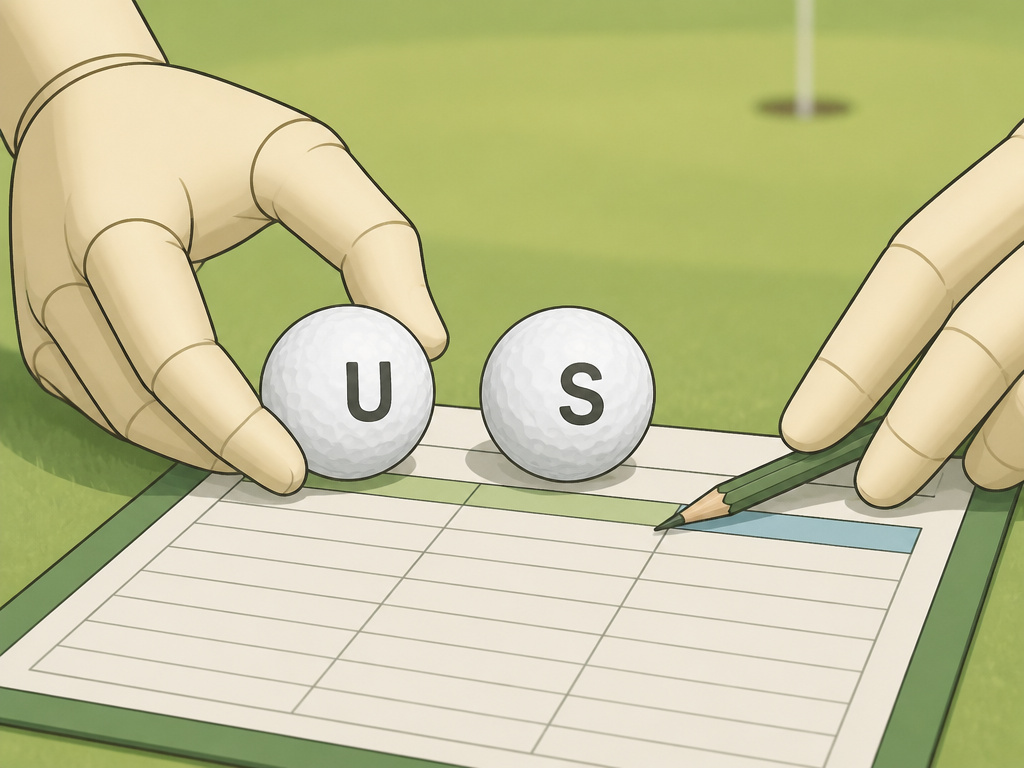
Don’t guess. Use two balls over nine holes and let the scorecard decide. Here’s the method.
- Pick two different balls: Take one premium urethane ball (like a Titleist Pro V1x) and one quality Surlyn ball (like a Callaway Supersoft). Make sure they are both new.
- Play alternate shots: Use the urethane ball on all even-numbered holes and the Surlyn ball on all odd-numbered holes. Keep separate scores for each ball.
- Pay attention to three shots: Note the result of your driving distance on a par 4 or 5, your spin control on a par 3 approach, and your speed control on a long lag putt.
- Compare the totals: Which ball produced the lower 9-hole score? That’s your answer, stripped of bias.
The ball that loses you fewer strokes off the tee and gives you more confidence around the greens is the right cover for your current game. Your choice should evolve with your swing speed and your skill, not with marketing. A proper ball selection guide focuses on this kind of real-world testing.
Frequently Asked Questions
Does a softer compression rating mean the cover is softer?
No. Compression measures the core’s firmness, not the cover’s. A 70-compression Surlyn ball has a very hard cover and a soft core. A 90-compression urethane ball has a firm core and a soft cover. They are independent dials. You need to understand both the golf ball construction and the cover material separately.
Will new wedge grooves make my Surlyn ball spin like a urethane ball?
No. Grooves matter most for channeling moisture and debris away in wet conditions or rough. From a clean fairway lie, the cover material’s friction is the dominant factor. New grooves on a Surlyn ball will not generate urethane-level spin.
Why do my urethane balls feel ‘dead’ sometimes?
If you buy recycled or refurbished urethane balls, the cover may have degraded from water immersion or UV exposure. The polymer can swell and lose its engineered Shore D hardness. The ball looks fine but performs like a harder, lower-spin ball. Stick with new or certified recycled balls from trusted sellers.
Are there any decent urethane balls for slower swing speeds?
Yes, but they are the exception, not the rule. Some manufacturers make lower-compression urethane balls aimed at slower swings, like the Callaway Chrome Soft or the Bridgestone Tour B RX. They trade a little spin for a little more driver distance. They are still more expensive and less durable than Surlyn balls, but they offer a middle path.
Is a ‘hybrid’ cover the same as Surlyn?
Not usually. A hybrid cover typically refers to a ball with a thin, softer outer layer (often a blend) over a firmer inner layer. It’s designed to feel softer than pure Surlyn while being more durable than pure urethane. It’s a performance compromise that works well for mid-handicap players.
Before You Go
Your golf ball cover is the first piece of your equipment that meets the club. Choosing between urethane and Surlyn isn’t about good versus bad; it’s about a deliberate trade-off between greenside spin and driver distance, between soft feel and hard durability, between tour-level cost and weekend value.
Match the cover to your swing speed first. If you’re under 85 mph with the driver, Surlyn’s extra yards will help your score more than urethane’s extra spin. If you’re over 95 mph, urethane’s control is a legitimate scoring tool. For everyone in between, the answer is in a simple nine-hole test. Play both, compare scores, and let your own game tell you which chemistry fits.
