
Essential Golf Cart Etiquette and Safety Rules to Follow
This post contains affiliate links. As an Amazon Associate, we earn from qualifying purchases.
This post contains affiliate links. As an Amazon Associate, we earn from qualifying purchases.
Golf cart etiquette and rules are a blend of common courtesy, turf protection, and strict mechanical safety. The core principles are staying on designated paths, driving at a safe speed for conditions, never driving on tees or greens, and following all posted course instructions. Ignoring these isn’t just rude, it damages the course, risks injury, and can get you banned.
That blend matters because a cart is a 600-pound vehicle, not a toy. The Yamaha YDRE electric model has a factory speed setting of 12 mph and a turning radius of 9.2 feet. On wet grass or a steep grade, those numbers define the line between control and a slide.
What follows breaks down the why behind every rule, the specific mechanical limits you’re working with, and the eight documented accident causes that turn a casual round into a liability claim.
Key Takeaways
- “Cart path only” means tires never leave the pavement. This rule protects saturated turf from deep ruts that take weeks to heal.
- Match your speed to the terrain’s traction. Wet grass cuts a cart’s stopping distance in half; a steep downhill grade demands a crawl.
- The 90-degree rule is a geometry problem. Enter the fairway at a right angle from the path, drive directly to your ball, and return directly back.
- Parking is not optional. Always use designated areas, never block other carts or players, and set the parking brake on any slope.
- Maintenance is a safety issue. Check tire pressure (20 psi for most models) and brake function before you rent or drive your own cart.
The 8 Major Accident Causes (From a City’s Data)
The City of Buena Vista’s golf cart operator manual doesn’t deal in vague warnings. It lists the eight major contributors to serious accidents, drawn from real incident data. This list reframes etiquette from politeness to collision avoidance.
Where this goes sideways: Making a turn without looking and signaling. On a shared-use path, a sudden turn into a driveway can cause a rear-end collision with a bicycle or another cart within three seconds.
- Making turns without looking and signaling. This is the top cause. A cart’s blind spots are significant, and other users, golfers, cyclists, pedestrians, expect a signal.
- Backing up without waiting and warning. The rearview mirror is limited. If you must reverse, have your passenger spot for you or get out and look.
- Entering traffic lanes without stopping. Treat a cart path crossing a road like a stop sign. Come to a complete stop, look both ways, then proceed.
- Speeding beyond the ability to maintain control. The posted speed is a maximum for ideal conditions. Rain, slopes, and rough terrain drop that number by half.
- Driving in a manner dangerous to passengers. Sharp turns at speed can tip a cart. Passengers have no seatbelts and nothing to hold onto but a grab bar.
- Traveling in an improper traffic lane, stay to the right. On shared paths, you are a slow-moving vehicle. Keep right to allow others to pass safely.
- Driving after dark without head or taillights. Most golf carts are not equipped for night driving. If yours is, the lights are non-negotiable for being seen.
- Operating an improperly maintained cart. Bald tires, weak brakes, or a loose steering rack fail when you need them most, often on a downhill slope.
This list from the university golf cart manual turns abstract “be careful” advice into a preventable checklist. Your first job as a driver is to not become a statistic.
Course Rules: “Cart Path Only” vs. The 90-Degree Rule
Courses post these rules to protect their most expensive asset: the playing surface. Understanding the difference is the first step in not being the person the marshall has to talk to.
“Cart Path Only” means exactly that. All four tires stay on the paved or gravel path for the entire hole. You walk from the path to your ball and back. This rule is almost always in effect after heavy rain or during winter months when the ground is soft. Driving on soaked fairways leaves deep tire trenches that damage root systems and require costly repairs.
The 90-Degree Rule is a compromise. You may leave the cart path, but only at a right angle (90 degrees) to drive directly to your golf ball. After your shot, you drive directly back to the cart path. This minimizes the total area of fairway driven on, spreading wear over a wider zone. Think of it as drawing a straight line to and from your ball.
| Rule | When It’s Used | What You Do | Risk If Ignored |
|---|---|---|---|
| Cart Path Only | Wet conditions, winter, delicate turf areas | Park on path, walk to ball with multiple clubs. | Creates deep ruts, kills grass, leads to ground-under-repair areas for weeks. |
| 90-Degree Rule | Dry conditions, standard course maintenance | Drive straight to ball, then straight back to path. | Concentrates wear, creates brown “tire track” paths across the fairway. |
| Open Fairway | Rare, on very dry, hardy courses | Drive anywhere, but avoid obvious wet spots. | Can still cause damage if drivers cluster in the same “worn track” areas. |
Never drive a cart within 30 yards of a green or onto a tee box. The grass there is cut too short to handle the weight. You’ll leave tire marks that affect putting surfaces and require immediate repair by the grounds crew.
Mechanical Limits You Can’t Ignore
Etiquette meets engineering here. A golf cart’s physical specs dictate what is safe, regardless of the rules. The official golf association guidelines assume you’re driving a vehicle that conforms to standards like ANSI Z130.1.
A Yamaha YDRE electric golf car has a minimum ground clearance of 4.5 inches. A standard course divot is about an inch deep. Hit a series of them at speed, and you’re scraping the chassis.
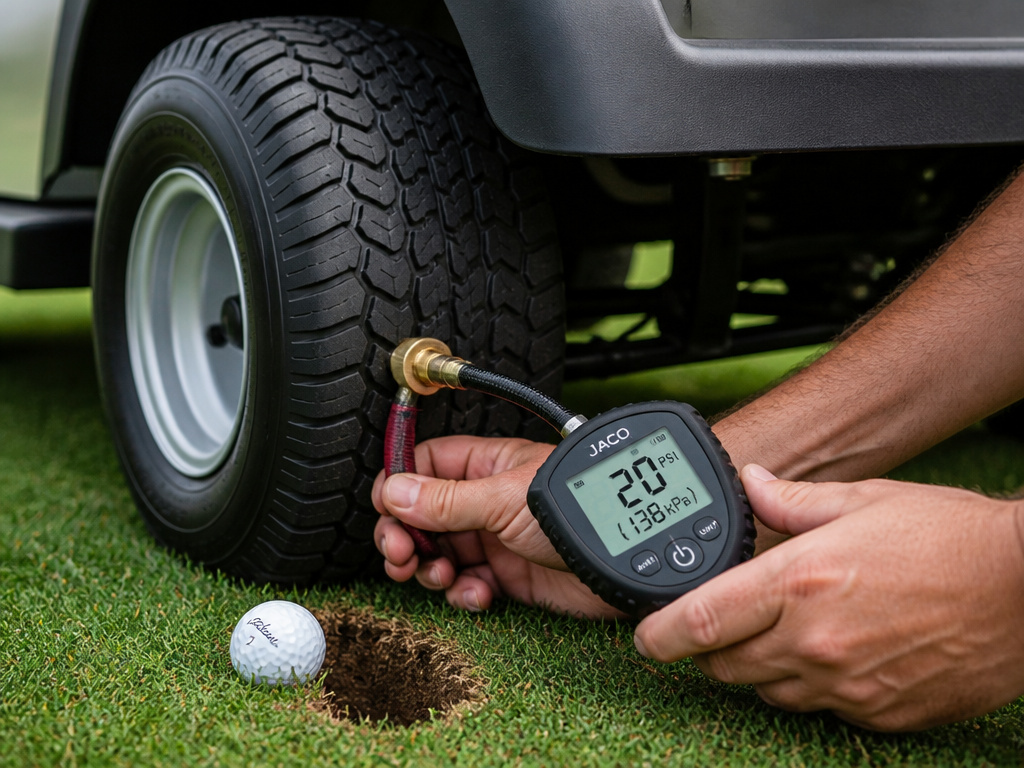
Tire Pressure (138 kPa / 20 psi): This is not a suggestion. Under-inflated tires increase rolling resistance, draining battery life on electric models and causing sluggish handling. Over-inflated tires reduce the contact patch, leading to less traction and a bumpier ride. Check it monthly.
Turning Radius (2.8 m / 9.2 ft): This is the space needed to make a full U-turn. On a narrow path between bunkers, you can’t pivot on a dime. Plan your route to avoid three-point turns that tear up the rough.
Weight Distribution: Most of the weight is in the rear (batteries or engine). Taking a sharp turn at speed can lift the inside front wheel. On a slope, this is how a rollover starts. Slow down before the turn, not during it.
Brake Fade: Mechanical drum brakes, common on many carts, overheat on long, steep descents. The pedal gets spongy, and stopping power drops. The solution is to use the motor’s regenerative braking (on electric models) by riding the accelerator lightly downhill, and to pump the brake pedal rather than holding it down.
These limits are why golf cart accessories like a digital tire pressure gauge or a rearview mirror aren’t luxuries. They’re tools for operating within the machine’s design.
Parking, Passing, and Shared Space Etiquette
Parking seems simple until you see a cart left blocking the path to the next tee box. The protocol exists to keep traffic flowing and avoid damage.
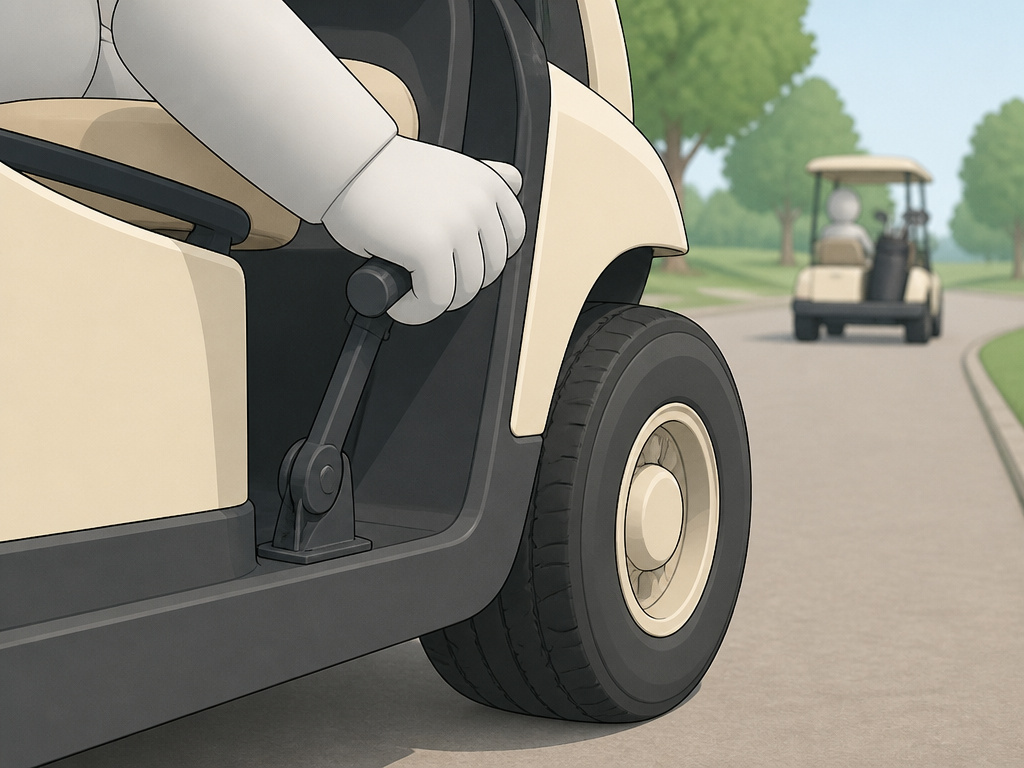
Always use designated parking areas. Near greens, this is usually a ring of pavement or a marked gravel section. If no area exists, park fully on the cart path, well behind the green and out of the way of the group behind you. Set the parking brake every single time, even on a slight incline. A rolling cart is a hazard.
When passing another cart, do so only on straight, wide sections of path and with a clear verbal warning (“Passing on your left!”). Slow down significantly. Throwing up gravel or dust onto other players is unacceptable.
At blind corners or crests of hills, slow to a near-stop and be prepared to stop. Assume someone is coming the other way. This is where many fender-benders happen.
Sharing a cart with a partner requires communication. The driver should drop the passenger at their ball before proceeding to their own. Agree on a meeting point for the next shot. The silent, efficient cart team is a thing of beauty and a huge pace-of-play booster.
Good general golf etiquette extends to your vehicle. It’s an extension of your presence on the course.
Safety and Maintenance: The Owner/Renter Split
Your responsibilities change depending on whether you own the cart or are renting it from the course. Both share one non-negotiable point: a pre-operation check.
For Renters: Your check takes 60 seconds. Before you drive off: * Visually inspect the tires for obvious cuts or low pressure. * Press the brake pedal to ensure it feels firm and stops the cart. * Confirm the cart moves forward and backward smoothly. * Note any existing damage and report it to the pro shop.
The course is responsible for deeper maintenance, like the semiannual lubrication of the front suspension or checking the brake pedal freeplay (which should be 20-25 mm on a Yamaha). If something feels wrong while driving, stop and call the pro shop.
For Owners: The manual is your bible. The Club Car Precedent manual outlines a precise schedule. For example, the chassis lube (EP NLGI Grade 2) is required every 50 hours of operation or 100 rounds. Ignoring this leads to worn components, noisy rides, and eventual failure.
Common mistake: Using a standard automotive tire inflator without checking the pressure setting first. The 20 psi requirement is low for a car tire. Over-inflating a cart tire to 35 psi is easy and creates a dangerous, bouncy ride.
Ownership also means investing in protection and upkeep. Protective cart covers prevent UV damage and keep the interior dry. Knowing the specs for replacement cart batteries (like the Trojan T-875) ensures you get the right runtime. Security matters, too, a cart security lock is a basic deterrent.
What About Street Use and Local Laws?
Driving a cart on public roads is a completely different legal arena, governed by state and municipal ordinances, not course rules. The Buena Vista manual is a prime example, mapping specific zones where carts are permitted.
Most jurisdictions require: * Street-Legal Modifications: Headlights, taillights, turn signals, rearview mirrors, a horn, and a slow-moving vehicle (SMV) emblem. * Registration and Insurance: The cart must be registered with the DMV and carry minimum liability insurance. * Driver’s License: The operator must have a valid driver’s license. * Route Restrictions: Carts are often prohibited on roads with speed limits above 35 mph.
The Kandi Kruiser 4P Element manual states clearly it is “designed and manufactured for off-road use only.” Modifying it for street use may void the warranty and be illegal. Always check your local golf rules and ordinances, what’s fine in one retirement community is a ticket in another town.
Frequently Asked Questions
Can I drink alcohol while driving a golf cart on the course?
No. This is a severe violation of both course policy and, in many areas, the law. Golf carts are vehicles. Driving under the influence is dangerous and carries the same legal penalties as driving a car drunk. The Yamaha safety manual explicitly warns against it.
What should I do if my golf cart starts to tip?
Do not try to jump out. Stay inside, grip the steering wheel or handholds, and lean your body weight toward the uphill side. This can sometimes counterbalance the cart enough to prevent a full rollover. The best strategy is to drive slowly on slopes and avoid sharp turns on hillsides altogether.
Are children allowed to drive golf carts?
Course policies vary, but they are strict. Most require the driver to be at least 16 years old with a valid driver’s license. Even on private property, allowing an unlicensed child to drive is a major liability risk. The Buena Vista manual lists “children drivers” as a specific consideration under its accident prevention section.
Why do some carts have GPS systems?
Modern golf cart GPS systems like Tagmarshal help courses manage pace of play, enforce geofencing (keeping carts out of restricted areas), and provide yardages. They are also a tool for the course to monitor cart location for safety and efficiency. Follow any instructions they provide.
How do I handle a cart on a very steep hill?
Descend with your foot lightly on the brake, using the motor to provide resistance. Never descend straight down; take a diagonal path if possible to reduce the grade. Ascend slowly and steadily. If the cart struggles or the wheels slip, stop and reconsider the route. It’s okay to walk.
The Bottom Line
Golf cart etiquette isn’t about arbitrary traditions. It’s the operating manual for a 600-pound vehicle in a shared, fragile environment. The rules protect the course you paid to play, the safety of everyone around you, and the longevity of the machine itself.
Start with the pre-drive check. Respect the “cart path only” and 90-degree rules as the groundkeepers’ direct requests. Park with purpose. Drive like the eight accident causes are posted on your dash. And remember, the cart is a tool to get you to your next shot, not the main attraction. Good etiquette here makes the round smoother, faster, and more enjoyable for your group and the ones ahead and behind you. That’s the whole point.
