
Guide to Golf Ties: Sudden Death and Other Playoff Formats
This post contains affiliate links. As an Amazon Associate, we earn from qualifying purchases.
This post contains affiliate links. As an Amazon Associate, we earn from qualifying purchases.
A golf tie is broken by a playoff, with the format dictated by the competition’s rules. In match play, a tied match extends one hole at a time until a winner emerges. In stroke play, the committee defines the tiebreaker, which is usually a sudden-death or multi-hole aggregate playoff. Major championships each have a unique, pre-defined format, like the PGA Championship’s three-hole aggregate.
That distinction between match play and stroke play is where most confusion starts. The Rules of Golf provide the framework, but the committee in charge of your event holds the final say on how to break a deadlock.
What follows is a breakdown of the two core playoff types, the exact formats used by the four majors, and what happens when a tie isn’t for first place. By the end, you’ll know why a sudden-death finish at The Masters feels different from a three-hole battle at the PGA Championship.
Key Takeaways
- Match play ties are extended hole-by-hole from where the match ended, while stroke play ties require a committee-defined playoff, often sudden death or aggregate.
- All four major championships use aggregate playoffs, not pure sudden death: The Masters (sudden death after regulation), PGA Championship (3 holes), U.S. Open (2 holes), The Open (3 holes).
- The 2026 PGA Championship playoff uses holes 10, 17, and 18 at Aronimink; if still tied, sudden death repeats on the 18th.
- Ties for places other than first are often broken by scorecard matching (last 9, last 6, last 3, last hole) if a playoff isn’t feasible.
- Always check the event’s “Terms of Competition” before assuming the tiebreaker procedure.
The Two Types of Golf Playoff Explained
Forget a one-size-fits-all rule. The format depends entirely on whether you’re in a match play or stroke play format.
Match Play: Rule 3.2a(4) states a tied match continues by playing one extra hole at a time until one side wins a hole. This is sudden death by definition, but it’s a continuation of the same round. The committee can override this in the Terms of Competition, allowing a match to end in a tie or specifying a fixed-hole playoff. Stroke Play: Rule 3.3a declares the winner is the player with the fewest total strokes. The committee must define the tiebreaker in the Terms of Competition. This is where you get sudden-death or aggregate playoffs.
Sudden death is the simpler, faster format. All tied players compete on a pre-selected hole. The player with the lowest score on that hole wins. If multiple players tie for the lowest score, everyone moves to the next designated hole and repeats. It continues until one player posts a lower score than all others on a completed hole. This format is common on the PGA Tour for regular events.
Aggregate playoff is the multi-hole test. Players complete a set number of holes, commonly two, three, or four. Their scores on only those holes are totaled. The player with the lowest cumulative score wins. If a tie remains after the aggregate holes, the format typically reverts to sudden death on a specified hole.
| Playoff Type | How It Works | Best For | The Risk |
|---|---|---|---|
| Sudden Death | One hole at a time, lowest score wins the hole. | Speed, drama, regular tour events. | One bad swing can lose a 72-hole tournament. |
| Aggregate (2,3,4 holes) | Total score over a set number of holes decides. | Fairness, testing consistency, major championships. | Can run long, risk finishing in darkness. |
The choice between them is a debate between instant drama and proven fairness. Most professional tours outside the majors use sudden death for its television-friendly conclusion. The majors have all moved to aggregate formats to ensure, as Tiger Woods once argued, that the better player over a longer test usually wins.
How Ties Are Broken in Match Play vs. Stroke Play
The governing rules provide the baseline, but local rules can change everything.
In match play, the default is straightforward. You finish the 18th hole all square. You then proceed to the 19th hole, and keep playing until one side wins a hole. There’s no aggregate scoring, it’s pure head-to-head sudden death. This is why you’ll hear a match ended “at the 20th hole.”
However, committee intervention is common, especially in team events like the Ryder Cup. The Terms of Competition can declare that a match ending all square results in a tie, with each side earning half a point. They can also specify that a playoff starts on a specific hole, not the next one in sequence.
In stroke play, the rulebook offers no default playoff. It mandates that the committee decides and publishes the method in advance. This is non-negotiable for any sanctioned competition.
If a playoff isn’t possible, due to weather, daylight, or logistics, ties are broken by scorecard matching, also called a “countback.” The committee compares scores starting from the last hole and works backward.
Common mistake: Assuming scorecard matching is a universal rule. It’s only used when the Terms of Competition specify it as the tiebreaker method, or when a playoff is impossible.
The typical countback sequence, used by bodies like the Florida State Golf Association, is: 1. Best score on the last 18 holes (the entire round). 2. Best score on the last 9 holes. 3. Best score on the last 6 holes. 4. Best score on the last 3 holes. 5. Best score on the 18th hole alone. 6. If still tied, a random draw (lot).
This is why meticulous tracking your score on every hole matters, even in a casual tournament. That bogey on the 17th could cost you a tiebreak.
Major Championship Playoff Formats (2026)
The four majors have distinct personalities, and their playoff formats reflect that. None use simple sudden death as the primary method anymore.
| Major Championship | 2026 Playoff Format | Specific Holes (If Known) | If Still Tied |
|---|---|---|---|
| The Masters | Sudden Death | Hole 18, then 10 | Continues alternating 18 & 10. |
| PGA Championship | 3-Hole Aggregate | Holes 10, 17, 18 at Aronimink | Sudden death on hole 18. |
| U.S. Open | 2-Hole Aggregate | Holes 17 & 18 at Shinnecock | Sudden death alternating 17 & 18. |
| The Open | 3-Hole Aggregate | Holes 14, 15, 18 at Royal Birkdale | Sudden death on hole 18. |
The PGA Championship’s three-hole aggregate is its signature. Adopted in 2000, it replaced a sudden-death format. The logic was to create a more substantial test. A player can recover from one bad shot over three holes, but not necessarily in sudden death. The 2026 playoff at Aronimink uses a brutal trio: a long par-4 with water, a daunting par-3 over a pond, and a tough par-4 finishing hole.
The Open Championship uses a three-hole format as of 2019, down from a four-hole aggregate used from 1989 to 2018. The R&A selects the three holes based on course flow and spectator access. At Royal Birkdale in 2026, the playoff will loop the par-5 14th, par-3 15th, and par-4 18th.
The U.S. Open switched to a two-hole aggregate in 2018, abandoning the traditional 18-hole Monday playoff. It’s a compromise, longer than one hole, but shorter than the other majors’ formats. The Masters is the outlier, retaining sudden death but only after regulation 72 holes. It’s the only major where a single playoff hole is the first step.
Where this goes sideways: Thinking a “three-hole aggregate” means you just add three holes to your 72-hole score. It’s a separate, mini-competition. Your scores on only those three holes are summed. This is detailed in the official Wikipedia entry on golf playoffs.
These formats aren’t arbitrary. They’re designed to provide a dramatic, fair conclusion that fits each major’s identity and broadcast window.
What Happens in a Multi-Player Tie?
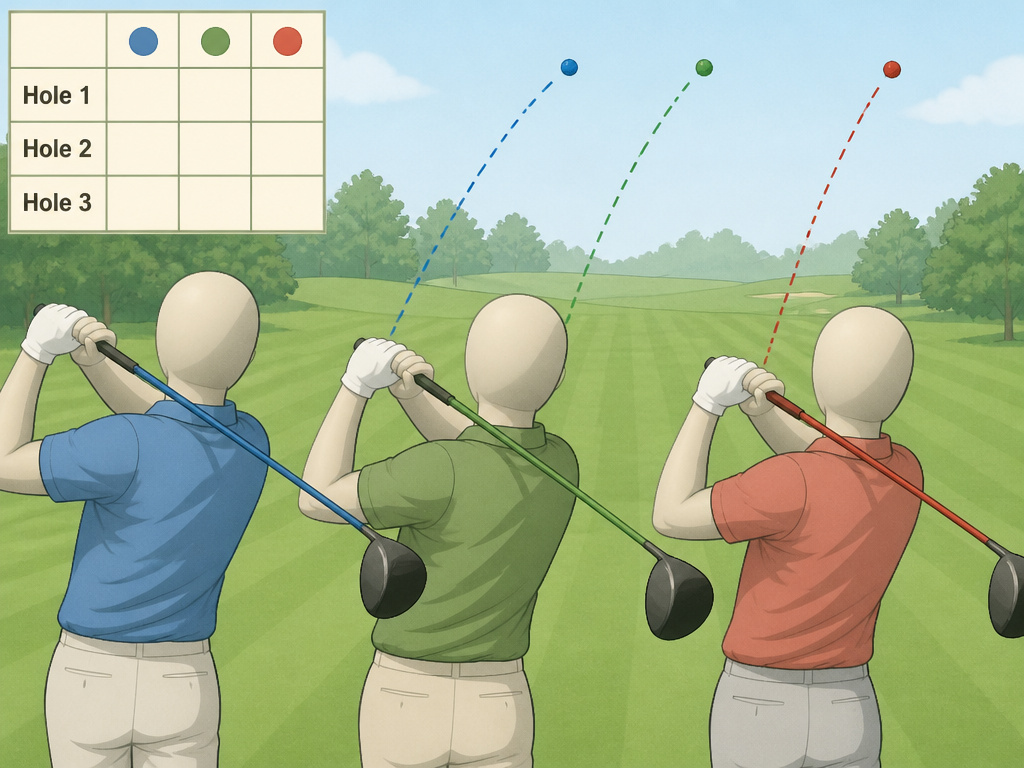 The playoff doesn’t shrink to a one-on-one match. All players tied for the lead participate.
In a three-hole aggregate, all tied players form a single group. They all play the three designated holes. The player with the lowest total score across those three holes wins. If two players tie but have a lower total than a third, the third player is eliminated, and the two leaders proceed to sudden death if required.
The record for a PGA Tour playoff is six players. The record for a major is four, at the 2002 Open Championship. Logistics get complex, but the principle holds: everyone plays the same holes at the same time.
For ties deeper down the leaderboard, say, for 5th place, a full playoff is rare. Tournaments typically use the scorecard matching method outlined in their rules. This is where understanding your net score vs gross score becomes critical in handicap events, as the countback is run on net scores.
The official FSGA tie decision rules are a perfect model. For non-first place ties, they use the countback method (last 9, last 6, etc.) unless the competition specifically mandates playoffs for all places, which is exceptionally rare.
The Evolution of Playoff Formats
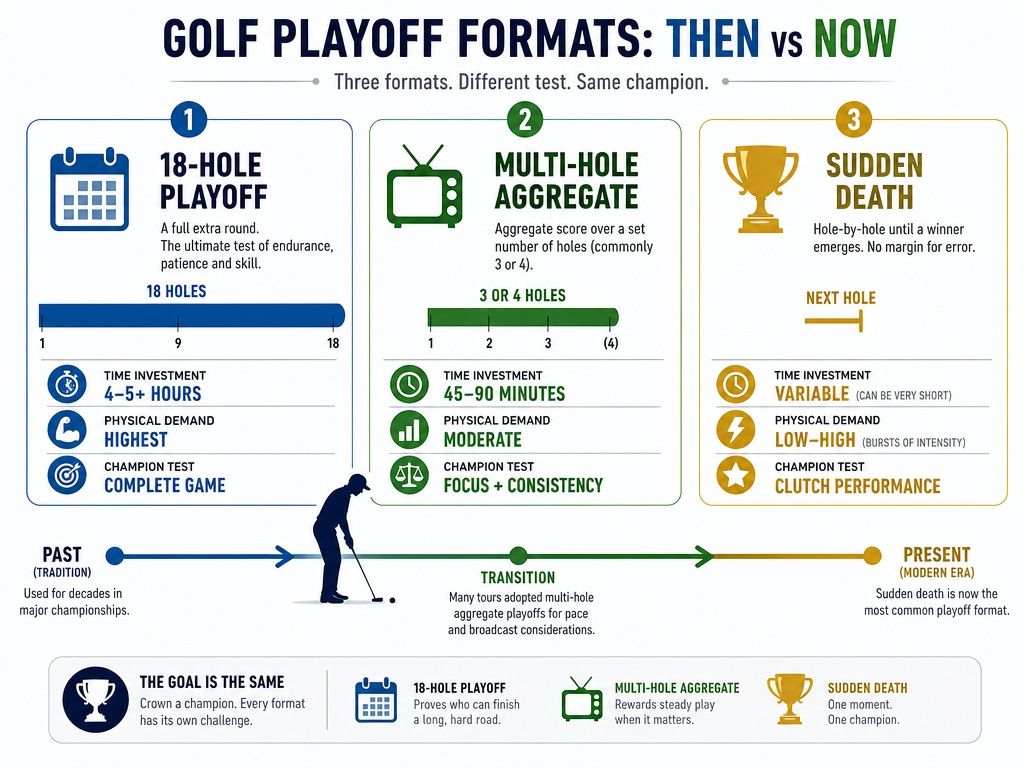 Playoffs have gotten shorter. Much shorter.
From the 1950s through the 1970s, 18-hole Monday playoffs were standard in majors. The 1961 and 1967 PGA Championships were decided by full 18-hole rounds. The shift began with The Open in 1989, introducing a four-hole aggregate to avoid a day’s delay. The PGA Championship was the last major to hold onto 18-hole playoffs, finally switching to sudden death in 1977.
The move to shortened aggregate formats was driven by television, fan engagement, and practicality. An 18-hole playoff requires another day of operations, crew, and security. It also loses the momentum of Sunday’s finale. A three-hole playoff happens immediately, capturing the live audience.
The debate on fairness persists. Some pros, like Chris DiMarco who lost in a three-hole playoff at the 2004 PGA, have argued that a full 18-hole test is the only fair way after 72 holes. Others believe the pressure of a immediate, short-form playoff is a valid skill test.
The current system is a compromise. The aggregate format reduces the lottery effect of sudden death, while the short length satisfies broadcast and logistical needs. It’s likely here to stay.
Frequently Asked Questions
Can a golf tournament end in a tie?
Yes, but only if the committee’s Terms of Competition allow it. In most professional stroke-play events, a tie for first is always broken by a playoff. In match-play team events (like the Ryder Cup), individual matches can end tied, with each team earning half a point.
What is the most common playoff format in golf?
Sudden death is the most common format worldwide, especially in weekly professional tours and club competitions. It’s fast and easy to administer. However, the most prestigious events (majors) all use some form of multi-hole aggregate playoff.
How does a scorecard playoff work?
Scorecard playoff, or countback, breaks ties by comparing scores starting from the last hole and moving backward. It first compares the total for the last 9 holes. If still tied, it goes to the last 6 holes, then last 3, then the 18th hole alone. It’s used when a physical playoff isn’t feasible.
Has there ever been a playoff at The Masters?
Yes, but it’s the least frequent among majors due to its sudden-death format. Recent examples include 2017 (Sergio Garcia over Justin Rose on the first playoff hole) and 2012 (Bubba Watson over Louis Oosthuizen on the second). Its sudden-death format often leads to a quicker, more dramatic resolution.
Before You Go
Know the format before you tee off in any competition. Whether it’s your club championship using sudden death or a best ball tournament with a scorecard countback, the tiebreaker rules should be clear from the start. For the pros, the major championships have settled on distinct aggregate formats that prioritize a fair test over instant drama. The next time you see a tie at the top on Sunday, you’ll know exactly what kind of battle is coming, and why.
