
Golf Scoring: Understanding Net vs Gross Score for Winners
This post contains affiliate links. As an Amazon Associate, we earn from qualifying purchases.
This post contains affiliate links. As an Amazon Associate, we earn from qualifying purchases.
A net score is your gross score minus your Course Handicap. Your gross score is every stroke you take, with no adjustments. The net score levels the playing field so golfers of different skill levels can compete directly; the gross score measures raw performance for handicaps and scratch events. Use your Course Handicap, not your Handicap Index, for the subtraction.
That subtraction is where most clubhouse arguments start. A player shoots 92, another shoots 78. The 78 looks dominant. Then the posted results show the 92 winning by a stroke. The confusion isn’t about math. It’s about which number you’re allowed to subtract.
The rest walks through the three numbers you need, gross, Course Handicap, net, where each one matters, and the exact mistake that invalidates a scorecard in a sanctioned event.
Key Takeaways
- Your gross score is your total strokes. It’s the only number that gets posted to GHIN for your handicap.
- Your net score is gross minus your Course Handicap (not your Handicap Index). Using the wrong one is the most frequent scoring error.
- Gross determines scratch champions and personal milestones like breaking 100. Net decides 90% of club competitions.
- In match play, apply handicap strokes hole-by-hole using the Stroke Index on the card, not as a total at the end.
- The net double bogey rule caps any single hole’s score for handicap posting, preventing one disaster from skewing your index.
What Gross Score Really Means (It’s Not Just Adding)
Gross score is the simplest number in golf. You count every swing that results in forward motion toward the hole. Tee shot, duffed chip, four putts, a penalty stroke for a lost ball, they all add one. Add them up over eighteen holes. That’s it.
But its simplicity is deceptive. That raw total does two critical jobs.
First, it’s the foundation of the entire USGA handicap system. You submit an Adjusted Gross Score to GHIN after every round. The “adjusted” part refers to the net double bogey maximum per hole, which keeps one horrific hole from destroying your handicap calculation. Your gross score, with that adjustment, is what the system uses to compute your Handicap Index.
Second, every meaningful personal benchmark is a gross score. Breaking 100, 90, 80, those are gross numbers. When you tell someone you shot 82, you mean gross. A golf handicap index is derived from these gross scores, specifically the best 8 of your last 20 score differentials. The system compares your gross score against the Course Rating and Slope Rating to see how you performed relative to the course’s difficulty.
Common mistake: Posting a “social” score where you took mulligans or didn’t count penalties. The Grateful Golfer blog points out that this ruins average score data, only scores from golfers following all rules should define what’s average. Your handicap is built on honest gross scores.
Net Score: The Great Equalizer
Net score is where fairness gets engineered. It’s your gross score minus your Course Handicap. The goal is to answer a single question: if we accounted for skill difference, who played better today?
The mechanic is simple subtraction. The prerequisite is often wrong.
You do not subtract your Handicap Index. You must first convert that Index into a Course Handicap for the specific tees you played. This number changes based on the Slope Rating. A player with a 15.0 Index might have a Course Handicap of 17 from the blue tees and 14 from the white tees on the same course. Using the Index directly is the quickest way to post an incorrect net score.
| If your Handicap Index is: | And the Course Slope is 113: | And the Course Slope is 130: |
|---|---|---|
| 10.0 | Course Handicap = 10 | Course Handicap = 12 |
| 18.0 | Course Handicap = 18 | Course Handicap = 21 |
| 25.0 | Course Handicap = 25 | Course Handicap = 29 |
The math: Course Handicap = Handicap Index × (Slope Rating ÷ 113). Most scorecards or a handicap app do this for you. Get this number right first.
How a 92 Beats a 78: A Gross vs Net Example
Let’s walk through the clubhouse scenario that confuses newcomers.
Player A (low handicapper): – Gross Score: 78 – Course Handicap: 4 – Net Score: 78 – 4 = 74
Player B (high handicapper): – Gross Score: 92 – Course Handicap: 19 – Net Score: 92 – 19 = 73
Player A wins the gross competition. They shot the better raw score. Player B wins the net competition by a stroke. Once the 19-stroke advantage is applied, their adjusted performance was slightly better. This is the entire point of net scoring. Without it, Player B would never have a realistic chance in a mixed-field event.
This system works because the USGA handicap system is designed to predict a player’s potential, not their average. A 19-handicap is expected to occasionally play to a net 73. When they do, they win.
Gross vs Net in Different Formats (It’s Not Always Subtraction)
You handle the numbers differently depending on the game.
Stroke Play: This is the straightforward “total score” format. You tally your gross score for 18 holes, subtract your full Course Handicap, and the lowest net total wins. Most weekend club competitions are net stroke play.
Match Play: Handicaps are applied hole-by-hole. You don’t wait until the end. Look at the Stroke Index column on your scorecard (holes ranked 1-18 by difficulty). The higher-handicapped player gets to subtract one stroke on each of the hardest holes where they have a stroke advantage.
If Player A gives Player B 5 strokes, Player B gets to reduce their gross score by one on the five holes labeled Stroke Index 1 through 5. You compare adjusted hole scores as you go. This makes course management crucial, a stroke given on the hardest hole is more valuable.
Stableford: This format uses points instead of strokes. You earn points based on your net score on each hole (e.g., 1 point for net bogey, 2 for net par, 4 for net eagle). Your total points win. It’s fast, encourages aggressive play, and a blow-up hole isn’t catastrophic. The handicap strokes are again applied per hole using the Stroke Index.
The NCGA Handicap 101 explainer states that understanding these format differences is essential for posting correct scores and competing effectively. Mixing up the procedures will cost you both strokes and credibility.
When to Use Gross vs Net: The Tournament Rulebook
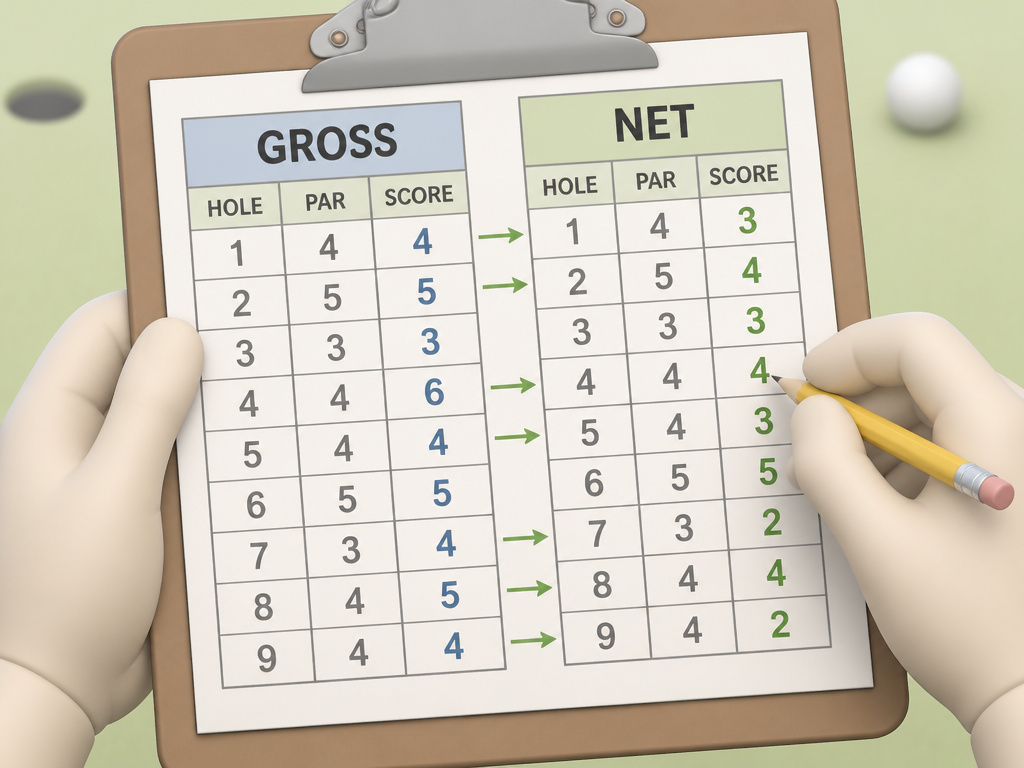
The format isn’t a choice. The committee decides it.
Use Gross Scoring When:
- The event is labeled a scratch competition or “Championship Flight.”
- You’re playing in a club championship for the overall title (though there are often net flights too).
- You’re establishing a personal milestone or record. Your first time breaking 80 is a gross score achievement.
- You are submitting a score to GHIN. You always post your Adjusted Gross Score.
Use Net Scoring When:
- The event is labeled “Net,” “Handicap,” or “All Flights.”
- You’re in a typical weekend club game or member-guest.
- The field includes players with a wide range of handicaps. This covers about 90% of amateur tournaments.
The choice dictates strategy. In a net event, a high-handicapper might play conservatively on holes where they don’t get a stroke and aggressively on holes where they do. A low-handicapper knows they have no strokes to give, so every hole demands precision.
The Tools That Change the Game
Your score is one thing. What you use to achieve it is another. The right equipment can shave strokes by improving consistency.
For most high-handicappers working on breaking 100, a durable 2-piece ball like a Titleist TruFeel or Callaway Warbird is the smart play. It’s forgiving, reduces spin on slices, and is affordable when you lose a few. Moving to a 3-piece ball like a TaylorMade Tour Response or Titleist Tour Soft makes sense as your swing speed and control improve, offering more spin around the greens without the premium price of a Pro V1.
And you need something to carry those clubs. A 14-way bag with full-length dividers, like models from Sun Mountain or Titleist, keeps your grips from tangling and speeds up your play. If you prefer walking, a 3-wheel push cart from Clicgear or Bag Boy is more maneuverable, while a 4-wheel push cart from Rovic or Stewart Golf offers superior stability on hills.
The Most Common Scoring Mistakes (And How to Avoid Them)

Even experienced golfers slip up. Here are the errors that get scorecards disqualified.
- Using Handicap Index Instead of Course Handicap. This is number one. Always check the conversion chart on the scorecard or in your app.
- Misapplying Strokes in Match Play. Giving strokes on the wrong holes changes the outcome. Always confirm the Stroke Index allocation before the first tee.
- Forgetting the Net Double Bogey Maximum for Posting. When you enter your score into GHIN, you cannot post more than a net double bogey on any hole. If you’re a 10-handicap, your maximum on the #1 handicap hole is a gross 8 (double bogey + 1 stroke). This handicap score adjustment protects your index from outlier holes.
- Not Posting All Acceptable Scores. You must post every round where you play by the Rules of Golf, even solo rounds. Selective posting manipulates your handicap and is a violation of the system.
Where this goes sideways: A foursome agrees to “gimmes” inside the leather all day. Those putts still count as strokes for your gross score. Not holing out means you cannot post that round for handicap, which skews your index over time.
Frequently Asked Questions
Does net score affect my handicap?
No. Your handicap is calculated solely from your Adjusted Gross Scores. Net scores are only for competition results. Think of it this way: your handicap produces your Course Handicap, which you then use to calculate your net score for an event.
Can you have a negative net score?
Theoretically, yes. If a scratch player (Course Handicap 0) makes a hole-in-one on a par 3, their gross score is 1. Net score is 1 – 0 = 1. A negative net score would require a gross score below zero, which is impossible. People sometimes say “net birdie” meaning they got a stroke on a hole and made a gross bogey for a net par.
Why did my net score not match the tournament results?
Double-check two things. First, confirm the tournament used your Course Handicap from the correct tee set. Second, in team events (like best ball), there are specific handicap allowance procedures, you often don’t use 100% of your handicap. The official handicap system documentation outlines these allowances.
Is a net score better than a gross score?
They measure different things. A net score tells you who performed best relative to their own ability on that day. A gross score tells you who hit the fewest absolute strokes. One isn’t “better”; they answer different questions.
How do I know if a tournament is gross or net?
It will be clearly stated on the entry form, tournament poster, or website. If it says “Championship Flight” or “Scratch,” it’s gross. If it says “Handicap,” “Net,” or has multiple flights (e.g., Flight 1: 0-9, Flight 2: 10-18), it’s net.
The Bottom Line
Gross score is your truth. Net score is the tournament’s fairness algorithm. Memorize this sequence: play by the rules to get an honest gross score, post it to GHIN to get a legitimate Handicap Index, convert that to a Course Handicap for the tees you’re playing, then subtract that number to find your net score.
The player who understands this sequence stops arguing about the 92 that beat the 78. They start planning which holes to attack with their stroke advantage. That’s how you move from just keeping score to actually winning.
