
Your Pre-Round Golf Warm Up Routine for Better Performance
This post contains affiliate links. As an Amazon Associate, we earn from qualifying purchases.
This post contains affiliate links. As an Amazon Associate, we earn from qualifying purchases.
A proper golf warm up routine before a round requires a minimum of 7–10 minutes of dynamic movement, not static stretching. Research shows dynamic warm-ups increase clubhead speed and accuracy, while static stretching can reduce power output by up to 28% immediately after. The goal is to raise your core temperature, activate golf-specific muscles, and prime your nervous system for explosive rotation.
That 7–10 minute floor is the essential threshold where physiological changes, increased blood flow, improved nerve signal speed, and enhanced joint lubrication begin to support the violent, multi-plane torque of a golf swing. Skip it, and your first-tee drive isn’t just a guess; it’s an injury risk waiting for one off-center strike.
What follows is the breakdown of why most range-time rituals fail, the three-phase structure proven in peer-reviewed studies, and the exact movements that translate to more yards and fewer penalties from the first tee. You’ll also get a bare-bones, five-minute version for when you’re running genuinely late.
Key Takeaways
- Static stretching before play reduces power and should be saved for post-round cool-downs. Dynamic movement is mandatory.
- An effective routine needs at least 7–10 minutes to raise core temperature and activate the neuromuscular system for rotational power.
- The sequence matters: start with light cardio, move to dynamic mobility, finish with swing-specific drills.
- Mental priming is part of the warm-up. Use the physical routine to transition your focus from the drive to the first fairway.
- Consistency beats duration. A focused 5-minute routine done every round is far better than a 20-minute session once a month.
Why Your Current “Warm-Up” is Probably Costing You Strokes
You show up 20 minutes early, hit a small bucket, roll a few putts, and walk to the first tee. That’s not a warm-up. That’s practice with a deadline, and it’s why your first three holes feel like a guessing game.
Common mistake: Using static stretching as a pre-round routine. A 2000 study by Fowles et al. Showed maximal voluntary contraction can drop by 28% immediately after static stretches, with a 9% deficit lingering an hour later.
The golf swing is a sprint, not a marathon. It’s a sub-two-second explosion that channels ground force through a kinetic chain ending at the clubhead. Your body needs to be prepped for that specific demand. Hitting balls cold is just reinforcing bad patterns under load. The stiffness you feel isn’t just age; it’s a system that’s literally not switched on.
Research is unambiguous on this point. A peer-reviewed warm-up program analysis found that a dynamic warm-up combined with light resistance work significantly improved smash factor, the ratio of ball speed to club speed, and consistent center-face contact compared to just hitting balls. Your body can’t find the center if it’s not awake.
The 3-Part Structure of an Effective Warm-Up
Think of your pre-round ritual in phases: wake up the system, teach it the movements, then ignite it for performance. The RAMP method (Raise, Activate, Mobilize, Potentiate) is a perfect framework for this.
Phase 1: Raise (3–4 minutes). This is pure physiology. Your goal is to increase heart rate, blood flow, and core temperature. A light jog around the practice green, brisk walking, or jumping jacks works. You’re not trying to break a sweat, just to signal to your body that intense activity is coming. This phase directly supports overall golf fitness by preparing your cardiovascular system for the walk ahead.
Phase 2: Activate & Mobilize (3–4 minutes). Now you move from general to specific. This phase uses dynamic stretches to take your joints through their full, golf-relevant ranges of motion. The focus is on the torso, hips, and shoulders, the engines of the swing. Movements here are controlled and continuous, not held. This is where you directly combat the stiffness that leads to lower back pain.
Phase 3: Potentiate (2–3 minutes). This is the performance ignition. Using very light resistance bands or even just your bodyweight, you perform exercises that “wake up” the high-threshold motor units needed for speed. Think of it as telling your glutes and core, “You’re in charge now.” Then, transition to slow, deliberate practice swings, focusing on the feeling of the full, connected motion.
| Phase | Goal | Time | Example Movements | Risk If Skipped |
|---|---|---|---|---|
| Raise | Increase heart rate & core temperature | 3–4 min | Brisk walk, leg swings, arm circles | Muscles remain stiff, prone to early-round strains. |
| Activate & Mobilize | Dynamic mobility for swing-specific joints | 3–4 min | Torso twists, walking lunges with rotation, hip circles | Restricted turn, loss of distance, compensatory injuries. |
| Potentiate | Prime nervous system for power & transition to swing | 2–3 min | Banded lateral walks, slow-motion swing drills | First-tee swing feels “wooden” and disconnected; loss of clubhead speed. |
Dynamic vs. Static: What the Research Actually Says
The debate is over, and static stretching lost. Holding a stretch for 20–30 seconds before you play is actively harmful to immediate performance.
A clear example comes from a PLOS ONE driving performance study on amateur golfers. It compared different protocols and reinforced that dynamic activity is key. Meanwhile, an NIH rotation-specific warm-up paper specifically designed a 10-minute dynamic routine to improve X-Factor, the differential rotation between the shoulders and hips, in amateur golfers.
The mechanism is simple. Static stretching elongates muscle fibers and tendons, reducing their stiffness and spring-like ability to store and release elastic energy rapidly. For a movement that requires snap, you’ve just taken the snap out. Dynamic stretching, in contrast, maintains that stiffness while increasing the functional range of motion you’ll actually use.
Save static stretching for your post-round cool-down. That’s when lengthening tight muscles aids recovery and can be part of a long-term strategy for injury prevention.
A Sample 5-Minute Emergency Warm-Up
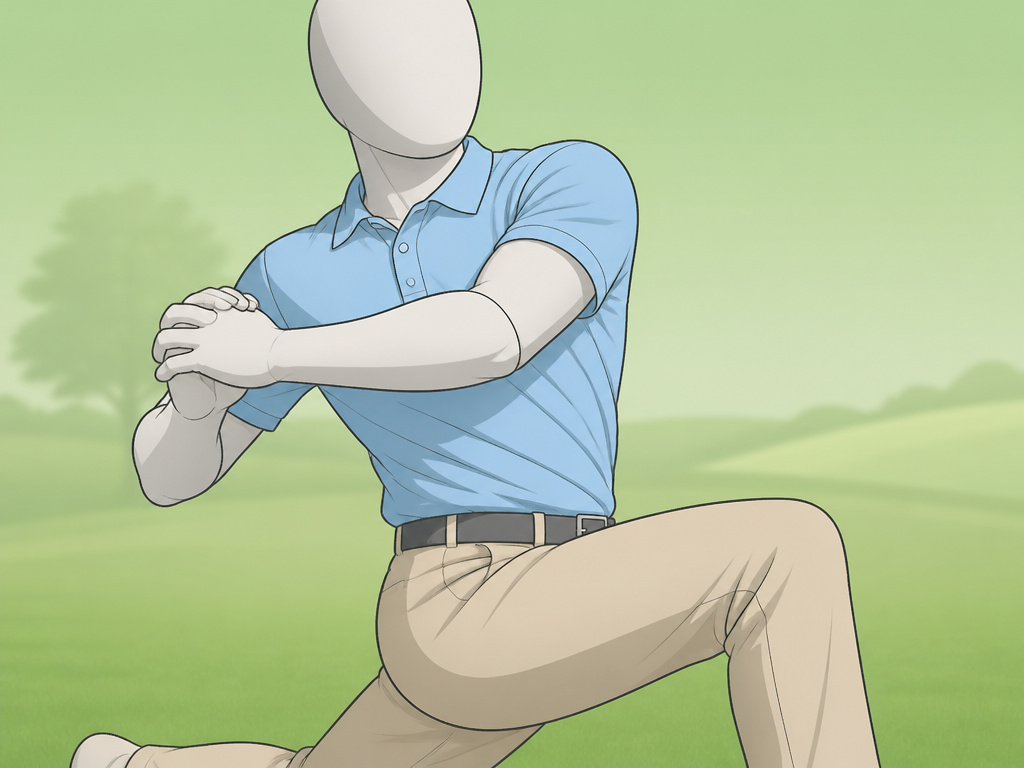 We’ve all been there: traffic was a nightmare, and your tee time is in six minutes. This is not the time to skip everything. An abbreviated, hyper-focused routine is drastically better than nothing.
Here’s the crash course. Do each movement for 30-45 seconds, moving with purpose.
- Power Walk (1 minute): From the car to the pro shop to the first tee, walk with intent. Pump your arms. Get your heart rate up.
- Torso Twists (1 minute): Hold a club across your shoulders. Gently rotate your upper body back and forth, letting your hips follow. Don’t force it; find your current end range.
- Walking Lunges (1 minute): As you walk toward the tee box, drop into a lunge every few steps. Add a slight torso rotation over your front leg to integrate the pattern.
- Practice Swings (2 minutes): Take three slow, half-swings focusing on balance. Then take three full, smooth swings at 50% effort. Your final swing should feel athletic, not stiff.
Where this goes sideways: Rushing through these motions without focus. The goal is neurological connection, not just checking a box. Five minutes of deliberate movement can reset your system; five minutes of frantic flailing will leave it confused.
This sequence raises temperature, touches on key mobility, and provides a swing rehearsal. It won’t unlock your full potential, but it will get you to the first tee without feeling like you’re swinging a sledgehammer.
Integrating Mental Preparation
 Your warm-up serves as your bridge from the stress of the drive to the focus of the fairway. The rhythmic, repetitive nature of a good dynamic routine creates a meditative state that quiets external noise.
Use the time during your activation phase to set an intention. It’s not “I need to shoot 75.” It’s a process goal: “Smooth tempo,” or “Commit to my target.” This mental shift is a core component of a robust pre-shot routine, which you’re essentially rehearsing before the first shot even matters.
As you move into the potentiation phase and start your practice swings, engage in pre-shot visualization. See the ball flight you want on the first hole. This primes the same neural pathways you’ll use when it counts. By the time you step onto the tee, you’ve already rehearsed the shot physically and mentally, which is a powerful tool for handling pressure.
Special Considerations: Senior Golfers & Cold Weather
The principles don’t change, but the application might. For senior golfer exercises, the “Raise” phase is non-negotiable but may take longer. A 5-6 minute brisk walk may be needed to safely elevate core temperature. Emphasize mobility in the thoracic spine and hips, areas that stiffen with age and directly limit the backswing turn.
In cold weather, everything expands. Your “Raise” phase might need to be 5 minutes of continuous movement indoors before you even step outside. Layer your clothing, do your warm-up, then remove the top layer just before you play to avoid overheating and then chilling. Cold muscles are brittle muscles; rushing is the fastest path to a strain.
Frequently Asked Questions
How long before my tee time should I start my warm-up?
Finish your full physical warm-up about 5-10 minutes before you need to be on the first tee. This gives you time to hit a few balls (if desired), putt, and make the mental transition without feeling rushed. The entire process, from first dynamic stretch to first tee shot, should take 20-25 minutes.
Should I hit balls before I play?
Hitting balls is optional, but if you do, it should come after your dynamic warm-up. Use the bucket not to find a swing but to confirm a feeling. Start with a short wedge, focus on rhythm and contact, and work up to the driver. Hit no more than 15-20 balls. The goal is rehearsal, not repair.
What if I’m sore from a previous workout?
Sore body needs a warm-up even more. Focus extra time on the “Raise” phase to increase blood flow to the sore areas. During the “Mobilize” phase, move gently into the ranges of motion that feel tight. The warm-up can act as active recovery. Avoid static stretching the sore muscles, as it can increase micro-tear damage.
Can a good warm-up really prevent injury?
Yes, directly. A proper warm-up increases muscle elasticity, improves joint lubrication, and enhances neuromuscular coordination. This means your body can handle the violent forces of an off-center hit or an awkward lie more effectively. It’s your best defense against common overuse and acute golf injuries.
What should I eat or drink as part of my warm-up?
This ties into golf nutrition. Hydration begins the day before. Drink 16-20 ounces of water in the hour before you leave for the course. A small, easily digestible snack (like a banana or a granola bar) 30-60 minutes before your warm-up can stabilize blood sugar without causing mid-round energy crashes.
The Bottom Line
A golf warm up routine before a round is fundamentally about achieving readiness. The science is clear: invest 7–10 minutes in dynamic movement, follow the Raise-Activate-Potentiate sequence, and banish static stretches until after the 18th hole.
This does more than add a few yards. It builds a reliable foundation for your swing from the first shot, manages the emotional jump from car to course, and protects the body that has to carry you for four hours. Your scorecard starts before you tee off. Make those first ten minutes count.
