
Unlock Power with Proper Ground Forces and Body Sequencing
This post contains affiliate links. As an Amazon Associate, we earn from qualifying purchases.
This post contains affiliate links. As an Amazon Associate, we earn from qualifying purchases.
Generating power in the golf swing involves a specific, timed transfer of energy from the ground, up through your body, and into the club in a proximal-to-distal sequence: hips, torso, arms, club. Get this sequence wrong, and you bleed energy into vibrations and off-center strikes, even with high club speed.Get it right, and you turn 145 km/h of club speed into 173 meters of carry instead of 145.**
That gap, nearly 30 meters from identical raw speed, is the entire point. It comes from clean energy transfer, measured by smash factor. The recreational player swinging out of their shoes at 145 km/h might post a 1.27 smash factor. The elite golfer, moving with efficient sequence, posts 1.36. That difference is where the extra distance lives, and it’s created by how you use the ground, not by how fast you move your arms.
What follows is a breakdown of the kinetic chain: why pushing into the earth matters more than lifting up, the exact order your body segments must fire and brake, and a single drill to reprogram the feeling. This is the biomechanical difference between effort and result.
Key Takeaways
- Power is transferred, not created, by the swing. It starts with pushing into the ground to create a ground reaction force that travels up your body. The kinematic sequence is essential: pelvis accelerates and brakes, then torso, then arms, then club. The secret is the deceleration of one segment to whip the next.
- Identical club head speed can produce a 30-meter carry difference based solely on strike efficiency (smash factor), which is dictated by sequence.
- Your weight shift is the engine’s first move. It must be a lateral push into the trail side in the backswing, then a driving push off it in the downswing.
- Lag is a result of correct sequence, not a forced wrist hinge. If the hips and torso fire early, the wrists will unhinge late as a physical consequence.
The Physics of Pushing, Not Lifting
Forget lifting the club. Think about launching it.
The swing is a kinetic chain, and every chain needs an anchor. Your anchor is the ground. When you push down against it with your feet, it pushes back with an equal and opposite force, a ground reaction force. This is the fundamental fuel for rotational speed.
A proper weight shift isn’t a lean. It’s a deliberate, athletic push into your trail-side leg during the backswing, loading that leg like a spring. The downswing starts by driving off that leg, channeling the stored force up through your hips.
The common mistake is to think “turn” without “push.” You spin your shoulders but your weight stays centered or even moves toward the target too early. The result is a weak, armsy swing with no power. The feel you want is of screwing your trail foot into the turf on the backswing, then explosively unscrewing it to start down.
The Kinematic Sequence: Your Body’s Relay Race
If ground force is the fuel, the kinematic sequence is the delivery system. This is the proximal-to-distal (center-to-extremity) order of movement. For a right-handed golfer, it’s pelvis, then torso (thorax), then lead arm, then club.
The magic lies in the deceleration.
Imagine a relay race. The first runner (your pelvis) sprints, reaches top speed, and then slows down to hand the baton to the next runner (your torso). If the first runner doesn’t slow, the handoff is messy and speed is lost. In the swing, each segment must accelerate to its peak, then brake violently to transfer its momentum to the next link.
| Body Segment | Primary Role | Peak Speed Timing | Consequence of Early/Late Fire |
|---|---|---|---|
| Pelvis/Hips | Initiates downswing, creates rotational torque | Early downswing | Early: Casts the club, loss of lag. Late: Blocks rotation, forces arms to overpower. |
| Torso/Thorax | Amplifies rotational speed, stabilizes spine angle | Mid-downswing | Early: “Spinning out,” no space for arms, pushes/slices. Late: Arms outrun body, pull/hook. |
| Lead Arm | Transfers rotational energy into linear clubhead path | Just before impact | Early: “Over-the-top” move, steep downswing. Late: “Stuck” behind body, requires flipping. |
| Club | Strikes the ball | At impact | N/A—this is the result of the sequence. |
This sequence creates the X-Factor, the coil between your shoulder turn and hip turn in the backswing, and the even more critical X-Factor Stretch in transition, where the hips begin to rotate back toward the target while the shoulders are still turning away. That stretch is the rubber band loading.
Where this goes sideways: Trying to swing with your arms first. Your arms are the last passengers on the train, not the engine. When they fire early, they break the chain and you lose all the power stored in your core and ground connection.
What’s the Difference Between Club Speed and Ball Speed?
Here’s the reality check that changes everything. You can have high club speed and mediocre ball speed.
Research comparing elite and recreational golfers found both groups swinging at roughly 145 km/h (90 mph). The elite players carried the ball about 173 meters (190 yards). The recreational group? About 145 meters (160 yards). A 30-meter gap from the same raw input.
The difference is smash factor (ball speed ÷ club speed). The elite group averaged 1.36. The recreational group averaged 1.27. That lower number means energy was lost, to clubhead twisting, vibration, and side spin from an off-center strike.
Smash factor is the report card for your kinematic sequence. A clean, on-center strike is the biomechanical end product of a correctly sequenced swing. You can’t will a high smash factor. You build it through sequence.
So where does the lost energy go? You feel it. It’s the harsh vibration stinging your hands on a toe shot. It’s the club twisting in your grip. That’s kinetic energy that never made it to the ball.
A Simple Drill to Feel the Sequence
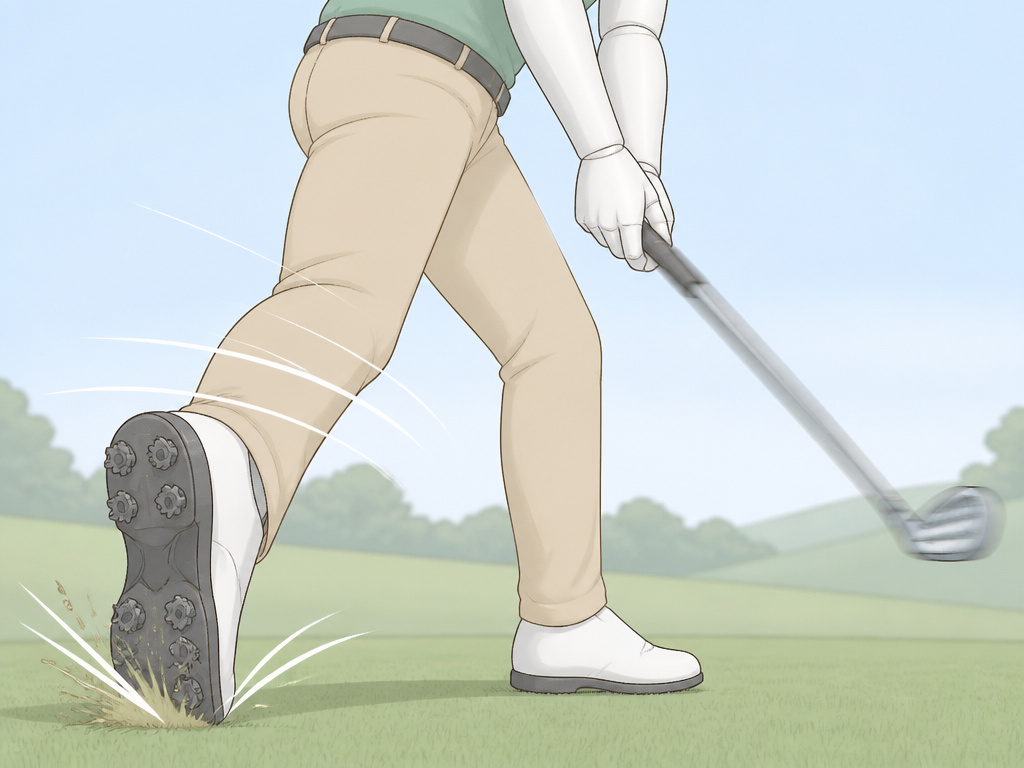 Theory is fine. Feeling is belief. This one-drill progression bypasses your brain and talks directly to your nervous system.
The Step-Through Drill:
- Take your 7-iron and set up normally, but with about 60% of your weight on your lead foot.
- Make a slow backswing. As you start down, push off your trail foot so forcefully that you finish with all your weight on your lead foot and your trail foot stepping through toward the target.
- Hit the ball with this motion. Don’t think about your arms. Think only about pushing off the ground with your trail foot to move your entire body toward the target.
Why it works: It makes the weight shift and ground-driven initiation unavoidable. It physically prevents your arms from racing ahead because your body is moving forward first. This drill ingrains the feeling that the swing is a rotational motion powered from the ground up, not a hand-and-arm action. Start with half-swings to get the pattern, then build to full.
I learned the importance of simple, repeatable movements like this through trial and error. Early on, I’d give players complex multi-step feels. They’d forget them by the next hole. A single, athletic motion like the step-through sticks. It’s a straightforward drill players can actually stick with, and it directly trains the kinematic sequence without a technical lecture.
How Hip Rotation Dictates Wrist Lag
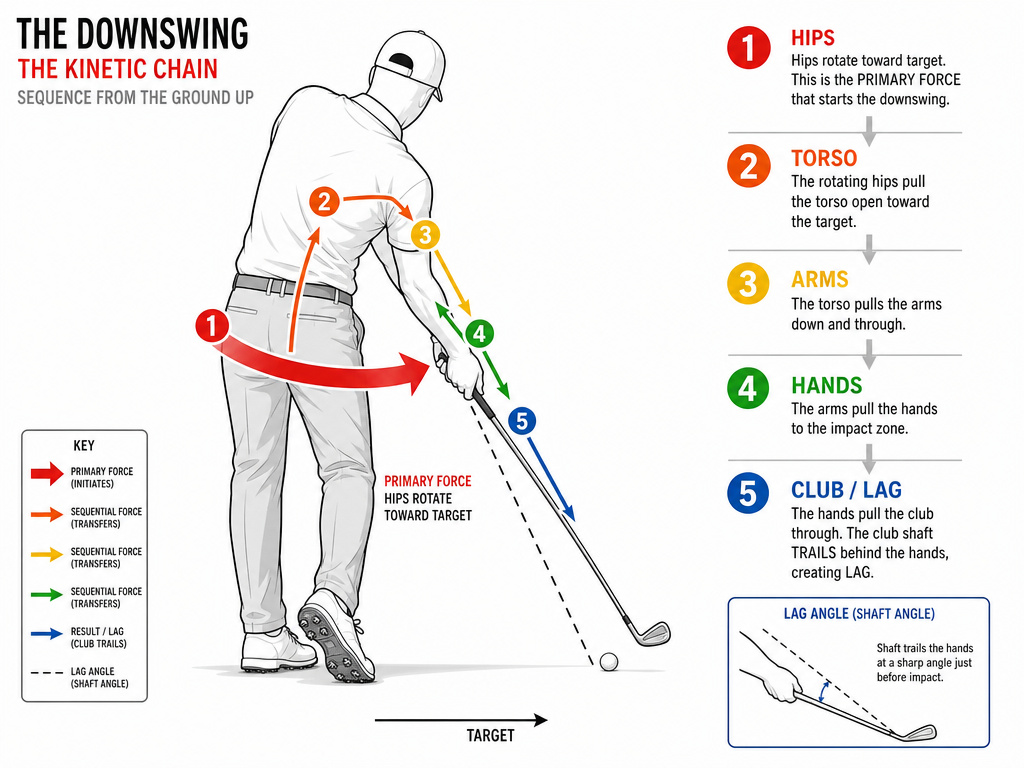 Lag, the angle between the lead arm and the club shaft in the downswing, is a symptom, not a cause. You don’t create lag by holding your wrists. You create it by starting the downswing with your lower body while your upper body and arms are still completing the backswing.
This is the X-Factor Stretch in action. As your hips rotate toward the target, they pull your torso, which pulls your arms, which pulls the club. Because the club is the last and lightest link, it lags behind, creating that angle. If your hips stall or your arms fire first, the lag disappears instantly.
Common mistake: Actively trying to “hold the lag” with your wrists. This tenses your forearms, kills clubhead speed, and usually delivers the clubface open. Let the physics of the sequence create the lag for you.
Your hip rotation is the governor. Fast, early hip rotation = more lag potential. Slow, late hip rotation = the arms take over and the angle collapses. Focus on a dynamic, athletic shoulder turn against a resisting lower body in the backswing, then unleash the hips to start down. The wrists will take care of themselves.
The Role of Your Setup in Ground Force
You can’t push effectively if you’re not balanced to push. Your weight distribution at address sets the stage for every ground force you’ll generate.
For a standard iron shot, aim for a 50/50 balance between your feet, with the weight felt in the balls of your feet, not the heels or toes. This is an athletic ready position, like a shortstop waiting for a ground ball. From here, you can push into the trail side on the backswing and drive off it on the downswing.
If your weight is too much in your heels, you’ll tend to “sit” and lose the ability to push forward. If it’s in your toes, you’ll be unstable and likely to early extend (stand up) through impact. A neutral, athletic posture is a non-negotiable foundation for the ground reaction forces you’re trying to create.
Frequently Asked Questions
Can you increase ground forces just by getting stronger?
Not directly. Strength helps, but it’s about rate of force development, how quickly you can push into the ground. A powerful, fast push is better than a slow, strong push. Plyometrics and explosive lower-body exercises are more beneficial than pure strength training for this.
I shift my weight but still don’t hit it far. What’s wrong?
You’re probably shifting, but not pushing. A lateral slide isn’t enough. You must push down and away into the ground with your trail foot to create the force. Think “drive your trail knee toward the target” in the downswing, which is a result of pushing off the ground.
How do I know if my sequence is off?
Film your swing face-on. Draw a line down from your lead shoulder at the top of the backswing. In the first move down, your lead hip should move toward the target before that shoulder line moves. If the shoulder moves first, your sequence is arms-led.
Does this apply to driver and irons the same way?
The principle is identical, but the expression changes. With driver, the weight shift may feel more dramatic because you’re hitting up on the ball. With irons, it’s more about a downward strike, but the ground force and sequence that deliver the club are the same.
What’s more important, sequence or swing speed?
Sequence, every time. A well-sequenced 90 mph swing will out-drive a poorly sequenced 100 mph swing because of strike quality. Swing tempo, the rhythm of your sequence, is the governor of both consistency and efficient speed.
Before You Go
Stop trying to add speed. Start trying to transfer it.
The goal is to move your body in the right order, using the ground as your launchpad. The next time you’re on the range, spend ten minutes on the step-through drill.Don’t worry about where the ball goes. Focus on the single sensation of pushing off your trail foot to move your whole body toward the target.
That feeling, of your body leading and the club following, is the cornerstone of power. It turns effort into distance. It’s the difference between swinging hard and hitting it far. Everything else is a detail.
