
Explained: Lag in the Golf Swing and the Physics Behind It
This post contains affiliate links. As an Amazon Associate, we earn from qualifying purchases.
This post contains affiliate links. As an Amazon Associate, we earn from qualifying purchases.
Lag in the golf swing is the retained angle between the lead arm and the club shaft during the early downswing. It is not a move you create with your wrists, but a physical consequence of a correct, sequential body turn that transfers energy from the ground up. Trying to artificially “hold” lag creates tension, disrupts timing, and is a primary cause of casting and poor contact.
That retained angle is a symptom of efficient energy transfer, not its source. The real work happens in the hips, torso, and shoulders long before your wrists do anything. When you understand lag as an outcome, you stop trying to manufacture it and start building the swing that produces it automatically.
What follows is a breakdown of the biomechanics, the three biggest myths that ruin iron play, and the one drill that gives you instant, physical feedback on whether your sequence is working.
Key Takeaways
- Lag is a byproduct of sequencing, not an independent technique. It appears when your lower body leads the downswing.
- The kinematic sequence, the order of peak speeds from pelvis to thorax to arm to club, is the engine. Amateurs often have the arm peaking before the thorax, which kills lag.
- “Holding the angle” is the most destructive myth. It creates tension and forces a last-second flip, leading to blocks and chunks.
- Functional lag delivers forward shaft lean at impact. Forced lag often produces the look of lean with poor contact and inconsistent ball flight.
- A yoga wedge drill provides immediate physical feedback to stop early release without conscious manipulation.
The Kinematic Sequence: The Real Source of Lag
Forget your wrists for a moment. The story of lag begins with the order in which your body segments reach their top speed. This is the kinematic sequence.
In a 2007 study comparing amateur and professional golfers, researchers found the professional’s peak segmental speeds occurred in a strict order: pelvis first, then thorax (upper torso), then the lead arm, and finally the club. In amateurs, the sequence often broke down, with the arm peaking before the thorax, a sure sign of casting.
This proximal-to-distal (from the center outward) timing is the non-negotiable foundation. Your pelvis rotates open, pulling your torso. Your torso rotates, pulling your arms. Your arms eventually pull the club. When this chain is intact, the club lags behind the body simply because it’s the last link. It has no choice.
If you start the downswing by pulling the club down with your arms, you break the chain. The club races ahead, the angle between your arm and shaft collapses early, and you’ve cast it. All the potential energy stored in your coil gets wasted.
The lag you see in tour players is the visible gap between their turning body and the clubhead that hasn’t caught up yet. It’s not something they think about. It’s something that happens to them because their sequence is correct.
The Three Myths That Ruin Your Strike
Most advice on creating lag is well-intentioned but mechanically backwards. Chasing these myths makes your swing worse, not better.
Myth 1: You Create Lag by Holding Your Wrist Angle
This is the most pervasive and damaging instruction. The idea is to consciously maintain the wrist hinge you established in the backswing for as long as possible into the downswing.
What goes wrong: Your hands and forearms tense up. This tension locks your wrists, preventing them from releasing at the right time. To square the clubface, you must make a last-second, flipping motion with your hands. The result is inconsistent contact, fat shots, thin shots, and blocks to the right. You might achieve the look of lag halfway down, but you’ve destroyed your chance to deliver the club properly.
Common mistake: Trying to “hold” the wrist hinge. This adds tension, stalls the body turn, and forces a flip at the bottom. You’ll hit two fat shots in a row, then one that rockets over the green.
Myth 2: More Lag Always Equals More Power
It’s easy to look at a freeze-frame of Dustin Johnson with extreme shaft lean and equate that with power. But lag is a measure of efficiency, not effort.
The physics check: Power comes from the speed of the clubhead at impact. That speed is generated by the sequential summation of forces from the ground up, not by how long you delay the release. A study in the Journal of Sports Sciences found that while factors like pelvic separation were related to ball velocity, a forced, delayed release often led to poorer kinematics. An efficient sequence with functional lag produces optimal speed. Maximum, strained lag often produces less.
Myth 3: Lag is a Wrist Action
This myth reduces a full-body phenomenon to a hand move. Sergio Garcia once described feeling like he was “pulling a chain” to create lag, but analysis shows his lag stems from a powerful lower-body initiation that lets his arms drop passively.
The reality: Your wrists are a hinge, not an engine. Their job is to transfer the energy created by your core, not to generate it. The 2004 work and power analysis of the golf swing published in the Journal of Sports Science and Medicine is clear: over 70% of the work in the swing comes from the hips and spine. The wrists contribute power, but their primary role is structural, they become a nearly “free hinge” just before impact as the club’s momentum takes over.
Thinking “lag = wrists” leads to a handsy, over-the-top motion. You might hit the occasional pure shot, but you’ll never own a repeatable strike.
The Physical Feel: What Proper Lag Actually Does
When lag is a product of good sequence, it creates specific, reliable sensations and outcomes.
First, you feel your weight move into your lead side early in the downswing. This is non-negotiable. A reverse pivot or a lateral sway steals the ground force you need to start the kinetic chain.
Second, you feel your arms being pulled down by your turning torso, not pulling the club. There’s a sensation of width and your hands staying back as your hips fire. This is the opposite of casting.
Third, at impact, you feel the clubhead release through the ball, not slap at it. The forward shaft lean happens because your body is ahead, not because your hands are shoved forward. This delivers a compressed, penetrating ball flight with predictable distance.
| Sensation | From Good Lag (Byproduct) | From Forced Lag (Manipulation) |
|---|---|---|
| Downswing Start | Hips lead, arms feel heavy and passive | Shoulders or hands yank the club down |
| Impact Feel | Solid, compressed, club releases through | Thin, glancing, or heavy; hands flip |
| Common Miss | A slight push or draw | Fat, thin, or big block to the right |
| Body Aftermath | Balanced, facing target | Falling back or off-balance |
A Simple Drill to Feel Lag (Without Thinking About It)
You need a feedback mechanism that bypasses conscious manipulation. The yoga wedge drill, advocated by top coaches, provides a physical obstacle that teaches your body the correct sequence.
How it works: Place a yoga block or a headcover about 6-8 inches behind the ball, on the target line. Your goal is to make a swing and miss the block entirely.
The Why-Layer: If you start the downswing with your arms or if your wrist angle collapses early, the club will drop to the inside and strike the block. To miss it, you must initiate with your lower body and maintain the radius of your swing until the club is pulled into the hitting area. The block gives you immediate, tactile feedback, a clunk, for an early release.
Worth knowing before you start: Don’t try to “hold” the angle to miss the block. That brings back tension. Focus solely on starting your downswing by shifting your weight and turning your hips. Let the club follow. The correct sequence will automatically preserve the radius long enough to clear the obstacle.
This drill moves lag from an abstract visual to a concrete physical task. You’re not “creating lag”; you’re “missing the block.” The lag is the result.
How Your Equipment Interacts with Lag
Your swing mechanics are primary, but your gear can either support or fight a proper sequence.
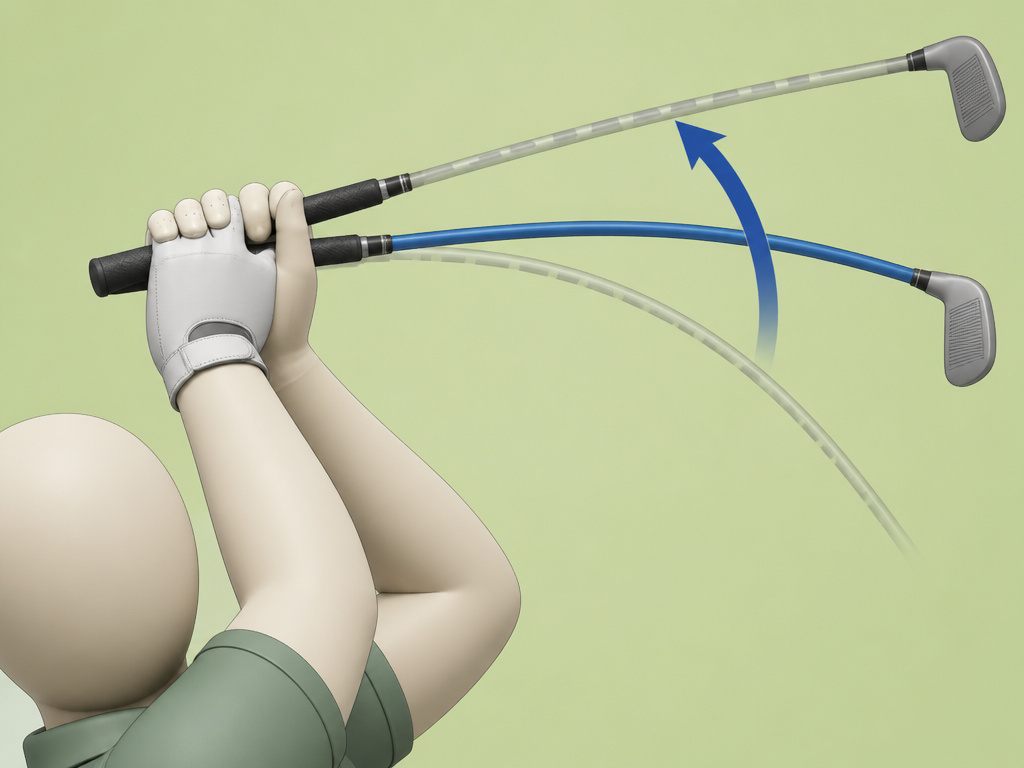
Shaft Flexibility: A shaft that is too stiff for your swing speed can feel unresponsive, prompting you to over-swing or manipulate the club with your hands to load it. A shaft that is too soft can kick too early, encouraging a casting motion to time the release. The right shaft flex supports a smooth transition and a timed release.
Swing Weight and Balance: A club that is too heavy in the head can be difficult to sequence properly, dragging your arms down and forcing an early release. A club that’s too light can lead to an overly quick, arm-dominated swing. Most players benefit from a standard swing weight (D0-D2) that provides enough head feel to sense the club’s position without being burdensome.
Lie Angle: An incorrect lie angle (too upright or too flat) causes the toe or heel to strike the ground first at impact. This can feel like a “catch” and subconsciously make you adjust your wrist angle or release pattern to square the face, disrupting your natural lag. A proper lie angle lets the sole interact cleanly with the turf through impact.
The goal is equipment that feels like an extension of your motion, not a separate object you have to manage. When in doubt, a standard set of game-improvement irons like the TaylorMade Stealth or the Callaway Paradym is engineered to be forgiving while still providing feedback.
Frequently Asked Questions
Does lag apply to the driver the same as irons?
The principle is identical, but the look is different. With a driver, you’re hitting up on the ball, so the ideal impact position has minimal forward shaft lean or even a slightly backward lean. However, the kinematic sequence that creates lag, pelvis, thorax, arm, club, is the same. The difference is the wrist release happens slightly later with a driver to promote the upward strike. If you try to “hold lag” with the driver, you’ll hit low, spinning smothers.
I have no lag. Is it a flexibility issue?
It can be, but it’s more often a technique issue. Limited thoracic (upper back) rotation can make it hard to create a full coil, reducing the potential energy for the downswing. However, many flexible golfers still cast because they don’t understand the sequence. Before blaming flexibility, video your swing. If your arm is moving faster than your torso in the downswing, that’s a casting fault, not a flexibility problem. Improving core mobility helps, but fixing the sequence is mandatory.
Can you have too much lag?
Yes, but it’s extremely rare among amateurs. What looks like “too much lag” is usually a severe manipulation, someone holding the wrist hinge so long that they have to violently flip the hands to make contact. This is unstable. True “excessive” lag in a professional context means the release is so late that it becomes difficult to square the face, potentially causing hooks. For the vast majority, the concern is having too little functional lag, not too much.
Does lag cause a draw or a fade?
Lag itself doesn’t dictate shot shape. Lag is about energy transfer and delivering the clubhead with speed and compression. Shot shape is controlled by the clubface orientation relative to the swing path at impact. A swing with good lag can produce a draw, fade, or straight shot depending on grip, alignment, and face control. However, a player who casts the club (no lag) often has an out-to-in path and an open face, resulting in a weak slice.
How do I know if I’m casting?
The easiest at-home check is the “foot spray” test. Spray the bottom of your clubface with foot powder or dry shampoo and hit a ball off a mat. If the strike mark is toward the toe, you are likely casting and coming over-the-top. If the mark is centered or toward the heel, your path is better. The other tell is ball flight: high, weak shots that lack penetration are classic casting outcomes. To fix it, you must address the root cause, which is almost always an incorrect downswing initiation.
The Bottom Line
Lag isn’t a magic move you add to your swing. It’s the receipt you get for buying the right sequence. Stop staring at your wrists in the mirror and start listening to your feet. When your weight shifts correctly and your body turns in order, the club will lag because physics demands it.
Chasing the look of lag leads to a fragile, timing-dependent swing. Building the sequence that creates it leads to powerful, repeatable strikes. Put the yoga block behind the ball. Make a swing focused only on starting from the ground. The clean miss, and the solid contact, will tell you everything you need to know.
