
How Golf Handicap is Calculated | The System Breakdown
This post contains affiliate links. As an Amazon Associate, we earn from qualifying purchases.
This post contains affiliate links. As an Amazon Associate, we earn from qualifying purchases.
A golf handicap is calculated by taking the average of your best 8 Score Differentials from your most recent 20 rounds. A Score Differential is your adjusted gross score, minus the Course Rating, times 113, divided by the Slope Rating, with a possible Playing Conditions Calculation (PCC) adjustment. This average is then capped to limit rapid increases and updated daily.
That formula is the engine. It converts your raw score into a portable number that represents your potential, not your average. The system’s entire design, the 8 of 20 average, the 113 baseline, the daily updates, exists to answer one question: what is this player capable of on a good day?
What follows: a walk through each variable in that formula, the two critical caps that stop your handicap from ballooning, and the final step that turns your Handicap Index into the strokes you actually get on the first tee.
Key Takeaways
- Your Handicap Index is the average of your best 8 Score Differentials from your last 20 rounds, with safeguards.
- A Score Differential uses the formula:
(113 / Slope Rating) x (Adjusted Gross Score - Course Rating - PCC). - The Playing Conditions Calculation (PCC) is an automatic, daily adjustment (-1 to +3) that accounts for abnormal weather or course difficulty.
- Soft and hard caps restrict how fast your handicap can rise, protecting the field from sandbagging.
- Your Course Handicap is what you look up on the tee sheet:
Handicap Index x (Slope Rating / 113) + (Course Rating - Par).
The Core Formula: Score Differential
Forget your final score for a minute. The system doesn’t see “92.” It sees a performance relative to the specific test you faced that day. That performance is the Score Differential.
Score Differential = (113 ÷ Slope Rating) x (Adjusted Gross Score – Course Rating – PCC adjustment)
Every term is a specific, rated number. Course Rating tells you the expected score for a scratch golfer. A 72.1 rating is a harder course than a 69.8. Slope Rating (with a standard value of 113) measures relative difficulty for a bogey golfer compared to a scratch golfer. Higher slope means the course gets disproportionately harder as your handicap goes up.
Your Adjusted Gross Score is your total, with one big rule: no single hole can count for more than net double bogey. Blow up, pick up, and move on. That hole is closed for handicap purposes.
The Playing Conditions Calculation (PCC) is the wildcard. It’s an automatic, daily adjustment ranging from -1.0 to +3.0. If at least eight acceptable scores are posted from players with a Handicap Index of 36.0 or below, the system checks if scores were abnormally high or low. A +2 PCC means the course played about two strokes harder than its rating that day, and that adjustment gets subtracted from everyone’s score before the differential is calculated. It’s why your handicap doesn’t punish you for playing in a 30-mph wind.
Common mistake: Comparing your raw score to par. Par is irrelevant to the handicap formula. Your score is measured against the Course Rating, not the par on the card. A 85 on a course with a 75.2 rating is a much better round than an 85 on a course rated 69.8.
Building Your Handicap Index: The 8 of 20 Rule
You don’t have a handicap until you post 54 holes of acceptable scores. Once you have 20 scores in your record, the calculation kicks in.
The system looks at your most recent 20 Score Differentials, finds the lowest 8, and averages them. That average is your Handicap Index. It’s not your average score. It’s the average of your best performances, which is why it’s called a measure of potential ability.
If you have fewer than 20 scores, the system uses a smaller number of your best differentials. The R&A Rules of Handicapping Rule 5 specifies the scale: with 3 scores, it uses the best 1; with 5, it uses the best 2, and so on until you reach the full 20-score record.
| Number of Acceptable Scores | Differential(s) Used in Calculation |
|---|---|
| 3 | Lowest 1 |
| 4 | Lowest 1 |
| 5-6 | Lowest 2 |
| 7-8 | Lowest 2 |
| 9-10 | Lowest 3 |
| 11-12 | Lowest 3 |
| 13-14 | Lowest 4 |
| 15-16 | Lowest 4 |
| 17 | Lowest 5 |
| 18 | Lowest 6 |
| 19 | Lowest 7 |
| 20 | Lowest 8 |
This is why new golfers see their handicap fluctuate wildly at first. With only a few scores, one great round can drop your index significantly. As your record fills to 20, it stabilizes.
The Safeguards: Caps and Exceptional Scores
An honest system needs protection against both vanity and fraud. The World Handicap System has two built-in brakes.
The soft cap activates when your calculated Handicap Index tries to rise more than 3.0 strokes above your Low Handicap Index (your best index in the last 12 months). Any increase above that 3.0-stroke threshold is reduced by 50%. It slows the climb.
The hard cap is the absolute ceiling. It prevents your index from ever rising more than 5.0 strokes above your Low Handicap Index. This is the final guard against sandbagging.
Then there’s the accelerator: the exceptional score reduction. Shoot a round that is 7.0 strokes or better than your current Handicap Index? The system automatically applies an additional reduction to your index, typically -1.0. It’s a immediate reward for a breakthrough round. Understanding these mechanics is a key part of learning the basic rules of the modern game.
Where this goes sideways: Assuming a high handicap is static. Those caps mean a 15-index player who stops practicing can’t drift up to a 25 in one season. The system pulls back on the reins.
From Portable Index to Tee Box Strokes
Your Handicap Index is a universal number. Your Course Handicap is the local translation. This is the number you write on your scorecard.
Course Handicap = Handicap Index x (Slope Rating ÷ 113) + (Course Rating – Par)
The first part (Handicap Index x (Slope Rating / 113)) adjusts your strokes for the course’s relative difficulty. The second part (Course Rating - Par) is a static adjustment that centers the competition around net par, not the Course Rating. On a course where the rating is higher than par, everyone gets a bonus stroke.
But you’re not done. For most competitions, you need your Playing Handicap.
| Format of Play | Typical Allowance | Purpose |
|---|---|---|
| Individual Stroke Play | 95% | Prevents high handicappers from having an overwhelming advantage. |
| Four-Ball Stroke Play | 85% | Further reduces the team advantage in a best-ball format. |
| Match Play | 100% | Full difference in Course Handicap is used. |
| Foursomes (Alternate) | 50% | Takes the combined handicap of the team and applies half. |
Your Playing Handicap is your Course Handicap multiplied by the allowance, rounded. If your Course Handicap is 18 and the allowance is 85%, your Playing Handicap is 15 (18 x 0.85 = 15.3, rounded). This final step is what creates equity across different formats, a concept just as important as understanding fundamental golf scoring terms.
The Daily Machine: Updates, PCC, and Deadlines

This isn’t a monthly statement. The USGA Handicap Index calculation guide states your index updates no later than the day after you post a score. Play on Saturday, see a new number on Sunday.
That daily update relies on you hitting the submit button. The official rule is clear: you must post your acceptable score before midnight on the day of play. Miss that deadline and the score won’t be included in that day’s PCC calculation, and your index won’t update for your next round. It’s a strict policy because the integrity of the daily PCC depends on a complete dataset.
The part nobody mentions: The PCC is blind to your personal struggle. It only looks at the collective performance of the field that day. If you alone had a nightmare round but the course was playing easy, you get no sympathy from the formula.
Handicap Index vs. Your Average Score
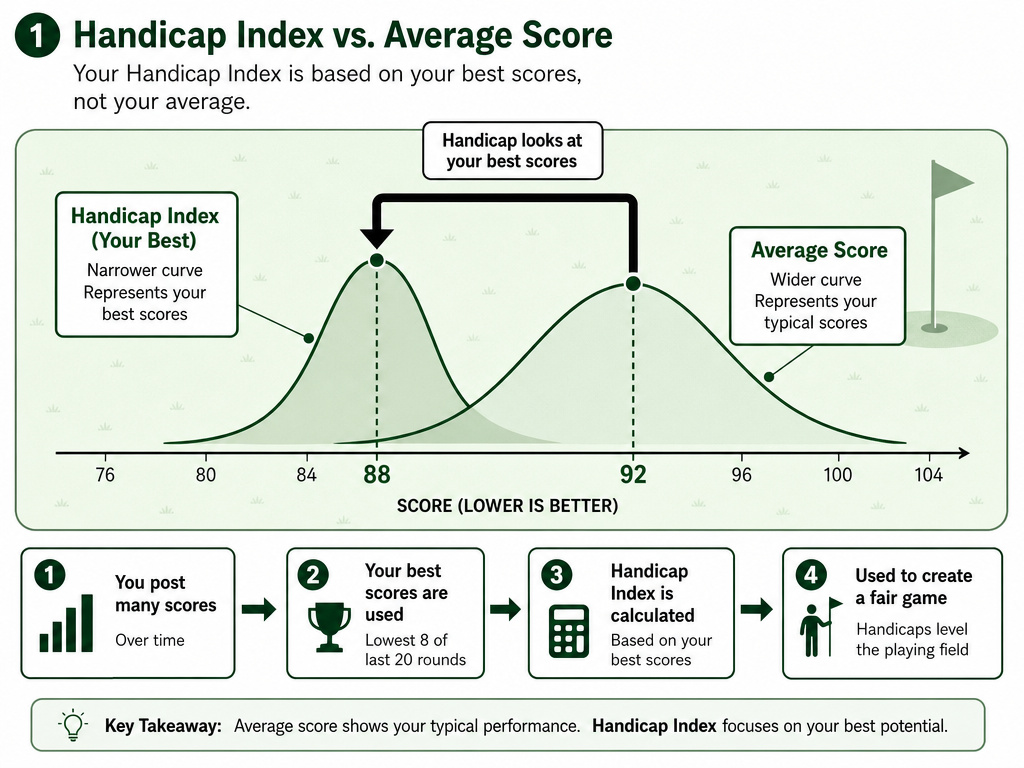
This is the mental hurdle. Your handicap is not your average. It’s the average of your best. For a mid-handicapper, your average score might be 92, but your handicap could be 16. That 16 represents what you shoot on your better days, maybe an 88 on a standard course.
This distinction matters for equipment choices, too. A player with a 16 Handicap Index isn’t looking for the same game improvement clubs as a 30-index player, and the golf balls for average golfers they choose will reflect that difference in potential. The index tells you about capability, not consistency.
Tracking this properly means more than just posting scores. To genuinely improve, you need to move beyond the handicap and start tracking your golf stats, fairways hit, greens in regulation, putts per round. That’s how you turn a 16 into a 12.
Frequently Asked Questions
Why is 113 used in the handicap formula?
113 is the standard Slope Rating. It’s the baseline against which all other slopes are measured. A course with a Slope of 113 is considered to have standard relative difficulty. The formula (113 / Slope Rating) creates a multiplier that adjusts your score based on whether the course is easier or harder than standard for a bogey golfer.
How does a “net double bogey” adjustment work?
It’s the maximum score you can take on any hole for handicap purposes. It’s calculated as: par + 2 + any handicap strokes you receive on that hole. If you get a stroke on a par 4, your max score is 7 (4+2+1). If you shoot a 10, you record a 7 for your adjusted gross score. This prevents one disastrous hole from skewing your entire differential.
What’s the difference between a Course Handicap and a Playing Handicap?
Your Course Handicap is the raw number of strokes you get on a specific course. Your Playing Handicap is that number adjusted by a “handicap allowance” for the specific format of play (e.g., 85% for four-ball). The Playing Handicap is the number you actually use to compete. You can see how this adjusts your final net score in competition.
Can my handicap go down if I play badly?
No. Your Handicap Index only changes when you post a new score. A bad score that is within your normal range will simply become one of the higher differentials in your record of 20, and it will eventually age out. It won’t directly raise your average because the system only uses your best 8 scores. To go down, you need to post a score that is better than your current 8th-best differential.
The Bottom Line
The handicap calculation is a robust, daily-updating algorithm designed for fairness. It weighs your performance against a rated course, averages your potential, and applies strict caps. The number it spits out, your Handicap Index, is just the starting point. You then translate it into a Course Handicap for the specific tees you’re playing, and finally into a Playing Handicap for the competition format.
Stop thinking of it as a judgment. It’s a tool. It lets a 25-index player compete fairly with a 5-index player on any course in the world. It quantifies improvement in a way that raw scores never can. Learn the formula, respect the posting deadline, and use your index for what it is: a passport to fair competition. For a deeper look at how this system came to be, the history of handicaps is a fascinating study in the pursuit of equity.
