
How Golf Rangefinders Work: The Technology of Pin-Seeking
This post contains affiliate links. As an Amazon Associate, we earn from qualifying purchases.
This post contains affiliate links. As an Amazon Associate, we earn from qualifying purchases.
Modern golf rangefinders calculate distance by firing an invisible infrared laser pulse and timing how long it takes to bounce back. An internal microprocessor uses the speed of light to convert this time into a yardage, displayed in the viewfinder. Advanced models add slope, wind, and temperature data to recommend the actual club you should hit.
That time measurement, down to a billionth of a second, is where the magic happens. But the number you see is the result of a dozen variables fighting against that perfect physics equation.
What follows is a breakdown of the laser, the chip, and the software that turns a click into a confident club choice. We’ll cover why a shiny flag gives you a reading at 300 yards when a dark tree trunk won’t, how slope adjustments actually work, and why your buddy’s fancy model beeps when yours doesn’t.
Key Takeaways
- The core measurement is time-of-flight: a laser pulse’s round-trip time, converted to distance using the constant speed of light.
- Maximum range isn’t a fixed number; it’s dictated by target reflectivity. Bright, shiny objects like prisms return a signal from much farther away than dark, matte surfaces.
- Slope technology uses a built-in inclinometer to calculate the adjusted playing distance, but this mode is illegal for tournament play unless disabled.
- Features like Bushnell’s JOLT and Leupold’s Flag Lock use secondary signals, vibrations or bracket icons, to confirm you’ve ranged the flag, not the trees behind it.
- All consumer golf rangefinders use eye-safe, FDA Class 1 lasers. They are not harmful to vision when used as intended.
The Core Technology: Time-of-Flight Lasers
Every laser rangefinder operates on the same fundamental principle. Press the button, and the device emits a brief, focused pulse of infrared light toward your target.
The Leupold GX series of rangefinders emit a series of invisible, infrared energy pulses that are reflected off the selected target back to the optical unit. State-of-the-art circuitry and precision computing circuits calculate the distance instantaneously by measuring the time it takes for each pulse to travel from the GX rangefinder to the object and back.
A sensor inside the rangefinder catches the reflection of that pulse. A high-speed microprocessor then performs the math: Distance = (Speed of Light × Time) / 2. You divide by two because the pulse travels to the target and back.
The speed of light is a known constant (approximately 186,282 miles per second). The timing is the variable, measured in nanoseconds. This is why accuracy is so high, +/- 0.5 yards is standard for models like the Leupold GX-6c. The limitation isn’t the math; it’s getting a clean signal back from the target.
What Affects Performance? Reflectivity is Everything
The published “maximum range” on a box is a best-case scenario. It assumes a perfectly reflective target under ideal conditions. In the real world, four factors dictate whether you get a reading.
Target Reflectivity: This is the biggest variable. A small, dark, matte target absorbs light. A large, bright, shiny target reflects it. Manufacturers often list two ranges: one for “most objects” (like trees) and one for “highly reflective” targets (like the special prisms courses often install on flagsticks).
| Target Type | Approximate Max Range | Why It Matters |
|---|---|---|
| Standard Flag (No Prism) | 150-250 yards | The standard test for basic rangefinder capability. |
| Tree or Bush | 400-700 yards (per Leupold GX-5c manual) | Useful for ranging hazards or layup points. |
| Reflective Prism | 800+ yards | Allows for extreme accuracy on long par 5s or when shooting to a distant landmark. |
Environmental Conditions: Fog, rain, heat haze, and even bright sunlight shining directly into the lens scatter the laser light. This degrades the signal. Most units have a “Fog Mode” that filters out some of this noise, but it reduces maximum range.
Steadiness: The smaller the target, the harder it is to hit with the laser. A shaky hand can mean the beam dances across the flag, the background, and back. This is why image stabilization, found in high-end models like the Leupold GX-6c, is a game-changer for players with less-than-steady hands.
Battery Power: A weak battery reduces laser output. The beam is less intense, so the returning signal is weaker. Most units have a low-battery indicator, but performance can degrade before that light comes on.
Where this goes sideways: Ranging a dark green flag against a shadowy tree line on an overcast day. The reflectivity is terrible, the contrast is low, and you might not get a lock at 160 yards. The fix? Look for a brighter part of the flag or a nearby bunker face to range instead.
From Distance to Decision: Slope, TGR, and Club Selection
Basic rangefinders give you line-of-sight distance. Advanced models answer the real question: what club should I hit?
Slope Measurement: A rangefinder with slope contains a digital inclinometer. When you range a target, it measures the angle of ascent or descent. It then uses trigonometry to calculate the “playing” distance, the actual yardage you need to cover, accounting for the hill.
- Uphill Shot: The playing distance is longer than the line-of-sight distance.
- Downhill Shot: The playing distance is shorter.
Crucially, slope mode is not allowed under the Rules of Golf for tournament play. All USGA-conforming models allow you to disable the slope function, often with a physical switch or setting.
True Golf Range (TGR) and Club Selection: Leupold’s system takes slope a step further. TGR factors in the angle, but also can incorporate altitude and temperature (manually input on models like the GX-2i3). It then cross-references this adjusted distance with a built-in club database.
When it locks on, the display shows the TGR distance and a club recommendation (e.g., “6i”). This is the pinnacle of decision-support technology in a handheld unit. The recommendation is based on typical carry distances, so it requires calibration to your own game to be truly precise.
Locking Onto the Pin: PinSeeker, JOLT, and Flag Lock
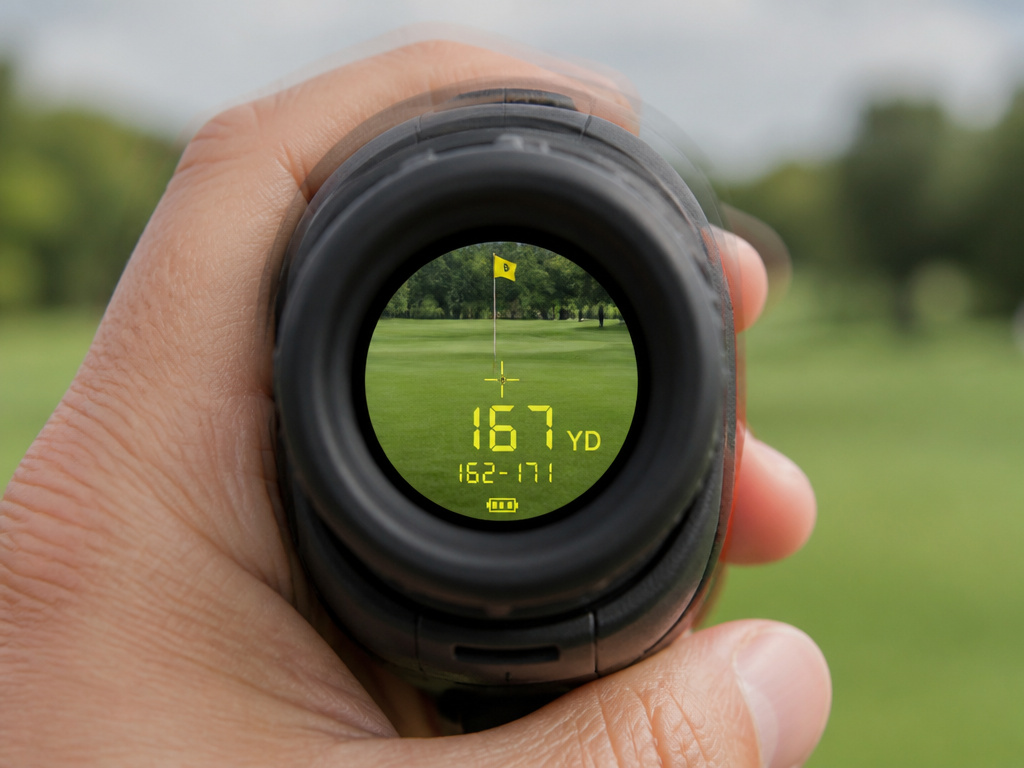 Ranging the flag is easy on an open green. It’s impossible when it’s tucked behind a tree. That’s where target-lock technologies come in.
These systems work by analyzing multiple return signals. The rangefinder knows a flagstick is a thin, vertical object. When it detects a small, close object in front of a larger, more distant background, it assumes the closer object is the pin.
- Bushnell’s PinSeeker with JOLT: When the system determines it has the flag, the viewfinder icon changes and the unit delivers a short, vibrating JOLT to your hand. The tactile confirmation means you can trust the number without taking your eye away from the eyepiece.
- Leupold’s Flag Lock: This technology illuminates a flag icon in the display and holds the distance reading solidly. As their manual states, it “eliminates the guesswork and guarantees an accurate range to the pin.”
Prism Lock is a related feature for courses that install reflective prisms on their flags. It detects the unique, strong return signal from a prism and gives an audible beep. This is the most foolproof lock you can get.
Laser Safety, Power, and Maintenance
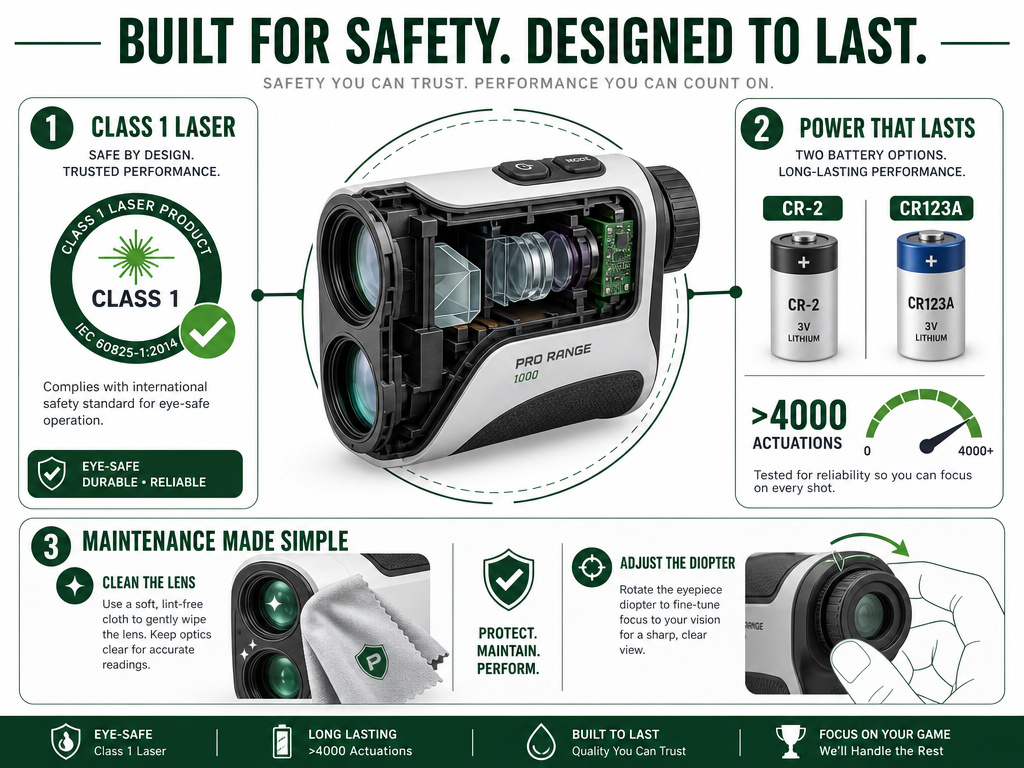 You are not holding a dangerous laser. Consumer golf rangefinders are classified as FDA Class 1 laser products. This is the safest category, meaning the laser output is harmless under any condition of normal use. You cannot damage your eyesight by looking through the device or at the target.
They are powered by standard, small lithium batteries. The most common are: * CR-2: Used in many Bushnell and older Leupold models. * CR123A: Used in larger, more powerful units like the Leupold GX-6c.
Battery life is typically measured in “actuations” (button presses). A rating of >4000 actuations, common for Leupold models, translates to years of regular use for most golfers.
Maintenance is straightforward. Keep the lenses clean with a soft brush or cloth designed for optics. Never spray cleaner directly on the glass. And if the view gets blurry, remember the eyepiece twists to adjust diopter focus for your individual eyesight.
Laser vs. GPS: How They Compare
Understanding how lasers work highlights the difference between the two main rangefinder types. A laser rangefinder is an active measuring tool. It calculates a direct, precise distance to any specific object you point it at.
A GPS rangefinder is a passive navigation tool. It uses satellite signals to locate you on a pre-loaded course map, then shows you distances to pre-mapped points (front, middle, back of green, hazards).
| Aspect | Laser Rangefinder | GPS Rangefinder |
|---|---|---|
| Core Function | Actively measures distance to a targeted object. | Provides distance to pre-programmed points on a map. |
| Precision | Extremely high (+/- 0.5 yds) to a specific spot. | Good, but to generalized zones (e.g., “middle of green”). |
| What You Can Range | Any visible object: flags, trees, bunker lips, people. | Only points mapped into the device’s software. |
| Speed | Instantaneous once you have a lock. | Instantaneous, no aiming required. |
| Dependency | Needs a clear line of sight. | Needs satellite signal and updated course maps. |
For pure, versatile accuracy to any target, a laser rangefinder is the definitive tool. For quick, hazard-aware play without the need to aim, a GPS rangefinder or watch is excellent. Many players use both.
Frequently Asked Questions
Are golf rangefinders accurate?
Yes, extremely. Standard accuracy for quality models is +/- 0.5 yards/meter under good conditions. The limiting factor is rarely the device’s calculation; it’s the user’s ability to hold steady on the target and environmental factors like haze or rain.
How does slope adjustment work on a rangefinder?
Built-in inclinometer measures the angle between you and the target. The device’s computer uses this angle to calculate the horizontal distance (the true playing distance) using trigonometry, rather than just the straight-line distance. Remember, this feature must be turned off for tournament play.
What does “JOLT” mean on a Bushnell rangefinder?
JOLT is Bushnell’s trademarked feature that provides a short, vibrating pulse when the device’s PinSeeker technology confirms it has locked onto the flagstick. It’s a tactile confirmation so you know the displayed yardage is for the pin, not the background.
Why won’t my rangefinder pick up the flag?
First, check for a steady hand and a clear line of sight. If it’s still not locking, the most common cause is low target reflectivity. A dark flag on a cloudy day against trees is a worst-case scenario. Try ranging a brighter part of the flag or a nearby bunker face. Second, ensure your battery is fresh. A weak battery dramatically reduces ranging power.
Can a rangefinder measure through glass or water?
No. Laser pulses cannot penetrate solid objects like windows. They will reflect off the glass surface, giving you the distance to the window, not what’s behind it. Water, like fog or heavy rain, will scatter the beam and severely reduce range or prevent a lock.
The Bottom Line
A golf rangefinder is a pocket-sized physics lab. It turns the constant speed of light into a yardage number by counting nanoseconds. The best models then layer on smart software to filter out trees, calculate slopes, and even suggest a club.
The technology is mature, accurate, and safe. Your choice comes down to which enhancements, slope, stabilization, or advanced target locking, justify the step up from a basic, reliable model. For pure, on-demand distance to anything you can see, the laser has no equal.
