
Jordan Spieth’s Short Game & Putting Mastery: Key Drills
This post contains affiliate links. As an Amazon Associate, we earn from qualifying purchases.
This post contains affiliate links. As an Amazon Associate, we earn from qualifying purchases.
Jordan Spieth’s short game and putting mastery is built on four specific practice pillars: start-line calibration with training aids, competitive scoring games for mid-range putts, a constrained “safety zone” drill for speed, and a variable-distance ladder routine. His 2015 U.S. Open preparation hinged on the ladder drill taken out to 58 feet. Recent struggles traced to a hands-over-reliance tendency he fixed by locking his left side, leading to a 2024 resurgence where he gained over 6 shots putting in a single tournament.
That last point about locking his left side is the mechanical fix. For years, Spieth’s putting stroke relied heavily on his hands, a style shared by greats like Tiger Woods and Ben Crenshaw. Under pressure, that reliance became a liability; his hands would try to save a stroke that his bigger muscles hadn’t properly initiated, resulting in inconsistent strikes on short putts. The correction wasn’t to abandon his feel but to anchor it in a more stable, rotational foundation.
What follows is a breakdown of the exact drills, the creative short-game mindset, and the practice philosophy that turned Spieth’s touch into a weapon. You’ll see the numbers behind his slumps and comebacks, and how to apply his constraint-based practice to your own game.
Key Takeaways
- Spieth’s core putting practice uses four structured drills: start-line work, a 10-foot scoring game, a mid-range gate drill, and a ladder drill for long-range speed.
- His short-game genius is a cut-shot bias and a pre-shot “movie” where he visualizes the shot’s entire flight, roll, and stop before he swings.
- A documented “bad tendency” of overusing his hands on short putts was fixed by focusing on a stable left side, referencing video from his 2015-2016 peak.
- Practice drills incorporate strict constraints and scoring systems (e.g., a “safety zone” three feet past the hole) to train under pressure and improve recall.
- His statistical putting prowess has fluctuated wildly, ranking as high as 2nd and as low as 155th on tour, showing that even elite touch requires constant maintenance.
The Four Pillars of Spieth’s Putting Practice
Spieth doesn’t just hit putts. He builds his sessions around a sequence of drills that train separate skills, start line, mid-range making, speed control, and pressure rehearsal. Each has a clear pass/fail metric.
He starts with the Dave Pelz Putting Tutor and a putting rail for six-to-eight foot putts. The goal is pure start-line calibration. “If I’m starting it on line the first six inches, it’s going to be starting on line,” Spieth said. This mechanical check ensures his stroke isn’t adding hook or cut spin immediately off the face. It’s the foundation everything else relies on.
A properly calibrated start line sounds like a firm, crisp tock off the center of the face. A mishit has a flatter, duller sound. Listen for it.
Next comes his 10-foot game. He places balls around the hole at that distance and plays a scoring game: ten putts, aim to be four under or better. A make is a birdie. A miss that finishes within two feet past the hole is a par. A putt left short or more than two feet long is a bogey. This turns repetition into consequence, simulating the cost of a poor speed read.
The third pillar is the mid-range gate drill. For putts from 10 to 25 feet, he places two ball markers a putter-head’s width apart at the midpoint of the putt. He strokes five balls, scoring one point for rolling through the gate, one point for correct speed (inside two feet past), and one point for a make. Ten total points means he moves on. If he makes the putt but misses the gate, it signals his green read is off.
| Drill | Primary Skill | Constraint / Scoring | Common Failure Mode |
|---|---|---|---|
| Start-Line Calibration | Face Alignment & Path | Must start on line using tutor/rail | Stroke manipulates face; inconsistent sound at impact. |
| 10-Foot Game | Making & Speed Control | Scoring: Birdie (make), Par (miss within 2ft), Bogey (short or >2ft long) | Decelerating due to score pressure, leaving putts short. |
| Mid-Range Gate Drill | Green Reading & Speed | 1 pt/gate, 1 pt/speed, 1 pt/make; need 10 pts with 5 balls | Making putts but missing the gate indicates misread. |
| Ladder Drill | Long-Range Speed | Must finish past hole but within a “safety zone” (e.g., 3 ft past) | Under-hitting due to fear of the long come-backer. |
The final piece is the ladder drill for long-range speed, which he used extensively before winning the 2015 U.S. Open at Chambers Bay. He sets balls in increments back to 15 feet, or even 58 feet, as he did that week, with the sole goal of finishing past the hole but within a defined “safety zone.” This zone, often marked by a club placed three feet past the back edge, removes the option of leaving it short. It’s a brutal honesty test for touch.
The Mechanism Behind the “Bad Tendency” and the Fix
Spieth’s putting statistics tell a story of volatility. After ranking 2nd in Strokes Gained: Putting in the 2018-2019 season, he fell to 105th, 155th, and 101st in subsequent years. The issue peaked on short putts, where once he ranked outside the top 50 for a decade.
The cause was a technical drift. Spieth has always been a “handsy” putter, using his wrists and hands for feel. Under tournament pressure, that handsy stroke became a “bad tendency”, his hands would actively try to correct a path or face-angle issue that his shoulders and arms hadn’t created. The result was a inconsistent strike on the ball, especially from inside ten feet where there’s no margin for a mis-hit.
Where this goes sideways: Letting the hands dominate the putting stroke under pressure. The hands twitch, the strike location on the face moves, and the putt either pulls or pushes without the player understanding why. It shows up as a three-putt from 30 feet where the first putt is a mis-hit.
His fix, developed with coach Cameron McCormick, was to “lock in” his left side. Spieth focused on a feel in his left arm and elbow, promoting a stroke driven more by the rotation of his shoulders and core. He used video from his 2015-2016 peak as a reference to match his setup and stroke mechanics. This gave his natural hand feel a stable platform to work from. The feedback was immediate; in 2024, he gained 5.8 shots putting at Pebble Beach and 6.1 shots at the Genesis Invitational.
This isn’t about eliminating hand action. It’s about sequencing. The big muscles initiate the motion, the hands respond with feel. Getting that order wrong is the difference between a putt that holds its line and one that wobbles off.
The Short Game: Creativity Over Mechanics
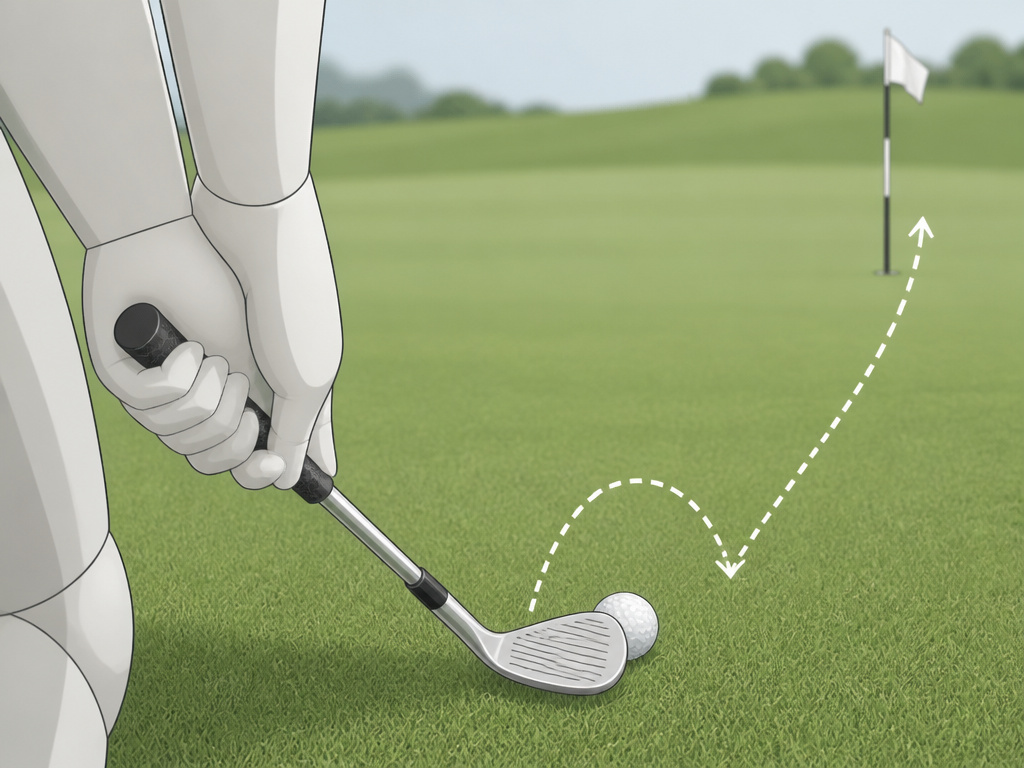 While his putting is meticulously drilled, Spieth’s short game around the greens is an exercise in creative visualization. He doesn’t think in technical terms like “wrist hinge” or “club path.” He sees a “movie” of the shot.
“I’m seeing the movie of the putt,” Spieth has said, and he applies the same artistry to chips and pitches. Faced with a 25-yard shot, he might see three different movies: a low spinner that checks, a medium flight with rollout, or a high flop that lands soft. His decision is based on a realistic assessment of the lie, the turf, and what it will “allow.”
His most trusted shot is a cut shot, a slightly out-to-in path that imparts a gentle fade spin. “Every single shot I hit on or around the greens is a cut shot,” he admits. This consistency in feel across different shots simplifies his decision-making. Whether he’s playing a bump-and-run or a flop, the underlying sensation is similar.
The practical takeaway isn’t to copy his cut shot. It’s to copy his process. Before you swing, play the movie. What is the ball’s trajectory? Where does it land? How does it roll out? Then, choose the technique that produces that movie. This is the opposite of standing over the ball thinking about five different swing mechanics.
The tee gate drill for putting path is one I’ve used since my certification because it gives immediate visual feedback on stroke direction. It’s the same principle of constraint Spieth uses, if the ball doesn’t go through the gate, your path is off. No debate. Good golf should feel less complicated the more you understand it, and a clear visual constraint cuts through technical noise.
Drills You Can Steal: The TPI Safety Zone and Alternating Structure
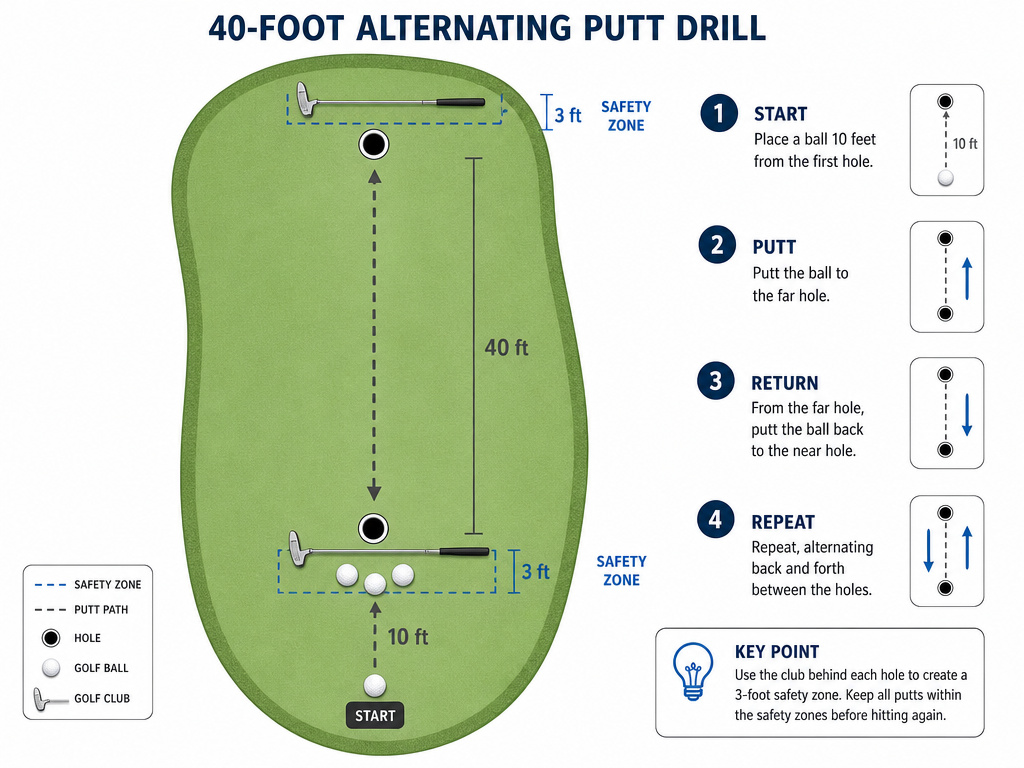 One of the most effective drills comes from Spieth’s work with TPI (Titleist Performance Institute). It’s a masterclass in training touch under variable conditions.
Find two holes about 40 feet apart. Place a club three feet past the back edge of each to create a “safety zone.” Start 10 feet from the first hole (so you have a 30-foot putt to the second). Putt three balls to the close hole. All three must finish in the safety zone (past the hole, not more than three feet by). If they do, putt three balls to the far hole with the same rule.
Succeed, and you move your starting point three feet closer to the far hole. Now the shots are 13 feet and 27 feet. Continue until you’re putting from 30 feet to the original far hole. Fail at any stage, and you restart.
The part nobody mentions: The alternating structure between a short and long target disrupts your muscle memory. Your brain can’t simply repeat the same stroke; it must constantly recalibrate force. This variability is what builds true touch, not hitting the same 20-foot putt over and over.
This drill scales to any skill level. A beginner’s safety zone might be five feet past the hole. The key is the constraint: the ball must get to the hole. This alone cures the most common amateur flaw, leaving putts short.
How Spieth’s Practice Translates to Your Game
You don’t need Spieth’s talent to use his practice philosophy. It boils down to three rules: add constraints, keep score, and embrace variability.
First, never practice putting without a constraint. Use two tees as a gate for your start line. Use a club to create a safety zone for speed. This turns vague “working on putting” into a binary test: did the ball go through the gate or not?
Second, always keep score. Use his 10-foot game, or create your own points system for the gate drill. This injects consequence, which is the only way to simulate the pressure you feel on the course. Practice that doesn’t raise your heart rate a little is just warm-up.
| Skill | Spieth’s Drill | Amateur Adaptation | Why It Works |
|---|---|---|---|
| Start Line | Putting Tutor / Rail | Two tees just wider than your putter head, 3 feet in front of the ball | Eliminates technical thought; you either hit the gate or you don’t. |
| Speed Control | Ladder Drill / Safety Zone | One hole, three balls from 20, 30, and 40 feet. All must finish past the hole but within a putter-length. | Cures leaving putts short and trains a feel for different lengths. |
| Pressure Putting | 10-Foot Scoring Game | Ten putts from 5 feet. Give yourself 1 point for each make. Try to beat 7. | Adds stakes to repetition, which improves focus and replicates tension. |
Third, fight repetition with variability. Don’t hit 50 putts from the same spot. Use the TPI alternating drill, or mix in breaking putts, different lengths, and different lies around the green. Your brain and muscles learn faster when they’re forced to adapt.
I favor straightforward drills players can actually stick with. The ladder drill with a safety zone is one anyone can set up in five minutes. It’s about practical routines, not chasing the latest tip.
Frequently Asked Questions
What is Jordan Spieth’s most famous putting drill?
His most famous drill is the ladder drill for speed control, which he used extensively before the 2015 U.S. Open. He sets balls at increasing distances from a hole, with the constraint that every putt must finish past the hole but within a “safety zone” (e.g., three feet past). This drill trains aggressive, consistent speed on long putts.
Why did Jordan Spieth struggle with putting?
Spieth’s putting struggles, particularly from 2019-2023, were linked to a technical “bad tendency” of over-relying on his hands to control the stroke, especially under pressure on short putts. This caused inconsistent strike quality. He fixed it by working with coach Cameron McCormick to stabilize his left side and use more shoulder rotation, referencing video from his peak years.
What is Jordan Spieth’s 10-foot putting game?
It’s a competitive practice game. From 10 feet, he takes ten putts and aims to score four under or better. A made putt is a birdie (-1). A miss that finishes within two feet past the hole is a par (0). A putt left short or more than two feet past is a bogey (+1). This system gamifies practice and penalizes poor speed control.
How does Jordan Spieth practice his short game?
Spieth practices his short game with a focus on creativity and visualization, not just mechanics. He “sees the movie” of the shot before choosing it. He favors a cut-shot feel for most shots around the green. His practice involves hitting many different shots from different lies to a single target, assessing what each lie allows, rather than grinding one technique.
What putting grip does Jordan Spieth use?
Jordan Spieth uses a left-hand-low (cross-handed) putting grip. This grip helps minimize wrist breakdown in his left hand and promotes a more shoulder-driven stroke, which has been crucial in stabilizing his putting under pressure.
The Bottom Line
Spieth’s mastery isn’t magic, it’s a library of specific, constraint-driven drills and a short-game mindset that trades technical jargon for vivid visualization. The ladder drill won a U.S. Open. The 10-foot game simulates Sunday pressure. The safety zone cures the timid stroke.
Your move isn’t to copy his cut shot or his cross-handed grip. It’s to adopt his practice method. Pick one drill this week, the safety zone ladder or the 10-foot game, and run it with real scorekeeping. The constraint is the teacher. The score is the motivator. The improvement, as his stats show, is never permanent, but the process for finding it again always is.
