
Golf Swing Casting Fix: Achieve Solid Contact with Key Data
This post contains affiliate links. As an Amazon Associate, we earn from qualifying purchases.
This post contains affiliate links. As an Amazon Associate, we earn from qualifying purchases.
To fix casting in the golf swing, you must first diagnose its root cause: a physical limitation (like poor hip mobility), a sequencing error (arms leading the downswing), or a grip/feel issue (trail hand dominance). The fix is to retrain the movement that creates lag naturally. A 2015 biomechanics review notes that lab-measured improvements in club head speed don’t always translate to better on-course performance, which is why your practice must be ecologically valid.
That gap between a clean range swing and a messy on-course shot is where casting lives. The instinct to help the ball into the air or to chase power with your hands overrides any technical fix if your practice doesn’t mirror real play.
What follows: a three-part diagnosis to pinpoint your specific cause, four drills that rebuild sequence instead of forcing a position, and the one training aid that makes the fault impossible to hide.
Key Takeaways
- Casting is almost always a sequencing problem, not a strength issue. Your body must lead the downswing; your arms and hands follow.
- Telling yourself to “hold the lag” usually makes it worse. It increases grip tension, which triggers the early release you’re trying to avoid.
- The Tour Striker Smart Ball is the most direct feedback tool for fixing casting. It forces connection and makes an arm-led swing feel immediately wrong.
- Improvement requires diagnosing the root cause. Is it a physical limitation, a bad sequence, or a dominant trail hand? Each has a different fix.
- Real change happens in weeks, not days. Expect about a month of consistent, focused drill work before the new movement pattern holds under pressure.
What Casting Actually Does to Your Strike (And Your Score)
Casting is the early release of the wrist hinge during the downswing. The angle between your lead arm and the club shaft collapses too soon, like opening a whip’s crack before the tip reaches its target. You throw the clubhead at the ball from the top instead of delivering it with a late, accelerating release.
Casting is one of the most common causes of loss of power and excessive spin on the golf ball. It adds loft to the face of the club and as a result we see a loss of power and consistency.
The consequence is a predictable pattern of failure, resulting in high, floating iron shots that fall out of the sky.Your driver balloons and drifts right. You take shallow divots or miss the turf entirely. Distance drops because clubhead speed peaks early and decays by impact. Consistency vanishes because a timed flip is never as repeatable as a sequenced rotation.
This fault connects directly to other common issues like a golf slice or topping the ball. If you’re fighting several ball-flight problems at once, casting is often the common thread.
The 3-Step Diagnosis: Is It Your Body, Your Sequence, or Your Grip?
You can’t fix what you haven’t named. Before you swing another club, run through this checklist. Your answer determines your practice plan.
1. The Physical Check: Can Your Body Do It?
The Titleist Performance Institute (TPI) frames casting as often stemming from physical limitations. The big one is a lack of lower-body contribution. If your hips, ankles, or core can’t initiate the downswing, your upper body takes over. That forces an early release.
Check for a reverse pivot or swaying, these are related faults that also stem from poor lower-body movement. Can you make a full backswing without your lead heel coming off the ground? Can you start the downswing by rotating your lead hip backward without your head dipping toward the ball? If not, you have a mobility or strength gap that no drill can overcome.
Where this goes sideways: Strengthening your glutes won’t fix your swing. It only removes a barrier. You still need to learn the correct movement pattern. Treat physical prep as enabling work, not the solution.
2. The Sequence Check: What Moves First?
This is the most common cause. At the top of your swing, what initiates the downswing? If it’s your hands or shoulders, you’ve already lost. The sequence must be hips, then torso, then arms, then club.
Film your swing face-on. Pause it at the moment your hands reach hip height in the downswing. The club shaft should still be angled back, your wrist hinge intact. If the shaft is already in line with your lead arm, you’ve cast. This faulty sequence destroys low point control and makes solid contact a lottery.
3. The Grip & Feel Check: Is Your Trail Hand Hijacking the Swing?
A tight, dominant trail hand is a silent killer. It wants to throw the club. You feel like you’re generating speed, but you’re just releasing energy early. Grip pressure above a 4 out of 10 locks your wrists. They can’t maintain hinge under centrifugal force.
Take your normal grip. Have a friend try to gently pull the club from your hands. If they can’t budge it, your pressure is too high. This often pairs with a weak lead hand grip, which opens the clubface and makes you flip at impact to square it up, a double fault.
| Root Cause | Primary Symptom | Immediate Test |
|---|---|---|
| Physical Limitation | Inability to start downswing with hip rotation; early extension. | Lead heel lifts in backswing; cannot rotate hips in isolation. |
| Faulty Sequence | Arms and hands visibly start downswing before hips turn. | On video, shaft is straight at hip-high hands position. |
| Trail Hand Dominance | Feeling of “hitting” with right side; club feels heavy in right hand. | Friend can easily pull club from your grip at address. |
Why “Hold Your Lag” is the Worst Advice You’ll Hear
It sounds right. If you’re releasing early, just hold the angle longer. The problem is intent. Consciously trying to “hold” anything in a dynamic swing increases muscular tension, specifically in your forearms and hands. That tension is the direct trigger for early release. Your nervous system, sensing the rigidity, dumps the angle to protect your joints and make contact.
Real [lag](https://golfworldtrips.Lag is preserved as a byproduct of a proper kinetic chain where the body leads and the club trails.The 2015 review in the Revista Brasileira de Fisioterapia highlights a critical point: lab studies measure things like club head velocity (CHV), but “swinging a golf club indoors surrounded by expensive equipment may not reflect what happens on the golf course.”
Your fix must work under real conditions, not just in the slow-motion, technical mindset of the range. Drills that teach feel and sequence beat commands to maintain a position.
The 4 Drills That Build the Right Sequence (Not Just a Position)
These drills aim to ingrain the movement that makes lag inevitable. Do them without a ball first.
Drill 1: The Pause & Fall
This kills the arm-led transition. 1. Take your backswing to the top. 2. Pause for a full two seconds. Let any urge to “go” subside. 3. Initiate the downswing by letting your lead hip rotate backward. Don’t move your arms. Feel them “fall” as your body turns. 4. Swing through. The goal is to feel your arms are passive riders, not drivers.
Skip this at your peril: Rushing the transition is casting’s fuel. This drill builds the gap between backswing and downswing that proper sequence requires.
Drill 2: The Towel Snap
This provides auditory feedback you can’t argue with. 1. Hold a bath towel by one end, gripping it like a club. 2. Make full swings. Listen for the sharp snap at the bottom. 3. The towel only snaps if you retain the “lag” and release it late. If you cast, it flops silently. 4. Chase the sound, not a feeling in your wrists.
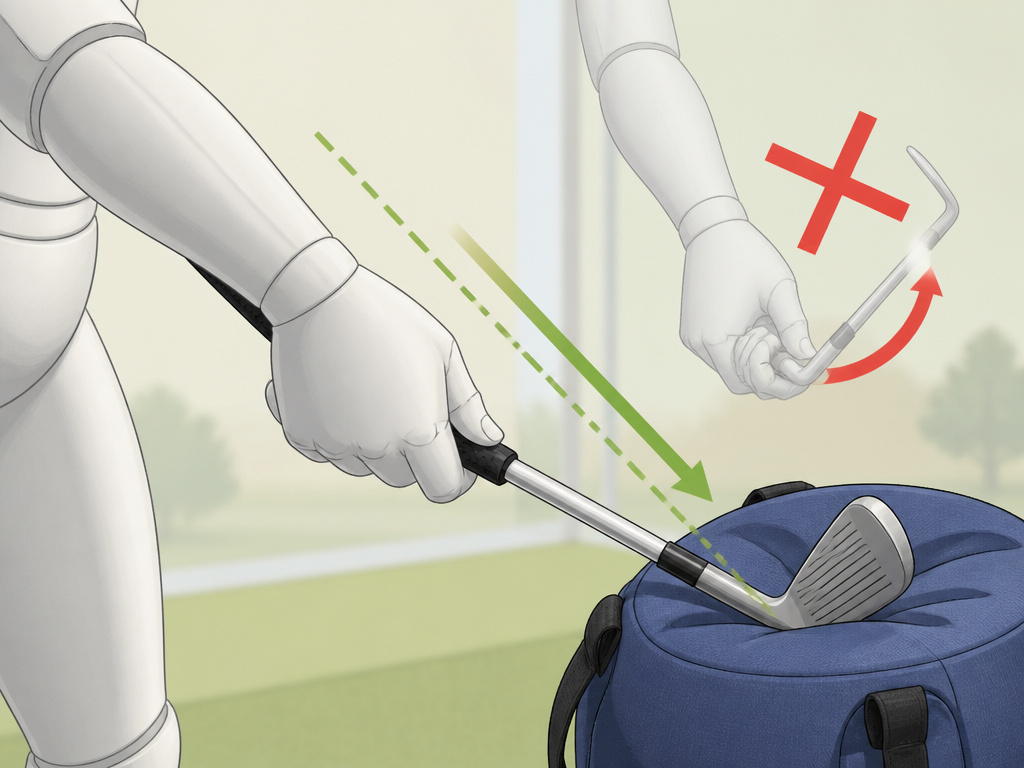
Drill 3: Impact Bag or Wall
This trains forward shaft lean without conscious hand manipulation. 1. Place an impact bag or stand facing a sturdy wall (use an old clubhead cover). 2. Take your address, then preset your impact position: weight on lead foot, hands ahead of imaginary ball, shaft leaning toward target. 3. From here, make small, slow swings, rehearsing the sensation of compressing the bag/wall with your hands ahead. 4. This kills the scooping instinct by making the correct impact position a starting point, not an elusive result.
Drill 4: Lead-Arm Only Swings
This removes the trail hand’s ability to dominate. 1. Grip a mid-iron with only your lead hand. 2. Make slow, half-swings. Focus on keeping the back of your lead wrist flat through impact. 3. The trail hand can’t throw the club, so you’re forced to use body rotation to deliver it. 4. This directly builds the feel of connection and rotation that prevents a flying elbow and casting.
When to Bring in a Training Aid (And Which One)
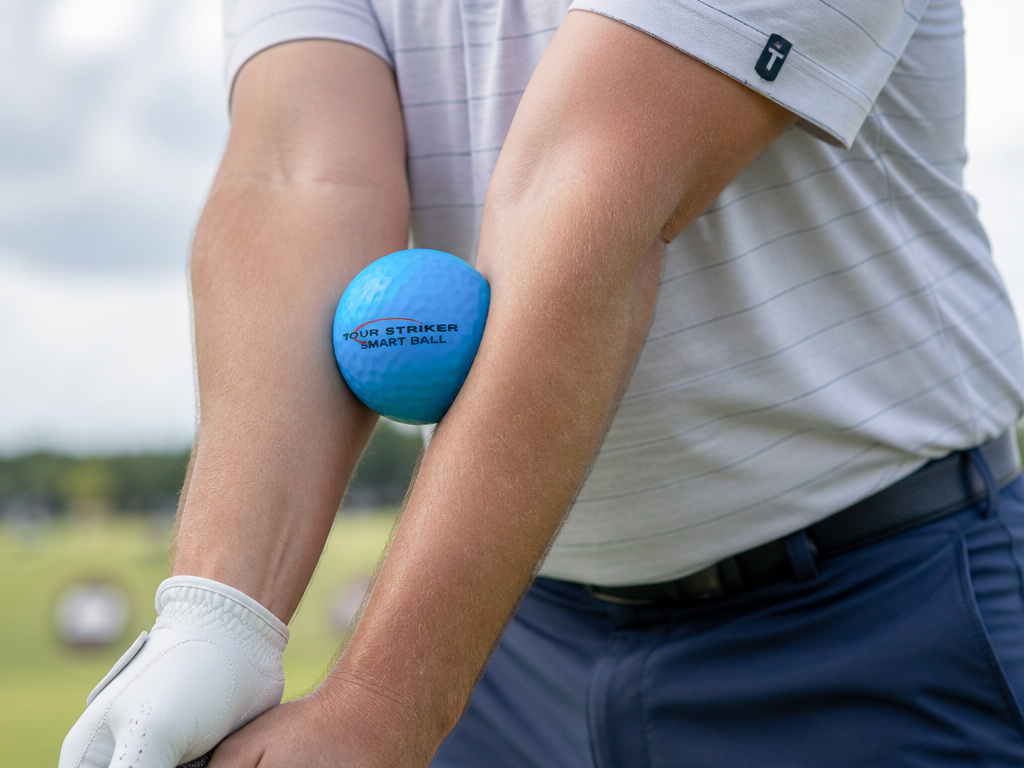
Feel is unreliable. If you’ve been casting for years, your “normal” is broken. A good training aid provides unmistakeable feedback.
The Tour Striker Smart Ball is the top pick for casting. You place it between your forearms. If your arms separate from your body or you throw the club from the top, the ball drops. It’s a direct, physical tether that enforces connection. You cannot cast successfully with it in place.
The Orange Whip is a close second, especially if your issue is more about tempo and rhythm than pure sequence. Its weighted, flexible design forces a smooth transition and a late release. You can’t rush it.
The Lag Shot Training Club has an extremely flexible shaft. If you cast, the head whips wildly and timing collapses. It exaggerates the consequence, making the correct move feel obvious.
Common mistake: Buying a training aid and using it randomly. Dedicate a full practice session to it twice a week. Use it for your warm-up and for specific drill work. It’s a teacher, not a toy.
How This Connects to Your Overall Swing
Fixing casting isn’t an isolated repair. It recalibrates your entire motion. A proper sequence improves your swing tempo naturally. The stable lower-body action that prevents casting also promotes a balanced finish. The forward shaft lean you learn is the exact opposite of the flip that causes a golf hook.
You’re not just patching a hole. You’re rebuilding the engine.
Frequently Asked Questions
Is casting the same as flipping?
No, but they’re neighbors. Casting is the early release of the wrist hinge during the downswing. Flipping is the last-second cup of the lead wrist and straightening of the trail wrist at impact to square the face. Casting often leads to flipping, but you can have one without the other.
How long until I see real improvement?
Most golfers notice better contact within 2-3 weeks of consistent drill work. For the new pattern to hold under pressure on the course, plan for 4-6 weeks. Lasting change takes months of reinforcement.
Can I cast with my driver too?
Absolutely. The symptoms change, you’ll see high, spinning balloon balls or weak slices, but the cause is identical. The body stall-and-arm-throw sequence is a universal fault.
Do any pros cast the club?
Virtually none. Tour-level ball striking requires maximizing energy transfer at impact, which demands a late release. What might look like a “cast” in a pro’s swing is usually an optical illusion from an extreme body rotation that delays the release until the last possible millisecond.
What if the drills don’t work?
You likely misdiagnosed the root cause. Go back to the three-step diagnosis. If you’re sure it’s not physical or grip-related, you may need an in-person lesson. A quality coach can see subtle sequencing errors a camera might miss.
Before You Go
Casting steals power and consistency because it breaks the swing’s kinetic chain. The fix involves retraining a fundamental sequence: hips lead, torso follows, arms trail, and the club releases last.
Start with the diagnosis. Be honest about whether it’s your body, your sequence, or your hands. Then pick one drill, the Pause & Fall is the most transformative, and stick with it for two weeks without worrying about ball flight. You’re building a new motor pattern, not chasing a result.
The feeling you’re after is effortless speed, not forced power. When you get it right, the strike sounds different. It feels solid. And the ball flight stops floating. It penetrates.
