
The Playing the Ball as It Lies Rule and Penalty Avoidance
This post contains affiliate links. As an Amazon Associate, we earn from qualifying purchases.
This post contains affiliate links. As an Amazon Associate, we earn from qualifying purchases.
The playing the ball as it lies rule requires you to hit your next shot from wherever your ball comes to rest, with specific exceptions. You cannot move it or improve the conditions around it. The principle is governed by R&A and USGA Rule 9, with Rule 8 covering the surroundings. Violating Rule 9 typically results in a general penalty (two strokes or loss of hole), while a one-stroke penalty applies for lifting your ball without authorization.
That distinction between the ball’s spot and the area around it is where weekend players lose strokes. You can perfectly follow the “play it as it lies” mandate for the ball itself and still break the rules by altering your lie, stance, or line of play.
What follows breaks down the rule’s three layers: the non-negotiable core principle, the official exceptions where you get free relief, and the specific penalties that turn a bad break into a scorecard disaster.
Key Takeaways
- The rule applies to your ball’s position; a separate rule (Rule 8) governs improving your lie, stance, or line of play.
- A general penalty (two strokes/loss of hole) applies for playing from a wrong place. A one-stroke penalty applies for lifting your ball at rest without a reason.
- Wind or water can move your ball after it stops; you play from the new spot with no penalty, unless the ball was already lifted and replaced on the green.
- Free relief is allowed from specific conditions like ground under repair, immovable obstructions, temporary water, and embedded balls in the general area.
- Knowing when you can and cannot touch your ball is the single most important skill for avoiding needless penalties.
The Core Principle: Play It As It Lies
You find your ball nestled against a tree root. Your first thought is to nudge it into a better spot. That thought costs strokes.
The foundational rule, codified in the official R&A Rule 9 official text and USGA Rule 9 official text, is simple in statement and brutal in application. Your ball at rest is your reality. You must play it from that exact spot unless another rule gives you an escape route. This is the “rub of the green” – the game’s built-in randomness that equalizes luck over a round.
The principle of “play the ball as it lies” is distinct from “play the course as you find it.” Rule 9 governs the position of the ball itself. Rule 8 separately governs the conditions affecting the stroke: the lie of the ball, the area of the intended stance or swing, and the line of play. A player can comply with Rule 9 but breach Rule 8 by improving any of those conditions.
This separation is critical. You can address your ball in its exact location. But if you then press down grass behind it with your foot, or snap a branch in your backswing path, you’ve breached Rule 8. You’ve played the ball as it lies, but you didn’t play the course as you found it. Both infractions carry the general penalty.
The rule’s purpose is fairness. Golf is played on a natural, variable landscape. Accepting your lie, good or bad, is the game’s central test.
When the Ball Moves After It Stops: Natural Forces vs. Your Actions
The ball is at rest. Then a gust of wind rolls it three feet closer to the hole. Is that a penalty? Do you replace it?
The answer hinges on what caused the movement and where the ball is located. The official ruling, detailed in the R&A 2023 Rules of Golf PDF, creates a clear hierarchy.
If natural forces (wind, water, gravity) move your ball, you generally play it from the new spot. No penalty. Your ball on a hillside trickles into a bush? That’s your problem now.
If you, your caddie, or your equipment cause it to move, it’s a one-stroke penalty (with specific exceptions). You must replace the ball on its original spot.
Where this goes sideways: The putting green is a special zone. If your ball on the green moves after you have already marked, lifted, and replaced it, you must put it back on its original spot—even if wind moved it. This exception overrides the general “play it from the new spot” rule for natural forces.
The “known or virtually certain” standard applies. You don’t get the benefit of the doubt. If it’s more likely than not that your footfall caused the ball to oscillate and drop into a divot, the penalty applies. When in doubt in a casual round, the honest call is the only one that matters.
| Cause of Movement | Action Required | Penalty? | Key Exception |
|---|---|---|---|
| Natural Forces (wind, water) | Play from new spot | No | On green after ball is replaced; must return to original spot. |
| Player or Caddie | Replace on original spot | One stroke | Accidental movement on putting green or while searching is no penalty. |
| Outside Influence (e.g., another player’s ball) | Replace on original spot | No | N/A |
| Opponent in Match Play | Replace on original spot | No (opponent gets penalty) | N/A |
The Official Exceptions: When You Can Move Your Ball
The rule is absolute, but the rulebook provides exits. These are not loopholes; they are integrated parts of the game’s fairness. You don’t have to play from a puddle or a burrowing animal hole.
Free relief is granted from what the rules term Abnormal Course Conditions and other specific situations. If your ball is in one of these, you may lift it and take relief, usually within one club-length of the nearest point of complete relief, no closer to the hole.
The most common free relief situations are: 1. Ground Under Repair (GUR): Any area marked as such by the committee. This includes piled grass cuttings, deep tire ruts from maintenance, and newly sodded sections. 2. Immovable Obstructions: Artificial objects that can’t be moved without effort, like cart paths, sprinkler heads, or fixed benches. You get relief if they interfere with your stance or swing. 3. Temporary Water: Any puddle or casual water visible before or after you take your stance. You can’t splash to see if it’s there. 4. Embedded Ball: When your ball is in its own pitch-mark in the general area (fairway or rough), with part of it below ground level. You get relief even in the rough. This does not apply in sand bunkers or penalty areas. 5. Dangerous Animal Condition: Like a bees’ nest or a snake near your ball. Relief is allowed.
You also get free relief on the putting green. You may mark, lift, and clean your ball at any time. This is why you see pros constantly using a ball marker.
If no free relief applies, you still have the option to declare an unplayable lie from anywhere except a penalty area. This costs one penalty stroke, but it gives you three relief choices: stroke-and-distance, back-on-the-line relief, or lateral relief within two club-lengths.
The Two Penalties You Must Know
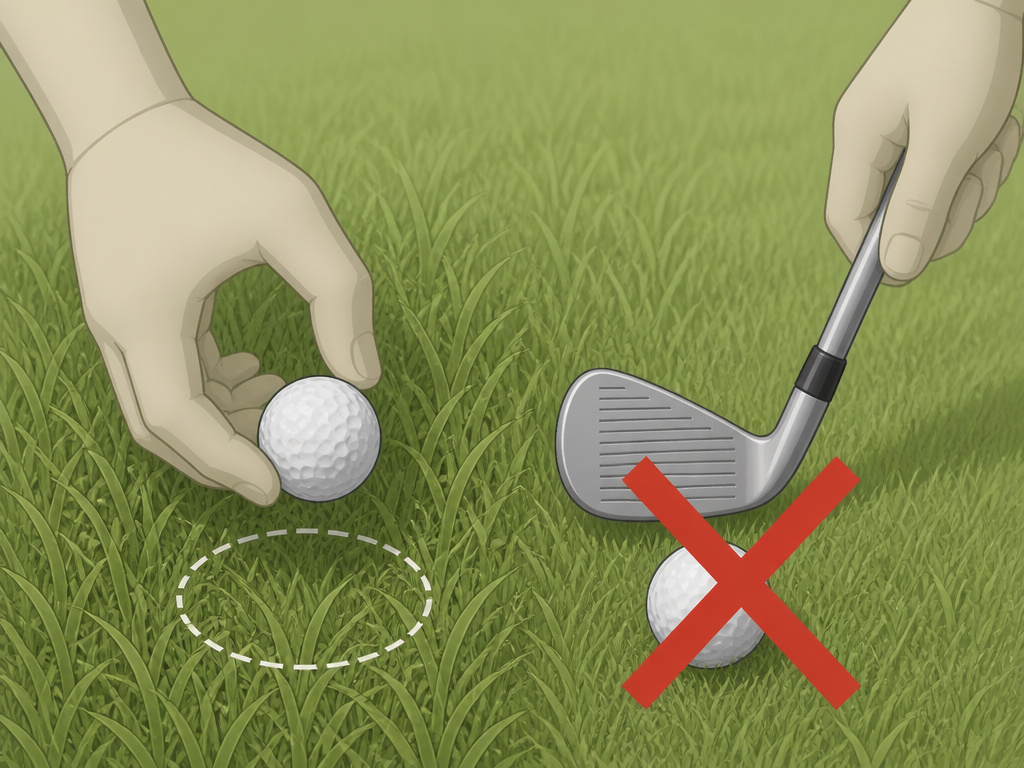
Violating Rule 9 doesn’t yield a single universal penalty. The consequence depends entirely on how you broke the rule. Confusing these two penalties is a fast way to post a wrong score.
1. The General Penalty (Rule 9.3/9.4)
This is the big one. It applies when you play your ball from a wrong place. Examples include: * Improving your lie and playing from the improved spot. * Not replacing your ball after accidentally moving it. * Taking relief from a condition (like casual water) but dropping in the wrong spot and playing from there. * The penalty is two strokes in stroke play or loss of hole in match play.
2. The One-Stroke Penalty (Rule 9.4)
This applies when you lift or deliberately touch your ball at rest without being allowed to. You then replace it correctly. The key is you haven’t played from a wrong place yet—you just touched it. If you then play from the right spot after the one-stroke penalty, you’re fine. If you play from the wrong spot, the general penalty kicks in instead.
Common mistake: Thinking a one-stroke penalty for moving your ball is the end of it. If you don’t replace it correctly before your next stroke, you incur the general penalty for playing from a wrong place on top of the original error. One mistake becomes two.
| What You Did Wrong | Primary Penalty | If You Then Play From Wrong Spot |
|---|---|---|
| Lifted/touched ball without reason | One stroke | General Penalty (replaces the one-stroke penalty) |
| Played from improved lie | General Penalty | N/A (already applied) |
| Failed to replace moved ball | General Penalty | N/A (already applied) |
Rule 9 vs. Rule 8: The Critical Separation
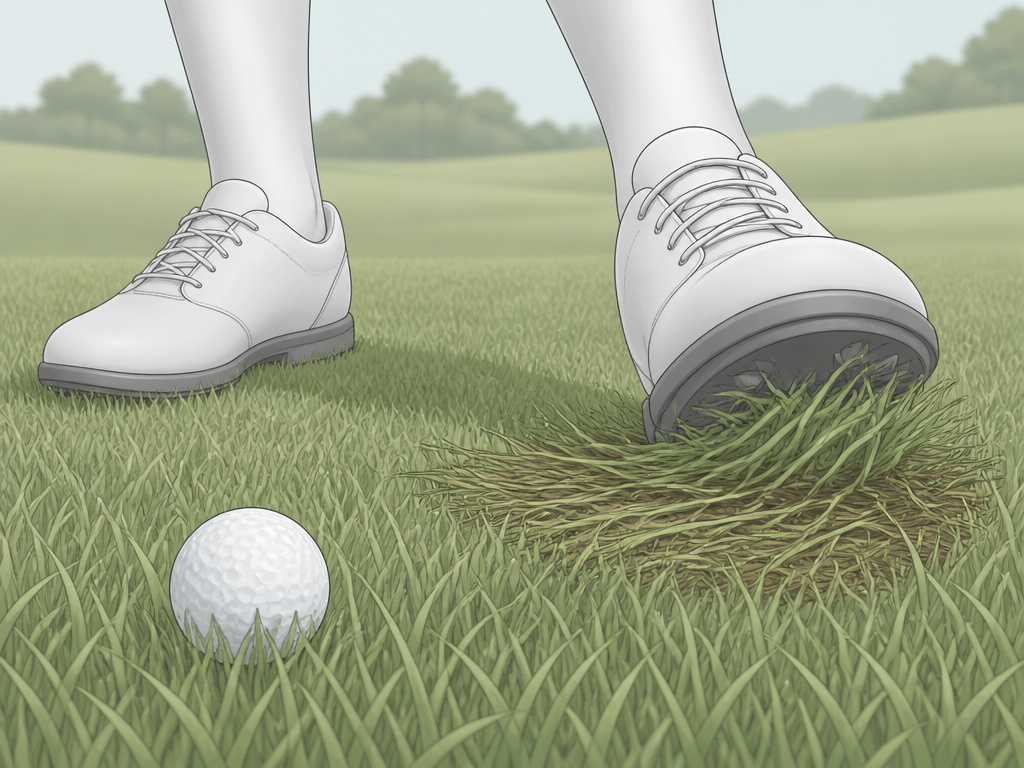
This is the nuance that separates casual players from rules-aware golfers. Rule 9 and Rule 8 are siblings, not the same rule.
Rule 9 is about the ball’s location. Can you move the ball? Can you play it from here?
Rule 8 is about the conditions affecting the stroke. Can you improve your lie, your stance, your line of play, or the area where you’ll drop?
You can be in perfect compliance with Rule 9 and still breach Rule 8. Imagine your ball is in light rough. You take your proper distance from the ball at setup. That’s fine. But if you then use your feet to trample down the grass behind the ball to create a better lie, you’ve breached Rule 8. The ball hasn’t moved (Rule 9 satisfied), but you’ve improved the conditions affecting your stroke (Rule 8 broken). That’s a general penalty.
Common Rule 8 breaches include: * Breaking a branch hanging in your backswing. * Pressing down a clump of grass behind the ball. * Wiping away dew or frost on your line of putt. * Kicking loose soil away from your ball in a divot.
The line is physical improvement versus reasonable action. You can firmly place your feet in taking your stance, even if it improves your lie. That’s allowed. You cannot repeatedly press your feet with the sole intent of improving it. Intent matters.
Practical Scenarios: How the Rule Plays Out on the Course
Let’s apply the rule to three common, frustrating situations. These are the moments where knowing the letter of the law saves strokes.
Scenario 1: Ball in a Divot in the Fairway
This is the classic gripe. Your perfect drive ends up in an old divot. The rule is harsh but clear: you must play it as it lies. A divot hole is not an Abnormal Course Condition unless it is marked as Ground Under Repair. It’s simply a “rub of the green.” You cannot take free relief. Your options are to play it from the divot or declare it an unplayable ball under penalty of one stroke.
Scenario 2: Ball Moves During Your Backswing
You start your backswing and your ball wobbles, then rolls. What now? Rule 9.1b is specific: if the ball begins moving after you have begun the stroke or backswing, and you complete the stroke, you play it from where it comes to rest. Do not replace it. However, a penalty under Rule 9.4b may still apply if you caused it to move (e.g., by grounding your club too hard). If you cause it to move before starting your stroke, it’s a one-stroke penalty and replacement.
Scenario 3: Ball Embedded in the Face of a Bunker
Your ball plugs into the steep face of a sand bunker. Is this an embedded ball for free relief? No. The embedded ball rule (Rule 16.3) applies only in the “general area” (through the green). Bunkers and penalty areas are excluded. You must play it as it lies in the sand, or declare it unplayable. If you declare it unplayable in a bunker, your relief options are limited—you typically must take relief inside the bunker with a penalty stroke.
Frequently Asked Questions
Can you move your golf ball out of a divot?
No. You must play the ball as it lies from a divot hole in the fairway or rough, unless the divot area is specifically marked as Ground Under Repair. It is one of the game’s toughest breaks, but it is not a basis for free relief under the rules.
Is there a penalty if the wind moves your ball on the green?
It depends. If your ball was at rest and wind moves it, you play it from the new spot—no penalty. However, if you had already marked, lifted, and replaced your ball on the green, and then wind moves it, you must replace it on its original spot. This is a key exception in Rule 9.3.
What is the penalty for improving your lie?
Improving your lie, stance, swing area, or line of play is a breach of Rule 8.1a. The penalty is the general penalty: two strokes in stroke play or loss of hole in match play. This is separate from any penalty under Rule 9 for moving the ball itself.
Do you get relief from tree roots?
No. Tree roots are a natural part of the course. You must play the ball as it lies if it comes to rest against or near them. If you are concerned about injury or damaging your club, your only option is to declare the ball unplayable, take a one-stroke penalty, and use one of the relief options under Rule 19.
Can you move loose impediments?
Yes. You may remove loose impediments (like leaves, stones, or twigs) anywhere on the course. But if your ball moves while you are removing a loose impediment, you incur a one-stroke penalty and must replace the ball, unless it happens on the putting green. Be very careful when moving impediments near your ball.
Before You Go
The playing the ball as it lies rule is the game’s great equalizer. It demands creativity, patience, and acceptance. The real skill isn’t just hitting from a good lie; it’s managing the bad ones without compounding the error with a penalty.
Remember the split: Rule 9 for the ball’s spot, Rule 8 for the surroundings. Know the two penalties—general and one-stroke—cold. Use the free relief exceptions when they’re yours. When they’re not, have the guts to play the shot or the sense to take your medicine with an unplayable.
That knowledge turns a rule from a restriction into a tool. It lets you play faster, score honestly, and argue with confidence. Now go find your ball, and deal with it.
