
How Routing in Golf Course Design Manages Risk and Flow
This post contains affiliate links. As an Amazon Associate, we earn from qualifying purchases.
This post contains affiliate links. As an Amazon Associate, we earn from qualifying purchases.
Routing in golf course design is the foundational process of determining the sequence and placement of tees, greens, and fairways across a piece of land. It’s not decoration. A great routing solves three puzzles at once: it maximizes the site’s natural features, creates a logical and enjoyable walk, and adheres to strict safety and construction constraints. Get it wrong, and you build an unplayable or financially doomed course before a single shovel hits the ground.
Think of it as writing a story where the land is the author. Your job is to listen. The best routings feel inevitable, as if the holes were always there, hidden just beneath the grass. This guide explains that listening process. We’ll cover the essential numbers, the artistic flow, and the hard lessons from courses that failed their first routing test.
Key Takeaways
- Safety dictates distance. Parallel fairways need at least 70 yards between centerlines. Property lines demand a 50-yard buffer. Ignoring these turns a golf course into a liability.
- Length is a myth for most players. While championship tees stretch beyond 7,200 yards, the ASGCA notes only 0.01% of golfers actually need that. Most courses thrive between 6,000 and 6,700 yards.
- The average golfer tops 23% of shots. This statistic directly shapes routing, deciding where a forced carry over water is strategic versus downright cruel.
- Routing is the first and last decision. It’s the one element almost impossible to change after construction without starting over. Everything else, bunkers, green contours, builds on this skeleton.
- Great routings use “triangulation.” This technique clusters three holes in a small loop, creating intimate settings and efficient land use, a hallmark of designs like those at Sand Hills.
What Exactly Is Golf Course Routing?
Routing is the skeleton. Before there are bunkers, before there are intricate green slopes, there is a line on a map connecting 18 points. Tom Doak defines it simply as “choosing the position of tees and greens for every golf hole on the course.” That sounds straightforward. It is not.
It’s a three-dimensional puzzle played with topography, wind, drainage, real estate, and biology. A great routing makes the walk between holes feel natural and inevitable. A poor one has you constantly wondering where the next tee is, or forces a brutal hike up a slope for no scenic reward. The goal is to make the whole course greater than the sum of its parts. You can have 18 spectacular holes that feel disjointed and exhausting if the routing fails.
The single-greatest impact to any course is the topography that dictates where golf holes may roam and how they are formed. Gentle rolling terrain is ideal for golf, and the extremes of too steep or too flat often limit a course’s potential. – Mike Nuzzo, “Bones of a Golf Course”
This is where the architect’s skill separates from the draftsman’s. Anyone can draw a hole. It takes a specific kind of vision to weave 18 of them into a coherent, flowing journey that respects the land.
What Are the Non-Negotiable Numbers in a Routing Plan?
Forget artistry for a moment. Routing begins with hard constraints. These numbers aren’t suggestions; they are the product of decades of data on golf ball flight, safety incidents, and maintenance logistics. Ignoring them is how you design a course that gets sued or goes bankrupt.
The most critical constraints involve space. You need room for the holes themselves, plus buffers for wayward shots.
| Constraint | Minimum Measurement | What Happens If You Ignore It |
|---|---|---|
| Parallel Fairways | 70 yards (center to center) | Constant risk of players hitting into adjacent groups. Becomes uninsurable. |
| Fairway Width | 30 yards | No strategic options. Course feels claustrophobic and punishes average drives. |
| Corridor Between Trees/Water | 65 yards | Plays like a tunnel, eliminates recovery shots, increases lost ball counts. |
| Buffer from Property Line | 50 yards | Neighbor disputes, potential property damage, legal restrictions on play. |
| Tee/Green Offset Angle | >15 degrees off line of play | Direct line-of-fire danger from other holes. |
These figures come from industry surveys cited in publications like Golf Course Industry. They exist because a golf ball in flight is a hazard. The 70-yard rule for parallel fairways isn’t arbitrary. It’s the distance needed to reduce the probability of a shanked drive reaching the other group to an acceptable risk.
Then there’s length. There’s a pervasive myth that a “real” course must be over 7,200 yards. According to the American Society of Golf Course Architects (ASGCA), that length is desirable for high-level amateur or professional events. But they flatly state that only 0.01% of golfers actually need it. For the daily fee player, a course between 6,000 and 6,700 yards from the back tees is more than sufficient. Chasing extreme length usually means sacrificing interesting holes for long, bland ones.
How Does a Routing Create a Journey?
Once the safety math is solved, the art begins. A routing is a narrative. It has an opening act, rising action, a climax, and a conclusion. The land provides the plot points.
The opening holes should be welcoming. A large first green, as Mike Nuzzo advocates, is a generous target that lets players settle in. The middle of the round can explore the property’s most dramatic features, its canyon, its coastline, its forest. The finale should bring a sense of resolution. Alister MacKenzie’s work at Cypress Point is a masterclass: he starts you in the dunes, weaves you through cypress forests, teases the ocean, and then delivers the breathtaking par-3 16th over the Pacific.
A siesta within a round of golf, a span of holes where we are not bombarded with stimuli, can be a decent thing. – Forrest Richardson, on designing The Links at Las Palomas
Not every hole needs to scream for attention. Richardson’s point about a “lull” is crucial. A few quieter, straightforward holes provide mental rest and make the dramatic ones feel more special. It’s about rhythm.
This journey is also physical. The walk from green to tee is part of the experience. A short, logical transition feels seamless. A long one needs a purpose, a stunning view, a change in ecosystem. That famous walk at Pacific Grove from the 11th green to the 12th tee is long, but it reveals a new, gorgeous vista. If a long walk just takes you through a maintenance shed parking lot, the routing has failed.
The Core Principles: What Makes a Routing “Work”?
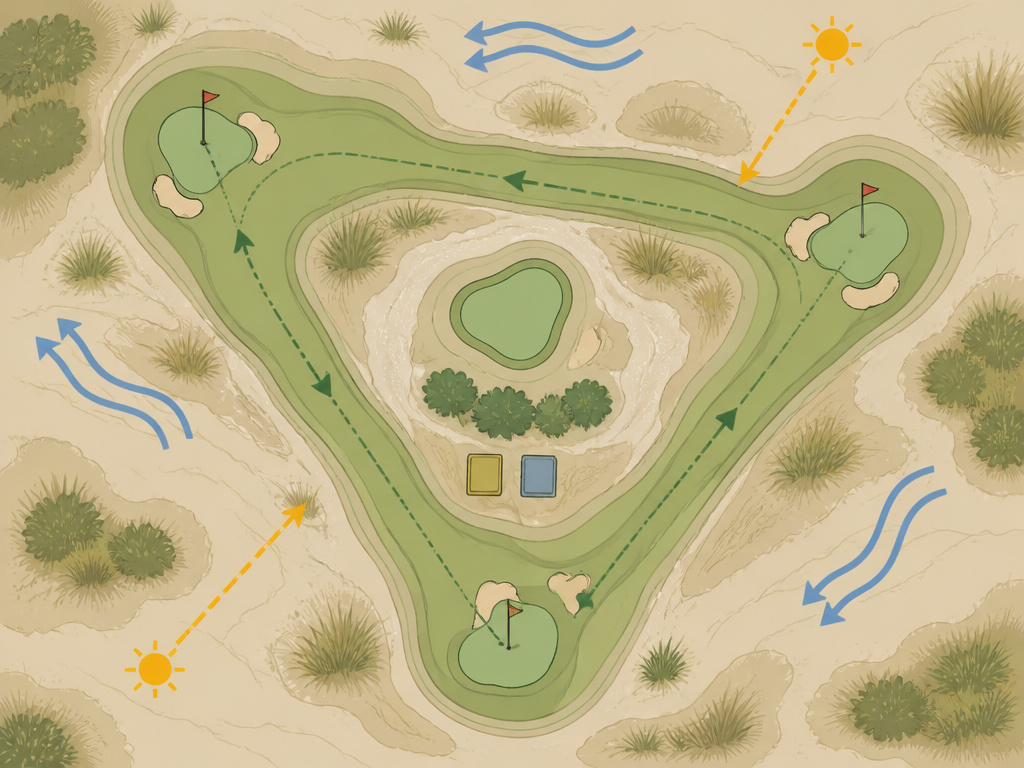
Great routings share common DNA. They aren’t accidents. While each site demands a unique solution, architects return to a few timeless principles.
Maximize Natural Features. This is the cardinal rule. The best holes look like they were discovered, not built. Bill Coore and Ben Crenshaw were given 8,000 acres for Sand Hills Golf Club; they walked until they found 18 perfect natural holes. The routing simply connected them. This minimalist design philosophy minimizes construction cost and maximizes character. Forcing a hole where the land doesn’t want it always looks and plays awkwardly.
Create Variety. Variety is the spice of golf. A great routing serves a mix of hole lengths (long par-4s, short par-4s, reachable par-5s), directions (into the wind, downwind, crosswind), and elevations (uphill, downhill, sidehill). This keeps the player engaged and tests every club in the bag. A course where every hole looks and feels the same is boring, no matter how pretty each individual hole is.
Consider the Wind and Sun. This is a practical, playability concern. A routing that has all 18 holes playing directly into the prevailing wind is a brutal slog. Good routings change direction frequently, like a sailboat tacking. Similarly, architects consider the sun’s angle, especially for morning and evening play, to avoid having players stare directly into a low sun on critical approach shots.
Use Triangulation. This is a specific, advanced technique. Instead of a long string of holes, the architect creates small, triangular loops where three holes share a corner of the property. This clusters greens and tees close together, creating an intimate feeling and reducing total land use. You can see it in the routing of Pine Valley and Sand Hills. It’s a efficient, elegant solution that often leads to more interesting golf course design principles.
What Are the Different Types of Routing Plans?
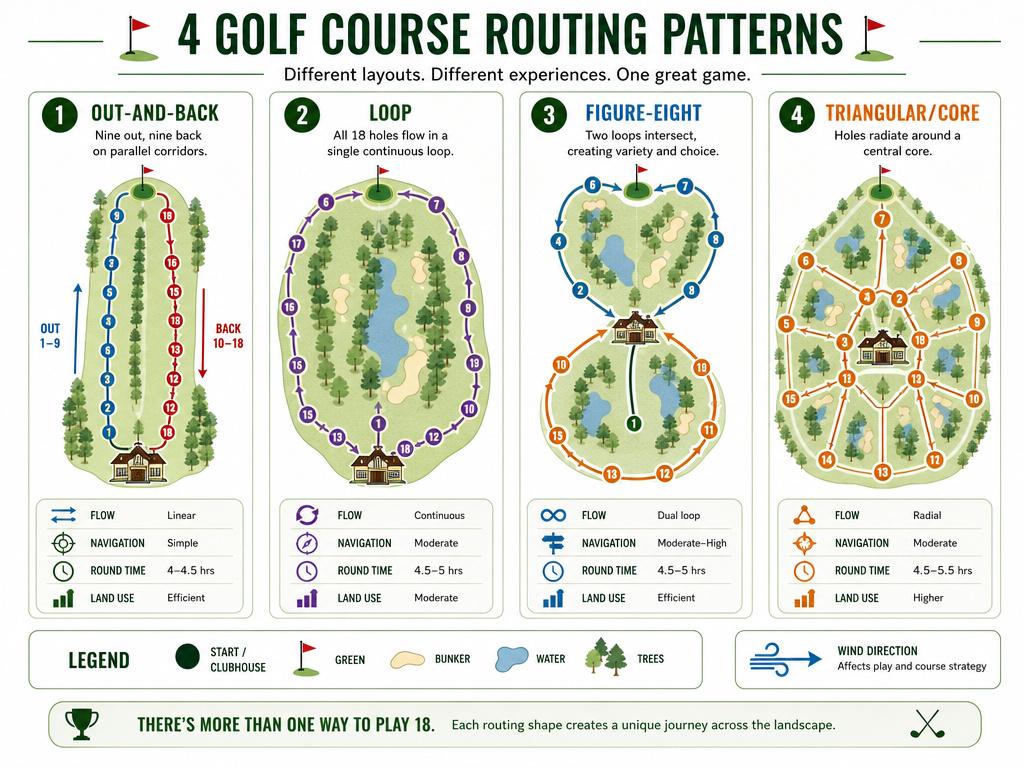
Over the centuries, a few classic routing patterns have emerged. They are templates, but flexible ones, adapting to the shape of the land.
- Out-and-Back: The oldest pattern, seen at St. Andrews. The front nine heads out in one direction, the back nine returns along a parallel corridor. It’s simple, efficient, and creates a natural sense of journey and return. The wind is a major factor, as you play straight into it and then straight downwind.
- Loop: A continuous circuit around the property’s perimeter. This is common on sites with clear boundaries or where internal land is unusable. It can feel a bit “follow the fence,” but done well, it showcases the entire property.
- Figure-Eight: Two loops that intersect near the clubhouse. This allows for a natural halfway point and can better distribute different landscapes across both nines.
- Triangular/Core: The most modern and sophisticated approach. Holes are arranged in a cluster, often using triangulation, rather than strung out in a line. This is the hallmark of Coore and Crenshaw and other minimalist architects. It minimizes walking, creates variety, and feels more integrated with the land. Studying their work provides a thorough understanding of their minimalist golf course design.com/what-is-minimalist-golf-course-design/) philosophy.
The choice depends entirely on the site. A long, narrow property almost demands an out-and-back. A large, square parcel can accommodate a brilliant core routing. The best architects don’t force a pattern; they let the land suggest one.
Environmental and Practical Constraints: The Real-World Puzzle
Today, an architect rarely gets a blank slate of perfect land. The routing puzzle includes pieces called “wetlands,” “endangered species habitats,” “utility easements,” and “housing lots.”
Environmental routing isn’t just ethical; it’s often legally mandated. The ASGCA environmental development guide details how routing can restore creek beds, create wildlife corridors, and use native vegetation to reduce water and chemical use. A routing that dances around these constraints can actually enhance the course’s ecological value and create unique, memorable holes in the process.
Clubhouse placement is another huge, often overlooked, constraint. Sometimes the best land with the best views is reserved for the clubhouse. This can anchor the routing in a specific spot, forcing the architect to work outward from a central point. Other times, existing roads or power lines carve the property into sections the routing must bridge.
Then there’s the “homemade design” lesson. A story from EGD.com recalls a course built across a deep, steep-sided canyon. The routing had players carry the canyon at right angles multiple times. It looked dramatic on paper. In reality, most players couldn’t make the carry. The course was unplayable and had to be hastily redesigned. The principle? Routing must serve the player, not the architect’s ego. The average golfer tops 23% of their shots. Your routing must account for that reality, not just the perfect swing.
Frequently Asked Questions
What’s the difference between routing and golf course architecture?
Routing is the first and most critical subset of architecture. It is the macro-plan: where the holes go. Golf course architecture encompasses everything that happens after that: shaping the land, placing bunkers, contouring greens, and designing the strategic options within each hole. The routing sets the stage; the architecture directs the play.
Who are some of the most famous golf course architects known for their routings?
The Golden Age architects like Alister MacKenzie (Augusta National, Cypress Point) and Perry Maxwell (Southern Hills, Prairie Dunes) were masters. Modern legends include Pete Dye (TPC Sawgrass), whose routings create dramatic finishes, and the minimalist team of Coore and Crenshaw (Sand Hills, Cabot Cliffs), who are renowned for finding routings that look utterly natural. The philosophy of a Tom Doak also places supreme importance on routing as the foundation of all that follows.
Can a golf course have a “bad” routing but still be good?
It’s very difficult. A bad routing creates long, tedious walks between holes, repetitive wind exposure, safety issues, and a feeling of disjointedness. You might have 18 beautifully designed holes, but if the routing is poor, the overall experience will be frustrating and exhausting. The routing is the one thing you can’t easily fix later.
How long does it take to route a golf course?
There’s no standard time. It can take weeks or months of repeated site visits, map study, and iteration. For the classic Sand Hills, Coore and Crenshaw spent over a year just walking the property and flagging potential green sites before a formal routing was drawn. Rushing this phase is the biggest mistake a developer can make.
What is a reversible or alternate routing?
It’s a rare but innovative concept where a course can be played in two different directions, like The Loop at Forest Dunes. This requires extremely careful planning so that greens can also function as tees and hazards work from both directions. It essentially gives you two courses in one, maximizing variety and value.
Before You Go
Routing is the most permanent decision in golf. Bunkers can be filled. Greens can be rebuilt. But moving a tee box 100 yards to fix a flawed sequence often means bulldozing two other holes. The pressure is real.
That’s why the process starts with the hard numbers, the 70-yard gaps, the 50-yard buffers. Then it listens to the land, finding the natural green sites and the logical paths between them. The final test is the walk. If you can play 18 holes without once feeling lost, tired by a pointless climb, or bored by repetition, the architect has done their job.
The mark of a truly great golf course is that you don’t think about its routing while you play it. You’re just on a journey, and every turn feels right. That seamless flow, that sense of inevitability, is the invisible art of routing. It’s the soul of the game, laid out on the ground.
