
Understanding the Official Rules of Amateur Status in Golf
This post contains affiliate links. As an Amazon Associate, we earn from qualifying purchases.
This post contains affiliate links. As an Amazon Associate, we earn from qualifying purchases.
The rules of amateur status in golf define a golfer who plays the game as a non-remunerative sport. You lose your amateur status by taking one of five specific actions: accepting a prize over the allowed value, playing in a competition as a professional, accepting payment for golf instruction, being employed as a golf professional, or holding membership in a professional golfers’ association. The current rules took effect January 1, 2022.
These rules exist to keep the amateur game separate from the business of golf. They are administered by The R&A and the USGA, but your specific case is handled by the national governing body where you live. That body has final say on your status and any request to get it back.
What follows is a breakdown of the five disqualifying actions, the exact prize limits, the nuanced exceptions that catch players off guard, and the step-by-step path to reinstatement if you’ve crossed the line.
Key Takeaways
- You become a non-amateur by committing one of five acts; the most common is accepting a prize (in cash or kind) worth more than $1,000 or the local equivalent.
- Entering a professional competition is fine, you only lose your status if you actually tee off in that event as a pro.
- Reinstatement is not automatic. Your national governing body requires a formal application and a recommended waiting period of at least six months from your last violation.
- The body that decides your case is the one for the country where you reside and play most of your golf, not necessarily your country of citizenship.
- These rules are about tee-to-hole competitions. Playing as a pro in a long-drive or putting contest does not affect your amateur status.
What Are the Rules of Amateur Status?
The rules of amateur status are a specific code maintained by golf’s governing bodies to preserve the distinction between playing for sport and playing for gain. Think of them as the guardrails for competitive integrity in non-professional events. Without them, local club championships could be skewed by players receiving undisclosed sponsorship or prize money.
The current framework is a modernized set that launched on January 1, 2022. It’s jointly published by The R&A and the USGA. While these two organizations write the rules, they delegate day-to-day administration. Your case is handled by the national golf union or association of the country where you live and play. This body interprets the rules, answers questions, and processes all reinstatement requests. Their decision is final, though most have an appeal process.
The R&A and USGA Rules of Amateur Status are the global standard. National governing bodies use this document to administer eligibility for all amateur competitions within their jurisdiction, from local club events to national championships.
This system means a golfer in Canada answers to Golf Canada, a golfer in England answers to England Golf, and a golfer in the United States answers to the USGA directly. Your adherence to the basic rules of the game is one thing; your adherence to the rules of amateur status is what keeps you eligible to compete for trophies instead of checks.
What Breaks Your Amateur Status? (The 5 Actions)
Losing your amateur status isn’t about playing poorly. It’s about crossing a clearly defined line into professional behavior. The rules specify five actions that cause you to become a “non-amateur.” Do any one of them, and your status is gone until you apply for reinstatement.
Here are the five, in plain terms:
- Accepting an Unallowed Prize. This is the big one for most players. You cannot accept a prize (cash or the equivalent value of merchandise) with a retail value above $1,000 (or the local currency equivalent, like £700 or €800). This limit applies to any form of competition, including hole-in-one prizes. Go over the limit, and you’re a non-amateur.
- Playing in a Competition as a Professional. This means you tee off in an event where you have entered or are listed as a professional golfer. Simply entering a pro event is okay, you only break the rule when you actually play a stroke in that competition under a professional designation.
- Accepting Payment for Golf Instruction. If you receive any form of payment for giving golf lessons, you lose your amateur status. This applies even if you’re not a certified teaching pro. Getting paid to coach is a professional act.
- Being Employed as a Golf Professional. Taking a job as a head pro, assistant pro, or director of golf at a club or driving range makes you a non-amateur. The job title and duties are what matter.
- Holding Membership in a Professional Golfers’ Association. Joining an organization like the PGA of America or the PGA European Tour as a member signifies you are a golf professional, which ends your amateur standing.
| Action | What It Means | Common Pitfall |
|---|---|---|
| Prize Over Limit | Accepting cash/merchandise worth > $1,000 (or local equivalent). | Forgetting to count the total retail value of a prize package from a tournament. |
| Play as a Pro | Teeing off in any competition where you are designated a professional. | Not realizing that signing up for a Monday pro mini-tour event and playing one hole triggers this. |
| Paid Instruction | Receiving any compensation for giving golf lessons. | Thinking “a few bucks for helping a friend” doesn’t count. It does. |
| Pro Employment | Holding any job as a golf club/driving range professional. | Assuming a seasonal assistant pro job at a muny is an exception. It is not. |
| PGA Membership | Being a member of a recognized professional golfers’ association. | Joining as an apprentice or associate member still counts. |
Where this goes sideways: Assuming a “scramble” or “charity event” has different prize rules. The $1,000 limit applies to any golf competition, no matter how casual. Win a $1,200 driver at a charity outing and you’ve broken your amateur status.
The line is bright. There is no “mostly amateur.” You either are or you aren’t. These rules interact with other equipment rules, like using non-conforming drivers in amateur play, which can lead to disqualification but doesn’t affect your status, a crucial distinction.
The Nuances and Edge Cases (What Most Articles Miss)
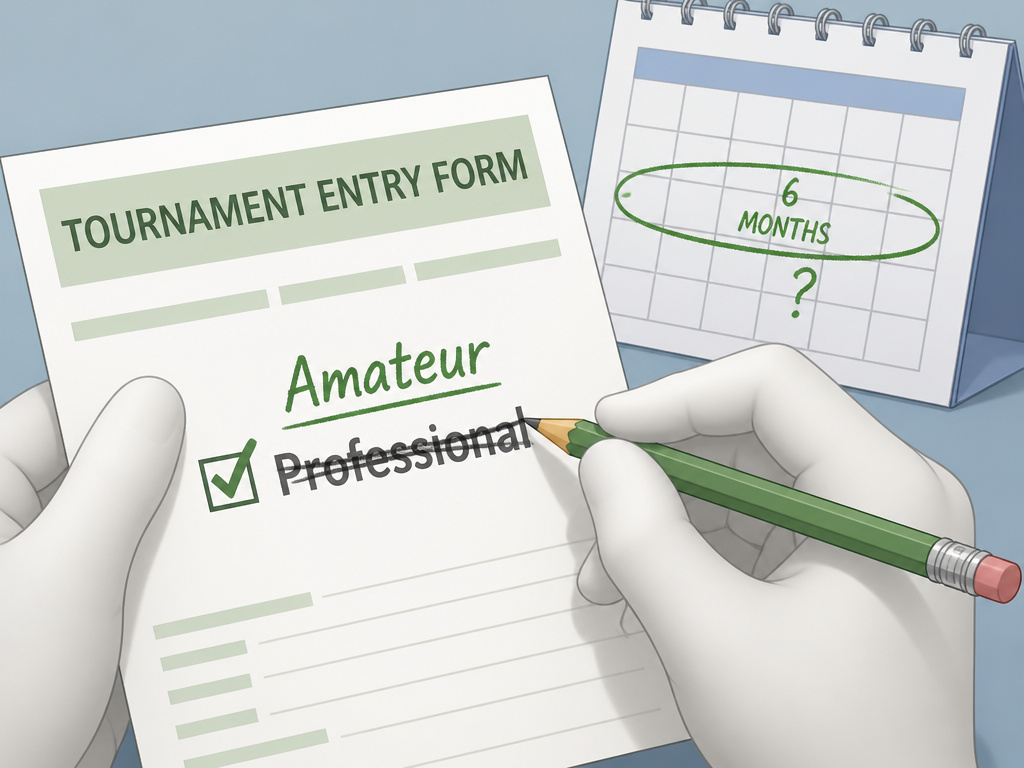
The straightforward list above has intentional gaps. The governing bodies know golf isn’t always simple, so the official Guidance Notes carve out specific exceptions. These are the clauses that keep a college golfer’s career from ending over a paperwork error.
You can enter a professional competition without consequence. The rule only bites when you play. If you enter a mini-tour event as a pro but withdraw your entry or change your status to amateur before you tee off, your amateur status remains intact. This allows players to test the waters or secure a spot while still competing in amateur events.
Non-tee-to-hole competitions don’t count. Your amateur status is only for traditional stroke or match play. If you compete as a professional in a long-drive contest, a putting competition, or a skills challenge, it has zero effect on your eligibility for the U.S. Amateur or your club championship.
Some competitions have no status designation. If you play in an event that doesn’t require you to declare as an amateur or professional, you can play freely. Your status remains amateur unless you accept a prize that breaks the monetary rule. This is common in some international or informal tournaments.
The six-month reinstatement wait is a recommendation, not a guarantee. Your national governing body has full discretion. They can set a longer waiting period if your case involves prolonged professional activity. They also decide the start date for that clock, which might not be the day you last got paid for a lesson, it could be the day you ended your pro club job.
Understanding these nuances is as important as knowing the penalty strokes for a lost ball. One misstep can cost you years of eligibility.
The Reinstatement Process: How to Get Your Status Back
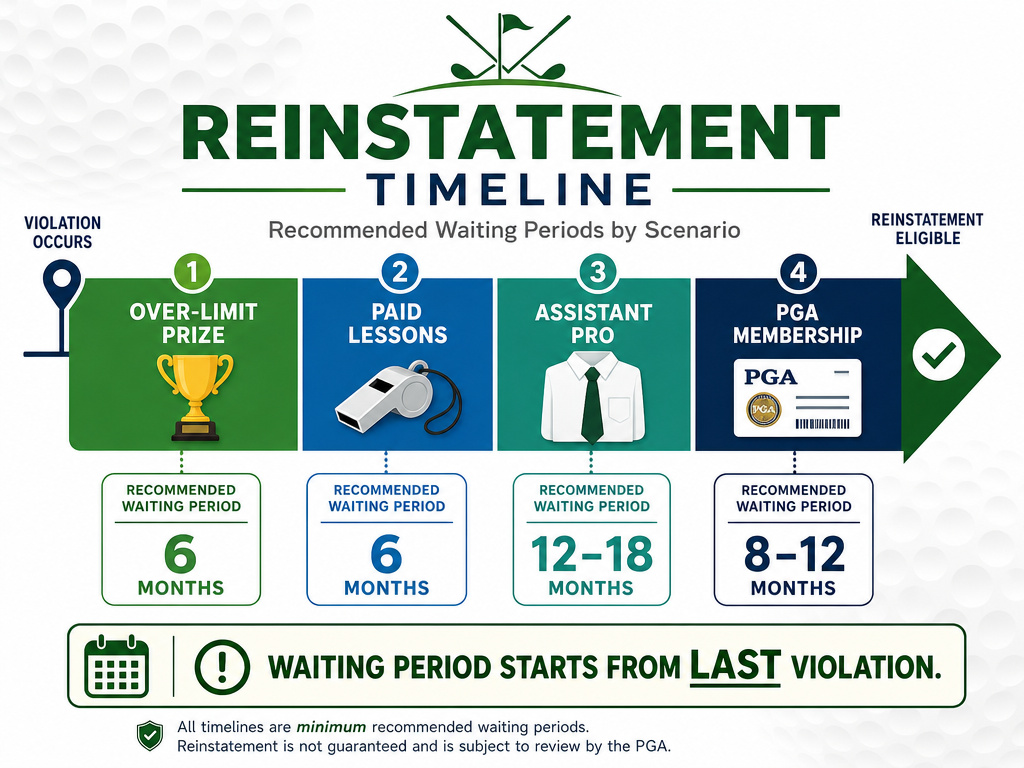
So you’ve broken the rules and become a non-amateur. Getting your amateur status back is called reinstatement. It’s a formal request, not an automatic right. The process is administered by the national governing body of the country where you reside.
The core of the process is demonstrating you have completely ceased all activities that made you a non-amateur. You must file a detailed application that documents your past violations and your current, clean separation from professional golf. The body will review the length and seriousness of your past actions, your conduct since stopping, and your stated intent to compete as a true amateur.
The part nobody mentions: The waiting period starts from the date of your last act that violated the rules, not the first. If you gave paid lessons from 2020-2023 and also worked as a pro shop assistant in 2024, your clock starts when the pro shop job ended.
The governing body is recommended to impose a waiting period of at least six months. In practice, for someone who was a club professional for several years, the wait is often one to two years. For a player who only accepted a single over-limit prize, six months might suffice.
| Scenario | Last Violating Act | Earliest Possible Reinstatement | Likely Real-World Timeline |
|---|---|---|---|
| Accepted a $1,500 prize | June 1, 2024 | December 1, 2024 | 6-8 months after application |
| Worked as Assistant Pro | Employment ended Sept 30, 2023 | March 30, 2024 | 12-18 months, given sustained employment |
| Held PGA Membership | Membership lapsed Jan 15, 2024 | July 15, 2024 | 8-12 months, depending on membership duration |
| Gave paid lessons | Last lesson paid for on Aug 10, 2024 | Feb 10, 2025 | 6 months, if isolated incident |
The body’s decision is final. You must wait out the full period before resubmitting if you are denied. This is why understanding the rules for penalties in golf is simpler than navigating amateur status, the stakes are your entire competitive future.
Why Do These Rules Exist? (The “Why” Layer)
This isn’t just bureaucracy. The rules of amateur status serve three concrete purposes that protect the game.
First, they preserve the spirit of amateur competition. Events like the U.S. Amateur or the Walker Cup are meant to showcase the best players who are not motivated by financial gain. If those fields were filled with players receiving under-the-table sponsorships or stacking prize money, the event’s character changes completely.
Second, they prevent unfair competition at all levels. Imagine a local club championship where one player is secretly on a equipment company’s payroll, receiving free clubs, balls, and travel. That creates an uneven playing field that undermines the event for every other member. The prize limit rule specifically stops this.
Third, they draw a clear line for governance. The rules give national bodies a clean, objective standard to enforce. This prevents endless disputes about “how amateur” someone is. You’ve either done one of the five things or you haven’t. This clarity is why organizations like the USGA can efficiently manage the USGA rules for driver head size and amateur eligibility under one consistent framework.
The system isn’t perfect, but its rigidity is its strength. It removes ambiguity, which in turn protects the vast majority of golfers who just want to play for the love of the game.
Frequently Asked Questions
Can I accept a prize if I donate it to charity?
Yes, but with a critical caveat. You may redirect a prize to a recognized charity without violating the rules, but you must do so before accepting possession or ownership of it. If you take the $1,200 check, you’re a non-amateur, even if you endorse it over to charity five minutes later. The act of acceptance is the trigger.
Does playing in a pro-am affect my amateur status?
No, playing in a pro-am does not affect your amateur status. In a pro-am, you are an amateur playing alongside a professional. You are not entering or playing the competition as a professional. You must still be mindful of the prize limits for any amateur prizes awarded within the pro-am.
I’m a college golfer with sponsors. Am I okay?
This is a minefield. Generally, accepting sponsorship that covers reasonable golf expenses (travel, entry fees, equipment) is allowed under strict conditions. The sponsorship must not be a form of payment for services, and it must be administered through your national governing body or educational institution. Never accept direct cash payments or endorsements for personal gain. When in doubt, consult your college compliance officer and your national golf federation.
How do I find my national governing body?
If you live in the United States, it’s the USGA. In Canada, it’s Golf Canada. In the United Kingdom, it depends on your home nation: England Golf, Scottish Golf, Golf Union of Wales, or the Golfing Union of Ireland. A quick search for “[Your Country] golf federation” or “national golf union” will point you to the correct organization. They handle everything from the golf dress code at national events to the 14-club rule and amateur reinstatements.
What’s the difference between amateur status and golf etiquette?
Amateur status is a formal eligibility rule with written consequences. Golf etiquette is a code of on-course behavior concerning pace of play, care of the course, and respect for other players. Breaking a rule of etiquette might get you a dirty look; breaking a rule of amateur status ends your ability to compete in sanctioned events. Both matter, but on completely different levels.
The Bottom Line
The rules of amateur status are specific, strict, and designed for clarity. They exist to keep the amateur game honest. Your job is to know the five lines you cannot cross: prize value, playing as a pro, paid instruction, pro employment, and PGA membership.
If you do cross one, reinstatement is a formal process with a mandatory waiting period. Your national governing body holds the keys. Don’t guess with this, when a decision involves your eligibility, go straight to the source and get it in writing. That’s the only way to be sure you’re playing by the official rules.
