
Strokes Gained vs Traditional Stats: A Complete Analysis
This post contains affiliate links. As an Amazon Associate, we earn from qualifying purchases.
This post contains affiliate links. As an Amazon Associate, we earn from qualifying purchases.
Strokes gained measures the quality of every shot by comparing it to a benchmark, while traditional stats like greens in regulation (GIR) and fairways hit only track binary outcomes. The strokes gained calculation assigns a precise value—positive or negative—based on a shot’s start and end location, revealing if a 300-yard drive in the rough is actually better than a 220-yard drive in the fairway. Traditional stats can’t make that distinction.
That distinction between quality and a simple checkmark is where your practice plan gets built or broken. A greens in regulation stat tells you you missed the green. It doesn’t tell you whether you missed from 180 yards in the fairway or from 40 yards in the first cut. One of those misses is a catastrophic failure for a low handicapper. The other is a minor slip. Your traditional stat sheet treats them the same.
What follows is a direct comparison of the two systems: the old-school totals that have guided golfers for decades and the modern, granular analytics that now guide Tour pros and serious amateurs. You’ll see exactly where each one fails, where each one shines, and how to blend them to find the specific shots costing you strokes.
Key Takeaways
- Strokes gained evaluates quality, not just outcome. It uses distance and lie to judge if a shot gained or lost strokes versus a benchmark, exposing nuances that fairways hit or GIR completely miss.
- Traditional stats are binary and can be misleading. Hitting the fairway but leaving a long approach is recorded as a success, even if it puts you in a worse scoring position than a longer drive in the rough.
- The real power of strokes gained is in its segmentation. Breaking down performance into strokes gained off the tee, approach, around the green, and putting tells you exactly which part of your game to practice.
- Handicap benchmarking is the next frontier. Early systems compare you to Tour players, but the most useful data for amateurs will compare you to players of your own handicap level, showing where you actually outperform or underperform your peers.
- You don’t have to choose one system. Use traditional stats for a quick, broad-strokes overview of your round. Use strokes gained analytics for your post-round practice prescription.
The Core Difference: Outcome vs. Quality
Traditional golf statistics are a checklist. Did the ball land on the short grass? Check. Did it land on the green in the required number of shots? Check. How many times did you use your putter? Write it down.
Strokes gained is a measuring tape. It asks where the ball finished and how much closer to the hole that spot puts you for the next shot compared to everyone else. The system, popularized by Columbia Business School professor Mark Broadie, uses a massive database of shots to establish a benchmark: the average number of strokes a player takes to finish the hole from any given location and lie.
Strokes Gained = (Strokes to finish from START location) – (Strokes to finish from END location) – 1
This is the foundational equation. You take the benchmark strokes to finish from where your ball was, subtract the benchmark strokes to finish from where it ended up, and subtract the stroke you just played. A positive result means you gained strokes on the field. A negative result means you lost them.
This turns every shot into a value. A 5-foot putt holed for par might gain you +0.8 strokes because the benchmark from that distance is 1.2 putts. A missed 5-footer loses you -0.8 strokes. Your fairways hit stat only records a check or an X. It cannot capture that a 320-yard drive into the first cut is often more valuable than a 260-yard drive in the center of the fairway.
The limitation of traditional stats is their silence on consequence. As noted in an OEM analysis, a player can miss a fairway by one yard, hit it into a penalty area, or hit it out of bounds. The fairways hit column sees only three identical “misses.” The strokes gained system sees three wildly different disasters, each with a specific cost attached.
What Does Strokes Gained Actually Measure?
Strokes gained analytics break your game into the four core segments of golf. This segmentation is its killer feature, transforming a round from a single number into a diagnostic report.
| Strokes Gained Category | What It Measures | The Traditional Stat It Replaces/Refines |
|---|---|---|
| Off the Tee | Every shot from the tee box on par-4s and par-5s. Values both distance and accuracy. | Fairways Hit (which ignores distance entirely). |
| Approach | Every shot from outside 50 yards to the green. Judges proximity, not just a GIR. | Greens in Regulation (GIR). |
| Around the Green | Any shot from within 50 yards of the green that isn’t a putt. | Scrambling Percentage or “up and down” rate. |
| Putting | Every putt, regardless of length. | Putts per Round (which penalizes good ball-strikers). |
This framework allows for precise strokes gained calculation. If you want to lower your scores, you find the segment with the largest negative number and attack it. It removes guesswork. You don’t just “work on your short game.” You work on your 20-30 yard pitch shots from the rough because the data shows you lose 0.4 strokes per attempt there compared to your handicap benchmark.
Where this goes sideways: Relying only on putts per round. A player who hits 18 greens might have 36 putts and look like a bad putter. A player who misses 18 greens might have 28 putts and look like a wizard. Strokes gained putting adjusts for the difficulty of the first putt, revealing the true performance.
This is why understanding how strokes gained is calculated matters. It’s not a black box. It’s a consistent formula applied to every shot, giving you an apples-to-apples comparison across every round you play, regardless of course difficulty.
Strokes Gained in Action: A Real Hole Breakdown
Let’s make this concrete. Take a 381-yard par 4. Two players hit their tee shots.
- Player A: Hits the fairway, 185 yards from the hole.
- Player B: Hits the rough, 60 yards from the hole.
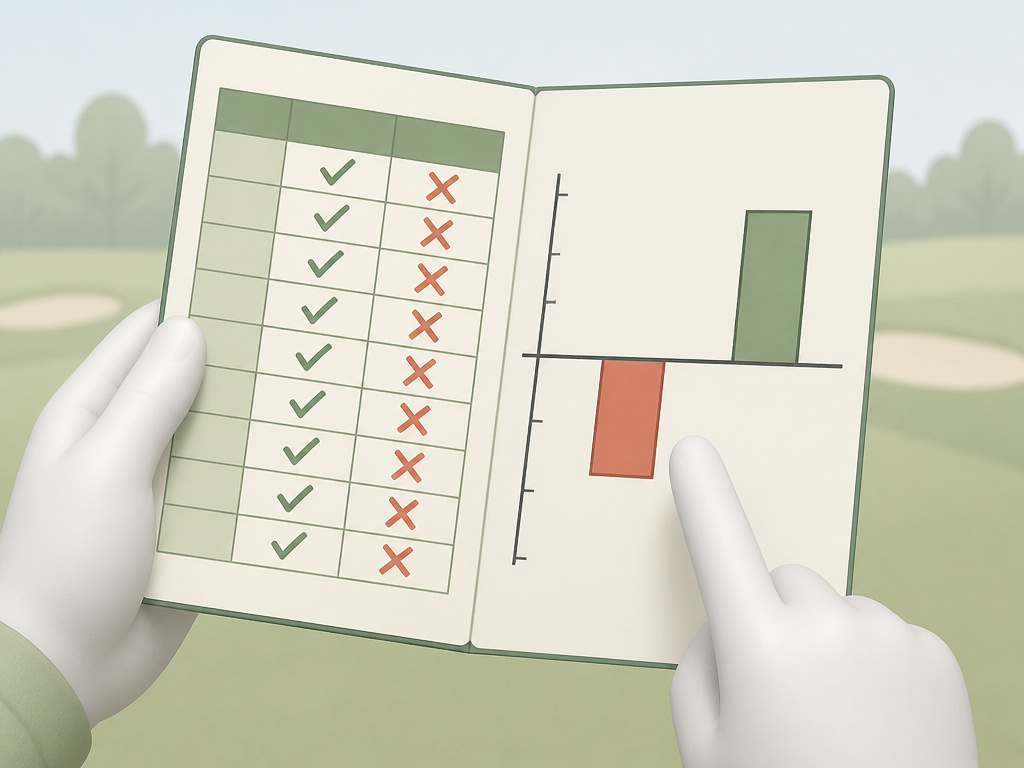
The traditional stats sheet looks like this: * Player A: Fairway Hit ✅ * Player B: Fairway Hit ❌
It suggests Player A did better. The strokes gained analysis, using a Tour benchmark, tells a different story. From 185 yards in the fairway, the benchmark to finish the hole is, say, 3.2 strokes. From 60 yards in the rough, it might be 2.8 strokes.
- Player A Strokes Gained: (3.2) – (Strokes to finish from 185y fairway) – 1. The math might show a loss of -0.1 strokes.
- Player B Strokes Gained: (3.2) – (2.8) – 1. This shows a gain of +0.3 strokes.
Player B’s massive distance advantage, even from the rough, earned them nearly half a stroke on Player A on that single tee shot. Over 14 driving holes, that’s a 4-5 stroke difference that the fairways hit stat would never show you. This is the essence of strokes gained off the tee.
Now, look at a full hole. A golfer makes a routine par. The traditional card shows a 4, maybe a GIR, and two putts. The strokes gained breakdown could reveal a different story:
- Tee Shot: -0.15 (A mediocre drive)
- Approach: +0.40 (A great shot to 15 feet)
- First Putt: -0.35 (A poor lag putt to 5 feet)
- Second Putt: +0.10 (A solid knee-knocker made)
Net for the hole: 0.00 strokes gained. They played to their benchmark. But the diagnosis is clear: their driving was shaky and their long putting was poor, saved only by a brilliant iron shot. This level of detail is what makes strokes gained approach and strokes gained putting such powerful tools for improvement.
The Limits and Strengths of Traditional Stats
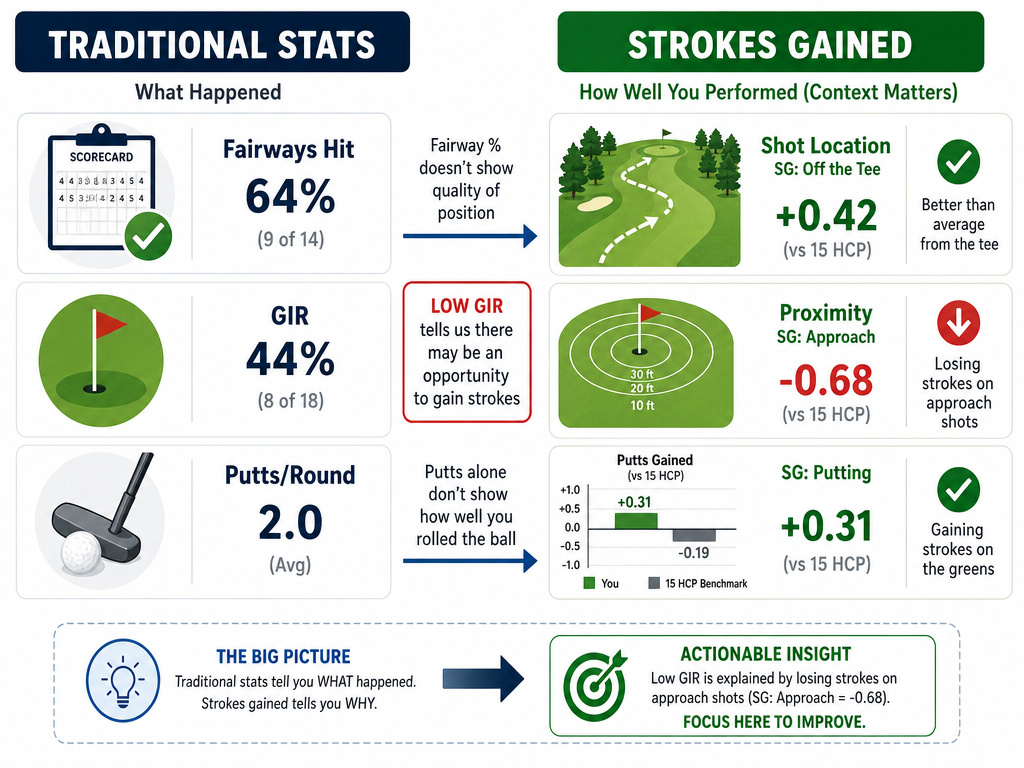
Traditional statistics are simple, easy to track, and provide a high-level snapshot. For a beginner, knowing your greens in regulation percentage is a fantastic starting goal.Tracking putts per round can highlight if you’re three-putting too often. They are the fundamentals.
Their strength is their accessibility. You need only a scorecard and a pencil. You can calculate your GIR percentage or fairways hit after a round in two minutes. This makes them perfect for establishing a baseline. Before you dive into the deep end of strokes gained data, you should have a firm handle on these basic metrics.
Their weaknesses, however, are structural:
- They Lack Context: As we saw, a fairway hit is not always good. A green hit with a 60-foot putt over three tiers is not the same as hitting it to 10 feet.
- They Can Mislead Practice: If your GIR is low, you might spend all your time on the range with your 7-iron. But the strokes gained data might show your real problem is strokes gained around the green from 30-50 yards, because you’re missing greens in the wrong places.
- They Are Interdependent: A high putts-per-round number often indicates poor approach play, not poor putting. You’re putting from longer distances because your irons aren’t close.
The part nobody mentions: Traditional stats work best as a broad filter. They tell you what happened. Strokes gained tells you why it happened and how much it mattered. You use the former to flag an area, and the latter to surgically operate on it.
For the golfer not ready for full analytics, focusing on one traditional stat at a time is a valid path. Just know its blind spots. Improving your GIR statistic is a worthy goal, but understand that simply hitting more greens isn’t the same as hitting them closer.
How to Use Both Systems to Lower Your Scores
You don’t need a Ph.D. In statistics or a $500 device to benefit from this. The goal is smarter practice, not data entry. Here’s a practical plan for integrating both worlds.
Step 1: Establish Your Traditional Baseline. For your next five rounds, track these three things manually: 1. Fairways Hit (Driver only) 2. Greens in Regulation 3. Total Putts / Number of 3-Putts
This gives you a snapshot. Is your driving all over the map? Are you barely hitting any greens? Are you averaging 38 putts? You now know where to start looking.
Step 2: Diagnose with Strokes Gained. This is where technology helps. Use a dedicated GPS watch or a stat-tracking app like Shot Scope or Arccos. Play three rounds with it. Don’t obsess over the numbers during the round. Just let it collect data.
After those rounds, look at your strokes gained benchmarks report. It will rank your four categories from biggest weakness to biggest strength. Your practice priority is the biggest negative number.
Step 3: Create a Targeted Practice Plan. Let’s say your biggest leak is strokes gained approach and specifically from 150-175 yards. * Traditional mindset: “I need to hit more greens.” * Strokes gained mindset: “I need to improve my proximity to the hole from 165 yards by 15 feet on average.”
Your practice session changes. Instead of mindlessly hitting 7-irons at a green, you set up a specific drill. Place three towels on the green at 10, 20, and 30 feet. Hit ten shots from 165 yards. Track how many finish inside the 20-foot towel. That’s a measurable, data-driven practice goal born from strokes gained analysis.
Step 4: Check Your Progress. After a month of targeted practice, check your strokes gained report again. Has that 150-175 yard category improved? Has your overall strokes gained approach number moved toward zero or into positive territory? This is how you know your practice is working.
Easy to miss: The benchmarks you use matter. Comparing yourself to PGA Tour data is inspiring but can be demoralizing. The real breakthrough for amateurs is handicap benchmarking—comparing your performance to other 10, 15, or 20 handicappers. This shows you where you are actually better or worse than your peers, giving you a relevant roadmap to get to the next handicap level.
Frequently Asked Questions
Can I calculate strokes gained by hand?
Technically, yes, using the formula and a published benchmarks table. Practically, it’s extremely time-consuming. The value of the strokes gained metric comes from automated tracking via a GPS watch, club tags, or a mobile app that does the strokes gained calculation for every shot instantly.
Do I need to buy expensive gear to use strokes gained?
No. Several mobile apps (like Golfshot, 18Birdies) offer basic strokes gained analysis with manual shot entry for a subscription fee. Dedicated systems like Shot Scope use a one-time purchase watch and club tags for automatic tracking. Start with an app to see if the data resonates with you before investing more.
Which is more important for a high handicapper: traditional or strokes gained?
Start with traditional. A high handicapper has fundamental, broad issues. Consistently making contact, avoiding penalty strokes, and reducing three-putts are the goals. Tracking fairways hit and putts per round is perfect for this. Once you break 90 consistently, then layer in strokes gained explained concepts to refine specific areas.
Why does “Putts per Round” still exist if it’s flawed?
Because it’s simple and historic. It’s a quick, universal number everyone understands. For a very rough gauge of a putting performance over a season, it has some use. Just never use it to diagnose a single round or guide your putting practice. For that, you need strokes gained putting.
How often should I review my strokes gained data?
After every round, glance at the overall category breakdown. Do a deeper dive once a month. Looking at data from 3-5 rounds together smooths out the outliers and reveals true trends. This monthly review is what should dictate your next month’s practice focus.
The Bottom Line
The debate between strokes gained and traditional stats is about using the right tool for the job.
Keep your pencil and track your greens in regulation and fairways hit. They are your vital signs—a quick check to see if you’re alive on the course. But when you need surgery, when you need to know exactly which organ is failing, you need an MRI. Strokes gained is that MRI.
Embrace the granularity. Let the data from your last five rounds tell you, unequivocally, that your driving is fine, your putting is average, but your wedge play from 75 yards is losing you two strokes a round. That’s a practice prescription you can trust. That’s how you stop working hard and start working smart. Your scores will follow.
