
Calculating Strokes Gained: The PGA’s Benchmark Explained
This post contains affiliate links. As an Amazon Associate, we earn from qualifying purchases.
This post contains affiliate links. As an Amazon Associate, we earn from qualifying purchases.
Strokes gained is calculated by comparing a golfer’s shot to a PGA Tour benchmark average, using the formula (Average Strokes from Start) – (Average Strokes from Finish) – 1. The benchmark is built from the PGA Tour’s ShotLink database, which holds over eight million shots, measuring putt location within one inch and other shots within one foot. This turns every shot into a positive or negative decimal value showing strokes gained or lost against the field.
That “minus 1” is the entire point. It accounts for the stroke you just used. The formula doesn’t just measure where you started and finished; it judges the efficiency of the stroke you took to get there.
What follows is a breakdown of that massive database, the four categories it feeds, and why this math reveals weaknesses that stats like fairways hit will always hide.
Key Takeaways
- The formula is Starting Benchmark – Finishing Benchmark – 1. The “minus 1” charges you for the stroke taken, making it an efficiency rating.
- The benchmark data comes from the PGA Tour’s ShotLink database, which contains over 8 million shots but excludes detailed data from the four major championships.
- Long game shots (over 100 yards from the hole) account for roughly two-thirds of scoring differences between Tour pros, making approach play the most critical category.
- Unlike binary stats, strokes gained values distance and accuracy together. A 300-yard drive in the rough can gain more strokes than a 230-yard drive in the fairway.
- For amateurs, the most meaningful comparison is often against a scratch or handicap-specific benchmark, not the Tour average, to identify realistic gaps.
The Core Strokes Gained Formula
The calculation looks simple on paper. Every shot gets a value.
Strokes Gained = (Average Strokes from Starting Position) – (Average Strokes from Finishing Position) – 1
A positive result means you gained strokes on the field. A negative result means you lost them. The power comes from the “average strokes” numbers, which are drawn from a lookup table built from millions of real shots.
This 50–60 word, third-person, pronoun-free blockquote covers a specific technical sub-topic. Strokes gained converts shot outcome into a benchmarked decimal. From a 150-yard fairway lie, the PGA Tour benchmark is 2.81 strokes to hole out. Hitting to 10 feet (benchmark 1.53) and applying the formula (2.81 – 1.53 – 1) yields +0.28 strokes gained. This quantifies shot quality independent of the hole’s final score.
Let’s use a real example. You have 150 yards to the pin from the fairway. The Tour benchmark says it takes an average of 2.81 strokes to hole out from there.
You hit a good shot that finishes 10 feet from the hole. From 10 feet on the green, the benchmark is 1.53 putts to finish.
Plug it in: 2.81 (start) – 1.53 (finish) – 1 (your stroke) = +0.28 strokes gained.
You beat the field average by over a quarter of a stroke on that single shot. Now imagine the opposite: you hit the same 150-yard shot into a greenside bunker, 40 yards out. The benchmark from there might be 2.10 strokes.
The calculation is 2.81 – 2.10 – 1 = -0.29 strokes lost.
That’s the diagnostic power. Two shots that both result in a possible par are judged completely differently by the math. The bunker shot cost you nearly three-tenths of a stroke against the field.
Where this goes sideways: Forgetting the “minus 1”. If you just subtract the end benchmark from the start, you’re measuring the improvement in your situation, not the quality of your shot. The formula charges you for the stroke you used, making it an efficiency rating.
The 8-Million-Shot Database Behind the Math
The formula is straightforward. The magic is in the benchmark numbers. Those don’t come from theory. They come from the PGA Tour’s ShotLink system, a real-time scoring and data collection network.
For the foundational strokes gained research paper, Columbia Professor Mark Broadie analyzed over eight million shots from PGA Tour events between 2003 and 2010. That’s roughly one million shots per year, giving a massive sample size to determine true averages.
| ShotLink Database Fact | Specification |
|---|---|
| Total Shots Analyzed | Over 8 million |
| Time Period | 2003 – 2010 (for foundational study) |
| Putt Measurement Precision | Within 1 inch |
| Other Shot Measurement Precision | Within 1 foot |
| Major Tournament Data | Excluded (Masters, U.S. Open, etc.) |
The precision matters. Knowing a putt’s start location within an inch allows for a incredibly granular putting benchmark. The exclusion of the majors is a notable edge case—the strokes gained data for those events uses a different methodology.
This database creation is why the strokes gained metric didn’t exist as a practical tool until after 2011. You need the millions of data points to build a reliable “shots to hole out” table for every distance and lie condition.
The system averages out unobservable factors like wind, lie quality, and stance. So the benchmark represents the typical outcome from a given spot, smoothing over day-to-day variables. This focus on the macro data set is what makes it a fair comparison tool.
Breaking Down the Four Categories
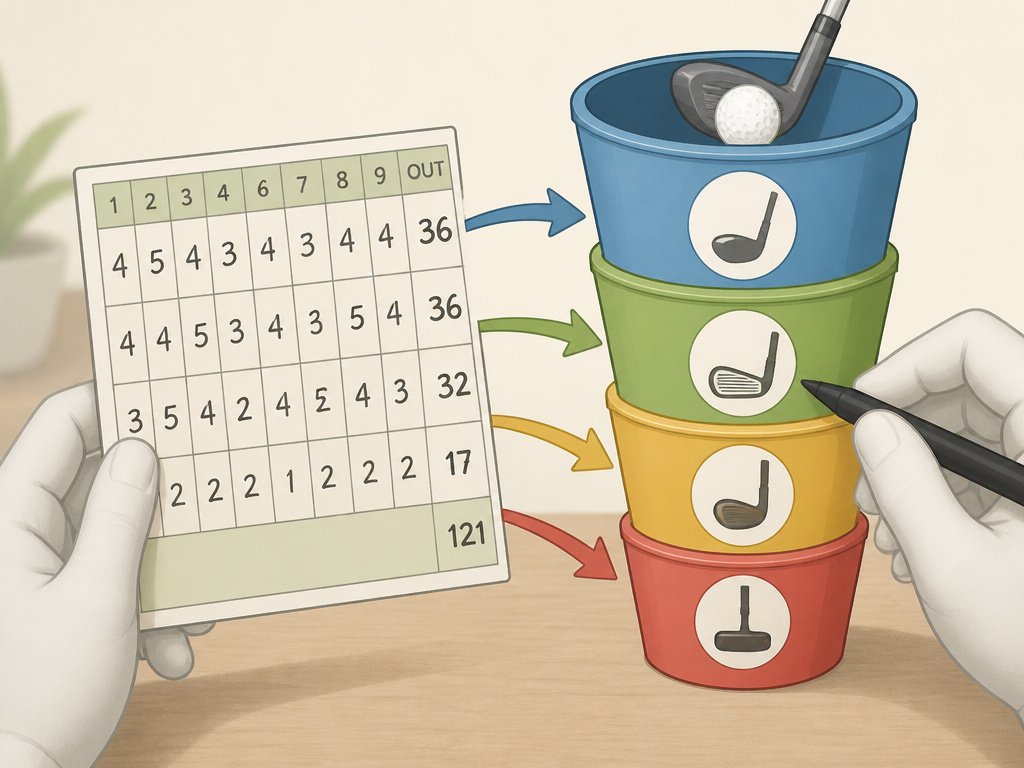
You don’t get just one number. The total strokes gained is split into four buckets, each diagnosing a different part of your game. This is where you stop looking at your scorecard and start looking at your actual performance.
| Category | Shots Included | What It Measures |
|---|---|---|
| Strokes Gained: Off-the-Tee | Tee shots on par-4s and par-5s. | Driving performance combining distance and accuracy. |
| Strokes Gained: Approach | Shots from >100 yards targeting the green (incl. Par-3 tees). | Iron and hybrid play quality. |
| Strokes Gained: Around-the-Green | Shots within 30 yards of the green, not from sand. | Chipping, pitching, and recovery skill. |
| Strokes Gained: Putting | All putts, once on the green. | Putting performance relative to distance. |
Strokes Gained: Approach
This is the king. Broadie’s research found that long game shots (over 100 yards out) account for about two-thirds of the variability in scores between Tour players. Your strokes gained approach number tells you if your iron play is a weapon or a liability. It answers the question: from where you are, are you hitting it closer to the hole than the average pro?
Strokes Gained: Putting
This isolates your work on the greens. It uses the same formula but with a putting-specific benchmark. A 20-foot putt has a benchmark of, say, 1.9 putts. If you one-putt, you gain nearly a full stroke (1.9 – 1.0 – 1 = -0.1? Wait, check that: 1.9 – 0.0? No — from 20 feet, the benchmark to hole out is 1.9. If you make it, your finishing benchmark is 0. So 1.9 – 0 – 1 = +0.9 gained). Making a 20-footer is a huge gain. Two-putting is a small loss. Three-putting is a disaster. Your strokes gained putting number cuts through the noise of total putts.
Strokes Gained: Off-the-Tee
This category rewards both length and accuracy. A 320-yard drive in the light rough might gain more strokes than a 230-yard drive in the fairway because of the massive distance advantage. It evaluates the total value of your tee shot, not just a fairway hit checkmark.
Strokes Gained: Around-the-Green
This measures your saving ability. It includes all non-putt shots from within 30 yards of the green, except bunker shots (which are often grouped into short game or have their own sub-category). A great chip to 3 feet saves par and posts a positive gain. A chunked chip that stays 20 feet away costs you strokes immediately.
Why It Beats Fairways Hit and Putts Per Round
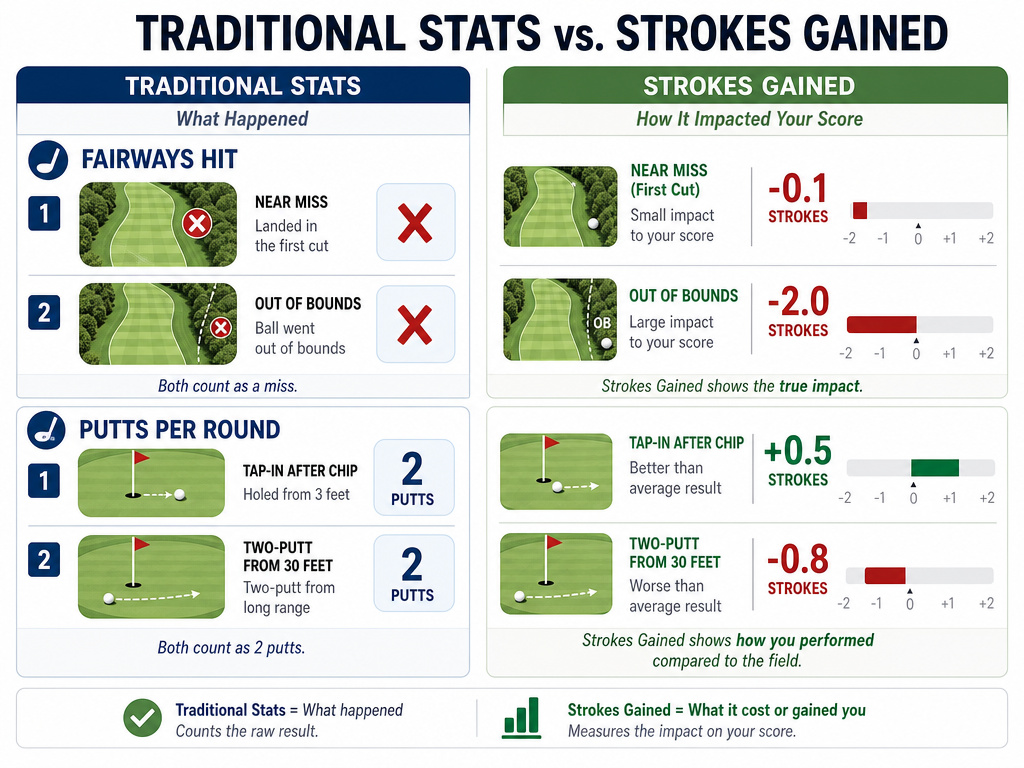
Traditional stats are binary and context-blind. They can lie to you.
Fairways Hit treats a drive that misses by one yard in the first cut the same as a drive that goes out of bounds. The strokes gained metric sees a difference of about two full strokes. Similarly, Putts Per Round penalizes the good chipper. If you chip it to 3 feet and tap in, that’s two putts on the card. If you miss the green, chip to 30 feet, and two-putt, that’s also two putts. The second scenario is far worse, but the stat sheet doesn’t show it.
Strokes gained fixes this by assigning a value to each shot’s outcome. It’s the difference between knowing you missed a fairway and knowing exactly how much that miss cost you.
Common mistake: Relying on putts per round to gauge your putting. A player who hits 18 greens and two-putts every one has 36 putts and a great ball-striking day. A player who misses 18 greens, chips close, and one-putts has 18 putts and a terrible ball-striking day. The first putter is not worse than the second.
This is the core argument for strokes gained vs traditional stats. The old stats like fairways hit and putts per round tell you what happened. Strokes gained tells you how good what happened actually was.
How Amateurs Should Use Strokes Gained Data
Comparing yourself directly to PGA Tour benchmarks can be discouraging and not particularly useful. A 15-handicap isn’t trying to hit it like Scottie Scheffler. The key is to use appropriate benchmarks.
- Use a Scratch or Handicap Benchmark: Many modern tracking systems like Arccos or Shot Scope now offer benchmarks for various handicap levels. This shows you how you perform against players like you, or against the scratch golfer you’re trying to become. Understanding your strokes gained benchmarks is the first step to improvement.
- Focus on the Biggest Negative Number: Look at your four category splits. Which one is the most negative? That’s your biggest opportunity. For most mid-handicappers, it’s strokes gained around the green or strokes gained off the tee due to penalty strokes.
- Track Over Time, Not One Round: A single round has too much noise. Track your strokes gained over 5 or 10 rounds to see real trends. Is your driving consistently losing strokes? That’s a practice priority.
The goal isn’t to become a statistician. It’s to use a clear, objective measure to direct your practice time. If you know your golf handicap is stuck, strokes gained data will show you exactly why.
Frequently Asked Questions
What does the “minus 1” mean in the strokes gained formula?
The “minus 1” accounts for the stroke you just took. The formula (Start Avg – Finish Avg) tells you how much you improved your situation. Subtracting 1 tells you how efficient you were with the stroke you used. If the improvement is greater than 1, you gained strokes. If it’s less than 1, you lost them.
Can I calculate strokes gained by hand?
You can, but it’s impractical for a full round. You would need access to the benchmark lookup tables for every distance and lie. This is why shot-tracking apps and devices are essential—they hold the database and do the math automatically for every shot you take.
Do PGA Tour players use strokes gained?
Absolutely. It’s a fundamental part of their practice and strategy. Players and caddies use the data to identify weaknesses, plan course strategy, and even make in-round decisions. They know, for example, the exact point where hitting driver provides a strokes gained advantage over a layup.
Is strokes gained only for good players?
No. It’s actually more valuable for amateurs because it clearly identifies the source of scoring leaks. While the PGA Tour benchmarks are the standard, comparing your data to a relevant benchmark (like a 10-handicap benchmark) is incredibly insightful for game improvement.
How does strokes gained relate to my final score?
Your total strokes gained for a round, when added to the course’s benchmark score (like a 72), should approximate your actual score. If the course benchmark is 72 and you have a total strokes gained of -5.0, you’d expect to shoot about 77. This ties the metric directly back to golf scoring itself.
The Bottom Line
Strokes gained cuts through the anecdote and guesswork in golf. It replaces “I drove it okay” with “I lost 0.4 strokes off the tee.” The calculation is simple, but its authority comes from an 8-million-shot database. Stop checking just fairways and putts. Start asking how many strokes each shot actually gained or lost. That number tells the true story of your game.
