
How to Fix a Shank in Golf | What It Is & the Real Cause
This post contains affiliate links. As an Amazon Associate, we earn from qualifying purchases.
This post contains affiliate links. As an Amazon Associate, we earn from qualifying purchases.
A golf shank is a shot hit off the hosel, the rounded socket where the clubhead connects to the shaft, instead of the clubface. It rockets off at a sharp right angle (for a right-handed player) and is the most dreaded miss in golf. Fixing it requires diagnosing which of two types you’re hitting, then addressing the root cause: your body moving toward the ball during the downswing, which brings the hosel into the path.
That movement toward the ball has a name: early extension. It’s not a hand path issue or a grip problem. It’s a weight shift failure that pushes your pelvis toward the ball as you start down, dropping the club’s sweet spot behind the ball and leaving only the hosel to make contact.
What follows: how to tell a hosel shank from a toe shank, a table to diagnose your specific fault, and four drills that rebuild your impact position from the ground up. The last drill uses an alignment stick as a physical barrier, if you move toward the ball, you feel it immediately.
Key Takeaways
- There are two shanks: the classic hosel shank and the less common toe shank, each caused by different path issues.
- The primary mechanical cause for most hosel shanks is early extension, your hips thrust toward the ball in the downswing, dropping the clubhead behind it.
- Check your ball position first. A ball too far forward in your stance forces you to reach, bringing the hosel into play.
- The Hosel Rock Drill is the most direct fix. It trains you to feel the clubhead’s center and builds the muscle memory to deliver it.
- Drills are temporary. The permanent fix is ingraining a downswing where your weight moves left, not toward the ball.
The Two Types of Shank (And Why It Matters)
Most players think a shank is a shank. That belief costs them months of frustration. You’re actually dealing with one of two distinct misses, each with a different clubhead path. Treating the wrong one makes the problem worse.
The hosel shank is the classic horror show. The ball makes contact with the curved metal socket of the hosel. It screams off at a near-90-degree angle to the right (for a righty). The feel is a sharp, jarring vibration up the shaft. This is almost always caused by an in-to-out swing path that is too extreme, combined with the clubface staying open. Your body’s instinct to save the shot pushes you toward the ball, dragging the hosel into the hitting zone.
Where this goes sideways: Calling every bad shot a shank. A toe shank needs the opposite fix of a hosel shank. Applying hosel-shank drills to a toe-shank problem will ingrain the fault.
The toe shank is a sneaky imposter. The ball strikes the far end of the clubface, near the toe, but with such a severely out-to-in path (over-the-top move) that it squirts low and right. It feels like a weak, glancing blow, not a jarring one. This miss often happens when a player is desperately trying to avoid the hosel and ends up swinging way too far from the inside, or when they stand too close to the ball.
| Shank Type | Contact Point | Ball Flight | Primary Cause |
|---|---|---|---|
| Hosel Shank | Hosel socket | Sharp, low rocket to the right (for RH) | Extreme in-to-out path + early extension |
| Toe Shank | Extreme toe of clubface | Weak, low squirter to the right | Severe out-to-in path (over-the-top) |
You must identify which one you’re hitting. The rest of this guide assumes the more common hosel shank. If your miss is the toe shank, your work is on correcting an over the top swing and improving your casting motion.
The Real Cause: Why Your Hips Move Toward the Ball
The hosel shank isn’t a mystery. It’s a predictable geometry problem. At address, the sweet spot is behind the ball. For it to reach the ball at impact, your body must create space for the arms to swing through. The breakdown happens when you do the opposite.
Early extension is the technical term. In the downswing, your hips thrust toward the ball instead of rotating around your lead leg. This moves your whole spine and center of mass closer to the ball. The club, following your body, gets stuck behind you. To avoid hitting the ground six inches behind the ball, your subconscious mind does the only thing it can: it stands you up and throws the clubhead outward. The hosel arrives first.
What triggers early extension? It’s usually a chain reaction starting with a poor backswing. * A backswing that is too long or disconnected forces a re-route. * A weight shift that never fully gets to your trail side leaves you stuck on your lead foot early. * The fear of hitting it fat makes you subconsciously pull up and out of the shot.
This is why quick fixes like “aim for the toe” fail. They address the symptom (hosel contact) but not the disease (body movement). You might shank one, then toe-shank the next three. The root cause remains.
Diagnose Your Shank: Symptom vs. Cause
Before grabbing a drill, match your symptoms to the likely fault. This table cuts through the noise. Your shank has a tell.
| Your Symptom | Likely Cause | The Fix Focus |
|---|---|---|
| Shanks happen with short irons, not driver | Ball position too far forward; reaching at address | Move ball back in stance; check posture |
| Shanks occur after a few good shots, when tired | Loss of posture; early extension from fatigue | Strengthen core; focus on maintaining spine angle |
| Shank is a low, screaming line drive | Pure hosel contact; extreme in-to-out path | Hosel Rock Drill; feel weight moving left |
| Shank is a weak, glancing blow off the toe | Severe over-the-top; out-to-in path | Work on correcting over the top |
| Shanks only with irons, woods are fine | Swing is too steep with irons; different ball position | Flatten iron swing plane; consistent setup |
Common mistake: Blaming your hands. Your hands are passengers. The shank is a body-movement problem that manifests at the clubhead. Chasing a hand-path fix adds a second variable and deepens the panic.
If your symptoms point to early extension and an in-to-out path, the following drills are your path out. They work because they address the cause, not the clubface.
The 4-Step Hosel Rock Drill That Re-Centers Your Strike
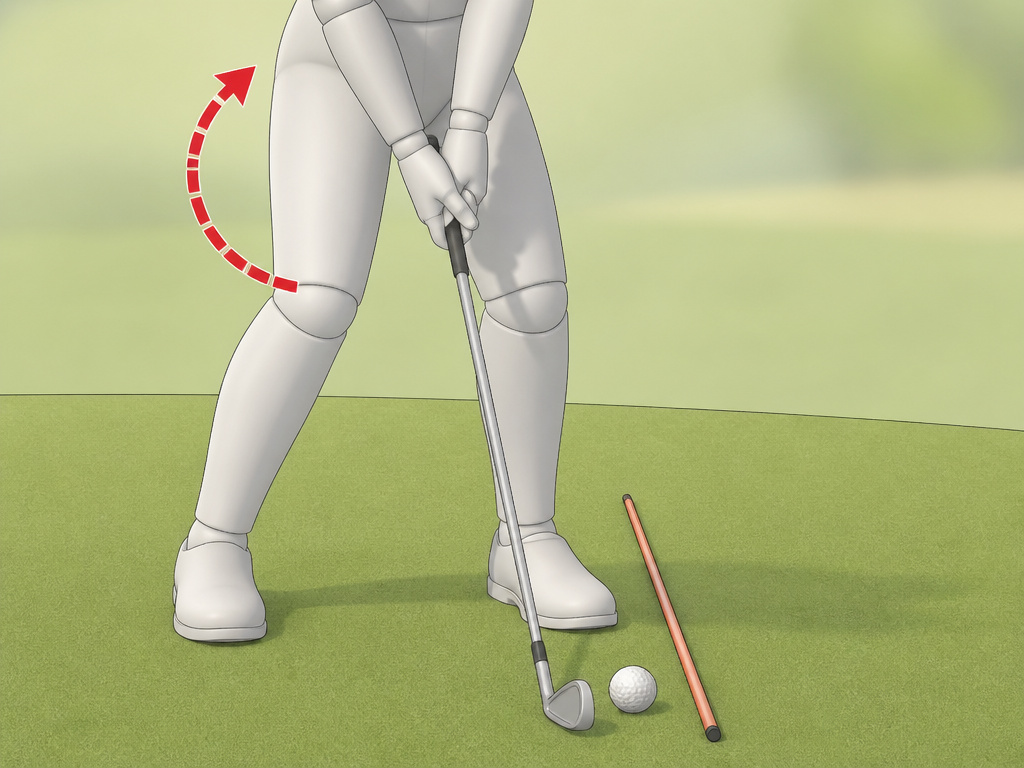
This drill removes the ball from the equation. You’re not learning to hit a ball; you’re learning to control the clubhead’s center. It’s the fastest way to break the shank cycle because it provides instant feedback.
What you need: A 7-iron and an alignment stick (or a golf shaft).
The risk if skipped: You’ll keep practicing the same faulty motion. The drill feels awkward because the correct move is unfamiliar.
Step 1: Set Up the Barrier.
Place the alignment stick on the ground, parallel to your target line, about 6-8 inches outside the ball (toward your toes). If you have no stick, use a headcover placed just outside the ball. This is your “early extension detector.”
Step 2: Assume Your Address.
Take your normal stance with a 7-iron. The ball is in the center of your stance. Focus on feeling balanced, not on the stick.
Step 3: The Rocking Motion.
Make a slow, controlled backswing. On the downswing, your only thought is to rotate your left hip back and around, as if you’re trying to keep your tailbone from touching the alignment stick. Make contact with the ball. If your hips thrust toward the ball, you will hit the stick.
Step 4: Repeat Without a Ball.
Hit ten slow-motion shots focusing solely on the hip rotation. Then hit ten real shots. The stick gives you a physical consequence for the wrong move.
This drill works because it forces the correct kinematic sequence: hips rotate, creating space, arms follow. It’s the antidote to the hips thrusting. Do this for five minutes before every range session for two weeks. The shank panic will fade.
Three More Drills to Lock In the Fix
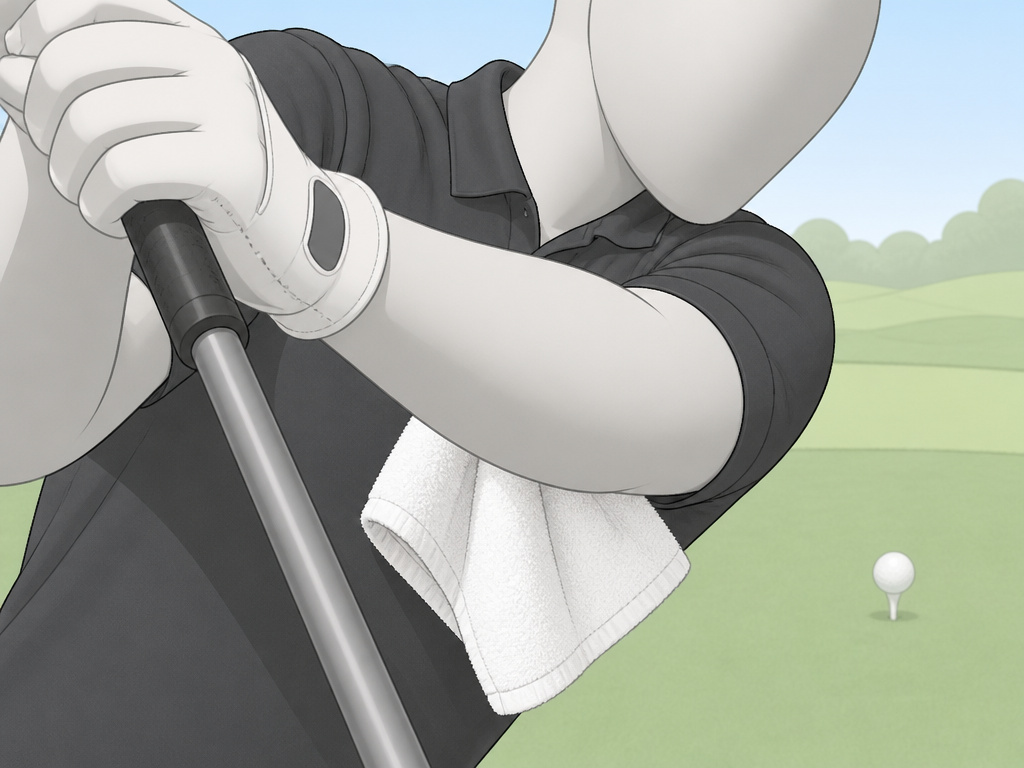
The Hosel Rock Drill is your foundation. These three drills build the house. They address the common compensations that lead to early extension.
1. The Towel Drill for Connection
A flying elbow in the backswing is a major cause of downswing re-routes. This drill locks your arms to your body.
Tuck a small towel under both armpits. Make half-swings, focusing on keeping the towel pinned throughout. If the towel drops, your arms have disconnected, forcing you to early extend to reconnect on the downswing. This drill promotes a one-piece takeaway and a connected downswing.
2. The Wall Drill for Posture
Early extension is a loss of spine angle. This drill makes you feel the proper axis.
Stand with your rear end touching a wall. Assume your golf posture. Make a slow backswing, keeping your tailbone in light contact with the wall. On the downswing, rotate so your left glute brushes the wall. You cannot thrust your hips toward the ball without losing contact. It’s a pure rotation feel.
3. The Headcover Drill for Path
This is the final test. It ensures your clubhead is approaching from the correct slot.
Place a headcover just outside the golf ball (about 2 inches toward the toe of your club). Your goal is to hit the ball without touching the headcover. If you swing too far from the inside (the hosel-shank path), you’ll clip the headcover. This drill fine-tunes your path and delivers the center of the clubface.
Worth knowing before you start: Drills are diagnostic tools. If the Towel Drill feels impossible, your backswing is the problem. If the Wall Drill is a struggle, your core mobility needs work. Let the drill tell you what to fix next.
How Your Grip and Setup Can Invite the Shank
While the body move is the cause, a poor setup is the invitation. Two setup errors directly increase the odds of hosel contact.
Ball Position is the Silent Culprit.
A ball played too far forward in your stance, opposite your front heel with an iron, forces your entire body to slide forward to reach it. This slide is early extension in its simplest form. For mid-irons, the ball should be just ahead of center. Check this first.
A Weak Grip Exacerbates the Problem.
A weak grip (hands turned too far to the left for a righty) promotes an open clubface. To square an open face, your body’s instinct is to thrust toward the ball, dragging the hosel. Strengthening your golf grip slightly can help the face square more naturally through rotation, not manipulation.
Don’t make a major grip change mid-shank crisis. But know that if you’ve always had a very weak grip and a two-way miss (slice and shank), a grip adjustment with a professional might be the long-term solution.
Frequently Asked Questions
Is a shank caused by standing too close to the ball?
Sometimes, but it’s often the opposite. Standing too close can cause a toe shank. Most hosel shanks happen because the player’s body moves toward the ball during the swing, effectively making them too close at impact. Check your dynamic movement, not just your static address.
Can new clubs cause a shank?
Yes, if the lie angle is wrong. Clubs that are too upright force the toe up and the hosel down, bringing it closer to the ball. If you start shanking immediately after getting new irons, have the lie angle checked. For most players, however, the shank is a swing flaw, not an equipment one.
Why do I only shank my wedges?
Wedges have the shortest shafts and the most upright lie angles. A slight early extension move is magnified. Also, players often try to help wedges into the air, leading to a body thrust. Focus on rotating through the shot and letting the loft do the work.
What’s the mental trick to stop shanking?
The best mental trick is a physical drill. Give your brain a task other than “don’t shank.” Your focus should be “rotate my left hip back” or “keep my towel pinned.” By focusing on a positive body move, you crowd out the negative fear. The ball flight laws tell us face and path determine everything, focus on controlling those.
How is a shank different from a slice?
slice is a curved shot caused by an open clubface relative to the path. A shank is a straight shot hit off the wrong part of the club. They can feel similar because both go right, but the cause and cure are different. A shank is an impact location error; a slice is a clubface error.
Before You Go
A shank feels like a game-ending bug in your swing. It’s not. It’s a specific mechanical failure with a clear diagnostic path and a set of proven fixes. Stop searching for magic tips. Identify your shank type, confirm early extension is your cause, and commit to the Hosel Rock Drill for ten days.
The fix isn’t in your hands. It’s in your hip rotation. Train your body to move left and around, not toward the ball. Use the towel, the wall, and the headcover to lock in the feel. Understand that this, like fixing a hook or a slice, is a process of replacing a bad pattern with a better one. The shank is curable. Now you have the blueprint.
