
What Is a Texas Scramble? A Guide to the Drive Rule Format
This post contains affiliate links. As an Amazon Associate, we earn from qualifying purchases.
This post contains affiliate links. As an Amazon Associate, we earn from qualifying purchases.
A Texas Scramble is a team golf format where every player must contribute a set number of tee shots, typically 3 or 4 per 18-hole round. This minimum drive rule forces strategic planning and prevents a single long hitter from dominating play. It’s a social format not recognized by the R&A or USGA, so scores can’t be submitted for official handicaps.
That drive requirement is the whole game. It turns a casual team outing into a puzzle where you must allocate a scarce resource, your weaker players’ mandatory drives, across 18 holes. Get the scheduling wrong and you waste strokes on holes where you’re forced to play a bad ball.
What follows: the exact handicap math for three and four-player teams, the smart way to map out your required drives before you tee off, and the one rule variation that can disqualify your team if you miss it.
Key Takeaways
- The minimum drive requirement is the only thing separating a Texas Scramble from a standard scramble. Each player must contribute 3-4 tee shots in an 18-hole round.
- Handicap formulas are fixed: 25%/20%/15%/10% of combined handicaps for four-player teams; 30%/20%/10% for three-player teams.
- Scores are unofficial. The format isn’t recognized by the R&A, USGA, or World Handicap System, so you can’t submit rounds for handicap indexing.
- Strategy is scheduling. You must plan which holes will use each player’s required drives early, or you’ll be forced to take inferior shots on closing holes.
- Rules vary by event. Always check the local competition sheet for the exact drive count, penalty for missing it, and ball-placement rules.
The Defining Rule: Minimum Drive Requirement
Forget everything you think you know about a standard scramble format. The Texas variation adds one non-negotiable layer.
The part nobody mentions: You don’t just pick the best drive each hole. You must ensure that, by the 18th green, each player’s tee shot has been selected as the team’s best ball a minimum number of times. This turns shot selection into a resource-management exercise.
The typical mandate is three or four drives per player over 18 holes. For a 9-hole event, that number is pro-rated. The exact figure is set by the tournament organizer and printed on the competition conditions sheet, ignore it at your peril.
The rule exists for one reason: inclusion. Without it, a team with one big hitter would use that player’s drive on every par-4 and par-5. The weaker drivers become passengers, only contributing on par-3 approach shots. The minimum drive rule guarantees everyone’s tee ball matters.
| Team Size | Typical Minimum Drives Per Player (18 Holes) | Strategic Implication |
|---|---|---|
| 4 Players | 3 or 4 | Must strategically “spend” 12-16 designated drives across 14-16 driving holes. |
| 3 Players | 4 or 5 | Higher individual burden; requires careful planning on par-3s (where drives don’t count). |
| 2 Players | 5 or 6 | Almost every driving hole is committed; very little flexibility in shot selection. |
The consequence of missing a drive is severe. Most competitions will add a two-stroke penalty per missing drive to the team’s final score, or disqualify the team from the net competition entirely. If a player gets injured, organizers usually grant an exemption, but you must declare it immediately.
Texas Scramble Handicap Formula
Because everyone plays from the best spot, teams shoot far lower than the sum of their parts. Handicaps adjust for this built-in advantage.
The system uses a conservative, percentage-based formula. It’s not up for debate or local variation; these are the accepted standards.
For a four-player team: Take the sum of all four players’ course handicaps. The team handicap is calculated as: * 25% of the lowest handicap player’s strokes * 20% of the second lowest * 15% of the third lowest * 10% of the highest handicap player’s strokes
Add these four numbers together, and round the total to the nearest whole number. That’s your team’s stroke allowance.
For a three-player team: The formula shifts to 30%/20%/10% from lowest to highest handicap.
25%/20%/15%/10% from lowest to highest handicap for four players; 30%/20%/10% for three players. These percentages account for the scramble advantage and prevent sandbagging.
Let’s say your foursome has handicaps of 4, 12, 18, and 22. * Low (4) : 25% of 4 = 1.0 * #2 (12): 20% of 12 = 2.4 * #3 (18): 15% of 18 = 2.7 * High(22): 10% of 22 = 2.2 * Total = 8.3, rounded to 8 strokes.
Your team gets 8 shots deducted from its gross score. A gross 64 becomes a net 56. This math is why winning net scores in Texas Scrambles are often in the mid-50s on a par-72 course.
Crucially, your Stableford scoring or best ball handicap doesn’t apply here. This is a separate calculation for this format alone.
How to Play: Rules and Procedure
You play one ball as a team. The procedure is straightforward, but two nuances trip up first-timers.
Step 1: All players tee off. Mark each ball’s position clearly.
Step 2: The team selects the “best” shot. This isn’t always the longest. Factor in lie, angle, wind, and the upcoming shot. A 240-yard drive in the fairway is often better than a 270-yard drive in the rough.
Step 3: All players move and place their ball. This is the key detail. Each player gets one club-length of relief from the chosen spot, no nearer the hole. The ball must remain in the same condition, fairway, rough, or bunker. You cannot use your club-length to move from the rough to the fairway.
Step 4: All players hit the next shot. Repeat the selection and placement process until the ball is holed. Record the team score for that hole.
On the green, placement tightens to a putter-head or scorecard’s length from the marked spot.
The format moves quickly, which is why it’s a favorite for shotgun start charity tournaments. The social pace keeps things light, but the drive rule keeps you engaged.
Strategy: Scheduling Your Mandatory Drives
This is where you win or lose. Treat your required drives like a budget.
Before you tee off, huddle with your team. Identify the holes where your weaker drivers have the best chance. Look for shorter par-4s, holes with wide fairways, or shots that suit a particular ball flight. Schedule those holes as “drive holes” for your high-handicappers first.
Common mistake: Taking the best drive every hole without a plan. By the 14th tee, you’ll realize your 20-handicap still needs two drives, and you’re staring down a 460-yard par-4 into the wind. That’s how you make a triple bogey.
Par-3s are your free plays. Since the drive rule usually only applies to par-4 and par-5 tee shots, use par-3s to reset. This is where you unleash your best ball-strikers without consequence. Attack every flag.
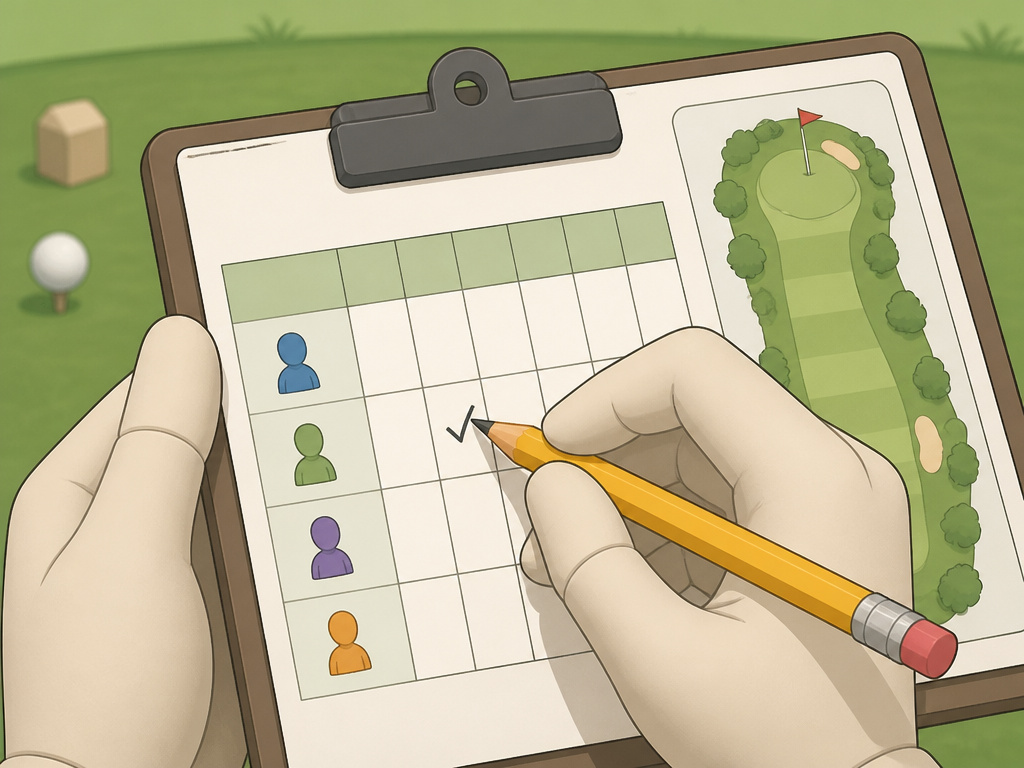
Track your drives visibly. Use a scorecard to tick off each player’s contributions. Six missed ticks is a twelve-stroke penalty. It happens every weekend to a team that “forgot.”
The mental shift is from reactive to proactive selection. You’re not just choosing the best shot; you’re investing a limited resource.
Texas Scramble vs. Other Team Formats
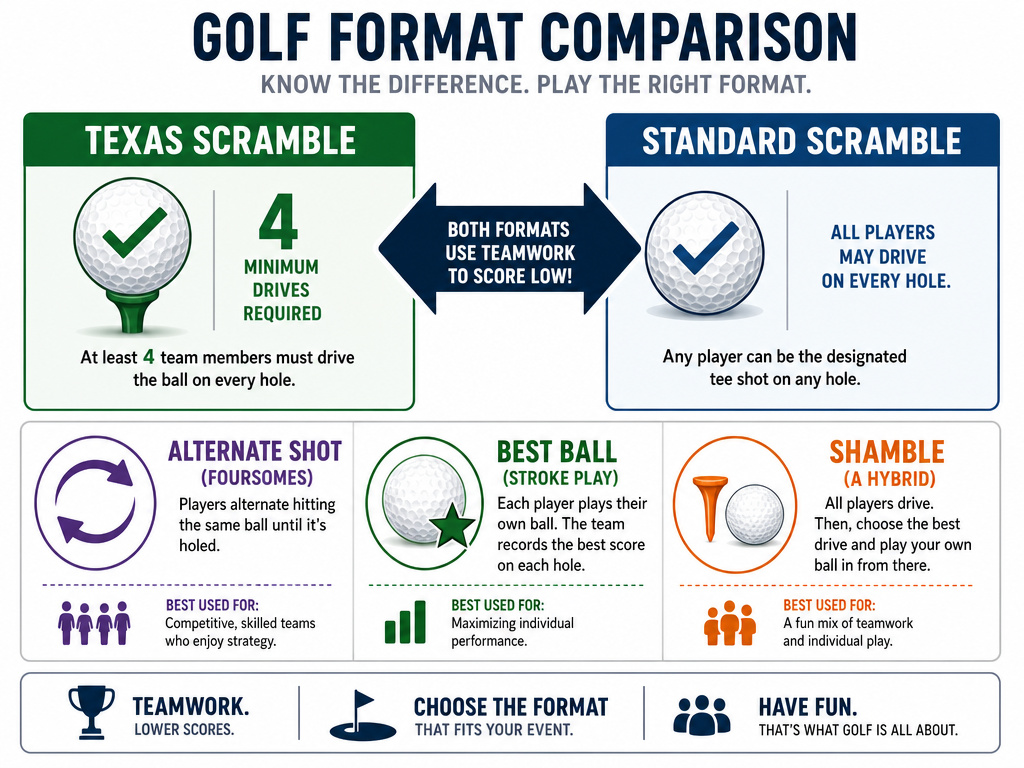
It’s easy to get formats confused. Here’s how the Texas Scramble fits in.
| Format | Key Mechanism | Best For |
|---|---|---|
| Texas Scramble | All play from best shot + minimum drive requirement. | Inclusive team events, charity days, ensuring all contribute. |
| Standard Scramble | All play from best shot, no minimum drives. | Casual outings, speed of play. |
| Alternate Shot | Partners take turns hitting one ball. | Serious team competition (e.g., Ryder Cup). |
| Best Ball | Each plays own ball; team takes best score per hole. | Showcasing individual skill within a team. |
| Shamble | Best drive selected, then each plays own ball in. | A hybrid test of team and individual play. |
The Texas Scramble is closer to a standard scramble than to a best ball format. Its sibling is the “Florida Scramble,” where the player whose shot is selected sits out the next stroke, adding another tactical layer on top of the drive rule.
Equipment and Preparation Tips
You don’t need special gear, but a few choices help.
Use the same model of golf ball. Modern 3-piece golf balls offer a great blend of feel and durability for this format. Consistency matters when everyone is putting from the same spot. Avoid mixing a firm distance ball with a soft spin ball; the putting feel will drive your team mad.
For most amateur players, forgiving amateur golf irons and reliable 2-piece golf balls are the smart, practical choice. The format rewards straight hitting over raw power.
Bring a pencil with a good eraser. You’ll be marking and re-marking ball positions all day. A small, magnetic scorecard holder keeps your drive tally sheet clean and visible.
Frequently Asked Questions
Is a Texas Scramble an official format?
No. The R&A and USGA do not recognize it in the Rules of Golf. It is a social, invented format. This means you cannot submit your score for your official World Handicap System (WHS) index. It’s for fun and competition within the event only.
What’s a good score in a Texas Scramble?
On a par-72 course, a gross score in the mid-50s is exceptional. A net score in the 52-58 range will usually win a club event. If your team with a combined handicap of 40 shoots a gross 65, you’ve played very well. If you shoot a gross 75, you left multiple shots on the course.
What if we can’t meet the drive requirement?
You face a penalty defined by the competition. The two most common are a two-stroke addition to the team score for each missing drive, or disqualification from the net prize competition. The rules sheet will specify. There is no grace, count your drives.
Can you play a Texas Scramble with 2 players?
Yes. The minimum drive requirement scales up, usually to 5 or 6 drives each over 18 holes. This makes strategy even more critical, as almost every driving hole is pre-committed to a specific player.
How does it differ from an Ambrose Scramble?
In some regions, “Ambrose” is synonymous with a standard scramble (no minimum drives). In others, Ambrose uses a different handicap calculation. The universal differentiator for Texas is the printed, enforced minimum drive rule. Always ask the organizer.
Before You Go
The Texas Scramble is the most democratic team format. It forces collaboration and rewards foresight. Remember the sequence: check the local drive rule, calculate your handicap using the fixed formula, and map out your mandatory drives on the scorecard before the first tee.
Your equipment should be consistent, pick a solid, versatile golf ball and focus on keeping it in play. The strategy isn’t about heroics; it’s about allocating your team’s weaknesses so they don’t surface on the hardest holes. Get that right, and you’re not just playing a scramble, you’re solving one.
