
Viktor Hovland Swing Changes Explained & Lessons Learned
This post contains affiliate links. As an Amazon Associate, we earn from qualifying purchases.
This post contains affiliate links. As an Amazon Associate, we earn from qualifying purchases.
Viktor Hovland’s swing changes stem from a deliberate 2023 decision to add “draw pieces” to his natural cut, aiming for versatility. The move unintentionally created a “sway gap” between his upper and lower body, killing his reliable fade and leading to an uncontrolled hook. His search for a fix involved multiple coaches and a lost 2024 season, highlighting the risk of overhauling a proven motion.
That gap between intention and outcome is where most golfers live. Hovland’s story isn’t just about a pro’s technical tweak; it’s a masterclass in how a single, well-meaning adjustment can unravel an entire system. When you change one thing, like trying to draw the ball, you don’t just change the ball flight. You change the takeaway, the pressure in your feet, and where your mind goes under tournament stress.
What follows is a breakdown of the why, the what, and the how it broke. We’ll look at the specific mechanical flaw that appeared, the coaching carousel it triggered, and the one lesson every amateur should take from Hovland’s expensive experiment.
Key Takeaways
- Hovland’s change was intentional: after his 2023 peak, he actively worked to add a reliable draw, reducing his dependence on a cut.
- The main mechanical fault was a “sway gap”, his upper body rotated too much behind his lower body on the backswing, a classic draw move that destroyed his fade.
- His 2024 season was his worst professionally, with missed cuts at three majors and a loss of all confidence in his ball flight.
- The coaching journey went from Joe Mayo to a split, then to Dana Dahlquist and Grant Waite, and now to TJ Yeaton as he pieces his old swing back together.
- The universal lesson: optimizing a strength is safer than trying to install a weakness. Your natural shot shape is a asset, not a bug.
The Core Change: Adding Draw Pieces
Hovland didn’t stumble into a swing change by accident. In early 2024, he stated plainly that after his dominant 2023, he “set out to add more ‘draw pieces’ to his swing.” He was a lifelong cutter of the ball, a fade that started left and curved right. For years, this was his superpower, leading to wins at the Memorial, BMW Championship, and the Tour Championship.
The technical snippet: A player’s “draw move” typically involves a more inward takeaway and a closed clubface path through impact, encouraging a right-to-left ball flight for a right-handed golfer. Hovland’s natural “cut move” relied on a more exterior path and a face open to that path, producing his signature left-to-right shot.
But standing across from ball-strikers like Scottie Scheffler, Hovland felt limited. He wanted the option to bend it both ways, believing that versatility was the final frontier. This is the siren song for every good player: the grass is always greener on the other side of the fairway. The problem wasn’t the goal. It was the assumption that his swing was a modular system where you could plug in a “draw module” without rewiring the entire circuit.
I see this weekly with students. They have a playable fade but watch a YouTube clip on creating lag for a powerful draw and decide to rebuild from the ground up. They don’t just add a draw; they often subtract their only consistent shot. Hovland’s experience is that same mistake, executed at the highest level. He lost the feel. “I couldn’t stand over the ball and know exactly where it was going,” he said. More often than not, it hooked left when he wasn’t expecting it.
What Actually Broke: The “Sway Gap” Explained
So what mechanically went wrong? The issue wasn’t just in his hands or his intent. It was in his body rotation. As Hovland explained during the 2025 Ryder Cup, when he tried to be “more dynamic” and rotate faster to generate more power, something subtle shifted.
In his 2020-2023 swing, he kept his arms more in front of his chest in the backswing. As he added speed and tried to draw it, he began turning his upper body more aggressively behind his lower body. This created a separation between the centers of his upper and lower body, a gap his coach Grant Waite, using the AI app Sportsbox AI, calls a “sway gap.”
| Swing Element | Pre-2023 (Fade) | 2024 Draw Attempt | Result of the Change |
|---|---|---|---|
| Upper Body Turn | Moderate, in sync with hips | Excessive, behind hips | Created “sway gap” |
| Arm Path | More in front of chest | Deeper, behind him | Led to being “stuck” |
| Intended Shot | Reliable Cut | Versatile Draw | Uncontrolled Hook |
| Feel | Centered, stable | “Spinning open” | Loss of start-line control |
This sway gap is a killer for a fade. To hit a cut, you need your upper body slightly more “in front” of the action. When your upper body gets behind you, the only way to get the club back to the ball is to either stall your rotation (leading to blocks) or violently rotate your hands to square the face (leading to hooks). Hovland found the hook. His fix attempt, trying to “slow down” his backswing, only made him spin his shoulders open faster, widening the gap.
The feel that finally started to work was counterintuitive. He felt a faster, more “up and back” takeaway, like Matt Fitzpatrick’s quick backswing. This sensation kept him more centered, slimming the sway gap and letting his lower body lead the downswing sequence properly again.
The Coaching Carousel and the Lost Season

A swing change of this magnitude doesn’t happen in a vacuum. It sets off a chain reaction in every other part of your game, and your coaching team is the first domino. Hovland’s partnership with Joe Mayo was famously productive, turning his short game from a liability into a strength in a six-month stretch using 3D imaging. But the draw experiment fractured that partnership.
By late 2023, they split for a second time. Hovland then worked briefly with instructor Dana Dahlquist and was seen with Grant Waite. As of early 2025, he was working with Nashville-based TJ Yeaton, often late into the night on range sessions, trying to reclaim his old kinematic sequence.
The cost was his 2024 season. Look at these numbers: * Zero wins for the first time in his PGA Tour career. * Missed cuts at the Masters, U.S. Open, and The Open Championship. * Ranked 133rd on Tour in strokes gained: tee-to-green, losing strokes with his signature strength, ball-striking.
Where this goes sideways: Believing a major change will be a quick fix. Hovland admitted he hoped for faster progress: “I was hoping to make a little bit more progress, feel a little bit better about my game. But it’s been… Challenging.” A pro’s “challenging” year is an amateur’s three-season detour.
The short game prowess he built with Mayo regressed, likely because his focus and practice time were wholly consumed by the full-swing rebuild. This is a crucial lesson: you cannot allocate mental energy infinitely. Fixating on your takeaway means your chipping stroke gets neglected.
The Universal Lesson: Tinkering vs. Trust
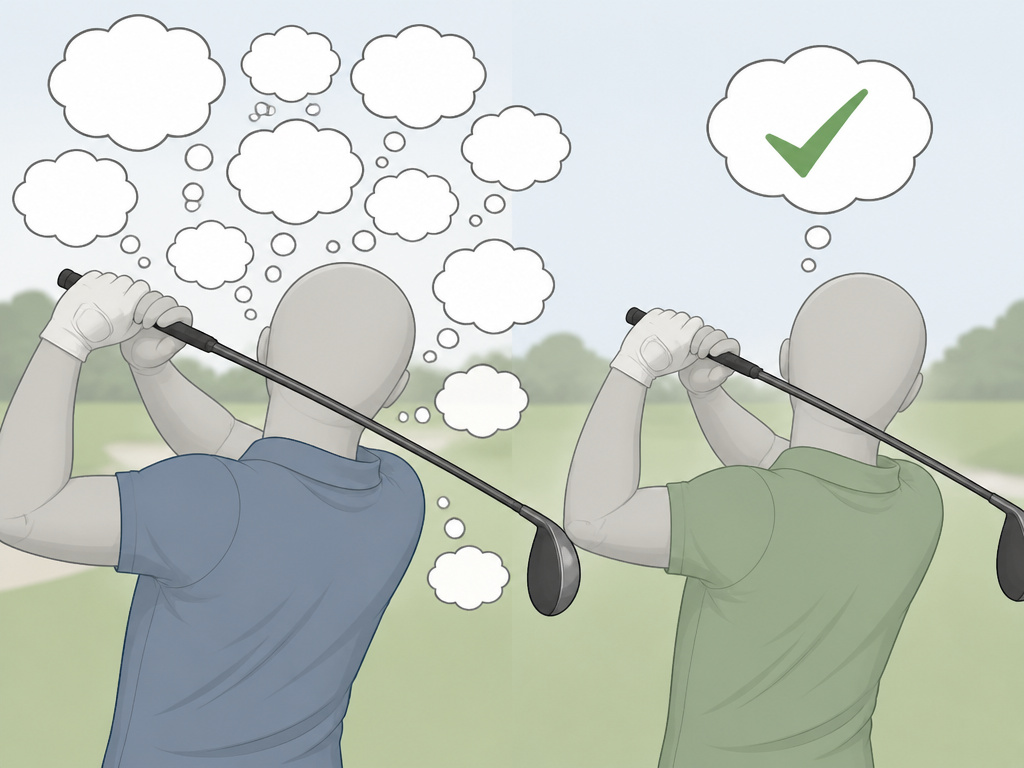
Hovland is a self-proclaimed “curious guy” and a “tinkerer.” He found Joe Mayo on Instagram. He taught himself AimPoint putting. This analytical mindset built him into a top-5 player. But it also contains the seeds of his downfall. As he told Golf Channel, “You want to be open-minded, but you don’t want to be so open-minded that your brain falls out.”
Last season, I got too clever with my own swing thoughts during a club championship. I was working on keeping my head “more centered,” a small tweak I’d seen in a swing plane analysis. On the course, it became all I could think about. I shot my worst score in years. I was tinkering when I should have been trusting. The desire to optimize had overridden the ability to execute.
That’s the razor’s edge. For amateurs, Hovland’s story is a permission slip to stop chasing the perfect swing. Your natural shot shape, whether it’s a fade, a draw, or a straight ball, is your foundation. Work on making it more consistent, not on replacing it. The goal is to own your motion, not to rent a new one every season.
Better golf comes from simpler, repeatable movements. Before you try to add a draw, ask if you can hit your fade to a 20-yard wide fairway under pressure. If the answer is no, the problem isn’t the shot shape. It’s the swing tempo and the trust underneath it.
| For the Amateur Golfer | Do This Instead | Why It Works |
|---|---|---|
| Wanting to change a fade to a draw | Practice hitting the fade with different trajectories (high, low) | Develops control of your existing pattern, which is faster than learning a new one. |
| Feeling “stuck” on the downswing | Focus on initiating the downswing with your lead knee moving toward the target | Addresses the root cause of the sway gap without overloading with technical thoughts. |
| Inspired by a pro’s swing change | Identify one functional drill from their change that applies to YOUR fault | Isolates a usable tool instead of adopting an entire system built for a different athlete. |
Frequently Asked Questions
Why did Viktor Hovland change his swing?
He changed it intentionally after his successful 2023 season to add a reliable draw to his arsenal, believing it would make him a more versatile and complete player. He wanted to reduce his dependence on his natural cut shot.
What is the “sway gap” in Hovland’s swing?
The “sway gap” is a term used by his coach to describe the separation that occurred when Hovland’s upper body rotated too far behind his lower body during his backswing. This is a common move for players trying to hit a draw, but it destroyed his ability to hit his signature fade and led to him getting “stuck” on the downswing.
Who is Viktor Hovland’s coach now?
As of early 2025, Hovland is working with TJ Yeaton, a Nashville-based instructor. This follows his second split from Joe Mayo and brief consultations with other coaches like Dana Dahlquist and Grant Waite during his swing struggles.
What can amateur golfers learn from Hovland’s changes?
The main lesson is the high risk of trying to fundamentally alter a proven, successful shot pattern. It’s almost always more productive to improve the consistency and control of your natural shot shape than to attempt a full-scale rebuild for the sake of theoretical versatility. Trust your swing.
Before You Go
Hovland’s path back isn’t about finding a new swing. It’s about reassembling the old one, piece by piece, with a new appreciation for what he had. For anyone watching, the takeaway is stark: the difference between a rotational swing that works and one that doesn’t can be a matter of two inches in your shoulder turn.
If you take one thing from this, let it be this threshold. If you can’t predict your ball’s starting line within a few yards, your issue is fundamental strike and path, not shot shape. Go work on that. Chasing a draw when you can’t control a fade is how you lose a year.
Hovland called his decision a “poor” one. He’s also certified nuts for the grind. Most of us don’t have that luxury. Your game needs practical routines, not a pro’s rabbit hole. Understand the mechanics, respect the process, but play with what you own.
