
The Essential Pre Shot Routine for Consistent Golf Shots
This post contains affiliate links. As an Amazon Associate, we earn from qualifying purchases.
This post contains affiliate links. As an Amazon Associate, we earn from qualifying purchases.
A pre shot routine in golf is a consistent 15-30 second sequence of mental and physical steps performed before every swing. Its sole job is to automate your process, locking out doubt and pressure by occupying your attention with a fixed, low-effort checklist. The over-the-ball phase, from setting your lead foot to impact, should last about eight seconds.
That eight-second window isn’t a guess. PGA pro Mike Bender and Michael Mercier timed it across major champions from Bobby Jones to Phil Mickelson. The full routine, from first look to swing trigger, runs about 20 seconds for elite players. Annika Sorenstam’s entire sequence held within a one-second window for her entire career. Your routine doesn’t need to be that precise, but its timing does need to be consistent. Variability is where nerves take over.
What follows is the architecture, not the ritual. We’ll walk through the five components every research-backed routine shares, why a six-week practice program might show zero statistical improvement, and how to build separate routines for drives, approaches, and putts. The goal is a sequence that works on the first tee with money on the line, not just on a Tuesday driving range.
Key Takeaways
- Timing is the signal. The “over-the-ball” phase should target eight seconds; the full routine 15-30 seconds. Inconsistency here is the first thing pressure destroys.
- Routines are shot-specific. Elite golfers use behaviorally and temporally distinct routines for drivers, wedges, and putters. One uniform routine is a beginner’s trap.
- Six weeks isn’t enough. A peer-reviewed study found no statistically significant improvement in driving performance after six weeks of pre-shot routine training. The change takes months.
- Focus must be external. Your attention should be on the target, a spot on the ball, or the intended ball flight, not on your grip pressure or backswing position.
- Build it in pieces. Assemble your routine off the course, rehearse it without a ball, then drill it on the range before ever taking it to the first tee.
Why a Pre-Shot Routine Actually Works (And When It Doesn’t)
The mechanism isn’t magic. A routine works by occupying your conscious attention with a fixed, low-effort sequence. This crowds out the kind of step-by-step swing thinking that wrecks performance under pressure. Sport psychologists call this shifting from a controlled process to an automatic one.
A 2021 meta-analysis found that pre-performance routines produce a larger measurable benefit under high-pressure conditions than in low-pressure practice. The routine isn’t a warm-up habit; its value shows up when the round is tight.
The research has honest, unglamorous edges. A study in PLOS ONE with 15 amateur golfers found no statistically significant improvement in club head speed, accuracy, or distance after six weeks across three different training programs. One group did a warm-up and a pre-shot routine, one did just the routine, one did just the warm-up. None moved the needle in that timeframe. The authors noted that meaningful change might require 16 weeks or more of consistent practice.
Another study of 48 amateurs found players reported using the same routine only 76.3% of the time, and there was a poor statistical correlation between routine consistency and average score. The inconsistency itself made the data messy. This is the reality most instruction glosses over: building a reliable routine is a months-long commitment, and most golfers abandon the process after a few frustrating weeks.
The 5-Step Framework for a Pressure-Proof Routine
This is a mental and physical protocol, not a checklist of superstitious tics. Each step has a specific job, and skipping one leaves a gap where doubt enters.
Step 1: The Decision (The “Think Box”)
This happens behind the ball, before you ever step into your stance. Your job here is to gather all information and make a final, committed choice. Look at the lie, gauge the wind, select your club, and pick a specific target, a distant tree branch, a spot on the fairway, the back of the cup. This is where you use your course management logic.
Do not step in until this decision is 100% final. Second-guessing over the ball is a guaranteed path to a decelerated swing or a yipped putt.
Step 2: The Visualization
With the decision made, you must see the shot. This is where visualization techniques become practical. Don’t just “think” about a high fade. Picture the exact ball flight: the launch angle, the curve, the landing, and the rollout. Make it a full-sensory image. For puts, see the ball rolling along your chosen line and dropping into the center of the cup.
Where this goes sideways: Skipping visualization. If you don’t have a clear picture of success, your brain has nothing to execute. The swing becomes a guess, and under pressure, guesses default to your worst miss.
Step 3: The Rehearsal (Practice Swing)
Take your practice swing from behind the ball, rehearsing the feel of the shot you just visualized. The key is external focus. Feel the rhythm needed to send the ball to your target, or the stroke length for the putt. Do NOT rehearse a technical swing thought like “keep my head down.” The feel is for distance and shape, not mechanics.
Step 4: The Setup (The “Play Box”)
Now step into your address. This starts the eight-second clock. Align your body and clubface to your target. Use a consistent physical trigger, a look at the target, a deep breath, a forward press with your hands. This trigger is your brain’s signal that the automatic sequence is starting and conscious thought must stop.
Step 5: The Trigger and Execution
Your trigger initiates the swing. No more thinking. Your focus should be intensely external: on the ball, a spot on the ball, or the target. The concept of “quiet eye”, a final, steady fixation on the ball before movement, is critical here. Then swing to your picture.
| Routine Step | Mental Focus | Physical Action | Common Mistake |
|---|---|---|---|
| Decision | Analytical, strategic | Stand behind ball, assess | Rushing, indecision |
| Visualization | Creative, sensory | See the shot happen | Vague or no image |
| Rehearsal | External (feel of shot) | Practice swing for feel | Rehearsing mechanics |
| Setup | Neutral, procedural | Step in, align, breathe | Over-aligning, fidgeting |
| Trigger & Execute | External (target/ball) | Initiate swing | Last-second technical thought |
How Elite Routines Differ From Amateur Habits
Elite players don’t just do these steps more consistently. They structure them differently. A single-case study of six elite male golfers (average handicap +1) found significant differences in their pre-performance routines between drivers, wedges, and putters. Their routines were behaviorally and temporally distinct for each shot type.
Amateurs tend to force one uniform routine onto every club. That’s a mistake. The routine for a 300-yard drive should differ from the routine for a 30-yard pitch. The decision phase for a drive is longer, involving wind and landing zone. The visualization for a wedge is more about trajectory and spin. The putting routine is its own world of green-reading and pace.
Your driver routine might be a 25-second process with two practice swings. Your putting routine should be a streamlined 15 seconds, with more time spent on reading the break than on rehearsal. Build separate templates and practice them separately. This level of specificity is what separates a functional routine from a generic one.
The Science-Backed Details Most Golfers Miss
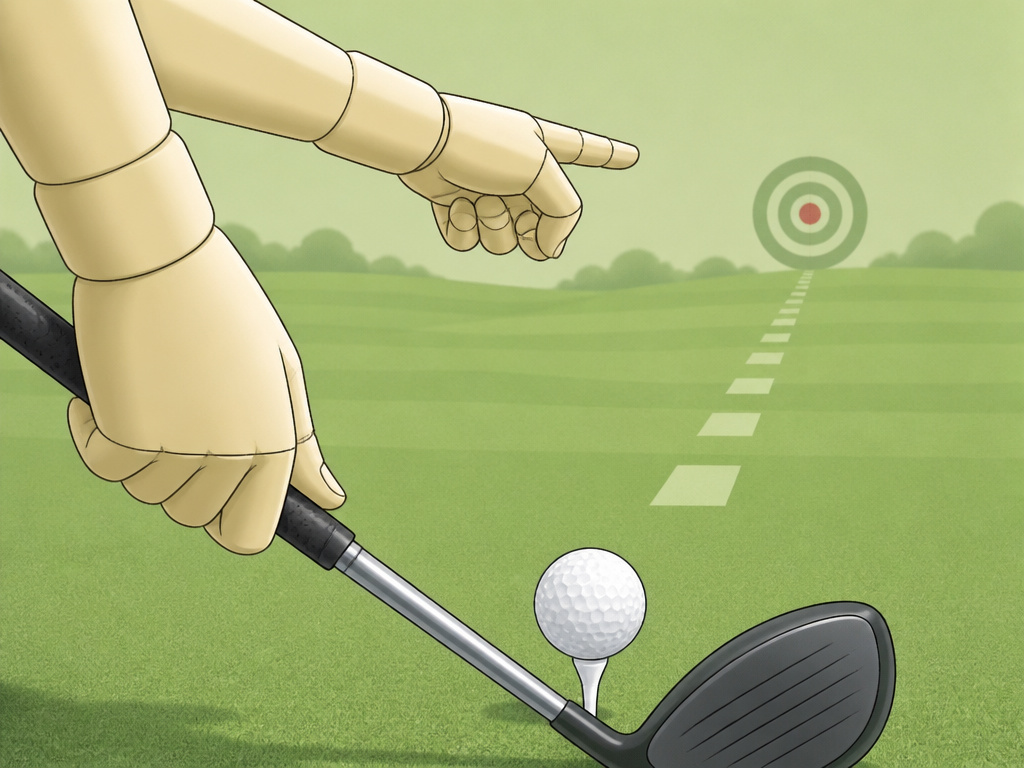
Two specifics from the research change how you should practice. First is the external focus of attention. Study after study confirms that focusing on the outcome of the movement (the target, the ball flight) is superior to focusing on the movement itself (your hands, your turn). Your routine must be designed to put your attention out there, not on your body.
Second is the validation of structured models. The STOP S.L.O.W. GO routine model was developed and validated through a Delphi study with NCAA coaches. While it didn’t reach full consensus on future utility, it provides a researched framework. The acronym stands for: Stop, Scan, Target, Organize, Walk, Go. It’s another proof that a deliberate sequence beats a random collection of habits.
Common mistake: Practicing your routine by hitting balls on the range. First, rehearse the entire sequence without a ball. Walk through the five steps in your backyard. Then, on the range, hit shots using the routine, but make the routine the goal, not the ball flight. The effects of pre-shot routines are neurological, not just physical.
Building Your Routine: A Practice Plan That Works
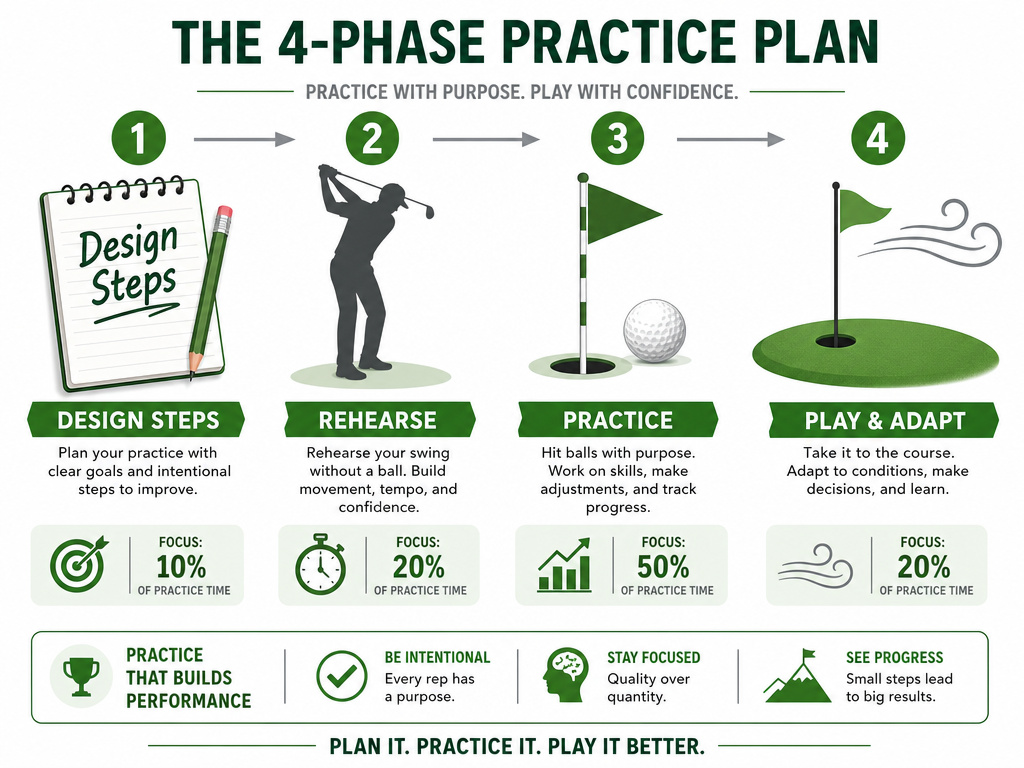
Since a six-week program might show no stats improvement, your timeline needs patience. This is a four-phase integration, not a weekend project.
- Phase 1: Design (Off-Course). Write down your ideal 5-step sequence for a driver, a wedge, and a putt. Time nothing yet. Just get the steps clear.
- Phase 2: Rehearsal (No Ball). Daily, for two weeks, walk through each routine without a club. Then with a club, but without a ball. The goal is to memorize the sequence until it feels boring.
- Phase 3: Range Integration. Take it to the range. Hit every single shot with the full routine. Start by hitting to huge targets, ignoring outcome. The discipline is to complete the routine even if you’re eager to “fix” your swing. This is where your golf practice routine must include mental work.
- Phase 4: On-Course Testing. Play a few holes alone, or during a casual round, and use your routine on every shot. Accept that scores might temporarily suffer. The goal is to expose the routine to real conditions like wind, bad lies, and waiting.
This gradual exposure is the only way to build a routine that holds up when you’re handling pressure on the 18th tee. Your warm-up routine before the round is the perfect time to run through your sequences, cementing the timing before you need it.
Frequently Asked Questions
Should my pre-shot routine be the same for putting?
No. Elite research shows routines vary significantly by shot type. Your putting routine should be shorter, with more time allocated to reading the green (Decision phase) and a much simpler, quieter rehearsal. The trigger is often a look at the hole and then back to the ball, without a practice stroke.
How long should a good pre-shot routine take?
The full sequence from first look to impact should average 15-30 seconds. The critical “over-the-ball” phase, from setting your lead foot to starting the swing, should target eight seconds. The USGA’s Rule 5.6b recommends playing a stroke within 40 seconds once you are free from distraction, so a 30-second routine is well within the guidelines.
Can a pre-shot routine hurt my performance?
Only if it’s poorly designed. A routine filled with technical swing thoughts (“keep elbow in”) will hurt you. A routine that is so long it causes you to overthink or rush will hurt you. A routine that varies wildly in timing is worse than no routine at all. The fundamentals of the golf mental game emphasize simplicity and consistency for a reason.
What’s the one thing pros do that amateurs don’t?
They have a definitive, non-negotiable trigger to start the swing. For some it’s a forward press of the hands, for others a final look at the target. This action signals the end of thinking and the start of the automatic swing. Amateurs often hover over the ball, still processing, which invites every possible doubt into the moment.
How do I keep my routine under pressure?
You must practice it under mild pressure first. Use competitive drills on the range, play games for small stakes, or simply commit to using the routine on every shot during a round where you’re keeping score. The mental focus required is a skill you build. When you feel rushed after a bad shot, the remedy is to physically step back behind the ball and restart the routine from Step 1, deliberately slowing your pace.
The Bottom Line
A pre shot routine is a cognitive tool for automating your process under variable conditions, not about superstition. The eight-second secret is a proof of consistency, not a magic number.Build yours around external focus, tailor it to your driver, wedge, and putter, and give it months, not weeks, to become unconscious. The payoff includes better shots and the quiet confidence that comes from knowing exactly what to do when the shot in front of you matters.
