
Boost Golf Swing Speed with Overspeed Training in 6 Weeks
This post contains affiliate links. As an Amazon Associate, we earn from qualifying purchases.
Overspeed training for golf works by swinging implements 6-10% lighter than your driver to recruit muscle fibers faster, leading to a 1-3 mph clubhead speed gain within 3-6 weeks. Gains are neurological, not muscular, and plateau after that initial window without a foundation of strength and mobility. It is an adjunct, not a substitute, for a complete performance plan.
That 6-10% range is the only one that works. A 2021 peer-reviewed study in the Journal of Sport and Exercise Science (JSES) found swinging a stick 20% lighter or 5% heavier than a driver decreased golfers’ swing speeds. The system adapts to a precise stimulus, not just “lighter is better.”
What follows: the exact protocol from the low-volume research, the three physical screens you must pass before starting, and the one mistake that turns a speed tool into a season-ending risk.
Key Takeaways
- Overspeed training increases clubhead speed through neurological adaptation, not increased strength. Expect 1-3 mph gains, with most occurring in the first 3 weeks.
- The effective weight range is 6-10% lighter than your driver. Sticks 20% lighter or 5% heavier can slow you down.
- Gains plateau after 6 weeks. Continued use without a strength and mobility foundation yields no further improvement and increases injury risk.
- It is not a standalone solution. Use it as a short-term (2-4 week) adjunct within a periodized plan that includes golf strength training.
- Before starting, assess your mobility and rotation. If you can’t control your current speed, overspeed training will likely cause injury.
How Does Overspeed Training Actually Work?
Overspeed training is a neurological hack, not a strength builder. You swing a lighter implement to “trick” your nervous system into removing its built-in governor on movement speed.
The principle is post-activation potentiation (PAP). A maximal, high-velocity effort with a sub-maximal load primes the nervous system to fire more motor units faster in the subsequent activity. For golf, swinging a light stick before hitting a driver can elevate clubhead speed for that session.
The goal is to improve your rate of force development (RFD), how quickly you can express the strength you already have. It does not make you stronger. A stick that weighs less than two pounds provides nowhere near the load needed to stimulate muscle growth. This is why pairing it with real strength training is non-negotiable.
The most cited data comes from a Par4Success study tracking golfers over six weeks. The key finding wasn’t the gain, it was the timeline.
| Training Week | Clubhead Speed Gain | Primary Driver |
|---|---|---|
| Week 3 | Meaningful increase | Neuromuscular adaptation |
| Week 6 | Plateau reached | No further gains despite more volume |
The nervous system adapts quickly. Once it learns the new movement pattern, the stimulus stops producing change. This is the core limitation of any overspeed-only program.
The Overspeed Protocol That Actually Works
The research is clear: more swings do not equal more speed. High-volume protocols calling for nearly 100 swings are unnecessary.
A 2018-2019 study found no statistical difference in speed gains over 6-8 weeks between a high-volume protocol (three sticks, ~100 swings twice a week) and a low-volume protocol (one stick, 30 swings twice a week). The low-volume protocol, with adequate rest, delivers the same result with two-thirds fewer swings.
Here is the research-backed, low-volume protocol:
- Select Your Stick. Use an implement 6-10% lighter than your standard driver. This is the golden range. The SuperSpeed Golf “Medium” stick fits this spec.
- Warm Up Thoroughly. Complete a dynamic warm-up targeting mobility, not just swings. Cold muscles and a stiff spine are the fastest route to a pulled oblique.
- Perform 3 Sets of 10 Swings. Take 2-3 minutes of rest between each set. This “glycolytic rest” is critical, it allows your phosphocreatine system to fully recharge so each swing is at maximum intent.
- Swing with Maximal Intent. This is not a technical drill. Your only thought is to move the stick as fast as humanly possible while maintaining balance. Grinding through slow, tired swings trains endurance, not speed.
- Do It Twice a Week, Max. Schedule sessions on non-consecutive days and never within two hours of a heavy strength program. Your nervous system needs recovery.
Where this goes sideways: Swinging when fatigued. If your tenth swing in a set is visibly slower than your first, you are done. Stop the set. Continuing teaches your body to move slowly, which defeats the entire purpose.
This protocol works because it respects the nervous system’s need for quality over quantity. It’s a focused stimulus, not a marathon.
Who Should (and Should NOT) Use Overspeed Training
Not every golfer is a candidate. The Titleist Performance Institute (TPI) frames this around a simple concept: you must have more “RPMs under the hood” than you’re currently using. If you’re already swinging faster than your body can safely control, overspeed work is a ticking time bomb.
You are a good candidate if:
- Your speed percentile is lower than your power percentile (you’re strong but slow).
- You have a baseline of mobility, particularly in thoracic rotation and hip internal rotation.
- You are engaged in a structured golf fitness routine.
- You have consistent swing mechanics. The speed needs a competent delivery system.
You should avoid it or proceed with extreme caution if:
- You have chronic back, shoulder, or rib pain.
- Your rotation is limited (you can’t turn your shoulders 90 degrees independently of your hips).
- You have not touched a weight in years. No foundational strength means no force to develop quickly.
- You are a “speed-over-strength” player already optimizing technique for max speed.
Easy to miss: The golfers who add 10 mph in 12 weeks are almost always the strong, stiff players who wake up their nervous system. The already-loose, technical players see minimal gains. Know your profile before you buy the sticks.
This is why a pre-assessment is non-negotiable. A tool like the TPI movement screen or a simple at-home rotation check can save you months of frustration and a potential injury.
The Essential Foundation: Strength and Mobility First

Overspeed training manipulates the top floor of your speed potential. If the foundation, your strength and mobility, is weak, the ceiling collapses.
Think of it as building a house. Strength training pours the concrete foundation and frames the walls. Overspeed training paints the walls and hangs the lights. You cannot decorate a house that isn’t built.
A comprehensive golf fitness plan addresses the three elements overspeed ignores:
- Force Production (Strength). Heavy squats, hinges, and presses build the muscular engine. The Par4Success database shows that adding overspeed to a strength plan triples speed gains compared to strength alone.
- Mobility and Stability. Can your thoracic spine rotate? Can your hips separate from your shoulders in the backswing? If not, the new speed will leak energy or strain connective tissue. Mobility work creates the efficient kinematic sequence speed requires.
- Power Development. Exercises like medicine ball throws and jump squats train the entire force-velocity curve, not just the speed endpoint. This builds a broader, more sustainable power base.
The most effective integration is periodized. Use overspeed training in short, 2-4 week blocks during “power conversion” or “peaking” phases of your annual plan, not year-round.
Overspeed vs. Other Speed Training Methods
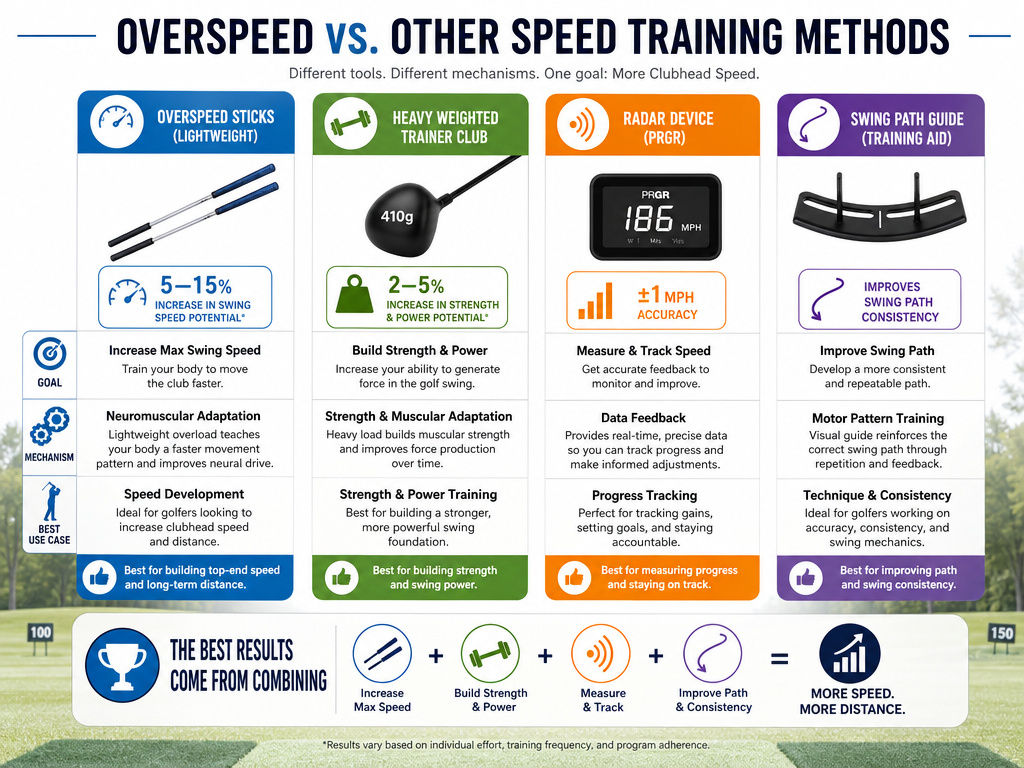
Overspeed is one tool in the box. It’s often confused with weighted trainers or general swing trainers, but the mechanisms and goals are different.
| Method | Primary Goal | Mechanism | Best For |
|---|---|---|---|
| Overspeed Sticks | Increase neural drive & RFD | Post-activation potentiation with light load | Adding 1-3 mph in a short, focused block |
| Weighted Trainers | Build strength endurance & feel tempo | Resistance training for the golf muscles | Improving sequencing and building stamina |
| Speed Trainers (e.g., PRGR) | Measure & provide feedback | Real-time radar feedback | Benchmarking and monitoring progress |
| General Swing Aids | Correct path, face, or plane faults | Mechanical constraint or visual feedback | Fixing technical flaws that limit speed |
Overspeed wins for a pure, acute speed stimulus. Weighted trainers are better for building the underlying strength that makes overspeed gains possible and sustainable. The best approach uses both, sequenced correctly.
Frequently Asked Questions
Does overspeed training work for senior golfers?
Yes, but the foundation is even more critical. A study by Top 100 instructor Ron Gring with golfers over 70 showed average gains of over 5%. The key is ensuring joint mobility and baseline stability are addressed first. For seniors, the risk-reward ratio tilts quickly, proper screening is essential.
How long do overspeed gains last?
The neurological adaptations are persistent if maintained. However, if you stop training entirely, you will detrain. The practical approach is to use overspeed in blocks, then maintain speed with one weekly low-volume “tune-up” session and a consistent fitness training routine that includes power exercises.
Can I use overspeed training if I have a history of back pain?
No. Not without clearance from a physical therapist or golf-specific medical professional. Overspeed places high torsional and shear forces on the spine. If you have pain, the underlying issue, often a mobility restriction or stability deficit, must be resolved first. Using speed tools to work around pain guarantees a worse injury.
Is one overspeed stick enough?
According to the low-volume research, yes. Swinging one stick 6-10% lighter than your driver 30 times twice a week produced the same gains as swinging three different sticks nearly 100 times. The single-stick method is simpler, cheaper, and just as effective for the goal of neurological potentiation.
What’s the best overspeed training system?
The most researched system is SuperSpeed Golf. Its protocols are derived from and supported by independent studies. The “Medium” club in their set is the 6-10% lighter implement the research validates. While other golf aids exist, no other system has the same depth of published, third-party data behind its specific weight progression and protocol.
The Bottom Line
Overspeed training for golf is a precise tool, not a magic wand. It can reliably add 1-3 mph of clubhead speed by rewiring your nervous system, but only within a strict 6-10% weight window and for about six weeks before gains stop.
Its value is unlocked only when layered on top of real strength and proven mobility. Before you buy the sticks, invest in a golf fitness assessment. Build the foundation first. Then, and only then, use a low-volume protocol for a few focused weeks to spike your speed. That’s how you add yards without ending up on the injured list.
