
The Essential Qualities: What Makes a Great Golf Course
This post contains affiliate links. As an Amazon Associate, we earn from qualifying purchases.
A great golf course is defined by three pillars: strategic design that presents multiple routes and mental challenges, seamless integration with its natural environment for both beauty and sustainability, and thoughtful playability that accommodates a wide range of skill levels while encouraging walking. It is not defined by raw length, pristine condition, or a specific par.
The design pillar is where the architect’s skill meets the player’s mind. Strategy is the soul of the game, turning a physical test into a cerebral one. The other two pillars, environment and playability, determine whether a course feels like a natural journey or a manufactured obstacle course. A course that masters all three creates a lasting, memorable experience that players want to revisit, regardless of their score.
What follows is a breakdown of each pillar, the common misconceptions that derail good design, and the specific site characteristics that give a course its best chance at greatness.
Key Takeaways
- Strategy beats length. A great course asks mental questions with varied hazards, multiple playing corridors, and greens that reward thoughtful approach shots. Length is a blunt tool; placement is a scalpel.
- The site is the canvas. Sandy soil, “core golf” routing free of roads and houses, and open, walkable land are the three most common physical traits among the world’s highest-rated courses.
- Playability is not dumbing it down. Good design accommodates all skill levels through multiple tees and width, while still challenging better players with intricate green complexes and risk-reward decisions. A course that is only hard is often a failure.
- Walkability is a design feature, not an afterthought. A walkable routing, with short transitions between green and tee, improves rhythm, pace of play, and the immersive quality of the round. It’s a hallmark of classic architecture.
- Condition is subjective. While elite players prioritize firm, fast greens and pristine fairways, most social golfers care more about a consistent, playable surface and a welcoming club atmosphere. Over-investing in perfection can hurt a club’s community.
The Three Non-Negotiable Pillars of Great Design
Forget the checklist of features. Enduring quality in golf course architecture rests on three foundational pillars. If one is weak, the course feels incomplete. Master all three, and you have a destination.
1. Strategic Design: The Mental Game
This is the essence. A strategic course presents options, asks questions, and punishes carelessness without being cruel. It’s more than just placing bunkers; it’s about shaping the entire landscape to engage the player’s brain from the tee box onward.
A strategic layout grows more interesting the more you play it. You discover new angles, different clubs off the tee, and subtle breaks on the greens. It’s a conversation that never gets old.
The goal is to create interesting decisions, not just difficult shots. A 500-yard par 4 with a forced carry over water is just hard. A 400-yard par 4 with a fairway that slopes toward a well-placed bunker on the left, encouraging a drive down the right side which then leaves a longer approach over a greenside pond, that’s strategic. The player must weigh risk against reward on every shot.
This philosophy is the bedrock of classic golf course architecture. Architects like Alister MacKenzie built their legacies on it. His principles emphasized variety in hole length and direction, and the careful placement of hazards to challenge better players while offering a safer route for others.
2. Environmental Harmony: The Course as a Place
A great course feels like it belongs. It doesn’t fight the land; it reveals it. This harmony is aesthetic, strategic, and ecological. The best sites have inherent advantages, but a skilled architect can coax a sense of place from almost any property.
The UMass landscape architecture thesis on applying Golden Age lessons underscores this. It frames the design process as starting with a deep understanding of the site’s rhythm and natural features. The routing follows the land’s existing flow, not a planner’s rigid grid.
| Site Characteristic | Why It Matters | Iconic Example |
|---|---|---|
| Sandy Soil | Provides perfect drainage for firm turf, reduces irrigation needs, and is easier/cheaper to build on. | Pinehurst No. 2, Sand Hills |
| Core Golf Routing | No internal roads or houses. Creates immersion, improves safety, and allows the wind to influence play. | Augusta National, Cypress Point |
| Open, Rolling Land | Enables long views across the property, promotes strategic width, and lets the wind become a key factor. | St. Andrews, Bandon Dunes |
Sandy soil is the secret sauce. A Golfweek analysis found that 15 of the top 20 classic courses and 9 of the top 10 modern courses are built on sand. It’s not a coincidence. Firm, fast conditions, the hallmark of great golf, start with the dirt under your feet.
3. Inclusive Playability: A Course for the Game
A great course is for golfers, not just for champions. Playability means the course is enjoyable and engaging for a wide range of abilities. This is where many modern “championship” designs fail spectacularly.
The R&A playability guidelines PDF makes a critical distinction. It notes that while low-handicap players loudly demand pristine conditions, most social golfers prioritize a fun, welcoming environment. A course littered with forced carries over water and deep, penal bunkers actively deters the average player.
Good design accommodates everyone. It uses width in the fairways, multiple tee boxes that actually change the angle of play, and greens that accept a running shot. The hazards are strategic, not just penal. A front bunker might catch a poorly struck shot, but it shouldn’t be the only way to access the pin.
Where this goes sideways: Designing only for the scratch player. Research shows features like forced carries, difficult water hazards, and greens surrounded by thick rough are the top reasons intermediate golfers get discouraged and quit.
Debunking the Common Myths of “Greatness”
The golf world is full of conventional wisdom that often steers projects in the wrong direction. The Australian Golf Facilities Guidelines directly challenges these misconceptions, arguing they narrow the game’s appeal.
Myth 1: Length and Par Define Quality.
A “championship course” must be over 7,200 yards and a par 72. This is nonsense. Some of the most revered tests in the world, like the Old Course at St. Andrews, can play under 7,000 yards. Length is a lazy substitute for strategy. The real test is in the approach shots and the putting surfaces.
Myth 2: Immaculate Condition is Everything.
Sure, smooth greens are lovely. But a course that is chemically green and perfectly manicured often plays soft and slow, removing the ground game and strategic bounce. The 2014 U.S. Opens at Pinehurst proved that firm, fast, and slightly brown conditions provide the ultimate examination of skill. For most players, consistent and playable beats perfect every time.
Myth 3: More Holes and Longer Walks are Better.
The 18-hole model is sacred, but it shouldn’t be. The guidelines highlight the success of 12-hole courses, par-3 courses, and short layouts. The key is the quality of the holes, not the quantity. Long treks between green and tee also break the rhythm of the round and exhaust players. MacKenzie’s 3rd principle explicitly called for short walks between holes.
The Great Site: Sand, Core Golf, and Open Views

While a genius architect can create something special anywhere, the raw material matters. The building blocks of great design often begin with a specific type of land.
Sandy soil is the single biggest advantage. It’s the difference between a course that drains 10 minutes after a storm and one that closes for two days. It allows the turf to be firm, which in turn demands more precise shot-making. The ball rolls out, revealing the true contours of the land. You can’t fake this.
Core golf is the second trait. A property where the holes exist in their own world, uninterrupted by roads or real estate, is a treasure. It allows for a natural, flowing course routing that feels like a journey. It also means the architect isn’t forced to cram holes into odd corners to avoid houses, preserving strategic integrity.
Open sites with long views complete the trifecta. An open landscape lets you see the trouble ahead, making the strategic choices clear. It also lets the wind sweep across the property, changing the game daily. This openness is a hallmark of the minimalist design philosophy, which seeks to disturb the land as little as possible.
Walkability, Rhythm, and the “Fifth Hole” Test
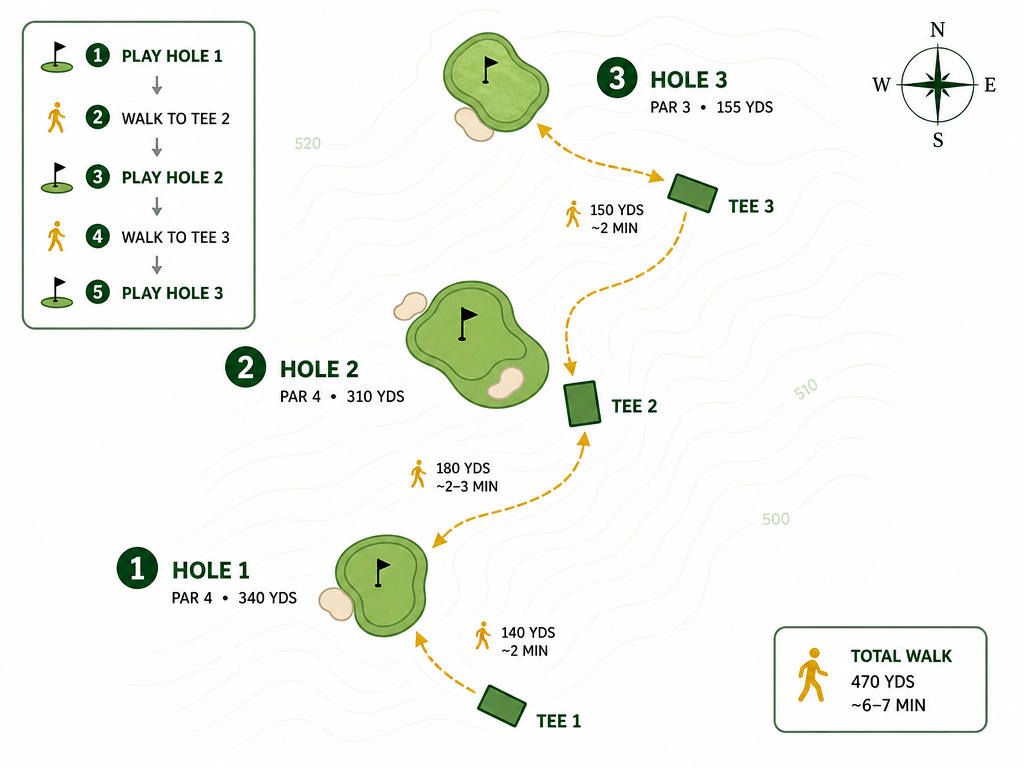
You can feel a great routing in your legs. A walkable course has a natural rhythm, the flow from green to tee is intuitive and often short. This isn’t about saving steps; it’s about maintaining engagement and pace of play.
Alister MacKenzie’s 3rd principle was clear: “There should be little walking between the green and the tees.” When you finish a hole and the next tee is a few paces away, you stay in the flow of your round. When you have a 300-yard cart path ride past three other holes, the spell is broken.
This focus on walkability is a direct link to the Golden Age of architecture, when courses were designed for golfers, not for golf carts. The sequence of holes should feel like a coherent journey, with variety in direction (playing to all points of the compass) and changes in elevation.
Here’s a simple field test: The “Fifth Hole” Test. After you finish the 4th hole, can you easily remember the specific shots you hit on the 1st, 2nd, and 3rd? If the holes have distinct characters and a logical flow, you can. If the course is a blur of similar-looking holes with awkward transitions, you can’t. Distinctiveness and rhythm are inseparable.
How Elite and Social Golfers See “Greatness” Differently
A club’s biggest critics are often its smallest demographic. Understanding this split is crucial for evaluating any course.
The Elite Golfer’s View (Sub-10 Handicap):
This group prioritizes championship conditions. Their checklist is precise: * Greens that roll smoothly at 10+ feet on the Stimpmeter. * Firm, tight fairways that reward driving accuracy. * Challenging, well-placed hazards. * A course that rewards strategic thinking and shot-making.
They are the primary audience for a championship course. Their feedback is valuable but represents a tiny fraction of the golfing population.
The Social Golfer’s View (The Majority):
This group defines greatness by experience, not agronomy. Their priorities are different: * A fun, playable layout where they can keep the ball in play. * A welcoming clubhouse and atmosphere. * Good pace of play (often aided by walkable design). * A course that is visually appealing and feels like an escape.
Common mistake: A club pouring 80% of its budget into maintenance to satisfy the 10% who demand perfection, while neglecting the social fabric that keeps the other 90% coming back. The research in the R&A guidelines is blunt: it’s easier to leave a perfect course than a perfect community.
My own experience aligns with this. I once worked with a client in his 60s who had never broken 100. He wasn’t obsessed with pristine fairways. He was dedicated to a simple, repeatable putting drill. He did it daily. Within two months, his confidence on the greens transformed his game, and he broke 90. For him, greatness was a course that allowed him to play his new game, not one that punished him for not being a tour pro.
Frequently Asked Questions
What is the most important feature of a golf course?
The most important feature is strategic variety. A great course offers a mix of long and short holes, demands different shot shapes, and presents multiple routes to the hole. This mental engagement is what makes a course memorable and replayable, far more than any single physical feature.
Does a great golf course need to be long?
No. Length is one of the least important factors. Many of the world’s best courses are not exceptionally long. Strategic design, clever hazard placement, and complex greens create difficulty and interest. Length alone just makes a course tedious for most players.
What is “core golf” and why does it matter?
Core golf means the course is laid out on a contiguous piece of land, without public roads or houses cutting through it. This matters because it allows for a natural, immersive routing, improves safety, and lets the course play as the architect intended, without compromises for real estate.
Why is walkability a sign of good design?
Walkability indicates that the architect prioritized the golfer’s experience and the natural flow of the land. Short transitions between holes improve pace of play, allow players to stay immersed in the round, and are a hallmark of thoughtful, classic design principles.
Can a course be great if it’s not in perfect condition?
Absolutely. While excellent maintenance helps, the underlying design is paramount. Many legendary courses, especially links courses, are rarely in “Augusta National” condition. Firm, fast, and natural often provides a better, more strategic test than soft, lush, and artificial perfection.
The Bottom Line
A great golf course is a lasting conversation between the land, the architect, and the player. It challenges your mind as much as your swing, feels like it grew there naturally, and welcomes you back regardless of your skill level. It’s not found on a scorecard or a fertilizer schedule.
If a course makes you think, fits its landscape like a glove, and leaves you wanting to walk another loop even after a bad score, you’ve found it. That’s the magic that separates a truly great layout from a mere collection of holes. Everything else is just grass and dirt.
