
What Is Minimalist Golf Course Design? A Complete Guide
This post contains affiliate links. As an Amazon Associate, we earn from qualifying purchases.
This post contains affiliate links. As an Amazon Associate, we earn from qualifying purchases.
Minimalist golf course design is a philosophy that creates engaging golf using the fewest manmade features possible, prioritizing natural landforms and restrained earth movement. It’s not just about moving less dirt; it’s about a calculated restraint that lets the existing landscape dictate strategy, making the game more interesting for players of all skill levels, especially those who play shots along the ground.
The confusion starts with the word itself. In golf, ‘minimalism’ gets slapped on any course that looks natural. But that misses the point. The real measure isn’t how a course looks from the clubhouse patio. It’s how many design gestures the architect needed to create the challenge in front of you.
What follows breaks down the philosophy, clears up the common misunderstandings, and shows you how this design approach directly changes your round—whether you’re plotting a tee shot at Sand Hills or trying to save par at your local muni.
Key Takeaways
- Minimalism in golf is defined by the minimum of design gestures needed, not just low earthmoving totals. A course can move a million yards of dirt and still be minimalist in its strategic intent.
- The philosophy is a direct reaction to the heavily manufactured courses of the 1970s and 80s. Architects like Tom Doak and the team of Coore & Crenshaw led a return to working with the land.
- For the average golfer, minimalist design is crucial because it emphasizes ground game. Between 50 and 80 percent of golfers play a significant amount of their golf along the ground, and these courses give those shots a chance.
- True minimalist routing seeks holes where the main features—fairway contours, hazards, green sites—already exist in the landscape. The architect’s job is to find them and accent them.
- Don’t confuse a natural aesthetic with minimalist design. A course like Oakmont was built with little earthmoving, but its bold, numerous manmade hazards make it a distinctly non-minimalist test.
The Core Philosophy: Restraint, Not Just Earthmoving
Most discussions trip over the first hurdle. They define minimalist design solely by its construction method: how much dirt got pushed around. That’s a useful metric, but it’s not the definition.
The real definition lives in the outcome. John Pawson, a minimalist architect outside of golf, defined it as “the perfection an artifact achieves when it can no longer be improved by subtraction.” In golf terms, it’s creating the most engaging, strategic golf with the fewest design gestures. The goal is to make the course feel inevitable, not invented.
A golf course can have a minimal design even if millions of yards of earth are moved, and a course built with only a small quantity of soil moved does not necessarily qualify as a minimalist design. The true measure is the minimum of design gestures to achieve the desired effect.
This is why the term causes so much debate. People look at a Coore & Crenshaw course and see beautiful, natural-looking landforms. They call it minimalist. But what they’re really seeing is the result of a philosophy that values the existing land above the architect’s ego. The team’s famous work at Sand Hills in Nebraska is the textbook example. They found 18 holes in the sand dunes; their job was mostly clearing and shaping, not creating.
The opposite of this is often a different philosophy. The heavily manufactured courses of the 1970s and 80s often started with a blank slate or a boring piece of land.Architects used massive earthmoving to create interest where none existed—building huge mounds, artificial water hazards, and greens perched high above grade. That approach can produce great golf, but it’s a different conversation entirely.
Where this goes sideways: Assuming a course is minimalist because it looks rugged and natural. The aesthetic is a byproduct, not the goal. The goal is strategic clarity born from simplicity.
Earthmoving: A Tool, Not The Scorecard
So where does earthmoving fit in? It’s the primary tool for executing the philosophy, especially on less-than-ideal sites. Tom Doak has pointed out that the philosophy is most important on tough sites.
On a severely hilly, rocky site like Stone Eagle, or a dead flat site like some projects in Texas, the ability to make good golf holes while moving less earth is the whole game. It forces creativity in the routing and precision in the shaping. On a gorgeous, rolling piece of sand like Sand Hills or Pacific Dunes, the land does most of the work. The architect’s touch is lighter.
| Site Type | Minimalist Challenge | Key Architect Tool |
|---|---|---|
| Topographically Rich (e.g., Sand Hills) | Don’t ruin what’s already there. | Restraint; selective clearing and subtle shaping. |
| Severe or Rocky (e.g., Stone Eagle) | Create playable, interesting golf without massive blasting. | Creative routing to find natural holes; precise, limited earthmoving. |
| Dead Flat (e.g., some Texas sites) | Create interest and strategy from nothing. | Strategic landform creation (often with moved soil) that feels natural. |
The table shows the flexibility. Minimalism is a mindset that asks, ‘What is the least I need to do here to create great golf?'” Sometimes the answer is “very little.” Sometimes, on a flat field, the answer is “build some landforms,” but do it with a light touch and a clear strategic purpose.
A Brief History: Reaction and Renaissance
Minimalism in golf course design is a return to the oldest form of the game. The classic links of Scotland and Ireland are the original minimalist courses.Old Tom Morris didn’t have a bulldozer. He had a keen eye, a team of men with shovels, and a landscape shaped by wind and sea. He found holes; he didn’t fabricate them.
This approach was largely forgotten in the United States during the mid-20th century, particularly in the 1970s and 80s. This was the era of the “modern” course, where powerful machinery meant architects could make land conform to their vision. The result was often a formulaic, obstacle-heavy style of golf.
The pendulum began to swing back in the late 1980s. Two projects are credited with sparking the modern minimalist movement: Tom Doak’s High Pointe (1989) in Michigan and Coore & Crenshaw’s Sand Hills (1995) in Nebraska. Golf Digest architecture editor Ron Whitten was among the first to apply the term “minimalism” to this new-old style.
These courses stood in stark contrast to their predecessors. They felt discovered, not built. They emphasized strategy over sheer penalty, and they celebrated the natural beauty of their sites. Their success created a new benchmark and influenced a generation of architects, including Gil Hanse and David McLay Kidd. This period reconnected American golf with the strategic, ground-based tenets of the Golden Age of design.
The Minimalist Toolbox: How Architects Work
If the philosophy is restraint, what tools do architects use to achieve it? The process starts long before a bulldozer arrives.
- The Walk: The most important tool is a pair of boots. Architects like Doak and Coore & Crenshaw spend weeks walking a property, often with the routing already in mind from topographic maps. They’re looking for natural green sites, interesting contours, and existing features that can define a hole. The goal, as stated in Doak’s “Minimalist Manifesto,” is “to route as many holes as possible whose main features already exist in the landscape.”
- Routing as Foundation: The routing of a course is everything. A great minimalist routing strings together those found holes in a way that feels seamless, offers variety, and respects the flow of the land. A bad routing forces the architect to manufacture interest later.
- Selective Earthmoving: When dirt must be moved, it’s for a specific purpose: to create a putting surface, to fine-tune a fairway contour for strategy, or to manage drainage. The amount moved is often a fraction of what a 1970s-era course would have moved. The aim is to make the moved earth look like it was always there.
- Accenting, Not Overkilling: This is the final, crucial step. Once the key landforms are identified or created, the architect “accents their strategies without overkilling the number of hazards.” This means a single, well-placed bunker or a subtle fairway tilt might be enough to present a compelling choice. The work of famous architects in this style is defined by this discipline.
Common mistake: Equating minimalist design with a lack of difficulty or architectural personality. The restraint required often results in a purer, more difficult form of golf where mistakes are compounded by the ground itself, not just by water or deep rough.
How Minimalism Shapes Your Round
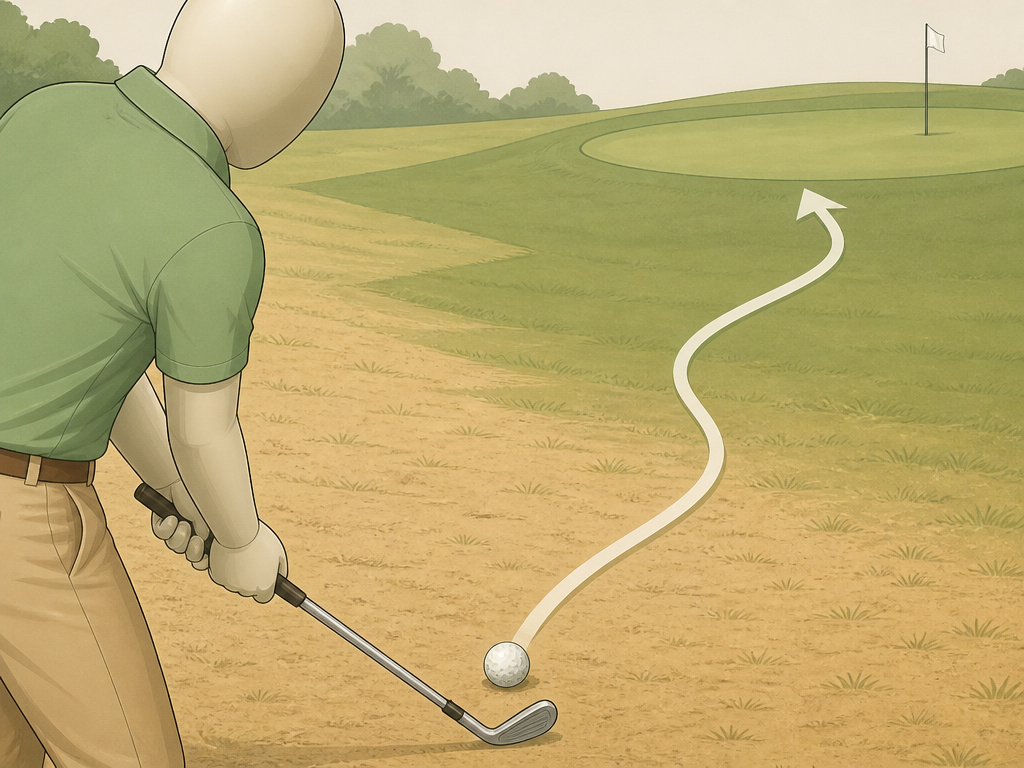
This isn’t an academic debate. The minimalist philosophy changes how you play. If you’ve ever wondered why your ball seems to roll forever on some courses or why the challenges feel more “honest,” you’ve felt its impact.
The biggest effect is on the ground game. In a Tom Doak minimalism interview, he stated that “somewhere between 50 and 80 percent of golfers play a fair amount of their golf along the ground.” They can’t make the ball stop like a tour pro. On a heavily manufactured course with soft turf, elevated greens, and thick rough, these players are punished on every shot. The course fights their game.
A minimalist course, especially one on firm, sandy soil, welcomes the ground game. The architect designs with the roll of the ball in mind. A drive might catch a slope and funnel 30 yards closer to the green. An approach shot can be bounced onto the putting surface. Trouble is often defined by angles and contours, not just by deep hazards. This opens up multiple routes to the hole, the hallmark of strategic design.
Think of it as chess versus checkers. A penal design (water left, thick right) is checkers. A strategic, minimalist design is chess. You have more options, but each has a consequence. The course asks you to think.
Spotting the Style: A Quick Guide
You don’t need a degree in golf course architecture to recognize the hallmarks. Ask yourself these questions during your next round:
- Do the hazards look built or found? Minimalist bunkers often look eroded, with ragged edges and natural placement. They seem to have been uncovered, not dug.
- Can you use the ground? Are there slopes in the fairways that actively move your ball? Can you run a shot up to most greens?
- Does the course feel “of” the land? Does it look like it belongs there, or does it look like it was dropped onto the site? A minimalist course should feel inseparable from its surroundings.
- Is the challenge clear from the tee? Good minimalist design presents options. You can see the risk and the reward, often defined by a single bunker or a contour, not a cluster of them.
Famous Examples and Architects
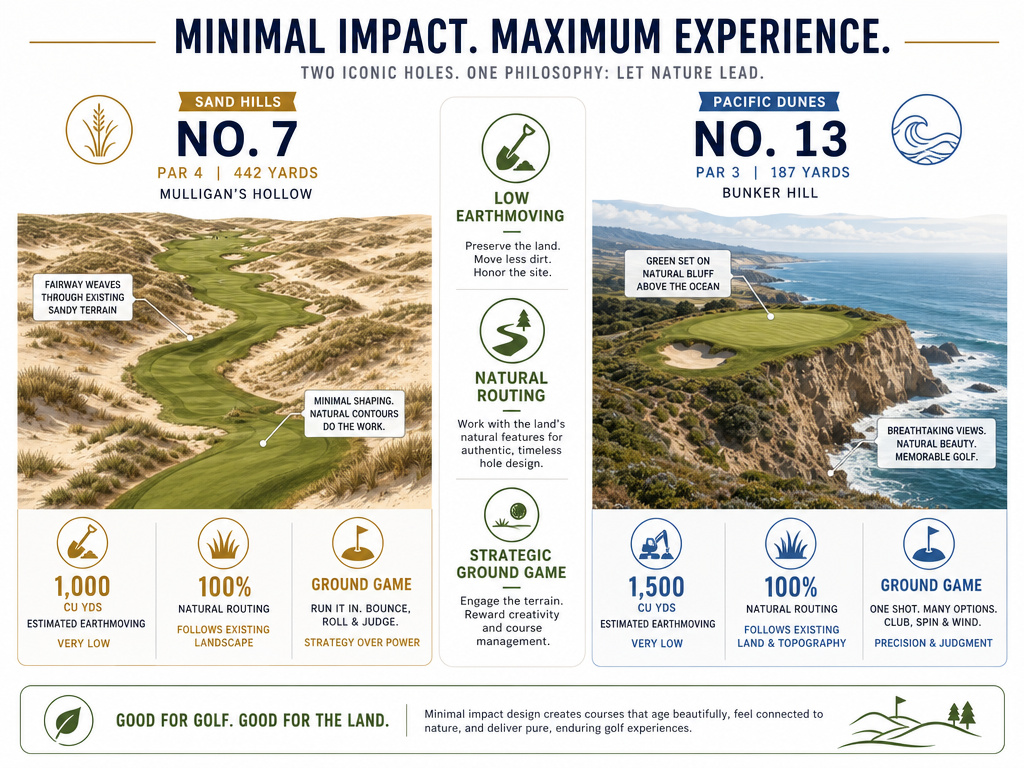
You can read about the philosophy, but you need to see it. These courses and architects define the movement.
- Sand Hills (Coore & Crenshaw): The archetype. Built on Nebraska sand dunes, it’s the course that proved world-class golf could be found, not made. It’s the purest expression of the Coore and Crenshaw approach.
- Pacific Dunes (Tom Doak): Doak’s masterpiece at Bandon Dunes. It takes a breathtaking coastal site and, with remarkably little earthmoving, creates a rollercoaster of dramatic, strategic holes. It embodies Doak’s philosophy of accenting the landscape.
- High Pointe (Tom Doak): The starting point. Doak’s first solo design in 1989 was a declaration of this new (old) way of thinking. It showed that minimalist principles could be applied to a wooded, midwestern site, not just sandy expanses.
- Modern Iterations: The philosophy evolves. Doak’s recent work, like Pinehurst No. 10 and the short, fascinating Sedge Valley at Sand Valley, shows how the principles adapt to different landscapes and client requests. The core belief—restraint, ground game, strategic clarity—remains.
| Course | Architect | Key Minimalist Trait |
|---|---|---|
| Sand Hills | Coore & Crenshaw | Routing that discovered 18 holes in existing dunes; extremely low earthmoving. |
| Pacific Dunes | Tom Doak | Dramatic coastal holes shaped with minimal intervention; emphasis on natural contours. |
| Ballyneal | Tom Doak | A “minimalist” course on a dramatic, rolling site where the land dictated every hole. |
| Sedge Valley | Tom Doak | A short course that proves minimalism is about strategic density, not length. |
Frequently Asked Questions
Is a minimalist course easier to build?
No. It’s often more difficult. Finding a great routing on a complex site requires more time, skill, and patience than simply moving dirt to a pre-planned blueprint. The construction process requires artisans who can shape earth to look natural, not just operators moving bulk material.
Does minimalist mean no bunkers or water hazards?
Not at all. It means every hazard has a clear strategic purpose. There are no redundant or purely decorative hazards. A single, perfectly placed bunker can do the work of three poorly placed ones.
Are all natural-looking courses minimalist?
This is the biggest confusion. A course can have a natural aesthetic but be highly manufactured in its strategy (e.g., using tons of earthmoving to create “natural-looking” mounds). Conversely, a course might need to move significant earth on a flat site to create the strategic landforms that define minimalist play. The look is secondary to the design intention.
Why should the average golfer care about this?
Because minimalist courses are often more fun and more playable for you. They reward thinking and creativity over sheer power. They give your mishits a chance to bounce and roll into playable positions. They represent a design philosophy that considers how you actually play the game, not just how a tour pro does.
Can a classic, old course be minimalist?
Absolutely. Many Golden Age courses built before heavy machinery are minimalist by necessity. Architects like Alister MacKenzie and Donald Ross worked with the land they had, using subtle shaping to create strategy. Their work is a direct ancestor of the modern movement.
The Bottom Line
Minimalist golf course design is a philosophy you feel under your feet and encounter in your strategy. It asks architects to practice calculated restraint and asks you, the player, to engage your mind as much as your swing.
The next time you play a course where the ball rolls forever, where a single bunker makes you pause, and where the holes feel like they grew there, you’re experiencing it. It’s golf that feels less complicated the more you understand it. That’s the real goal: stripping away the unnecessary to reveal the essential, strategic game beneath. Com/what-makes-a-great-golf-course/)**.
