
What Is a Desert Golf Course | Target Golf’s Dry Reality
This post contains affiliate links. As an Amazon Associate, we earn from qualifying purchases.
This post contains affiliate links. As an Amazon Associate, we earn from qualifying purchases.
A desert golf course is a target-style layout built into an arid landscape, where maintained turf is limited to tees, fairways, and greens, and the surrounding native desert, rock, sand, and scrub, forms the playing corridors and hazards. The design philosophy minimizes water use and integrates the natural terrain, creating a game that penalizes inaccuracy more severely than parkland or links courses.
That definition is the blueprint. The experience is something else: a round where a missed fairway doesn’t mean thick grass, it means a one-stroke penalty, a search for a ball in a cholla cactus, or a decision to sacrifice an old club to rocky ground. This isn’t golf with a desert backdrop. It’s golf where the desert is an active, punishing participant.
What follows is a breakdown of why these courses exist against ecological odds, the specific design and maintenance tricks that keep them green, and the blunt, practical adjustments you need to make in your strategy and gear to get around one intact.
Key Takeaways
- Miss the short grass, take the penalty. On most desert courses, the native area is marked as a red or yellow penalty area. A ball lost in the desert costs a stroke and a drop, searching is often discouraged due to terrain and wildlife.
- The ground is a club killer. Hard-packed earth, rocks, and caliche (a hardened mineral layer) can damage clubfaces. Regular players often carry a dedicated “desert club”, an old utility iron, for recovery attempts.
- Target golf is the only strategy. Fairways are visual islands. You must trust your rangefinder over your eyes, as the lack of trees and scale-distorting vistas makes judging distance deceptively difficult.
- They use less water than you think. Through strict irrigation limits, drought-tolerant Bermuda grass, and the “target” design that reduces maintained turf sometimes to under 70 acres, modern courses are engineered for efficiency.
- Sustainability is an open question. While technologically advanced, a 2024 study noted desert golf in places like Phoenix still accounts for about 3.5% of regional water demand, highlighting a persistent environmental tension.
The Defining Visual and Strategic Signature
Forget the postcard. The first thing you notice stepping onto a true desert course isn’t the beauty, it’s the stark line. Emerald green fairways and greens end abruptly, replaced by shades of tan, red, and brown. There are no gradual transitions from first cut to second cut to trees. It’s grass, then desert. This visual shock is the core of the experience.
A desert course integrates the native landscape as a primary hazard. The 2019 USGA/R&A Rules of Golf allow these areas to be marked as penalty areas, meaning a ball in the desert is treated like a ball in water: one stroke, play from a drop zone or the previous spot. This rule transforms the desert from scenery into a direct, punitive strategic element.
This “target golf” design philosophy was pioneered by architects like Robert “Red” Lawrence at Desert Forest Golf Club in 1962. His minimalist approach, where only 67 of the club’s 165 acres are irrigated turf, proved you could craft compelling golf course architecture by working with the land, not against it. The contrast creates narrower playing corridors that demand precision. A miss isn’t just offline; it’s often out of play.
| Course Type | Typical Rough | Primary Hazard | Missed Fairway Consequence |
|---|---|---|---|
| Parkland | Grass, trees | Water, bunkers | Recovery shot, possible punch-out |
| Links | Tall fescue, dunes | Wind, pot bunkers | Difficult recovery, possible unplayable lie |
| Desert | Rock, sand, brush | The desert itself | One-stroke penalty & drop; often no recovery attempt advised |
The strategic shift is absolute. On a parkland course, you might gamble on a hero shot from the trees. On a desert course, that kind of gamble can break a club or land you next to a rattlesnake. The smart play is almost always to take the penalty and move on. This fundamental risk/reward calculus is what separates desert golf from every other style.
Why They Exist: Economics, Engineering, and Environment
Building a lush golf course in a desert seems perverse. It happens because the demand, from tourists, retirees, and real estate developers, creates immense economic value. The engineering that makes it possible is a story of water law, grass science, and smart design.
Arizona state law, for instance, caps irrigated acreage for courses and limits the size of decorative lakes. This regulatory pressure forced innovation. The solution is a three-part system: source, grass, and design.
First, water comes from allocated groundwater rights, reclaimed wastewater, or a mix. Then, agronomists plant Bermuda grass, a drought-tolerant warm-season variety that thrives in heat. It goes dormant and browns in winter, so to keep courses green year-round, superintendents overseed with ryegrass each fall. It’s a cyclical, resource-intensive process just to maintain the playing surface.
The most critical water-saving innovation, however, is the golf course design itself. The target model drastically reduces the area needing water. Why irrigate 150 acres when you can create a great challenge with 70? The space between holes remains untouched desert, requiring no water and providing habitat. This approach is a cornerstone of modern sustainable golf course management in arid regions.
Yet, the environmental equation isn’t settled. A recent peer-reviewed sustainability assessment of desert golf in the Phoenix area noted that while individual courses are efficient, their collective footprint is significant. The study found golf uses about 3.5% of the region’s water, a resource under constant strain. The existence of these courses is a permanent negotiation between recreation, economics, and ecology.
The Ground Truth: Caliche, Critters, and Carry Clubs

The desert isn’t a uniform sand trap. The playing surface off the turf has unique physical properties that change your game. In much of the Sonoran Desert, the ground sits atop caliche, a layer of cemented calcium carbonate. It’s not soft dirt; it’s a hardpan that gives the ground a concrete-like firmness and causes unpredictable, hot bounces.
Where this goes sideways: Trying to play a standard wedge from a rocky desert lie. The clubhead can skid or bounce into the ball, leading to a thinned shot that screams across the green, or worse, the rock can gouge the clubface. The damage is immediate and permanent.
This is why seasoned desert golfers often have a “desert club” in the bag, an old hybrid or utility iron they don’t mind scratching up. It’s for the one recovery shot they might attempt from a clean-ish lie. For most lies, the better part of valor is to declare the ball unplayable.
Then there’s the wildlife. Courses post warnings for rattlesnakes, scorpions, and Gila monsters. Cholla cactus, nicknamed “jumping cholla,” drop barbed segments that attach on contact. This isn’t scare talk; it’s the reason most courses strongly advise against searching for a ball in the native areas. The “desert rule” isn’t just about golf; it’s a safety protocol.
Your standard golf course management strategy needs a desert overhaul. Here’s the short list:
- Commit to the Rangefinder. The vast, treeless vistas destroy depth perception. You cannot trust your eyes. The number is the only truth.
- Play for the Firm Bounce. Desert fairways are hard. Your drive will roll out 30+ yards more than you’re used to. On approach, land the ball short of the pin and let it release.
- Respect the Waste Area. When you miss, you’ll likely be in a waste area, a mix of sand, rock, and scrub. Survey your lie honestly. If it’s rocky, take your medicine.
- Hydrate Relentlessly. The dry air dehydrates you faster than you feel. Drink water every hole, no exceptions.
Desert vs. Resort vs. Championship: Clearing the Confusion
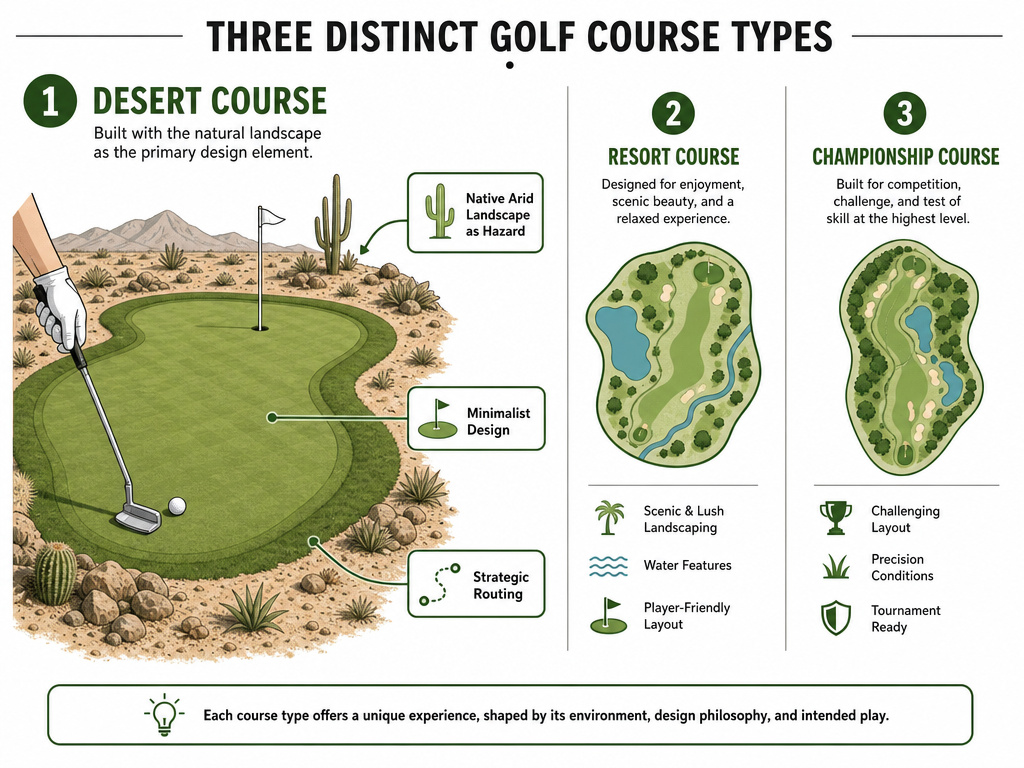
Not every course in a dry climate is a desert course. The label refers to design, not geography. It’s helpful to see how it fits alongside other common types.
A desert course is defined by its integration of the native arid landscape as a hazard. A resort golf course, which can be built in the desert, is defined by its amenity package, luxury accommodations, multiple pools, and a design that prioritizes playability and scenery for vacationing golfers. They can overlap, but the core missions differ.
Similarly, a championship golf course is built to test the world’s best, with length, difficulty, and infrastructure for tournaments. TPC Scottsdale’s Stadium Course is both a desert course and a championship venue. Desert Forest is a iconic desert course but isn’t set up for modern professional tournaments.
The defining quality of a great golf course is that its design fits its environment. A great desert course doesn’t imitate a parkland; it exaggerates the desert’s natural drama and makes a strategic virtue of its harshness. This often involves minimalist golf design and thoughtful golf course routing that follows the existing contours of the land.
Iconic Examples and Where to Find Them
You can’t understand the category without knowing its landmarks. These courses set the standard.
- Desert Forest Golf Club (Carefree, AZ): The original. Red Lawrence’s 1962 minimalist masterpiece defined the genre. It’s walking-only, with no parallel fairways, fully embracing the rugged Sonoran Desert.
- Stadium Course at TPC Scottsdale (Scottsdale, AZ): The most televised. Home to the raucous WM Phoenix Open, its 16th hole is a stadium par-3. It shows how desert target golf can accommodate massive galleries.
- Wolf Creek Golf Club (Mesquite, NV): The dramatic fantasy. Carved into high-desert canyons, it features extreme elevation changes and breathtaking vistas. It’s desert golf amplified for spectacle.
- Courses of the DP World Tour (UAE): The international standard. Events in Dubai and Abu Dhabi are played on lush courses built from the desert, a testament to the global appeal and engineering required.
These destinations prove the model works at the highest levels of both pure design and tournament spectacle.
Frequently Asked Questions
What is the “desert rule” in golf?
It’s a local rule adopted on most desert courses where the native desert areas are marked as red or yellow penalty areas under the Rules of Golf. If your ball is lost in the desert, you take a one-stroke penalty and drop a ball at a designated relief area or where you last played from. It’s designed to speed play and discourage dangerous searches.
Is it bad to hit irons off desert ground?
Yes, it can be. Hitting off hard-packed dirt, rocks, or caliche can damage the clubface, leading to dents, scratches, or even cracks in extreme cases. This is why many players use an old, sacrificial club for the rare recovery attempt from a clean desert lie.
What is the best grass for desert golf courses?
Bermuda grass is the primary turf. It’s a warm-season grass uniquely tolerant of heat, drought, and high salinity. For winter color, courses overseed with perennial ryegrass, which thrives in cooler temperatures but dies off when the summer heat returns.
How do desert courses get water?
Sources vary by location and regulation. Common sources include reclaimed wastewater (treated effluent), allocated groundwater from specific aquifers, or a blend of sources. Advanced computer-controlled irrigation systems deliver water with precision to minimize waste.
What should I wear to play desert golf?
Functional, breathable clothing is essential. Wear a hat, UV-protective sunglasses, and sunscreen. Golf shoes with soft spikes or spikeless soles are ideal, as some courses prohibit traditional metal spikes to protect their delicate turf and hard surfaces.
The Bottom Line
A desert golf course is a specific, engineered answer to a simple question: can you hit your target? It strips away the comfort of grassy rough and replaces it with a definitive penalty. Playing one successfully is less about majestic power and more about disciplined decision-making, knowing when to swing away and when to pocket your ball.
The tension between the game’s thirst for perfect turf and the desert’s inherent dryness won’t vanish. But understanding the design, the science, and the strategy behind these courses changes how you see them. They’re not miracles. They’re carefully managed compromises, offering a stark, beautiful, and brutally honest version of the game. Your job is to adapt to that honesty, one targeted shot at a time.
