
The Ultimate Guide to Low Point Control in Your Golf Swing
This post contains affiliate links. As an Amazon Associate, we earn from qualifying purchases.
This post contains affiliate links. As an Amazon Associate, we earn from qualifying purchases.
Low point control in the golf swing means positioning the bottom of your swing arc so the club strikes the ball before the turf with irons, and slightly after the ball with a driver. For a tour pro’s 7-iron, that low point is consistently 3 to 5 inches in front of the ball. You control it not with your hands, but by shifting 80-90% of your pressure to your lead foot by impact while keeping your head back.
That gap between “in front” and “behind” the ball is where every mishit lives. A fat shot means your low point drifted behind the ball; a thin shot often means it’s too far in front or your entire arc got too high. This is about a specific, measurable shift in your body’s center that physics demands.
What follows breaks down the one number that matters, the counterintuitive body rule that fixes it, and three drills you can use on any practice tee to own your low point within a week.
Key Takeaways
- Your sternum dictates low point. The club’s arc bottoms out directly below your upper body’s center. Move your chest forward, the low point moves forward.
- Head forward equals low point back. Drifting your head toward the target during the downswing pushes the swing’s bottom backward, causing fat contact. Stability beats effort.
- Pressure shift is non-negotiable. By impact with an iron, 80-90% of your pressure must be on your lead foot. This physically moves your center forward.
- Low point and divot depth are separate. You can have the correct low point position but still hit fat if your swing arc is too steep and deep into the ground.
- Driver strategy flips the script. For max distance, you want the low point behind the teed ball, achieved by a wider stance and a slight spine tilt away from the target.
What Low Point Actually Is (And What It Isn’t)
Forget the abstract definitions. On a launch monitor screen, low point is a number with a letter. A reading of 3.1A means the club bottomed out 3.1 inches after impact. 1.2B means it bottomed out 1.2 inches before impact. This is the measurable truth that separates a pure strike from a mishit.
Trackman, the industry-standard launch monitor company, defines low point as “the distance from the geometric centre of the clubhead to the lowest point on the swing arc at the moment of maximum ball compression.”
It is not the divot. A divot is a result. Low point is the cause. You can take a divot with the low point in the wrong place, that’s a chunk. You can have no divot with a perfect low point, that’s a picker’s clean strike. Confusing the two makes practice frustrating.
The tour data gives us the gold standard. For a 7-iron, a professional’s low point is typically 3 to 5 inches in front of the ball. Coach Stephen Arnold’s testing showed solid 8-iron shots averaged a low point 3.7 inches after the ball. Your goal is to move your number consistently forward for irons.
| Club | Ideal Low Point | Attack Angle | Result |
|---|---|---|---|
| Mid-Iron (e.g., 7-iron) | 3-5 inches in front of ball | Downward (-3 to -5 degrees) | Ball-first contact, shallow divot after |
| Driver | Behind or level with teed ball | Level to upward (+1 to +3 degrees) | Ascending strike, high launch, low spin |
| Fairway Wood (fluffy lie) | Level with the ball | Slightly downward to level | Clean pick off the turf |
Where this goes sideways: Trying to make the ball the low point. It feels logical to bottom out at the ball, but that instinct causes a scoop or a hang-back. Your body’s protective reaction moves the actual low point behind the ball. Every fat shot starts with this intention.
The Physics of Low Point: Your Sternum is the Pivot
Think of your swing as a pendulum. Your body is the fixed point at the top, and the clubhead is the weight at the end. The bottom of that pendulum’s arc will always be directly below the pivot point. In your golf swing, that pivot point is roughly your sternum, the center of your chest.
This changes everything. You don’t control low point by manipulating the club with your wrists. You control it by managing where your sternum is at impact.
Common mistake: Throwing your chest toward the target in the downswing. This actually moves the low point backward. Your subconscious, knowing the club would crash into the ground, pulls your arms up to compensate. Result: fat or thin.
The relationship is simple but absolute: where your sternum goes, the low point follows. To move the low point forward, your body’s center must move forward. This happens through a pressure shift, not a lunge.
The Two Body Moves That Control Everything
Controlling your sternum’s position comes down to two coordinated actions: a pressure shift and head stability. Get these wrong, and your low point wanders. Get them right, and it locks in.
1. The Pressure Shift (It’s a Leg Drive, Not a Slide)
The research is specific. At the top of your backswing, about 60-70% of your pressure should be loaded on your trail foot. Your first move down should be shifting that pressure toward your lead foot. By the time of impact with an iron, you need 80-90% pressure on your lead foot.
This is a drive into the ground with your lead leg, which rotates your pelvis and moves your center mass forward. This kinematic sequence, legs, then torso, then arms, is what creates power and moves the low point forward predictably.If your swing plane is off, this sequence breaks down.
| Fault | Pressure at Impact | Where Low Point Goes | Shot Result |
|---|---|---|---|
| Hanging Back | 60%+ on trail foot | Stays behind the ball | Fat or weak thin |
| Over-Sliding (no rotation) | 90%+ on lead foot, but center behind ball | Can still be behind ball | Fat, often with a pull |
| Correct Shift & Turn | 80-90% on lead foot, center forward | 2-4 inches in front of ball | Ball-first, compressed strike |
2. The Head-Stay-Back Rule
Here is the most counterintuitive piece. While your pressure surges forward, your head must stay relatively back. Drifting your head toward the target during the downswing is a primary cause of fat shots.
If your head moves forward three inches during the downswing, you move the bottom of your swing arc back three inches. Physics is undefeated.
The best ball-strikers have aggressive lower-body motion with remarkable upper-body stability. Their head might even drift slightly away from the target as they rotate. This preserves the spine tilt needed for a descending strike. Fixing a reverse pivot or excessive swaying is foundational to achieving this stability.
How to Find (And Fix) Your Low Point: 3 Drills
Theory is useless without a way to see the problem. These drills give you instant feedback.
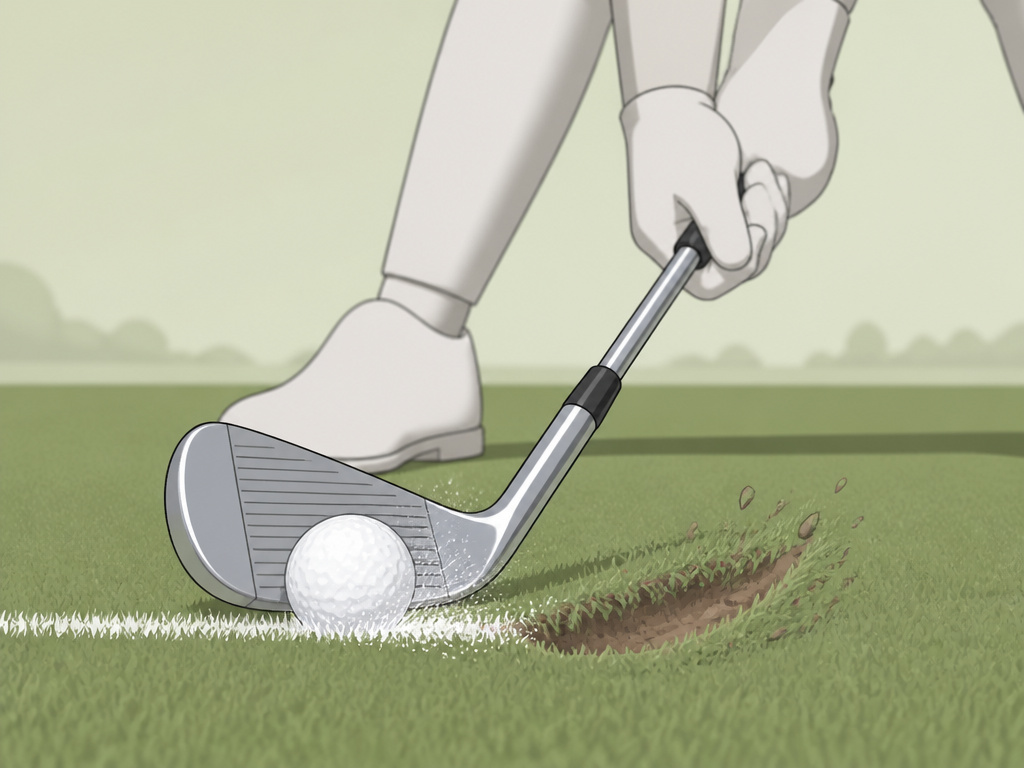
The Divot Test Drill
This is the fastest diagnostic. You need a can of foot powder spray or a line of sand.
- On the practice tee, spray a straight line on the turf perpendicular to your target.
- Place a ball on the line. Take your normal stance.
- Hit five shots with a mid-iron.
- Observe: Does your divot start behind the line, on the line, or in front of it?
Divot starts behind the line: Your low point is too far back. You are likely hanging back or your head is drifting forward. Focus on the pressure shift and head stability.
Divot starts on the line: You’re bottoming out at the ball. This leads to inconsistency. You need to feel more drive forward with your lower body.
Divot starts in front of the line: Good. Now check its depth. A deep, gouging divot means your angle of attack is too steep even with a good low point.
The “Low Point Paint Box” Exploration Drill
Taken from the NCBI biomechanical swing study, this drill builds skill by encouraging variability. Use spray paint to draw a box about a foot long and a few inches wide on the ground.
- Without a ball, take practice swings trying to make the club brush the ground at different points in the box, way forward, way back, in the middle.
- First, keep your body movement the same and change the low point only with your arms (e.g., casting it back, holding lag to move it forward).
- Next, keep your arm swing the same and move the low point using only your body (e.g., more forward flexion to move it forward, early extension to move it back).
This “calibration” practice teaches your body the cause-and-effect relationship. It’s more effective than trying to be perfect every time.
The Face-On Video Check
Your phone is a powerful launch monitor. Set it up face-on, about 15 feet away.
- Record your swing with a 7-iron.
- Pause the video at address. Draw an imaginary vertical line up from the outside of your lead ear.
- Now pause at impact. Where is your head relative to that line?
If your head has moved noticeably toward the target, you’ve found the root of your low point inconsistency. Work on drills that emphasize a stable center, like the balanced finish, to retrain this feel.
Driver vs. Iron: The Low Point Flip
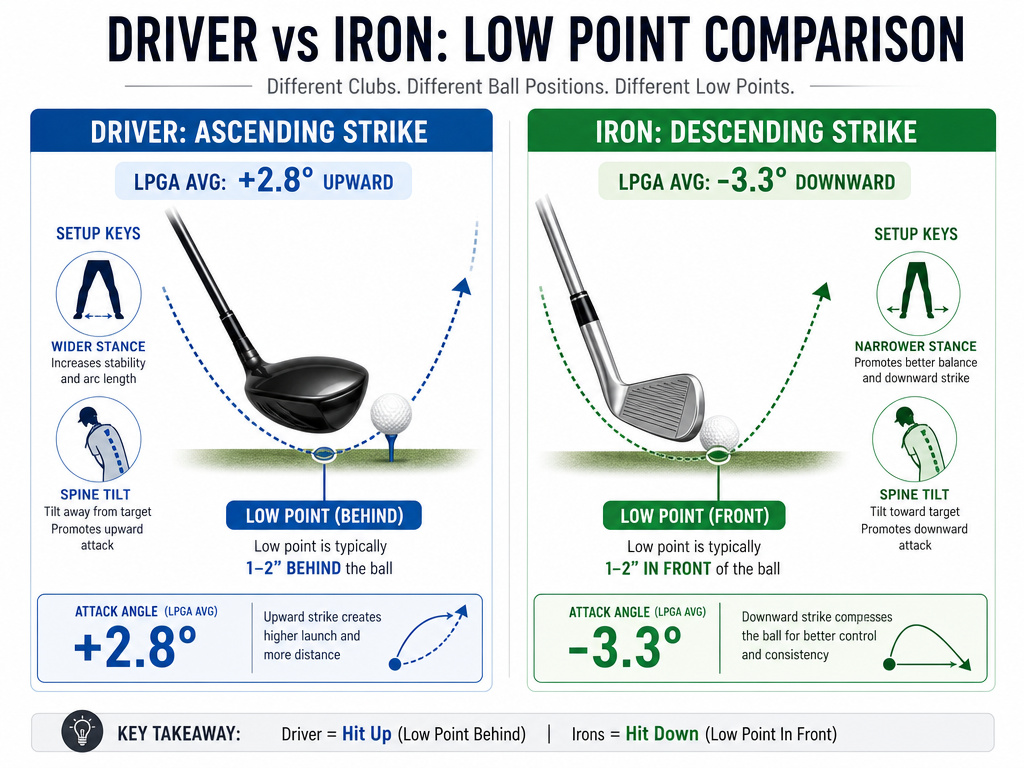
This is where golfers get stuck. The brilliant iron strike is a disaster with the driver. You must change the goal.
For the Driver: You want the low point behind the ball. Why? The ball is teed up. An ascending strike, hitting up on the ball, maximizes launch and minimizes spin for distance. PGA Tour averages show a slightly downward attack angle, but LPGA Tour pros average +2.8 degrees upward. For amateurs, hitting up is almost always better.
How to set it up:
- Widen your stance.
- Tilt your spine slightly away from the target at address. This moves your sternum back.
- Feel like your head stays behind the ball through impact.
- The feeling is of sweeping the ball off the tee, not hitting down.
This different objective is why your golf swing rhythm and timing might feel different between driver and iron. It’s not a flaw; it’s a required adaptation.
Frequently Asked Questions
Where should the low point be for a wedge?
Even more forward than a 7-iron. With a wedge, you want a steeper angle of attack to create spin and a predictable flight. Your divot should be deeper and start 4-6 inches in front of the ball. This requires an even more stable head and committed pressure shift.
Can you have a good low point but still hit bad shots?
Absolutely. Low point controls forward/back contact. You can have a perfect low point but strike the ball on the heel or toe because your swing path is off. You can also have the correct low point position but hit it fat because your arc is too “V”-shaped and steep, digging too deep. Controlling the height of your arc (through posture maintenance) is the other half of the equation.
Do I need a launch monitor to work on this?
No, but it helps. The spray paint or foot powder line drill gives you all the feedback you need. A launch monitor like Trackman or a cheaper personal radar (like a Rapsodo) confirms you’re moving the numbers in the right direction. The “3.1A” reading becomes your target.
Why do I hit my driver well but struggle with irons?
This pattern points directly to a low point issue. You’ve naturally found a sweep-style swing that works for the driver (low point behind the ball). When you try to use that same “sweep” with an iron, your low point stays behind the ball, causing thin or fat contact. You need to learn to move your center forward for irons while keeping it back for the driver. It’s two different athletic moves.
How does this relate to creating lag?
Lag, the retained angle between your lead arm and the club shaft, helps preserve a forward low point. Casting the club early (losing lag) often raises the handle and moves the low point backward. A good kinematic sequence creates lag naturally, which in turn supports a forward low point.
The Bottom Line
Low point control is the physical outcome of doing two things correctly: shifting your pressure aggressively forward by impact, and keeping your head from chasing the target. When those align, your sternum moves forward, the bottom of your swing arc moves forward, and the club compresses the ball before the turf.
Stop trying to help the ball up. Start trusting that a forward low point makes it rise. Use the divot test. Film your head. The difference between hoping for good contact and knowing how to create it is about four inches of turf in front of your golf ball. Own that space, and you own the strike.
