
Pitching vs Chipping Difference: Techniques for Short Game
This post contains affiliate links. As an Amazon Associate, we earn from qualifying purchases.
This post contains affiliate links. As an Amazon Associate, we earn from qualifying purchases.
The pitching vs chipping difference comes down to three things: trajectory, carry distance, and the club you use. A chip is a low-running shot that spends more time on the ground than in the air, used from just off the green. A pitch is a higher, softer shot that carries most of the way to the hole, used from 40 yards and in. The wrong choice adds two strokes before you even putt.
That 40-yard line isn’t a suggestion. It’s the mechanical limit where a chip shot’s required carry turns into a ground-bound rocket that skips past the pin every time. Cross it with a chip and you’re guessing. Stay inside it with a pitch and you control the ball’s first and second bounce.
What follows: the exact yardage math that separates the shots, the club breakdown that makes each one work, and the three practice moves that lock the decision into muscle memory. This is how you stop throwing away strokes from inside 50 yards.
Key Takeaways
- The 40-yard rule is your decision line: inside 40 yards from the hole, you pitch; outside that, you chip or use a full wedge.
- Club selection dictates trajectory. A 60-degree wedge can’t chip; an 8-iron can’t pitch. Match the loft to the required airtime.
- A poor chip fails on the first bounce, it skids or chunks. A poor pitch fails in the air, it comes up short or flies the green.
- Your weight distribution is opposite: 60% on your front foot for a chip, 50/50 or slightly back for a pitch.
- Practice the one-club drill to feel the difference: hit 10 shots with a sand wedge from the same spot, alternating chip and pitch swings.
The 40-Yard Rule: Your Short Game’s Tipping Point
Forget “chip when you’re close, pitch when you’re far.” That’s vague. The real division is a measurable distance: 40 yards from the edge of the green. This is the carry distance where a low chip shot’s landing angle becomes too steep to control.
A chip shot needs to land on the green and release like a putt. Beyond 40 yards of carry, the ball must be in the air so long that its descent angle plummets, turning a controlled release into an unpredictable skip. That’s why the pitch shot takes over, it maintains a shallower landing angle by flying higher and softer.
Inside 40 yards, you have the green real estate to land a high, soft pitch. Outside 40 yards, a chip requires a landing zone so far onto the green that it becomes a long putt, which defeats the purpose. Your first diagnostic question from any lie is always: “Am I inside the 40-yard circle?”
| Scenario | Shot Type | Why It’s the Right Call | Common Mistake |
|---|---|---|---|
| Ball 5 feet off green, 20 feet to hole | Chip | Minimal carry needed; let it roll out. | Using a high-loft wedge, causing the ball to pop up and stop short. |
| Ball 15 yards off green, pin in middle | Pitch | Needs enough carry to reach the green’s center before release. | Using a 7-iron to chip, resulting in a hot, uncontrollable run. |
| Ball 30 yards out, tight pin | Pitch | Requires stopping power; needs height and spin. | Deciding to chip and landing the ball too early, leaving a 40-foot putt. |
Where this goes sideways: Choosing a chip from 35 yards because the lie looks good. The ball carries 30 yards, lands on a downslope, and releases 40 feet past the hole. That mistake happens in the decision, not the swing.
Club Selection: Your Toolbox for Each Shot
You don’t decide to chip or pitch and then grab any club. The club decides the shot’s physics. Using a pitching wedge for a chip is like using a hammer to screw in a lightbulb, the tool is wrong for the job.
For Chip Shots (Low Runner):
- Primary Club: 8-iron or 9-iron.
- Why it works: Lower loft (35-40 degrees) gets the ball rolling quickly. The ball spends 20% of its journey in the air, 80% on the ground.
- Backup Option: Pitching wedge (46-48 degrees) for a slightly higher chip that needs to carry a fringe or light rough.
- Never Use: Sand wedge (54-56 degrees) or lob wedge (58-60+ degrees). The high loft kills roll-out, leaving you short every time.
For Pitch Shots (High Soft Shot):
- Primary Club: Sand wedge or lob wedge.
- Why it works: High loft (54+ degrees) creates steep descent angle and spin. The ball spends 80% of its journey in the air, 20% on the ground.
- Backup Option: Gap wedge (50-52 degrees) for a lower, running pitch from 40-50 yards.
- Never Use: Anything less than 48 degrees of loft. A pitching wedge hit with a pitch swing produces a low line drive that won’t hold the green.
The loft is your launch controller. More loft equals more height and less roll. Your wedge selection process starts with identifying the required landing zone and how much green you have to work with behind the hole.
Technique Breakdown: The Body’s Two Blueprints
The chip and pitch swings are different motions. Confusing them is the source of fat and thin contacts. A chip is a putting stroke with an iron. A pitch is a mini full-swing.
The Chip Shot Motion:
- Stance: Narrow, feet close together. Ball positioned back in your stance, off your right instep (for right-handers).
- Weight: 60-70% on your front foot. Lean the shaft forward so your hands are ahead of the ball.
- Swing: Shoulders and arms rock back and through in a pendulum. No wrist hinge. The clubhead stays low to the ground.
- Contact: Strike the ball with a descending blow. The ball pops out low.
- Follow-through: Short and low. The finish is about knee-high.
Common mistake: Letting the wrists break down. The moment you add wrist, you add loft, and the ball flies higher than intended. It lands dead with no roll.
The Pitch Shot Motion:
- Stance: Slightly wider than shoulder-width. Ball centered in your stance.
- Weight: Evenly distributed, or slightly favoring your back foot.
- Swing: A three-part move: take the club back with your shoulders and allow your wrists to hinge naturally. On the downswing, lead with your lower body and unhinge the wrists through impact.
- Contact: Brush the grass. You’re sweeping the ball off the turf, not driving down into it.
- Follow-through: Full and high. Your chest faces the target, and the club finishes around shoulder height.
The chip is a push. The pitch is a throw. Trying to push a ball 30 yards in the air is impossible. Trying to throw a ball 10 yards along the ground is a waste of energy.
When to Break the Rules: Lie, Slope, and Weather
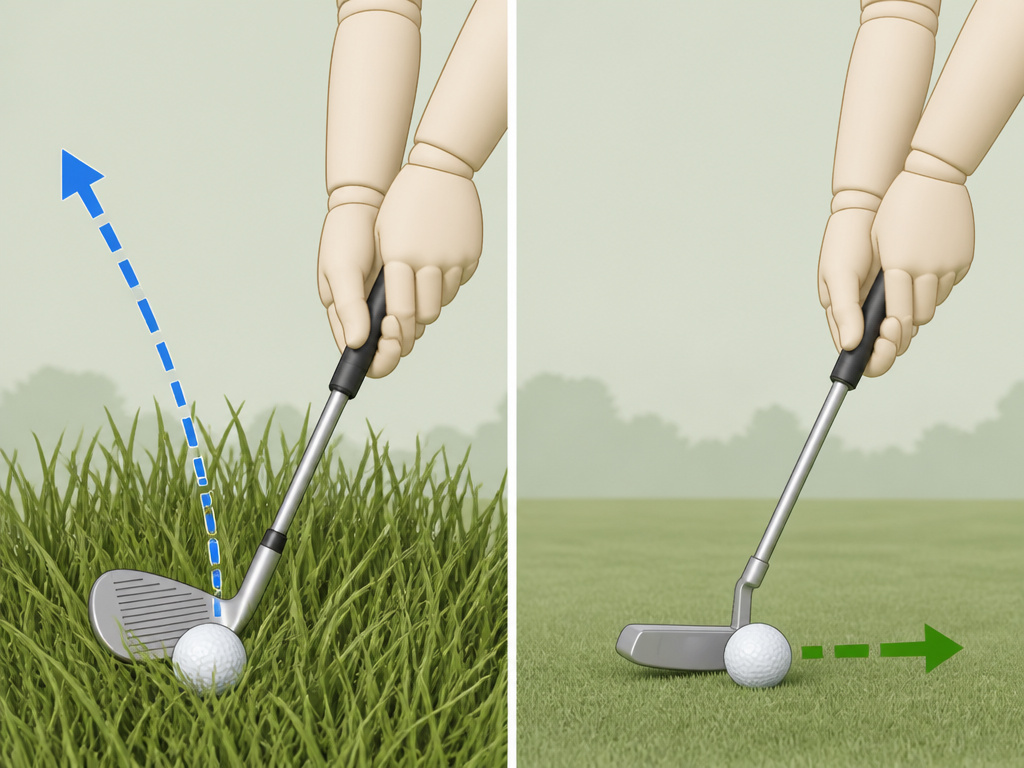 The 40-yard rule and standard techniques assume a basic lie on level ground. Golf isn’t that polite. Your lie dictates your shot, sometimes forcing you to swap the textbook play for the only play.
Bad Lies That Change the Plan:
- Ball Sitting Down in Rough: This kills a chip. The grass grabs the clubhead. You must pitch it out, using the loft of a sand wedge to slide under the ball. A chip here results in a chunk.
- Uphill Lie: Adds loft to any club. You can chip with a less-lofted club (like a 7-iron) because the hill effectively turns it into a 9-iron. For a pitch, it adds height, choose one less club (gap wedge instead of sand wedge).
- Downhill Lie: Reduces loft. Chipping becomes very difficult as the ball wants to come out low and hot. A pitch is often mandatory, but you must play the ball back in your stance and lean into the hill to make contact.
- Wet Conditions: The ball won’t release. Chip shots stop quickly. Factor in 30-50% less roll and consider a lower-lofted chip club or a pitch that lands closer to the hole.
Your shot selection process must start with a lie audit. Look at the grass around the ball before you look at the distance to the pin.
Practice Drills That Cement the Difference
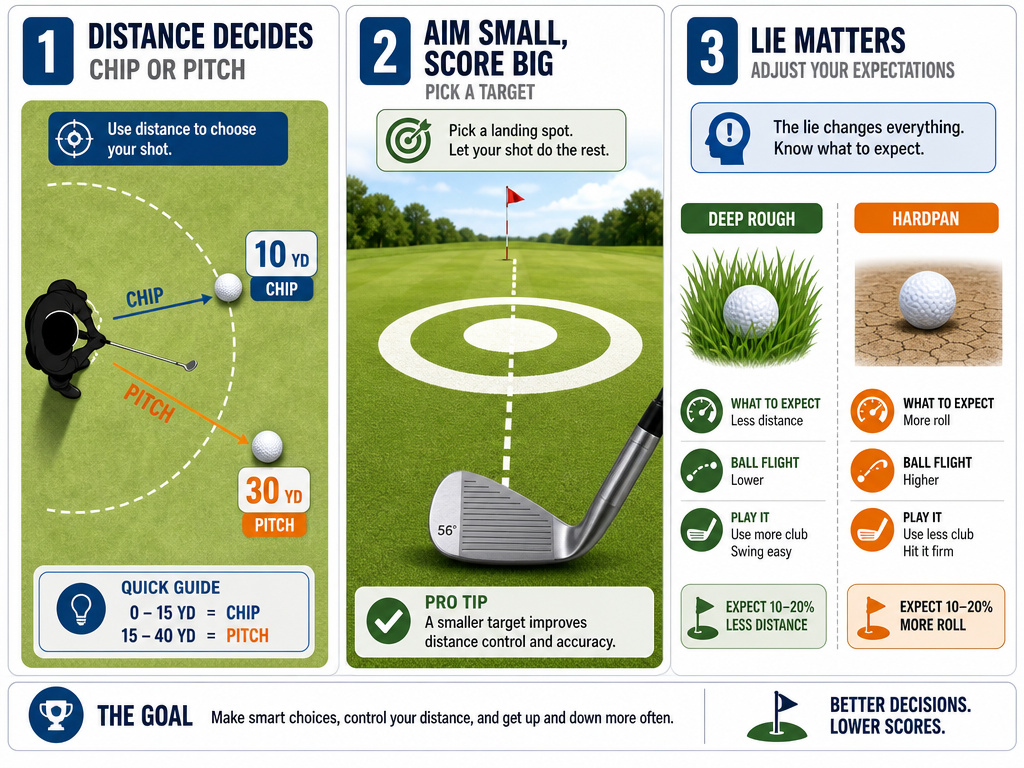 Knowing the difference isn’t enough. You have to feel it. These three drills create the physical memory so the right shot becomes automatic.
1. The 10-Yard/30-Yard Contrast Drill.
- Place two markers: one 10 yards from you, one 30 yards.
- With a bucket of balls and your sand wedge, alternate shots.
- Hit a chip to the 10-yard target. Then hit a pitch to the 30-yard target.
- Goal: Feel the complete absence of wrist hinge on the chip versus the natural hinge and full finish of the pitch. Do this until you can switch without thinking.
2. The One-Club Landing Zone Drill.
- Take your gap wedge to the practice green.
- Pick a hole and find a spot 20 yards away.
- Hit ten shots trying to land the ball on a specific two-foot circle 5 yards short of the hole.
- Goal: This forces pitch-shot precision. A chip has a vague landing zone; a pitch has a bullseye. This drill builds that commitment.
3. The Worst-Ball Lie Game.
- On the short game area, play nine “holes” from different lies.
- For each, you must play the worst ball in the area, deep rough, hardpan, sidehill.
- Goal: Practice your chipping technique and pitch shot technique under pressure from bad lies. You’ll learn which shot is actually possible from each situation.
Incorporate these into your short game practice routine twice a week. The difference between a 5-handicap and a 15-handicap is almost entirely these shots.
Pitching vs Chipping: A Direct Comparison
Sometimes you need to see the choices side-by-side. This isn’t about which is better, but which is right for the yardage and conditions in front of you.
| Factor | Chip Shot | Pitch Shot |
|---|---|---|
| Primary Use | Getting the ball onto the green and rolling like a putt from close range. | Carrying the ball most of the way to the hole with a soft landing from 40 yards and in. |
| Typical Yardage | Inside 40 yards, often 5-20 yards off the green. | 10 to 40 yards from the hole. |
| Key Club(s) | 8-iron, 9-iron, Pitching Wedge. | Sand Wedge, Lob Wedge, Gap Wedge. |
| Trajectory | Low (5-10 feet high). | High (20-40 feet high). |
| Carry vs Roll | 20% air, 80% ground. | 80% air, 20% ground. |
| Swing Motion | Pendulum, no wrist hinge, weight forward. | Mini full-swing, wrist hinge, balanced weight. |
| Miss Hit Result | Chunks or skulls (ground contact error). | Fat or thin (timing error). |
| Best For | Tight lies, lots of green to work with, windy conditions. | Carrying over hazards, stopping the ball quickly, fluffy or difficult lies. |
The table shows they are complementary tools, not substitutes. Mastering both, and knowing when to use each wedge, is what turns three shots into two around the green.
Frequently Asked Questions
What is the main goal of a chip shot?
The main goal is to get the ball on the green as soon as possible and let it roll to the hole like a putt. You’re minimizing airtime and maximizing control through roll. Think of it as a long putt with a small hop at the start.
What is the main goal of a pitch shot?
The main goal is to carry the ball most of the distance to the hole with a high, soft landing so it stops quickly. You’re maximizing airtime and using loft and spin to control the finish. Think of it as a tiny, controlled approach shot.
Can I use my pitching wedge to chip?
Yes, but sparingly. A pitching wedge is your highest-lofted option for a chip shot. Use it only when you need to carry the ball a few extra feet over light rough or a fringe before it starts rolling. For a standard chip from fairway grass, an 8 or 9-iron is more reliable.
How do I know if I should chip or pitch from the rough?
Examine the lie. If the ball is sitting up in the rough, you can likely chip. If it’s sitting down or buried, you almost always must pitch. The grass will grab a chipping club and cause a mishit. The loft of a sand or lob wedge is needed to slide under the ball.
What is a “bump and run” and how is it different?
bump and run is a specific type of chip shot, often played with a 7 or 8-iron, designed to “bump” the ball into a slope on the green to kill its speed before it “runs” out to the hole. It’s a chip with a strategic landing spot, used on links-style courses or when the green is running fast.
Should I use a different ball for short game shots?
No. Consistency is key. Use the same ball you play for full shots. Modern urethane-covered balls provide plenty of spin for pitch shots around the green. Switching balls introduces an unnecessary variable in feel and performance.
Before You Go
The pitching vs chipping difference isn’t academic. It’s the line between getting up-and-down and writing down a bogey. Remember the 40-yard rule. Let your club selection, 8-iron for roll, sand wedge for stop, dictate your technique. Practice the contrast until the wrong shot feels awkward.
Track your results. Use a strokes gained mindset to see if you’re losing shots from inside 40 yards. That’s where the scoring separation happens. Choose the right shot, execute the right swing, and watch those three-foot putts for par become routine.
