
Learn How to Putt in Golf with These Fundamental Techniques
This post contains affiliate links. As an Amazon Associate, we earn from qualifying purchases.
This post contains affiliate links. As an Amazon Associate, we earn from qualifying purchases.
To putt in golf with sound fundamentals, control two things above all else: the putter face angle at impact (83% of initial direction) and a consistent stroke rhythm for distance. Your setup, eyes over the ball, hands under shoulders, a putter of correct length, enables a pendulum stroke where the face returns square. A 1-degree error in face angle makes you miss a 4-meter putt. The rest is practice.
That 83 percent figure isn’t a suggestion. It’s the single most important number in putting, pulled from a PGA Tour data sample analyzed by Science&Motion. It means nearly everything you’ve heard about “keeping the path straight” is secondary. If your face is off by a hair, the ball isn’t going in. This shifts the entire practice priority from chasing a perfect swing arc to ensuring the putter blade is square at the moment of truth.
What follows is a breakdown of the six fundamentals, grounded in that data. We’ll cover the non-negotiable setup, the face-versus-path math, the rhythm that prevents deceleration, and the drills that give you instant feedback. By the end, you’ll know which three fixes yield 90 percent of the improvement.
Key Takeaways
- Putter face angle dictates 83% of the ball’s starting direction. A 1-degree error causes a miss on a 4-meter putt.
- Fit your putter length first. A golfer who is 6 feet tall typically needs a 33-inch putter for a neutral, athletic setup.
- Use a 50:50 stroke rhythm for control. SAM PuttLab data shows equal backswing and forward-swing distances prevent over-acceleration and deceleration.
- Keep your backswing short on short putts. PGA Tour average is 35% of the complete swing length to ensure natural acceleration through impact.
- Drill with a mirror and string line. These tools provide unambiguous feedback on alignment and starting line, eliminating guesswork.
The 83% Rule: Putter Face Angle vs. Swing Path
Forget the old advice about swinging down the line. The data is clear and brutal.
Putter face angle at impact determines 83% of the ball’s initial direction. Swing path direction accounts for the remaining 17%. This means face angle is almost five times more influential. A 1-degree error in face angle will result in missing a 4-meter putt. A 2-degree error misses a 2-meter putt.
That finding, from Science&Motion’s “The Fundamentals of Putting” research, reframes every putting lesson. You can have a beautiful, inside-square-inside path, but if the face is two degrees open at impact, your six-footer lips out. The path error required to miss that same putt is a massive 9 degrees.
The implication is simple. Your primary technical focus must be delivering a square face. This starts with aiming it correctly at setup and ends with a stroke that returns it to that position without manipulation.
Common mistake: Trying to steer the path to correct for a misaligned face. This adds a compensation layer that destroys consistency within three putts.
| Error Type | Influence on Start Direction | Error to Miss a 4m Putt | Error to Miss a 2m Putt |
|---|---|---|---|
| Face Angle | 83% | 1 degree | 2 degrees |
| Swing Path | 17% | 4.5 degrees | 9 degrees |
Your brain already knows this on some level. When you push a putt, your first thought is “I left the face open,” not “my path was out-to-in.” Trust that instinct. The golf mental game is about quieting the noise, and this fact should quiet a lot of it.
The Setup: Your Non-Negotiable Foundation
A neutral, athletic setup is the platform that makes a square face possible. Get this wrong, and every stroke becomes a compensation.
Your hands should hang relaxed directly under your shoulders. Your eyes should be directly over the golf ball or just inside it. Your elbows have a slight bend, and your forearms align with the intended target line. This creates the “stable triangle” between shoulders, arms, and hands that can swing like a pendulum.
The most frequent setup killer is an ill-fitted putter, specifically one that’s too long.
Where this goes sideways: Using a putter that’s too long. It forces you to stand too far from the ball or bend your arms excessively, pulling your eyes inside the line. Your shoulders then align left, the path follows, and you fight all day with a push or a pull.
Science&Motion provides a clear guideline: for a golfer approximately 1.80 meters (6 feet) tall, an adequate putter length is about 33 inches. Most off-the-rack putters are 34 or 35 inches. That extra inch or two is why so many amateurs struggle with consistency on short putts. If you’re missing both left and right with no pattern, check your putter length before you rebuild your stroke. Our guide on putter selection dives deeper into fitting specifics.
Rhythm and Timing: The 50:50 vs. 60:40 Debate
Distance control lives here. It’s not about power; it’s about predictable rhythm.
You’ve likely heard of the 60:40 ratio, a backswing 60% of the length of the total stroke, with a follow-through of 40%. This theory, attributed to researcher Art Olfs, suggests it promotes a constant putterhead speed.
However, data from SAM PuttLab tells a different story for consistency.
SAM PuttLab data suggests a “pure 50:50 stroke”, equal backswing and forward-swing distance with zero speed manipulation, is ideal to avoid over-accelerating the putterhead.
The 50:50 rhythm encourages you to let the putter swing freely and collide with the ball, rather than actively hitting it. This minimizes face rotation and promotes centered strikes. The debate exists because both methods can work, but the 50:50 principle is simpler: swing it back a certain distance, let it swing through the same distance. Your backswing length becomes your single variable for distance control.
For short putts, the rule is even stricter. PGA Tour data shows the backswing should be kept short, at only 35% of the complete swing length. This ensures you accelerate through impact instead of decelerating from a backswing that’s too long.
Impact Spot and Strike Quality

Where you hit the ball on the face affects both direction and distance. A heel or toe strike twists the head, opens or closes the face, and loses energy.
The vertical sweet spot on a putter is often slightly above the geometric center due to the mass of the hosel and shaft. Poor balance is the chief culprit for inconsistent impact. If your weight is on your toes, you’ll hit it on the heel. If you’re on your heels, you’ll catch the toe.
Easy to miss: The relationship between balance and putter length. A putter that’s too long makes it impossible to find a balanced, athletic posture. You’ll sway during the stroke just to reach the ball.
A simple test: at address, lightly lift your putter an inch off the ground and set it back down. If it doesn’t return to the exact same spot, your setup isn’t balanced. Fix your stance and putter fit before you try to steer the clubhead to a better impact spot.
The Essential Practice Drills
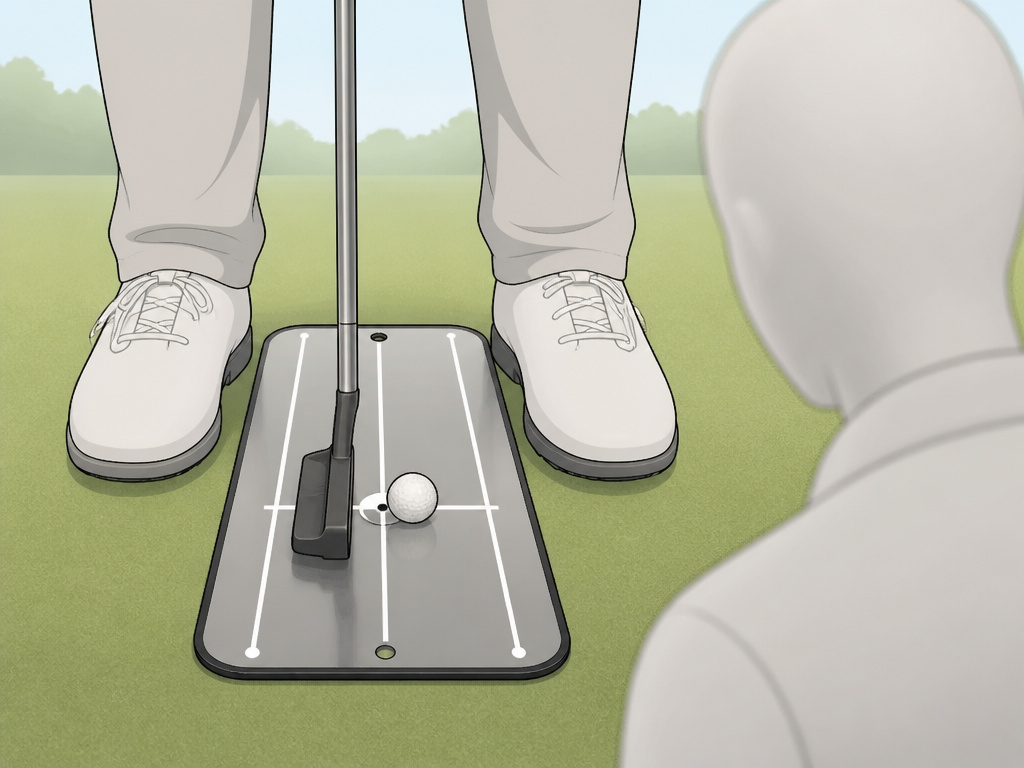
Theory is useless without feedback. These two drills give you immediate, unambiguous answers.
- The Mirror Drill. Place a putting mirror on the ground. Its lines force your eyes over the ball, your shoulders square, and the putter face perpendicular to your body lines. Hit twenty putts looking only at the mirror, not the hole. You’re training the feeling of a square setup and a stroke that doesn’t require visual steering.
- The String Line Drill. Stretch a string at a height of about 20 cm (8 inches) directly over the ball to the hole. Align your body parallel to the string. Now, putt. The ball must travel under the string to go straight. This is the purest test of your starting direction and your ability to deliver a square face. It’s the fastest way to diagnose a consistent push or pull.
Incorporate these with other short-game drills to build a complete practice session. The goal is to make your stroke so reliable it holds up under pressure, which is the core of building confidence on the greens.
How Many Putts Does It Take to Measure Improvement?
Practice with purpose requires knowing when you’re actually getting better. A recent PMC putting reliability study provides the answer.
The research found that for medium-to-high handicap players, you need 28 putting trials using a simple scoring system to get a reliable measure of performance. This means hitting twenty-eight putts from the same spot to the same target and recording the result. Anything less is just noise, a lucky or unlucky streak.
This has huge implications. Don’t judge a change in your grip or stance after five putts. Give it a real sample. Set aside time to hit thirty putts, track where they finish, and then decide if the adjustment is working. This scientific approach beats endless tinkering.
Frequently Asked Questions
What is the most important fundamental in putting?
Putter face angle at impact. It controls 83% of the ball’s starting direction. A error of just one degree is enough to miss a 13-foot putt. All other fundamentals, setup, path, rhythm, ultimately serve the goal of delivering a square face.
Should my putting stroke be 50:50 or 60:40?
For maximum consistency, aim for a 50:50 rhythm where your backswing and forward-swing distances are equal. Data from SAM PuttLab indicates this promotes a pendulum motion and prevents the over-acceleration and deceleration that cause face twisting and poor distance control.
How long should my putter be?
As a guideline, a golfer who is 6 feet tall (1.80 m) typically needs a putter about 33 inches long. A putter that is too long forces poor posture, misalignment, and inconsistent ball striking. Proper length is the first step in putter fitting.
How can I stop pulling or pushing my putts?
First, check your alignment with a mirror or string line. Most pulls and pushes start with shoulders or eyes aimed left or right of the target. Second, ensure your putter isn’t too long, as this forces compensation. Finally, practice the double-ball drill to see if your face is open or closed at impact.
What’s the best way to practice putting alone?
Use drills that provide objective feedback. The string line drill for direction and the mirror drill for setup are the most effective. Combine them by putting down the string line while checking your setup in a mirror. Record your results over 28-putt sessions to track real progress.
Before You Go
Putting fundamentals aren’t a mystery. They’re a set of measurable, trainable actions. Start with a putter that fits, which for most means it’s probably shorter than what’s in your bag. Build a neutral setup where your eyes are over the ball and your hands hang under your shoulders. Then, focus relentlessly on delivering a square face, trusting that the path will largely look after itself. Practice with tools that give you truth, not guesswork. The numbers don’t lie: control the face, manage your rhythm, and the putts will drop.
