
Understanding What Causes a Slice in Golf: The Key Factors
This post contains affiliate links. As an Amazon Associate, we earn from qualifying purchases.
A golf slice is caused by a clubface that is open relative to the swing path at impact. For a right-handed golfer, this means the face points right of where the clubhead is traveling. Data from over 14 million analyzed swings shows mid-handicap slicers typically have a face 4-7 degrees open to a path that is 3-6 degrees out-to-in. The clubface controls 75-85% of the ball’s starting direction; the gap between face and path dictates the curve.
That gap is the whole problem. Most advice tells you to swing more from the inside or strengthen your grip. For the majority of recreational players, that’s backwards. Fixing the path before the face just turns a slice into a worse, push-slice. The correction has a sequence.
What follows is the breakdown of those two variables, face and path, and the three biomechanical patterns that create them. You’ll get the specific numbers that define a slice, a method to diagnose your own miss without a launch monitor, and the honest timeline for fixing it. This is about what the data from systems like GOLFTEC OptiMotion and TrackMan actually measures.
Key Takeaways
- The face is not the villain. An open clubface alone doesn’t cause a slice; it’s the face being open relative to the swing path. A square face with a severe out-to-in path still slices.
- Data from 14 million swings shows three patterns: an open face-to-path relationship (4-7°), an out-to-in swing path (3-6°), and early extension of the hips through impact.
- Fix in this order: face angle first, then swing path, then lower-body movement. Reversing this sequence entrenches the mistake.
- A weak grip is almost never the sole cause. GOLFTEC’s database contradicts this common amateur belief.
- Equipment is a bandage, not a cure. A draw-biased driver like the Ping G430 SFT can reduce a slice by 3-5 yards, but it doesn’t fix the underlying swing fault.
The Three Measurable Causes (Backed by 14 Million Swings)
Forget “swing easier” or “aim further left.” Modern motion capture and launch monitor data have removed the guesswork. GOLFTEC’s OptiMotion system records over 4,000 data points per swing. Across millions of swings from mid-handicap golfers, three specific, measurable breakdowns appear every time.
GOLFTEC’s analysis of 14 million swings found that a slice is “almost never caused by a ‘weak grip’ alone.” The primary culprits are biomechanical: an open face-to-path relationship, an out-to-in path, and early extension through impact.
If you don’t fix these, no amount of grip change or aim adjustment will stick. The ball flight laws are physics, not opinion.
1. An Open Club Face Relative to Path
This is the lead actor. For a right-handed golfer, a slice requires the clubface to be pointing right of the clubhead’s path at the moment of impact. The size of this gap, called face-to-path, determines the severity of the curve. – Mid-Handicap Average: The face is typically 4 to 7 degrees open relative to the path. – Why it happens: A weak lead-hand grip (seeing one or zero knuckles), a “cupped” lead wrist at the top of the backswing, or an early release where the hands flip before impact.
The clubface is responsible for 75-85% of the ball’s starting direction. So if your face is 5 degrees open at impact, the ball will start roughly 5 degrees right of your target, before any curve even begins.
2. An Out-to-In (Over-the-Top) Swing Path
Once the face is open, the path multiplies the problem. This is the classic “over-the-top” move, where the club approaches the ball from outside the target line and cuts across it. – Mid-Handicap Average: 3 to 6 degrees out-to-in with a driver. – Tour Player Average: 1 to 3 degrees in-to-out.
The path dictates the spin axis. An out-to-in path combined with an open face imparts maximum clockwise sidespin for a righty, the recipe for a banana ball. Many golfers develop this path as a compensation, trying to pull an already-open-faced shot back to the target.
3. Early Extension Through Impact
This is the silent killer most amateurs never notice. Early extension is when your hips thrust toward the ball in the downswing, reducing the space between your body and the ball. Your arms get blocked, forcing a flip of the hands to make contact, which re-opens the clubface. – The Consequence: It looks like a loss of power and consistency. In reality, it’s a mechanical block that guarantees an open face and a steep, out-to-in path. Tour players maintain or increase their distance from the ball through impact; most slicers do the opposite.
Diagnosing Your Slice Type: Face Problem or Path Problem?
You don’t need a $20,000 launch monitor. Your ball flight and a simple setup check give you a 90% accurate diagnosis. Most recreational golfers have a face problem first, which then creates a path problem. Use this table to identify your primary issue.
| Observation | Likely Cause | Simple Check |
|---|---|---|
| Ball starts straight or right, then curves right. | Open Clubface. The face is pointing right at impact, so the ball starts right. The path is relatively neutral or slightly out-to-in. | Look at your lead hand grip. If you see 1 or fewer knuckles, your grip is too weak. |
| Ball starts left of target, then curves sharply right. | Combination: Out-to-In Path + Open Face. The path is severely left, pulling the start line, but the face is open to that path, causing slice spin. | Check your alignment. Are your feet, hips, and shoulders aimed left of your target? |
| Divot points left of your target line. | Out-to-In Swing Path. The club is cutting across the ball from outside to inside. | Place a club on the ground along your toe line. Is it pointed left of your target? |
Common mistake: Aiming left to “compensate” for a slice. This forces your body to swing along your aligned path, which is left, guaranteeing an out-to-in swing. You are engineering the very miss you’re trying to avoid.
The fix starts with what you see. If your ball starts right, work on your face angle through grip and wrist position. If it starts left, you must tackle your swing path and alignment before the face will matter.
The Physics: Why “Close the Face” Is Bad Advice
The old instruction to “release the club” or “close the face through impact” is incomplete. It treats the symptom, not the disease. Teaching a player to manually close the clubface doesn’t fix a path that’s moving 6 degrees to the left.
Where this goes sideways: Telling a player with a severe out-to-in path to close the clubface. They often succeed, creating a face that’s square to the target but now closed relative to their path. The result is a pull-hook, a shot that starts left and curves violently further left.
The relationship is everything. TrackMan’s data formalizes it with the face-to-path number. A positive face-to-path (face right of path for a righty) equals a fade or slice. A negative number equals a draw or hook. Your goal is to reduce the gap between where the face points and where the club is going.
This is why sequence matters. If you work on swinging more from the inside (in-to-out path) while your face is still 5 degrees open, you’ll produce a push-slice that starts even further right. Face first. Then path.
How Equipment Masks (But Doesn’t Fix) a Slice
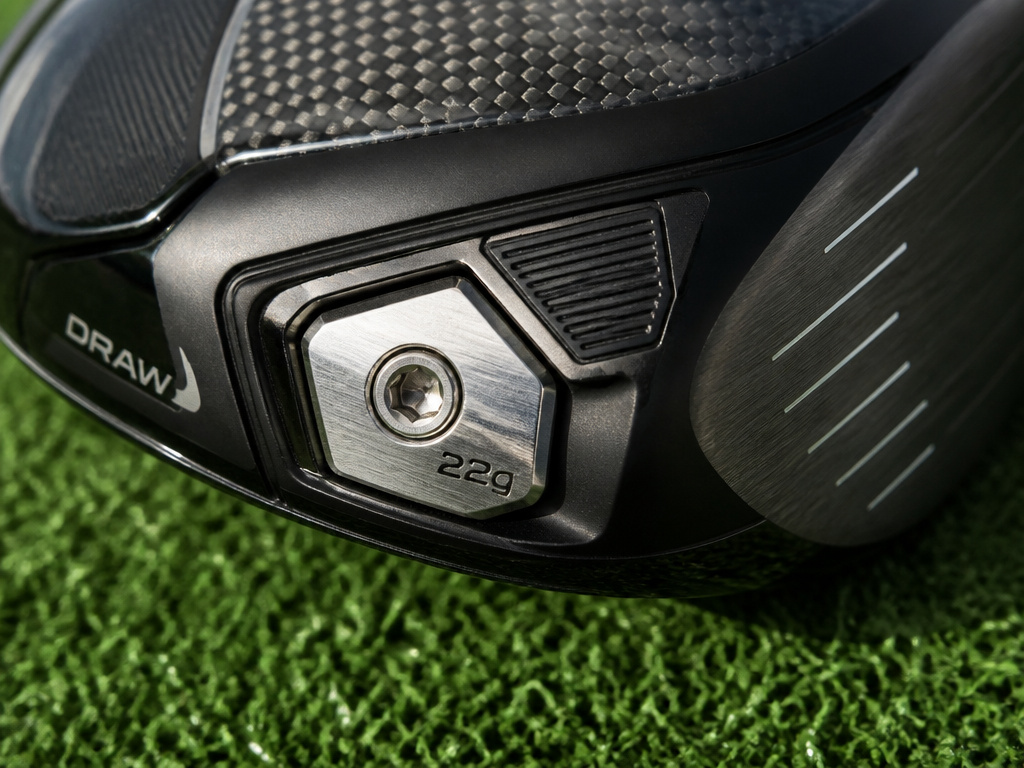
You can buy a reduction in slice curvature. You cannot buy a new swing. Draw-biased drivers are engineered to help, but they have a hard ceiling.
| Equipment Fix | How It Works | Real-World Limit |
|---|---|---|
| Heel-Weighted Driver (e.g., Ping G430 SFT) | A 22-gram tungsten weight in the heel encourages the clubface to close slightly through impact. | Can reduce slice curvature by 3-5 yards. It’s a correction, not a cure. |
| Adjustable Hosel (Draw Setting) | Lofts the face and changes lie angle to promote a more closed face at address and impact. | Might close the face 1-2 degrees. Useful for minor face-angle issues. |
| Higher-Lofted Driver | Increases backspin, which reduces the relative effect of sidespin. | Less slice curve, but also less distance. A trade-off. |
The Ping G430 SFT is the benchmark here. Its heel-weighted design can provide up to 20 yards of right-to-left correction compared to a neutrally weighted driver. That’s significant for a moderate slice. For a severe, out-of-control slice, it’s a bandage. The Wilson Launch Pad and Callaway Big Bertha B21 operate on similar principles.
The honest takeaway? If your slice is costing you 30 yards of fairway, a draw-biased driver might bring that down to 10 or 15. That’s a win while you work on your swing. But if you never work on your swing, you’ll always be dependent on that heel weight, and your bad days will still be very bad.
The Correction Timeline: What to Expect
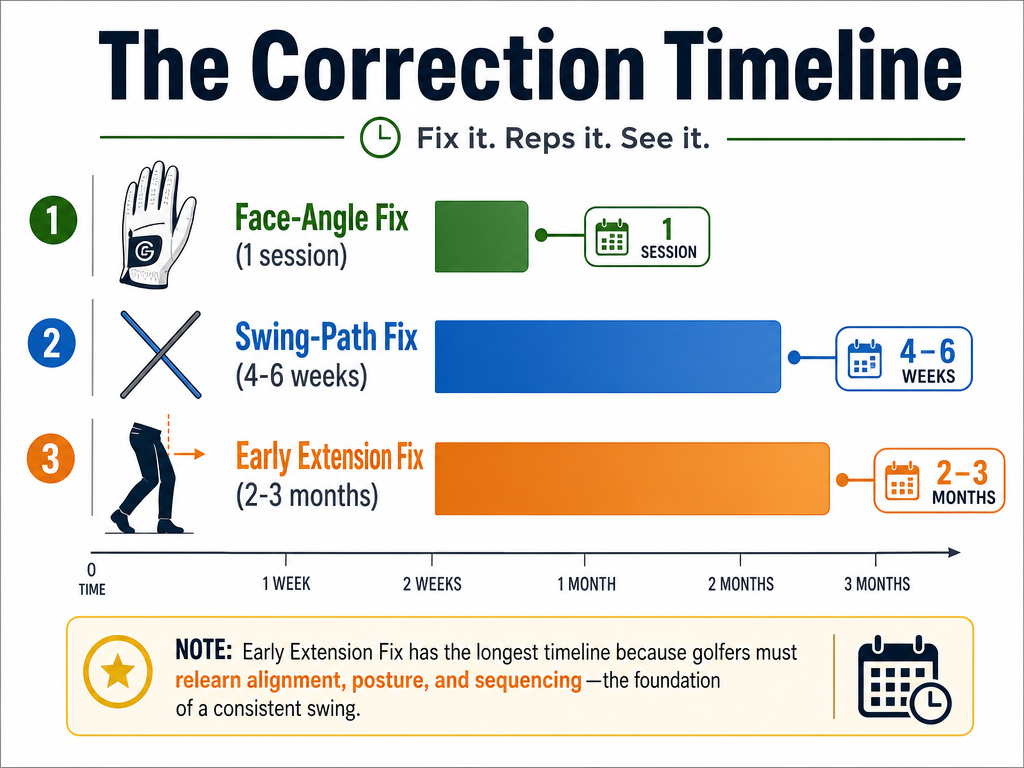
How long does it take to fix a slice? The answer depends entirely on your diagnosis.
- Face-Angle Fix (Grip, Wrist): This can show results in a single range session. Changing to a stronger grip where you see 2-3 knuckles on your lead hand alters the geometry immediately.
- Swing-Path Fix (Alignment, Over-the-Top): This takes 4-6 weeks of consistent practice. You’re rewiring a deep muscle memory. Drills with alignment sticks or the “towel under the trail arm” drill provide the necessary feedback.
- Early Extension Fix: This is the longest haul, often taking 2-3 months to feel natural. It requires changing your body’s instinctive movement pattern through the ball.
The part nobody mentions: Golfers who have aimed left for years to compensate for a slice need the longest timeline, 4 to 8 weeks. Their entire perception of “straight” is broken. They must relearn setup and trust that a swing to the right will produce a straight ball.
Most mid-handicap players, following a structured plan of 2-3 range sessions per week, can neutralize a slice within three to six weeks. Turning it into a reliable draw takes longer. The fastest path is data-driven: using a personal launch monitor like a Garmin R10 to get immediate feedback on your face-to-path numbers after every swing.
Frequently Asked Questions
What causes a slice in golf for a beginner?
Beginners typically slice due to a combination of a very weak grip and a severe over-the-top swing path. They lack the hand strength and coordination to square the clubface, so they use their shoulders and arms to chop at the ball, creating the classic out-to-in path. Start with the grip basics, seeing two knuckles on the lead hand, before worrying about path.
Can a slice be caused by standing too far from the ball?
Yes, but indirectly. Standing too far away forces you to reach, which often locks your arms and promotes an upright, “over-the-top” swing plane. This steep angle of attack makes it very difficult to deliver the club from the inside, fostering an out-to-in path. It’s a common swing fault linked to both topping the ball and slicing.
Why do I slice my driver but not my irons?
You likely use the same swing for both. The driver’s low loft (9-12 degrees) amplifies side spin from an open face. Your 7-iron has 30+ degrees of loft, which creates more backspin that stabilizes the ball and neutralizes the slice spin. The driver exposes the flaw; the iron hides it. Working on your driver swing mechanics will help all your clubs.
Is a slice caused by an open or closed clubface?
Slice is caused by a clubface that is open relative to the swing path. This is critical. You can have a face that is technically “closed” to the target (pointing left) and still hit a slice if your swing path is even more severely left (out-to-in). The face must be closed relative to the path to draw the ball.
What’s the difference between a slice and a fade?
Curvature and control. A fade is a small, intentional left-to-right shot (for a righty) with a face-to-path gap of +2 to +3 degrees. A slice is a large, uncontrolled curve with a face-to-path gap of +5 degrees or more. A fade finishes near the target; a slice finishes in the next fairway. Understanding golf stance and ball position helps control this curvature.
Before You Go
A slice is a measurable gap between two numbers: clubface angle and swing path. The data from millions of swings tells us the fix has a sequence, square the face first, then shallow the path.Equipment can help in the short term, but it’s a compensator. The long-term fix is mechanical.
Start with your grip. Check your alignment. If you can, get on a launch monitor once to see your real face-to-path number. That single data point will tell you more than a year of guesswork on the range. From there, the drills are straightforward. It takes weeks, not days. But the feeling of hitting a drive that starts on line and stays there? That’s worth every minute of the grind.
