
Fix a Slice in Golf Using the Essential Grip-Path Sequence
This post contains affiliate links. As an Amazon Associate, we earn from qualifying purchases.
This post contains affiliate links. As an Amazon Associate, we earn from qualifying purchases.
To fix a slice in golf, you must close the gap between your clubface and your swing path at impact. The correct sequence is face first, then path: strengthen your grip to promote face closure, square your setup, then train an inside-out path. According to GOLFTEC data, roughly 60% of golfers fight this shot. A face-to-path number above +5 degrees produces a visible slice; your target is to get it under +3.
Most advice gets the order backwards. Telling a slicer to “swing more from the inside” before their face knows how to close just creates a worse slice with a different shape, a pull-slice that starts left and curves farther right. The ball’s starting direction is controlled by the face. The curve comes from the relationship.
What follows is the five-step sequence that holds up on the course. We’ll cover the two grip changes that work in one range session, the setup fix that takes a week, the path drill that needs a month, and the gear that can cut your curve in half while you rebuild the swing. By the last section you’ll know exactly which number to chase on a launch monitor and why a six-week timeline is realistic, not pessimistic.
Key Takeaways
- Fix the clubface before you touch your swing path. A stronger grip showing 2-3 knuckles on your lead hand is the fastest correction.
- Your target metric is face-to-path under +3 degrees. A launch monitor like the Garmin R10 provides the data; guessing without one adds months to the fix.
- Significant improvement takes 2-4 weeks of consistent practice. Path correction to make it reliable under pressure requires 4-6 weeks.
- Equipment like a draw-bias driver or a higher-lofted head can reduce slice curvature by 30-40%, but it doesn’t fix the root cause.
- You slice your driver more than your irons because the lower loft amplifies sidespin. The same swing fault produces a minor fade with a 7-iron and a 30-yard slice with a driver.
The Root Cause: Face-to-Path
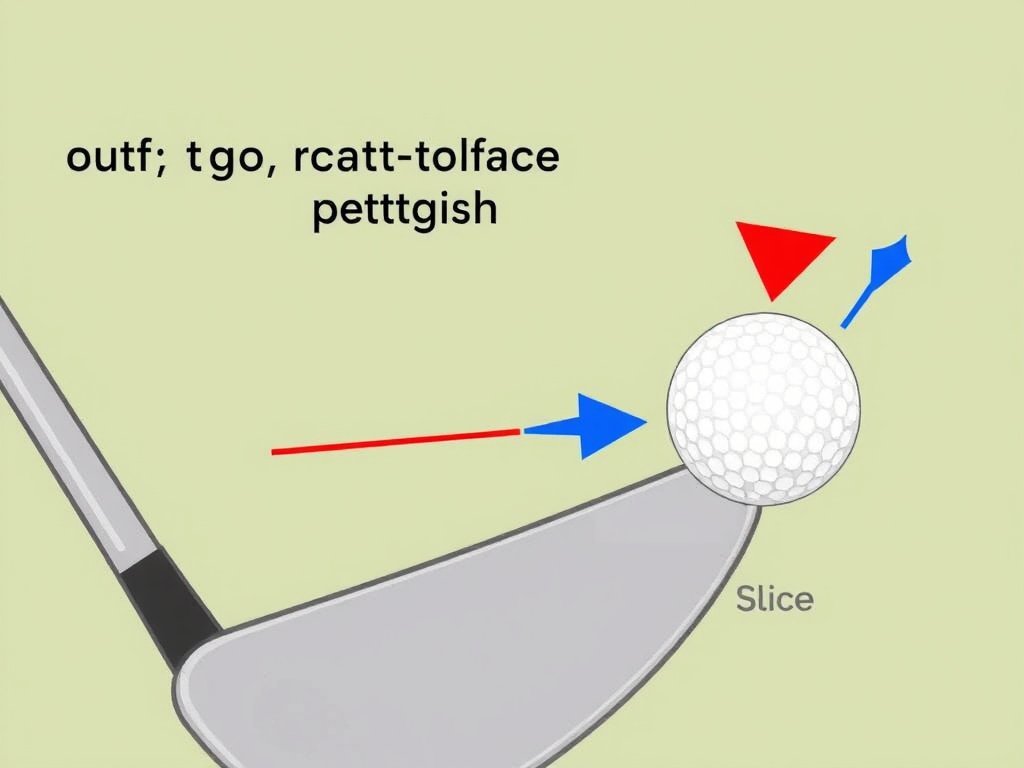
A slice is not a mystery. It’s a physics equation with two variables: face angle and club path. The ball launches roughly where the face points. It curves based on the difference between where the face points and where the club is traveling.
Face-to-path is the difference between face angle and club path at impact. A positive number means the face is open relative to the path, producing a left-to-right curve for a right-handed player. TrackMan research indicates face angle controls 75-85% of the ball’s starting direction.
If your clubface is 5 degrees open (pointing right) and your path is 2 degrees out-to-in (moving left), your face-to-path is +7 degrees. That’s a severe slice. Swinging more from the inside, making your path even more leftward, without closing the face first turns that +7 into a +10. The ball starts even farther right and curves more.
GOLFTEC’s swing data shows mid-handicap slicers average an out-to-in path between -3 and -6 degrees with a face 3 to 5 degrees open. That combination puts face-to-path in the +6 to +11 range. That’s the banana ball.
The table below shows how these numbers translate to ball flight.
| Face-to-Path | Ball Flight | Description |
|---|---|---|
| +8 to +12 | Severe Slice | Uncontrollable banana ball, major distance loss. |
| +5 to +7 | Slice | Consistent right curve, rarely finds the fairway. |
| +3 to +5 | Controlled Fade | Playable 5-10 yard curve, used by many pros. |
| -2 to +2 | Straight | Minimal curve, the primary target for fixing a slice. |
Your goal is to move from the top row to the bottom row. That journey starts with the clubface.
Step 1: Lock Down the Grip (The 3-Session Fix)
The grip is your only connection to the club. A weak grip, where you see only one knuckle on your lead hand, forces the face to stay open through impact. You have to manipulate your wrists to square it, a timing feat few golfers manage consistently.
Strengthen it. Turn your lead hand clockwise so you see two, even three knuckles at address. Your trail hand’s “V” formed by thumb and forefinger should point toward your right shoulder. This isn’t a subtle shift. It feels exaggerated, like you’re turning your hands too far to the right.
Why it works: A stronger grip pre-sets your wrists in a position that naturally closes the face through the hitting area. It reduces the need for perfect timing.
Common mistake: Strengthening the grip but then regripping the club at the top of your swing. You take your strong grip, make your backswing, and your hands unconsciously twist back to their old, weak position. Hold the grip pressure in your last three fingers of the lead hand to prevent this.
This change produces visible results in a single range session. It takes three to five sessions for the new feel to stop feeling foreign. Don’t move to path drills until you can hit ten shots in a row with a stronger grip without instinctively weakening it mid-swing.
For a deep dive on hand placement and pressure, our guide on the proper golf grip breaks it down frame by frame.
Step 2: Square Your Setup (The 1-Week Foundation)
A crooked setup guarantees a compensatory swing. Most slicers aim left of their target, trying to “make room” for the curve. Your body then swings along your shoulder line, creating that out-to-in path. You’ve built the slice into your stance before you even take the club back.
Get an alignment stick. Place it on the ground parallel to your target line, just outside the ball. Set your feet, hips, and shoulders parallel to that stick. This is square alignment. It feels like you’re aiming well right of your target. You aren’t.
| Setup Fault | Typical Slicer Error | The Fix |
|---|---|---|
| Alignment | Feet & shoulders aimed left of target. | Use an alignment stick parallel to target line. |
| Ball Position | Too far forward with driver, encouraging an outside takeaway. | Inside left heel for driver; center for irons. |
| Posture | Upper body tilted toward target, weight on toes. | Hinge from hips, weight balanced on arches. |
Spend a week hitting balls with the stick on the ground. Don’t worry about ball flight yet. The goal is to make a square stance your new default. This alone can reduce an out-to-in path by 2-4 degrees. Combined with the stronger grip, many golfers cut their slice in half before making a single swing change.
Step 3: Train the Inside Path (The 4-6 Week Project)
With a square face and a square setup, you can now attack the path. The classic slicer’s over-the-top move, starting the downswing with the shoulders and pulling the club across the line, is a sequencing issue. The lower body needs to lead.
The headcover gate drill is the standard for a reason. Place a headcover or towel just outside the ball and slightly behind it. Your goal is to swing the clubhead to the right of that obstacle on the downswing. If you come over-the-top, you’ll hit it.
Where this goes sideways: Trying to swing “inside” by dropping your hands straight down. That creates a stuck position and leads to blocks and hooks. The feel isn’t “down.” It’s “back and around” as your hips clear.
This is the slow part. Changing deep-seated motor patterns takes hundreds of repetitions. Expect to spend 4-6 weeks, with 2-3 range sessions per week, before the inside path feels reliable under pressure on the course. This is where most golfers quit. They see improvement from the grip and setup, declare victory, and wonder why the slice comes back on the 15th tee when they’re tired.
If you struggle with the classic over-the-top move, dedicated drills to stop coming over the top can break the cycle.
The Gear Accelerator (Not the Engine)
You can buy help. Equipment adjustments provide immediate slice reduction while you work on the mechanics. Think of them as a crutch, useful for walking now, but the goal is to heal the leg.
A draw-bias driver moves weight toward the heel, promoting face closure. Increasing loft from 9.5 to 10.5 or 12 degrees adds backspin, which can mask sidespin. A softer shaft flex (regular instead of stiff) can help if your swing speed is below 95 mph, allowing the clubhead to release more easily.
| Equipment Adjustment | How It Fights a Slice | Realistic Benefit |
|---|---|---|
| Draw Bias / Heel Weight | Promotes face closure at impact. | Reduces curve by 5-10 yards. |
| Increase Loft (+1-2°) | Adds backspin, reduces sidespin effect. | Less slice curvature, higher launch. |
| Softer Shaft Flex | Allows for more head release through impact. | Can help square the face for slower swing speeds. |
| Low-Spin Ball | Reduces overall spin, including sidespin. | Less exaggerated curve off the driver. |
The Titleist Velocity and Callaway Supersoft are examples of distance balls that spin less. They can turn a 30-yard slice into a 20-yard slice overnight.
The part nobody mentions: A draw-bias driver set to 12 degrees with a regular shaft might reduce your slice by 30-40%. A proper grip change reduces it by 70%. Do both, but know which one is doing the heavy lifting.
For specific recommendations, our reviews of the best drivers for a slice and best golf balls for a slice match technology to your swing speed and fault.
Why a Launch Monitor Is Non-Negotiable
Fixing a slice without data is like tuning a radio station blindfolded. You might get close, but you’ll waste a lot of time. A launch monitor tells you if your face angle improved from +6 to +3 (good) or from +6 to +5.5 (meaningless).
The Garmin R10 is the entry point. For under $600, it gives you face angle, club path, and face-to-path. Your practice session becomes diagnostic: test a change, measure the result, adjust. Golfers who use this feedback loop typically fix their slice in 2-3 weeks instead of 2-3 months.
Your target numbers are straightforward: * Face Angle: Within 2 degrees of your target line. * Club Path: Between -2 and +3 degrees (slightly in-to-out is ideal). * Face-to-Path: Under +3 degrees.
Hit ten shots with your driver. If your average face-to-path is +7, you work on the grip until it drops to +4. Then you work on the path until it’s +2. This removes all guesswork. For more on tech-assisted practice, explore the options in our guide to golf swing analyzers.
Frequently Asked Questions
How long does it really take to fix a slice?
Most golfers see significant improvement within 2-4 weeks of consistent practice (3-4 range sessions per week). A grip change works in a session. Setup fixes take about a week. Changing your swing path to be reliably from the inside requires 4-6 weeks of dedicated drills. Going from a +8 face-to-path (severe slice) to under +3 (straight or fade) is a realistic 6-week project.
Can I fix a slice without taking lessons?
Yes. The grip, alignment, and basic path drills in this guide are self-teachable. A launch monitor like the Garmin R10 provides the objective data a pro would use, so you can verify your progress. However, golfers with a deeply ingrained over-the-top move, often those who’ve sliced for five years or more, may save months of frustration with a few targeted lessons.
Why do I only slice my driver?
Three reasons: lower loft, longer shaft, higher ball speed. A 7-iron has about 34 degrees of loft, which creates a lot of backspin to stabilize the ball. A driver has 9-10.5 degrees, so sidespin has a much greater effect. The longer shaft is harder to control, making it difficult to square the face. The higher speed with a driver simply magnifies any curvature. Check your driver-specific setup: tee height (half the ball above the crown), ball position (inside lead heel), and a slightly wider stance.
Is a draw better than a fade?
No. A controlled fade is a powerful, playable shot. Jack Nicklaus and Dustin Johnson built careers on it. The goal isn’t to turn your slice into a draw. It’s to turn an uncontrollable 30-yard slice into a predictable 5-10 yard fade you can aim. A fade that starts at the left edge of the fairway and drifts to the center is as effective as any draw.
Will a “slice fix” driver solve my problem?
It will help, not solve. Draw-bias drivers can reduce slice curvature by 5-10 yards by promoting face closure. They are excellent as a temporary aid while you work on your mechanics. Relying on equipment alone means you’re always one bad swing away from the slice returning. Fix the swing first, then let the gear optimize your new ball flight.
The Bottom Line
Stop chasing quick tips. The slice fix is a sequence: grip, setup, path. Strengthen your grip to see three knuckles, that’s the fastest way to close the face. Use an alignment stick for a week to kill the aim-left habit. Then spend a month on the headcover gate drill to train an inside path.
Buy a Garmin R10 launch monitor or book a session with a fitter who has one. Your target is a face-to-path number under +3 degrees. A draw-bias driver and a low-spin ball will help while you rebuild, but they are supporters, not saviors.
Sixty percent of golfers fight this battle. The difference between those who fix it and those who just manage it is following the correct order and measuring the results. Face first, then path. Data over feel. Six weeks of work beats a lifetime of aiming left.
