
How to Hit a Draw | The 3 Non-Negotiable Setup Changes
This post contains affiliate links. As an Amazon Associate, we earn from qualifying purchases.
This post contains affiliate links. As an Amazon Associate, we earn from qualifying purchases.
To hit a draw, you need an in-to-out swing path relative to your target line and a clubface that is closed to that path but open to the target. Achieve this with three setup changes: a slightly closed stance, a “strong” grip with both hands rotated clockwise, and the ball positioned forward in your stance, just inside your lead heel.
That face-to-path relationship is the entire physics of the shot. A clubface two degrees closed to a path that is four degrees in-to-out produces a gentle right-to-left curve that starts right of the target. Get the relationship wrong by even a few degrees, and the ball starts left and hooks violently or starts right and never comes back.
What follows: the three non-negotiable setup adjustments, the one practice drill that ingrains the path, and the specific mistakes that turn a draw into an unplayable snap-hook, especially with the driver.
Key Takeaways
- A draw requires a clubface closed to the swing path but open to the target. If the face is closed to the target at impact, you get a pull-hook.
- Set up with a closed stance (feet aligned right of the target), a strong grip (both hands rotated clockwise), and the ball forward in your stance.
- The most common mistake is over-rotating the forearms through impact, which shuts the face and causes a low, screaming hook.
- With a driver, hitting too high on the face adds backspin that can override sidespin, turning your draw into a straight push or a fade.
- Use two alignment sticks in a “railroad track” drill to physically feel the correct in-to-out path.
The Physics of a Draw: Why It Curves
A golf ball curves in flight because of sidespin. Sidespin is created by the difference between the direction the clubhead is moving (swing path) and the direction the clubface is pointing (face angle) at the moment of impact. This is the face-to-path relationship.
For a right-handed golfer, an in-to-out swing path (clubhead moving to the right of the target line) combined with a clubface that is closed relative to that path (pointing left of the path but still right of the target) imparts a clockwise sidespin. This spin makes the ball curve from right to left—a draw.
Think of the clubface as the ball’s initial launch director and the path as its spin director. The ball starts roughly 70-85% in the direction the face is pointing. Then, it curves away from the path. So, if your face is pointing two degrees right of the target and your path is four degrees further to the right (in-to-out), the ball starts slightly right and draws back to the target.
| Impact Condition | Face Direction | Path Direction | Resulting Shot |
|---|---|---|---|
| Ideal Draw | 2° right of target | 4° right of target (in-to-out) | Starts right, draws to target |
| Hook | Closed to target | Extremely in-to-out | Starts left, curves further left |
| Push | Open to target | Straight or in-to-out | Starts right, flies straight right |
| Push-Draw | Open to target | More in-to-out than face is open | Starts right, draws slightly |
If you only remember one thing, remember this: the face must be open to the target at impact for a draw to start right. A face closed to the target at impact, regardless of path, produces a pull or a hook. This is the foundational mistake.
The 3 Non-Negotiable Setup Changes for a Draw
You cannot swing from a neutral setup and reliably produce an in-to-out path with a slightly closed face. Your body’s geometry will fight you. These three adjustments pre-set the conditions for the correct impact.
1. Adopt a Closed Stance
Align your feet, knees, and hips on a line that is parallel-left of your target line (for right-handed golfers). Imagine railroad tracks: your body is on the inner track, and the ball-to-target line is on the outer track. This stance of a few degrees does two things. It encourages your body to rotate through impact along your stance line, naturally promoting an in-to-out path. It also creates the visual illusion that you are swinging “out to right field,” which is the feel you want.
Where this goes sideways: Closing your shoulders along with your feet. Your shoulders should remain more or less parallel to the target line. If you close your shoulders, you’ll likely come over the top, producing an out-to-in path and a slice.
2. Strengthen Your Grip
A “strong” grip means rotating both hands clockwise on the club handle. In your lead hand (left for righties), you should see two to three knuckles when you look down. Your trail hand should sit more on top of the club, with the “V” formed by your thumb and forefinger pointing toward your trail shoulder. This grip preset makes it easier to return the clubface to a slightly closed position (relative to the path) at impact without having to manipulate your wrists violently.
What happens if you skip it? With a neutral grip, you must perfectly time a forearm rotation through impact to close the face. Most golfers overdo this rotation, leading to a hook, or underdo it, leaving the face open for a push.
3. Move the Ball Forward
Position the ball just inside your lead heel. This forward position encourages a slight upward strike with your irons and a more pronounced one with your driver, which helps deliver the clubhead on an in-to-out path as your body has already begun rotating toward the target. For a mid-iron, this might be one ball-width forward of center. For a driver, it’s off the inside of your lead foot.
The Swing Thought That Becomes a Hook (And How to Fix It)
The most destructive advice in golf is “release the club” or “roll your wrists” to hit a draw. This mental image causes golfers to over-rotate their forearms through impact, slamming the clubface shut. The result is a low, diving hook that starts left and goes further left.
The correct feel is the opposite. Focus on swinging your entire body along your closed stance line—toward right field. Let your arms and hands passively respond to that rotation. The strong grip and closed stance you’ve set up will handle the face angle. Your job is to control the path with your body.
A practice drill to kill the hook:
- Place two alignment sticks on the ground in a “railroad track” pattern. The outer stick is your target line.
- Set up with your feet on the inner stick, in your closed stance.
- Make slow, half-swings, focusing on brushing the grass on the inner side of the outer stick (the in-to-out path) after impact.
- The goal is to feel your chest rotating through, pulling the club along the inner track. If you hear the club hit the outer stick, you’ve come over-the-top.
Driver-Specific Draw Considerations: Gear Effect
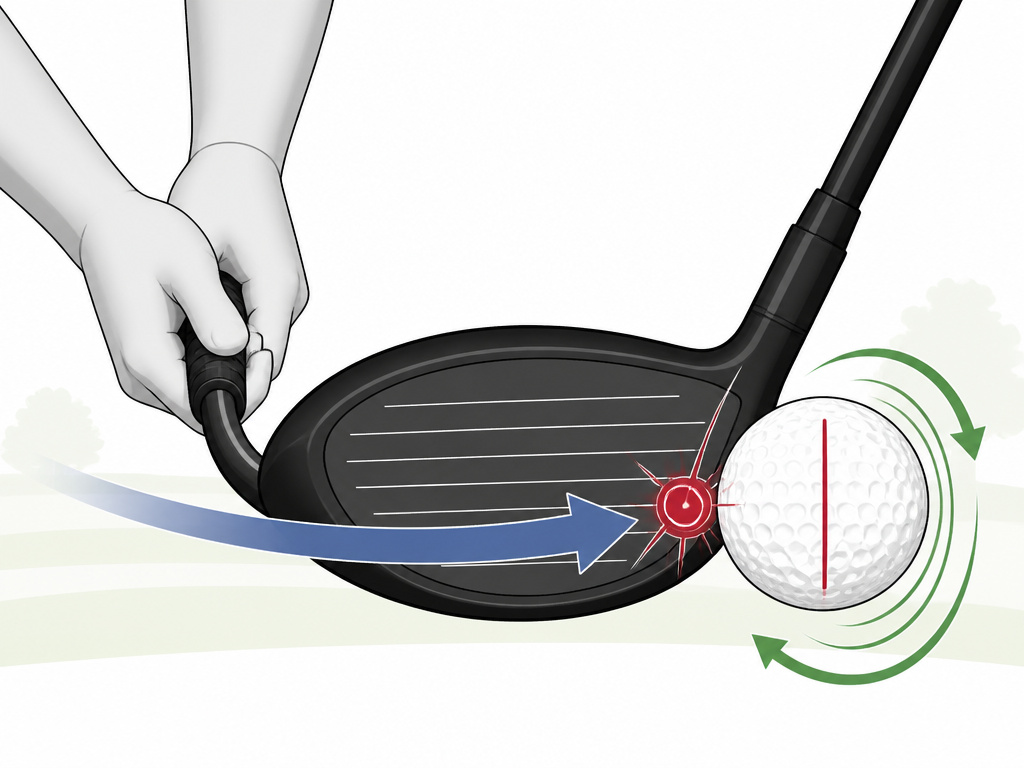
Hitting a draw with a driver introduces a major variable: gear effect. Modern drivers have a large, curved face. Striking the ball away from the clubhead’s center of gravity imparts a correcting spin.
Common mistake: Trying to help the ball draw by swinging extra in-to-out with a driver. If you strike the ball high on the face (a common miss with a forward ball position), the gear effect adds backspin, which can neutralize the sidespin needed for a draw. Your well-intentioned draw swing can produce a straight push or even a fade.
To hit a reliable draw with a driver, you must make center-face contact, slightly toward the heel. A heel strike uses gear effect to actually promote a draw spin. This is why your driver setup is critical—it must allow an upward attack angle while ensuring centered contact.
Draw vs. Fade: Choosing Your Shot Shape
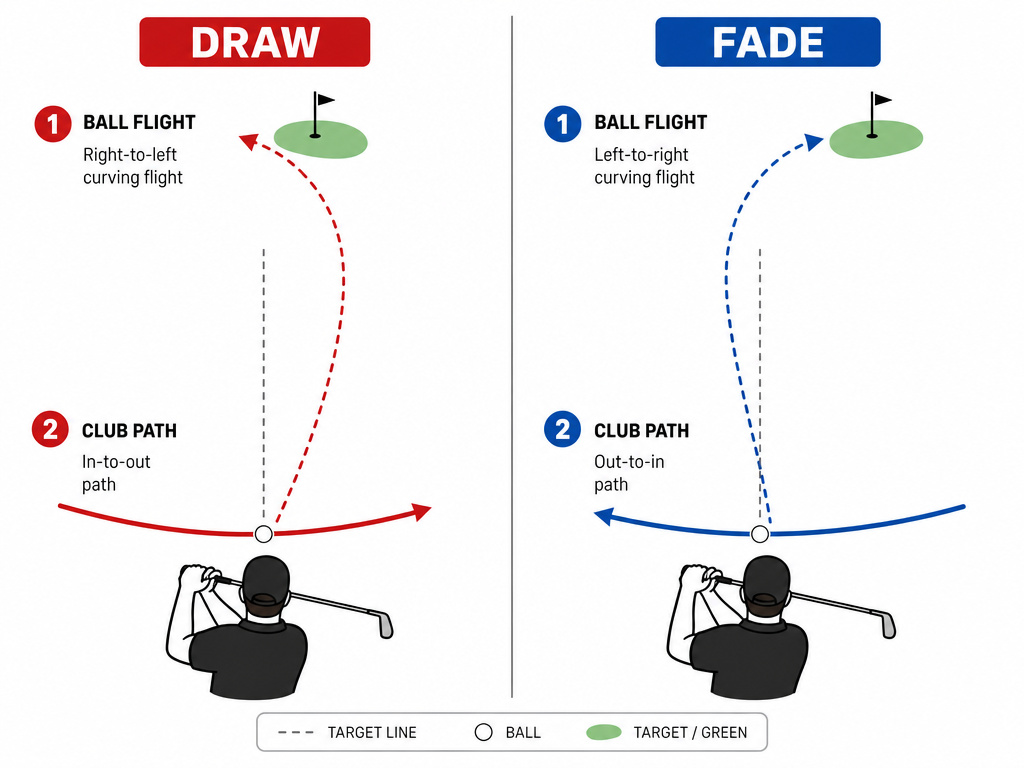
A controlled fade (left-to-right for righties) is often a safer shot, as it uses a slightly out-to-in path and an open face, which produces more backspin and a steeper descent. The draw, with its in-to-out path and closed face, generates less backspin and more roll. Your choice should be strategic.
For most golfers, the draw is a distance-seeking shot, ideal for dogleg left holes or when you need maximum roll on firm fairways. The fade is the control shot, better for holding firm greens or navigating trouble on the left. Understanding the strategic use of a draw versus a fade is what separates a player from a scorer. If you’re also working on specialty shots, the principles for a stinger shot or a controlled punch shot start with mastering your baseline ball flight.
Troubleshooting Your Draw Attempts
| Problem | Likely Cause | Immediate Fix |
|---|---|---|
| Snap-Hook | Face severely closed to target at impact. | Weaken grip slightly; focus on keeping the back of the lead hand facing the target longer through impact. |
| Block/Push (straight right) | Face open to target, path in-to-out. | Strengthen grip; ensure full body rotation through the shot to square the face. |
| Push-Draw (starts right, curves right) | Face open to target, path more in-to-out. | This is a path problem. Lessen your in-to-out swing by aligning your feet less closed. |
| No Curve | Face and path are too closely aligned (both in-to-out). | Widen the gap: maintain your path but feel like you’re leaving the face slightly more open through impact. |
If you’re struggling with consistency, the issue often originates before you even swing. Revisit your ball position and your stance for a draw. A flaw there undermines everything that follows.
Frequently Asked Questions
Why do I hit a draw with my irons but a slice with my driver?
This is usually a setup issue. With irons, your ball is centered, promoting a descending strike. With a driver, you move the ball forward to hit up on it. If your upper body moves forward with the ball, your head gets ahead of it, causing an out-to-in path and a slice. Keep your head behind the ball at driver impact. Review the differences in setup for clubs.
Can I hit a draw with a weak grip?
It’s possible but inconsistent. A weak grip requires perfect timing to close the face through impact. For a reliable draw, a neutral-to-strong grip is recommended. It’s a simpler, more repeatable motion.
My draw is too low. How do I get more height?
Low draw often means your dynamic loft is too low at impact—you’re delofting the club. This can happen if you’re too focused on “hitting down” or if your hands are too far ahead of the ball at impact. Ensure your correct ball placement is forward enough, and feel like you’re hitting the back of the ball with a slightly more lofted clubface.
Should I try to hit a draw if I’m a beginner?
Focus on a neutral, repeatable swing first. Trying to manipulate shot shape adds complexity. Work on solid iron contact and a reliable driver swing before introducing intentional curvature. Once you can hit the ball straight, learning to curve it is easier.
The Bottom Line
Hitting a draw isn’t about a magical wrist flip. It’s a product of a specific, repeatable setup that creates the correct face-to-path relationship. Commit to the closed stance, the strong grip, and the forward ball position. Practice swinging your body along that closed line, letting your hands follow. When you need that right-to-left ball flight for extra distance or to work around a corner, you’ll have a dependable shot, not a hopeful guess. And when the situation calls for the opposite, you’ll know how to hit a fade.
