
Stack and Tilt Golf Method: The Pro Circuit’s Divisive Swing
This post contains affiliate links. As an Amazon Associate, we earn from qualifying purchases.
The Stack and Tilt golf method is a swing system that keeps 55% to 70% of a golfer’s weight over the lead foot from setup through impact, with the spine tilting toward the target during the backswing. Invented by Mike Bennett and Andy Plummer, it aims for consistent low-point control by eliminating lateral weight shift, but its biomechanical demands have sparked debate over long-term back and knee strain.
That 55-70% front-foot starting weight is the non-negotiable anchor. Most conventional instruction starts you at 50-50. This single number changes everything about how you turn, where your head stays, and what your back feels at the top of the swing. It’s a commitment, not an adjustment.
What follows breaks down the three things that make Stack and Tilt work, and the two things that make it break. We’ll cover the exact setup numbers, the tour players who won with it and then left it, and the specific physical trade-offs that decide whether this system is a fix for your fat shots or a fast track to your physiotherapist.
Key Takeaways
- Start with 55-70% of your weight on your lead foot and keep it there. Any shift back defeats the system’s core premise of a stable, centered pivot.
- The “tilt” is a forward spine lean toward the target during the backswing, not a reverse pivot. Your lead shoulder works down, not around.
- Critics, including the United States Golf Teachers Federation (USGTF), argue the forced front-weight position is biomechanically stressful and unnecessary for coordinated players, potentially leading to chronic back issues.
- The method is best viewed as a diagnostic or transitional teaching tool for golfers who chronically sway or hit fat/thin, not as a universal long-term swing model for distance.
- Success stories like Aaron Baddeley’s first PGA TOUR win are real, but his subsequent move away from the method is a telling data point about its physical sustainability at the highest level.
What is the Stack and Tilt Golf Method?
The Stack and Tilt is not a minor swing tweak. It’s a full architectural rebuild of the golf motion, codified by instructors Mike Bennett and Andy Plummer and launched into the mainstream by a June 2007 Golf Digest cover. Their premise was simple: the average handicap had barely budged in decades despite better equipment. The fault, they argued, was in the inconsistent weight shift of the traditional swing.
The system prioritizes a repeatable low point over athletic dynamism. By presetting impact conditions at address, weight forward, spine ready to tilt, it seeks to make ball-first contact a geometric certainty, not a timed coincidence.
The name describes the two key moves. “Stack” means keeping your upper body centered over your lower body, minimizing head movement. “Tilt” refers to the spine leaning toward the target as you make your backswing, a direct contrast to the classic coil away from the ball. This philosophy is deeply rooted in Homer Kelley’s engineering manual, The Golfing Machine, and borrows from the principles of the Iron Byron testing robot: a stable axis, a circular swing path, and a clubface that doesn’t roll.
For a golfer stuck in a cycle of fat and thin shots, this can feel like revelation. It removes the timing-based weight transfer that causes so much inconsistency. But removing that motion also removes a source of power and places new physical demands on the lead side of the body. Your choice in golf ball compression matters less if your swing’s foundation is straining your joints.
The Core Principles: Weight, Tilt, and Turn
The system lives or dies by three interlocked rules. Break one, and the mechanics unravel.
1. Forward Weight Distribution (55-70% at Address)
You don’t start at neutral. Bennett and Plummer mandate at least 55% of your weight on your lead foot at setup, pushing to 70% for beginners struggling with sway. This isn’t a feeling. It’s a measurable spec. The goal is to make your swing center, the midpoint between your hips, a stable post you rotate around, not a pendulum you swing from side to side.
2. Forward Spine Tilt in the Backswing
As you turn your shoulders, your lead shoulder works down toward the ball. This causes your spine to tilt toward the target, not away from it. From face-on, your head stays centered or even moves slightly forward. This is the “tilt.” It keeps your swing on a steeper, more vertical plane and pre-sets your impact position. It feels completely alien if you’re used to coiling behind the ball.
3. The “Jumping Up” Downswing
This is the least-discussed and most athletic part of the move. As the club approaches impact, you drive upward with your legs, “jumping” to level your hips and extend your spine. Bennett and Plummer compare it to a shot-putter’s release. This upward thrust is what shallows the club and delivers power without a weight shift. Skip it, and you’ll drive the club steeply into the ground.
| Principle | Stack & Tilt Execution | Conventional Swing Equivalent |
|---|---|---|
| Weight at Setup | 55-70% on lead foot | 50-50 distribution |
| Head Movement | Stays centered or moves toward target | May shift slightly off the ball |
| Spine in Backswing | Tilts toward target | Tilts away from target |
| Power Source | Upward leg thrust & rotation | Lateral shift into lead side |
| Primary Goal | Consistent low-point, ball-first contact | Dynamic loading for maximum speed |
Where this goes sideways: Letting the hips slide toward the target in the backswing while the upper body leans forward. That’s a reverse pivot, not a stacked turn. You’ll hit weak slices and strain your lower back within a few rounds.
These moves demand a specific type of athletic posture. If your baseline mobility is poor, forcing the tilt and the jump will magnify those limitations fast.
The Controversy: Biomechanics and Back Pain
The debate around Stack and Tilt isn’t about philosophy. It’s about physiology. From its debut, the method faced skepticism from biomechanics experts and teaching bodies who saw red flags in its forced positions.
The United States Golf Teachers Federation (USGTF) published a direct critique. Their central argument: maintaining weight on the front foot throughout the swing is not necessary for a coordinated player with a proper transition. They describe the feel as paradoxical, coiling the upper body away while willing the weight to stay forward often leads to golfers increasing pressure on their lead side, creating unnecessary strain.
A scholarly review on PerfectGolfSwingReview.net was more blunt. It labeled the swing “biomechanically unnatural” and argued the combination of a forward-tilted spine at the top of the backswing and an aggressive “jumping” downswing is “very likely to cause chronic back problems over the long-term.” No large-scale clinical study has proven this, but the mechanism is clear: the lumbar spine is placed in a compromised, flexed position under rotational load.
Common mistake: Adopting Stack and Tilt to fix back pain from a sway. You might trade one pain for another, more centralized one. The system loads the lead-side knee and lower back aggressively.
The most damning evidence often cited is anecdotal but specific. Rotary Swing founder Chuck Quinton recounts a clinic where 13 golfers adopted the method; within two weeks, nine reported new pain or injury. Tour adopters like Mike Weir and Aaron Baddeley eventually moved on to other techniques. This doesn’t mean the swing is “wrong,” but it signals that its physical cost may outweigh its consistency benefits for many bodies. It’s a stark contrast to the goals of overspeed training, which aims to build athleticism, not restrict it.
Stack and Tilt vs. The Single Plane Swing
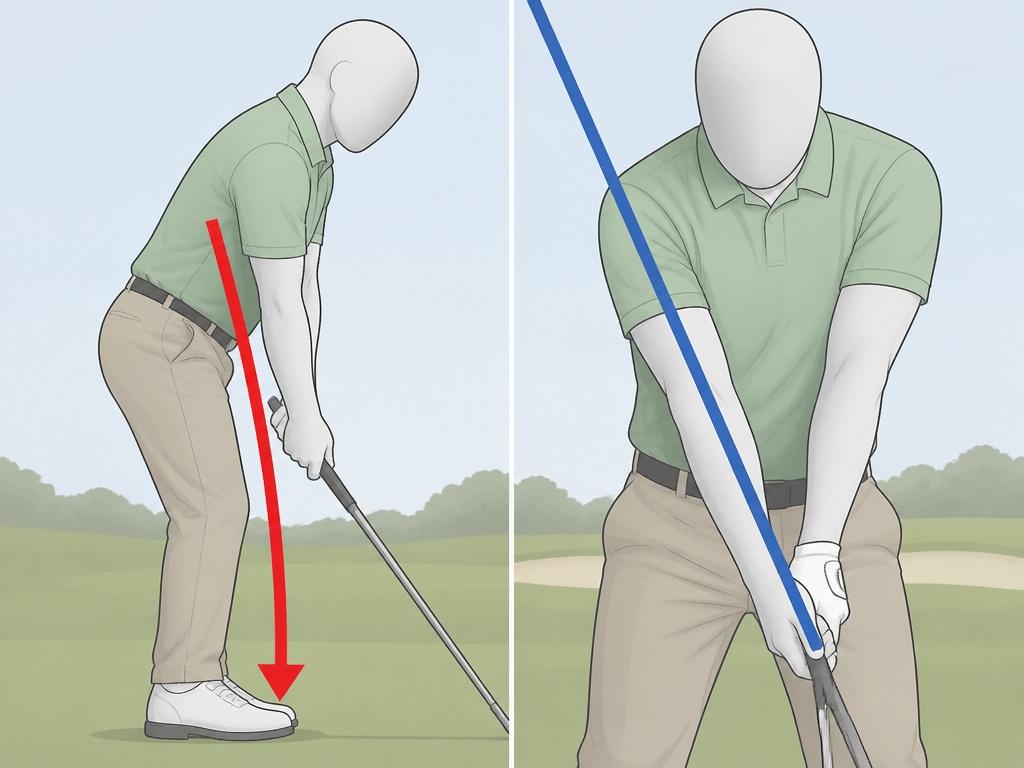
Golfers searching for a simpler swing often confuse Stack and Tilt with the single plane swing. Both are “system” approaches, but their geometry and intentions differ fundamentally.
The single plane swing, popularized by Moe Norman and later Bryson DeChambeau, uses one angled plane for the arms and club from address to finish. The set-up is more upright, with the hands high and the shaft in line with the lead arm. It’s a geometry-focused method that promotes a straight ball flight by minimizing clubface rotation.
Stack and Tilt is more about weight management and pivot than plane geometry. Its plane can actually be steeper than conventional swings due to the forward spine tilt. The focus is exclusively on controlling the low point of the swing arc by locking the weight forward.
| Aspect | Stack and Tilt | Single Plane Swing |
|---|---|---|
| Primary Focus | Weight distribution & low-point control | Swing plane geometry & clubface control |
| Setup | Weight 55-70% forward; spine neutral | Hands high, shaft in line with lead arm; weight neutral |
| Backswing | Spine tilts toward target; steepens plane | Club stays on single angled plane; minimal spine tilt change |
| Power Source | Upward leg thrust & rotation | Wide arc & body rotation |
| Best For | Golfers who sway and hit fat/thin shots | Golfers who struggle with clubface consistency and path |
Think of it this way: Stack and Tilt fixes a vertical problem (fat and thin contact). The single-plane swing method fixes a horizontal problem (left and right dispersion). Trying to blend them usually results in a convoluted, ineffective motion. Choose the problem you need to solve.
Who Should (and Shouldn’t) Try Stack and Tilt
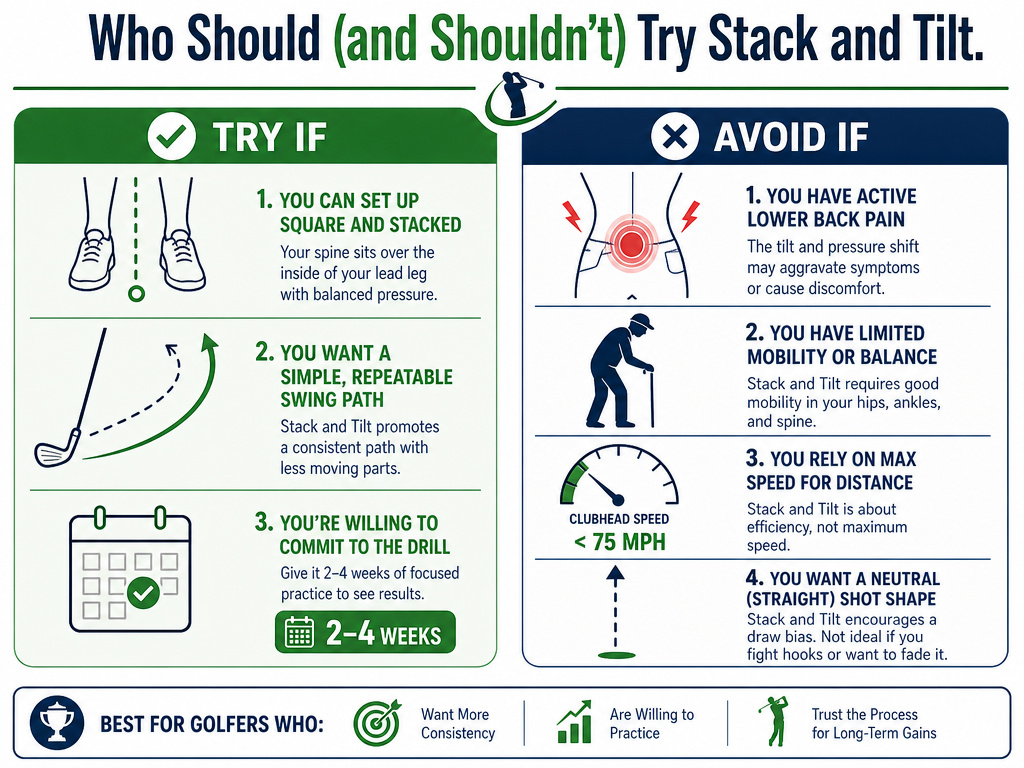
This method is a specialist tool, not a universal upgrade.
Try Stack and Tilt if:
- You chronically hit behind the ball or blade it thin due to a lateral sway.
- You’re a beginner overwhelmed by the timing of a weight shift and need a simple, repeatable pattern for contact.
- You have a short, quick swing and need to feel a fuller shoulder turn and a more descending blow.
- You are using it as a 2-4 week drill with a qualified instructor to feel centered rotation, not as a permanent swing.
Avoid Stack and Tilt if:
- You have existing lower back, lead hip, or lead knee issues. The stress is predictable and significant.
- You are a senior golfer or have limited mobility. The “jumping” downswing and deep rotation require athleticism.
- Your primary goal is maximizing distance. The restricted weight shift caps potential clubhead speed.
- You already strike the ball consistently but want to work on shot shaping. The system is designed for neutrality.
The equipment you pair it with matters, too. A forgiving game improvement iron can help mask residual strike errors, but no club fixes a swing that’s hurting you. Similarly, a soft 3-piece golf ball might feel better, but it won’t protect your joints.
A Step-by-Step Practice Progression
Don’t overhaul your swing on the first tee. Use this progression on the range.
1. The 70/30 Setup Drill
Take your 7-iron. Set up with 70% of your weight on your lead foot. Feel your nose over your lead kneecap. Make half-swings, focusing on brushing the grass in the same spot just ahead of the ball. The goal is contact, not distance. Do this until you can take a dollar bill out of the turf ten times in a row.
2. The Wall Tilt Drill
Stand with your lead shoulder touching a wall. Make your backswing, pressing your shoulder down the wall. This forces the forward spine tilt and prevents your upper body from pulling away. If you lose contact with the wall, you’ve swayed.
3. The Step-Through Finish
After impact, practice letting your trail foot step forward toward the target. This encourages the full weight transfer to the front side that the method demands by the finish. It feels like walking after the shot.
What most people get wrong: Rushing to full swings. The positions are so specific that ingraining them requires exaggerated, slow-motion rehearsal. A full-speed swing with old habits will simply disguise the same flaws.
Frequently Asked Questions
Did any PGA TOUR players really use Stack and Tilt?
Yes, and it produced results. Aaron Baddeley, Dean Wilson, Eric Axley, and Will Mackenzie all credited the method with helping them secure their first PGA TOUR wins in the late 2000s. Mike Weir was also a notable adopter. However, most of these players, including Baddeley and Weir, have since modified their swings and moved away from the pure Stack and Tilt model, which many instructors point to as evidence of its limitations for long-term, elite performance.
Does Stack and Tilt cause back injuries?
There is no definitive large-scale medical study, but credible biomechanical criticism suggests high risk. Instructors like Chuck Quinton and organizations like the USGTF argue the combination of a forward-tilted spine at the top of the swing and an aggressive upward thrust places unusual shear forces on the lumbar spine and compresses the lead-side knee. Anecdotal reports of back and knee pain among adopters are common. If you have a history of back issues, it is not recommended.
Can Stack and Tilt help a slicer?
It can, but indirectly. Stack and Tilt promotes a steeper swing plane and a more in-to-out path for many golfers, which can reduce a slice. However, its primary goal is solid contact, not curvature control. If your slice is caused by an over-the-top move from a sway, Stack and Tilt may fix it by eliminating the sway. If your slice is due to a weak grip or open clubface, it likely won’t help.
Is Stack and Tilt good for seniors?
Generally, no. The method requires good flexibility in the hips and back to achieve the deep rotation and forward tilt. The “jumping” downswing move also demands leg strength and stability that often diminishes with age. For most seniors, a swing with a more natural weight shift and less spinal manipulation is safer and more sustainable.
How is Stack and Tilt different from just keeping your head down?
“Keeping your head down” is a static, restrictive feel that often causes a hunched-over posture and a lack of rotation. Stack and Tilt is a dynamic system where the head stays centered as part of an athletic pivot. The head may actually move slightly toward the target during the backswing. It’s about controlled movement, not artificial stillness.
Before You Go
The Stack and Tilt golf method is a fascinating case study in swing theory. It solves a real, frustrating problem, inconsistent contact, with a radical, logical fix. The data point of multiple first-time tour wins is undeniable proof of its potential efficacy.
But potential isn’t prescription. Your decision hinges on a physical cost-benefit analysis. If you are an agile golfer plagued by fat shots, working with a certified instructor on its principles for a few weeks could provide a breakthrough feel. If you have any joint concerns or seek maximum distance, view it as a historical footnote in golf instruction, not a manual.
The search for a repeatable swing often leads us to complex systems. Sometimes the answer is simpler equipment, like finding the best all-around golf balls for your game, or focusing on foundational stability with the right arch support shoes. Stack and Tilt reminds us that every swing method is a trade-off. Understand what you’re trading before you commit.
