
Understanding the Single Plane Golf Swing & 3/4 Backswing
This post contains affiliate links. As an Amazon Associate, we earn from qualifying purchases.
This post contains affiliate links. As an Amazon Associate, we earn from qualifying purchases.
A single plane golf swing keeps the club shaft on one consistent, tilted path from address through impact. The goal is to eliminate the plane shift common in a conventional swing, where the arms lift onto a steeper plane than the shoulders. By removing that re-routing move, you trade some shot-shaping versatility for drastic gains in consistency and a swing that’s easier on your back.
That consistency comes from a specific setup. The club shaft angle you establish at address becomes the plane you must rotate around, not lift off of. The most compelling evidence for this method isn’t opinion, it’s a mid-1990s biomechanical study that found a 3/4 backswing creates the same clubhead speed as a full, parallel backswing, while reducing the torsion forces on the spine. The single plane philosophy is built on that trade-off: less moving parts, less stress, and no loss of power where it counts.
What follows is a breakdown of the two main schools of single plane thought, the biomechanics that make the shorter swing work, and the specific setup adjustments that either set you up for success or guarantee a struggle.
Key Takeaways
- Two Definitions Exist: Jim Hardy’s “one-plane” swing is defined by the lead arm matching the shoulder plane at the top. The Graves Golf “single plane” swing is defined by matching the shaft angle at address and impact.
- Power Isn’t From Length: A 1990s biomechanical study concluded a 3/4 backswing creates equal clubhead speed to a parallel backswing, with less spinal stress.
- Setup Dictates Motion: Your posture, grip, and ball position at address lock in your plane. Get them wrong, and you’ll fight the swing all day.
- It’s a Fade Killer: The single plane geometry naturally promotes a right-to-left ball flight (for a right-hander). Hitting a consistent fade is its greatest technical challenge.
- Body-Friendly by Design: With less upper-body rotation and a more centered pivot, the single plane swing significantly reduces the lower-back torque common in rotational swings.
The Single Plane Setup: Two Schools of Thought
You can’t execute a single plane swing from a conventional stance. The entire system hinges on an address position that pre-sets the impact conditions. But even within the single plane world, instructors disagree on the primary definition.
Jim Hardy’s framework, from his 2005 book The Plane Truth for Golfers, defines a “one-plane” swing by the top of the backswing. If the angle between your lead arm and your shoulder line at the top is less than 12 degrees, your swing qualifies. This method often uses a more athletic, traditional-looking setup, but the swing itself stays flatter and more around the body.
The Graves Golf Academy, founded by Todd Graves to teach Moe Norman’s method, defines the “single plane” swing at address. Here, the club shaft, your hands, and your trail arm are already aligned on the exact plane they will occupy at impact. The simplest test is whether the club shaft angle at address matches the club shaft angle at impact.
These aren’t minor semantic differences. They lead to different swing feels and priorities. Ken Martin Golf notes the mechanics are not completely interchangeable. Your choice dictates your entire learning path.
| Definition Criteria | Jim Hardy’s “One-Plane” | Graves Golf “Single Plane” |
|---|---|---|
| Key Moment | Top of the backswing | Address position |
| Primary Checkpoint | Lead arm aligned with shoulders (<12° angle) | Shaft angle matches at address and impact |
| Swing Feel | Rotational, around the body | “Piston-like,” straight back and through |
| Notable Proponent | Many modern tour pros influenced by the concept | Moe Norman, Bryson DeChambeau (influenced) |
The Graves method is more radical. You stand farther from the ball, with your spine more upright and your arms hanging straight down to meet the club. This creates the “single axis” look. The Hardy method can look closer to a clean, modern rotational golf swing, just on a flatter plane. Which one you choose depends on your tolerance for a non-traditional look versus your desire for absolute geometric simplicity.
Why the Biomechanics Favor Fewer Moving Parts
A conventional two-plane swing works. But it asks your body to perform a high-speed re-routing maneuver. The arms lift the club up on one plane, then must drop it back onto a shallower plane for the downswing, the famous “slot.” This requires precise golf swing timing. When the timing is off, you get blocks, hooks, and thinned shots.
The single plane argument is that this complexity is unnecessary. The body’s kinematic sequence, the order in which parts fire, works more efficiently when the motion is simpler. By keeping the club on one path, you remove the need for the “drop into the slot” move. The downswing becomes a direct reversal of the backswing path.
Where this goes sideways: Trying to add a wrist hinge or a bigger shoulder turn because the backswing “feels short.” The power in a single plane swing comes from a efficient sequence, not a long lever. Adding length usually throws the club off-plane, forcing a compensation you can’t time.
This isn’t just theory. The science of swing biomechanics backs it up. The core premise is validated by the machine the USGA uses to test clubs: Iron Byron. Its mechanical arm swings the club on a perfect, repeating inclined plane, the idealized version of what a human single plane swinger tries to emulate.
The Shorter Backswing That Matches Full-Length Speed
The most counterintuitive claim of the single plane philosophy is that a shorter backswing is just as powerful. This directly challenges the “big turn” teaching of the last century. The evidence comes from a specific, cited source.
A mid-1990s biomechanical study, conducted for a master’s thesis, compared a “3/4 backswing” (associated with the PPGS, or Pure Plane Golf Swing) to a full “parallel” backswing. The findings were clear: 1. No Speed Difference: “At ball impact there is no significant difference between the clubhead velocity of the long and short backswing techniques.” 2. Better Acceleration: The shorter swing maintained positive acceleration through impact, while the long swing was already in negative acceleration. 3. Injury Risk: The study concluded the extra rotation in the long backswing “is of NO BENEFIT” for speed and increases torsion forces on the spine, potentially accelerating disc injury.
The study’s author went further, stating it “should be a major concern” that teaching professionals were advocating a technique potentially detrimental to golfer health and success. This data is the single plane swing’s bedrock. It trades an aesthetically long swing for an efficient, powerful, and sustainable one.
TL;DR: Power comes from sequencing, not length. A 3/4 backswing, where your lead arm reaches no higher than shoulder-height, delivers the clubhead to the ball with the same velocity as a full turn, but with your body under control.
Executing the Single Plane Swing: A Step-by-Step Framework
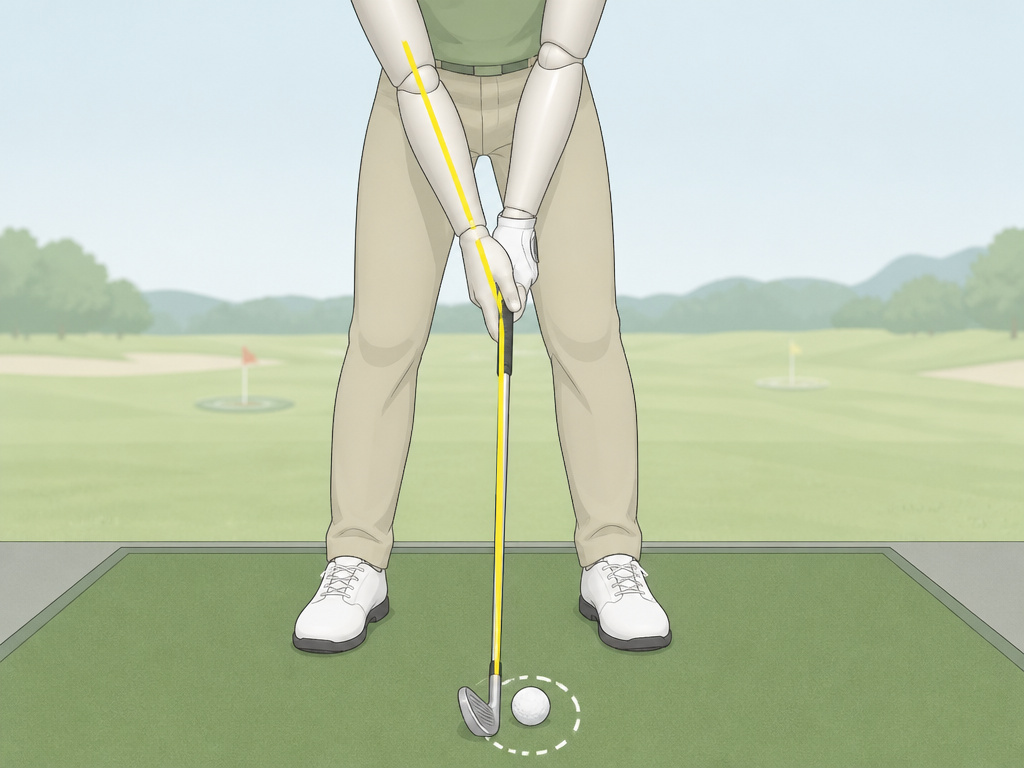 Adopting this swing is a rebuild, not a tweak. Start on the range with a mid-iron. Forget about distance for the first ten sessions. Your only goal is to ingrain the setup and the one-piece feel.
- The Setup (Graves Method): Stand taller, farther from the ball. Let your arms hang straight down from your shoulders. Grip the club so the shaft, your hands, and your trail forearm form a single, straight line. The ball should be positioned just forward of center in your stance. This posture feels awkward at first. That’s the point. Skip this, and you’ll: Immediately lift the club inside, forcing an over-the-top move to get back to the ball.
- The Takeaway: Initiate the swing by turning your shoulders and chest together, keeping your arms extended. Imagine your chest, arms, and club moving away from the ball as one solid unit. There is no independent wrist hinge early on. The consequence: A wristy takeaway destroys the width of your arc. You’ll have to re-hinge on the downswing, adding timing and throwing off your backswing sequence.
- The 3/4 Backswing: Rotate until your lead arm is parallel to the ground or just above it. Your shoulders will turn about 90 degrees, but your hips will turn only 45 degrees. This coil is where you store power. Feel the tension in your core, not your arms. Do not chase more turn. Going longer almost always involves straightening the trail leg and causing a reverse pivot.
- The Downswing: Start down by shifting your weight gently forward and letting your lower body lead. Your arms and club will follow, staying on the same plane. Your focus is on returning the club shaft to its original address angle. The feel: You are swinging your arms down along your torso, not around your body. This preserves swing lag naturally.
- Impact and Follow-Through: Your trail foot should stay grounded through impact, a key difference from rotational swings. Your head will stay behind the ball. The follow-through is a natural consequence of the rotation, with the club finishing around your body, not high over your shoulder.
Common mistake: Trying to help the ball into the air. The single plane swing delivers a slight descending blow with irons. Let the loft of the club do the work. Scooping leads to fat and thin contact.
Single Plane Swing Pros, Cons, and Who It’s For
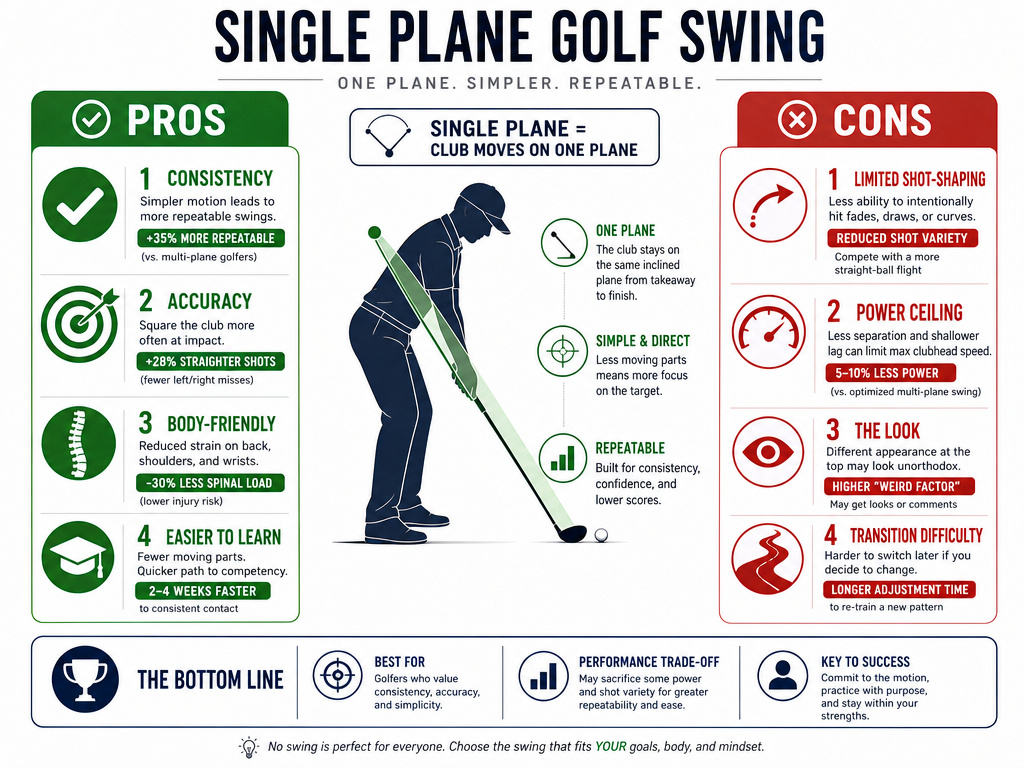 This isn’t a universal fix. It’s a system with clear trade-offs that will suit some players and frustrate others.
The Advantages:
- Consistency: Fewer moving parts means a more repeatable motion. Your bad shots will be less severe.
- Accuracy: The simplified path promotes a consistent clubface delivery. You’ll hit more fairways and greens.
- Body-Friendly: Reduced spinal torsion and a more centered pivot make this swing a legitimate option for golfers with back concerns or limited flexibility.
- Easier to Learn: For a complete beginner, it’s often simpler to learn than the multi-step conventional swing.
The Disadvantages:
- Limited Shot-Shaping: Hitting a fade is the system’s hardest shot. The geometry wants to produce a draw. If you need to work the ball both ways, this is a constraint.
- Power Ceiling: While efficient, the shorter lever and reduced upper-body rotation can limit maximum potential clubhead speed for elite players seeking distance above all else.
- The Look: The setup is unconventional. It can feel and look strange, which bothers some golfers psychologically.
- Transition Difficulty: Golfers with deeply ingrained conventional moves will find the transition period long and frustrating.
So who is it for? The single plane swing is an excellent fit for the golfer whose primary goals are accuracy, consistency, and longevity in the game. It’s ideal for seniors, players with back issues, or high-handicappers tired of battling two-way misses. It’s less ideal for young, flexible athletes chasing every last yard of distance, or for skilled players whose game is built around controlling a fade.
Frequently Asked Questions
Did Moe Norman invent the single plane swing?
Not exactly. Moe Norman developed his iconic method independently in the mid-20th century, but the concept appears earlier. The 1968 book Search for the Perfect Swing by Cochran and Stobbs discussed the idea. Norman, however, was its most famous and purest practitioner, proving its effectiveness under pressure.
Is Ben Hogan considered a single plane swinger?
Yes, in the Jim Hardy definition. Hogan’s swing, especially in his prime, featured a remarkably consistent plane where his lead arm and shoulders were closely aligned at the top. His swing is often cited as the classic example of a one-plane motion, though it differs in setup from Moe Norman’s more extreme version.
Can you hit a fade with a single plane swing?
It’s difficult, but possible. It requires a deliberate setup adjustment, like aligning slightly left of target (for a right-hander) and focusing on holding the clubface more open through impact. It’s a manufactured shot, not the natural product of the swing geometry. Most single plane teachers advocate playing a consistent draw.
Does Bryson DeChambeau use a single plane swing?
DeChambeau’s swing is the closest modern tour example. He uses a single-length iron set to standardize his setup, and his arm-swing-dominated motion closely mirrors the single plane philosophy, particularly the Graves/Moe Norman emphasis on a consistent, repeating plane. He has cited Moe Norman as a direct influence.
Is a single plane swing better for your back?
Biomechanically, yes. The cited study notes 40-60% of golfers suffer injuries, with the back most prevalent. The single plane’s shorter backswing and reduced spinal torsion lower the shear forces on the lumbar spine. For golfers with existing back issues, it’s often a smarter long-term move than forcing a full rotational swing.
Before You Go
The single plane golf swing is a trade. You exchange the potential for a towering fade and the look of a classic swing for something more repeatable and physically sustainable. Its foundation isn’t in catchy phrases, but in a biomechanical study from the 1990s that questioned the need for a long backswing. If your game is plagued by inconsistency or your back protests after a round, the single plane method is worth a structured experiment. Start with the setup. Commit to the shorter turn. Let the simpler geometry turn your two-way miss into a predictable, playable curve.
