
Pitching vs Gap vs Sand Wedge: The Essential Wedge Guide
This post contains affiliate links. As an Amazon Associate, we earn from qualifying purchases.
This post contains affiliate links. As an Amazon Associate, we earn from qualifying purchases.
The gap between your pitching wedge and sand wedge is a modern equipment problem. A gap wedge (48°–54°) bridges that 10–15 yard hole, but the right loft depends entirely on your pitching wedge’s strength. Match bounce to your turf and swing, and replace wedges every 75-125 rounds when the grooves wear smooth.
That 10-15 yard gap isn’t a skill problem. It’s a geometry problem created by stronger-lofted modern irons. Your pitching wedge is now what a 9-iron used to be, while your sand wedge stayed the same. The result is a scoring-distance black hole that costs you four to six strokes a round on approach shots you know you should hit.
What follows: the exact loft numbers that create the gap, the difference between a set gap wedge and a tour-proven specialty wedge, and the 4-degree rule that rebuilds your scoring club distances from 120 yards in. We’ll also cover bounce, groove wear, and when to actually use each club around the green.
Key Takeaways
- Your modern pitching wedge is 5–7 degrees stronger than 20 years ago, creating a 30+ yard gap to your sand wedge. A gap wedge fixes this.
- Follow the 4-degree loft rule for consistent yardage gaps. If your PW is 44°, your next wedge should be 48° or 50°, not 52°.
- Set gap wedges match your irons for full-swing feel; specialty gap wedges (Vokey, Cleveland) offer sharper grooves and grind options for shots inside 100 yards.
- Wedge grooves lose meaningful spin after 75-125 rounds. Replace them every 2-3 seasons, not when the head wears through.
- Bounce angle is turf insurance. Low bounce (4°–8°) for firm conditions and shallow swings; high bounce (10°–14°) for soft turf, sand, and steep divots.
The 4-Degree Loft Rule That Fixes Your Yardage Gaps
Wedge gapping focuses on closing holes rather than adding clubs. The single metric that matters is the loft difference between your wedges.A 10-degree gap between a 44° pitching wedge and a 54° sand wedge is a full two-club jump in your iron set. That’s why you have a 115-yard shot with no confident swing.
Keep loft gaps between consecutive wedges to 4–6°. Anything more creates yardage gaps of 15+ yards; anything less wastes a slot in your bag. This principle, detailed in guides on wedge distance control, turns three wedges into a ladder.
The problem started when iron manufacturers began strengthening lofts to sell distance. A 1990s pitching wedge was 48°–50°. Today’s game-improvement set often ships a 43°–44° PW. The sand wedge, designed for bunker physics, stayed at 54°–56°. That 10+ degree void is where strokes disappear.
| Club | 1990s Typical Loft | 2020s Typical Loft | Yardage Gap Created |
|---|---|---|---|
| Pitching Wedge (PW) | 48° | 44° | +10–15 yards |
| Gap Wedge (GW) | (Didn’t exist) | 48°–52° | Fills the 30-yard hole |
| Sand Wedge (SW) | 56° | 56° | Unchanged |
Your first step involves reading the spec sheet for your irons, not buying a wedge. Find your pitching wedge loft.The number is often stamped on the club or listed on the manufacturer’s website. If it’s 44° or lower, you need a gap wedge. If it’s 46° or higher, you might get by with a tightly spaced sand wedge.
The short version: Subtract your PW loft from your SW loft. If the difference is 8 degrees or more, add a gap wedge halfway between them.
Pitching Wedge: Your 120-Yard Workhorse (And Where It Fails)
A pitching wedge is the shortest iron in your set, designed for one job: full-swing approach shots from 100–130 yards. Its low loft (42°–48°) and minimal bounce (2°–5°) make it predictable from the fairway.It wants to be swung, not finessed.
Use your pitching wedge for: * Full swings from clean fairway lies. * Low-running chip shots when you have green to work with. * Long bunker shots where the lip is low and you need carry.
The pitching wedge’s failure point is versatility. It has almost no bounce, so it digs in soft turf or thick rough. Its grooves are shallower than a specialty wedge, so it generates less spin on partial shots. And because it’s part of your iron set, its sole is designed to glide, not to be opened up for flop shots.
Where this goes sideways: Using a PW from a buried lie in the rough. The leading edge digs, the ball comes out dead, and it rolls 30 feet past the hole. That happens on the first swing, not the tenth.
When your wedge selection guide says “pitching wedge,” it means a full swing from a good lie. Anything else is a compromise. This is why better players often replace their set PW with a specialty 48° wedge that matches their other wedges—it gives them one more club that can handle touch shots.
Sand Wedge: The Bunker Specialist That Saves Par
The sand wedge exists because of physics, not marketing. Its high loft (54°–58°) and high bounce (10°–14°) are engineered to skid through sand, not dig. The Wikipedia sand wedge page notes the design hasn’t changed much since Gene Sarazen invented it; the loft and bounce angles required to lift a ball from a bunker are constants.
Use your sand wedge for: * Any shot from a greenside bunker (its only non-negotiable use). * Pitches from thick rough where you need the bounce to avoid digging. * High, soft shots to a short-sided pin. * Full swings from 70–95 yards.
Its high bounce is a curse from tight lies. On firm fairway or hardpan, the sole literally bounces the leading edge into the ball’s equator, causing a thin, skulled rocket. That’s why you carry other wedges.
For the average player looking for reliability, a 56° sand wedge with 12° of bounce is the default. Models like the Cleveland CBX ZipCore or the Callaway Jaws Raw offer forgiveness where most best sand wedges for mid-handicappers focus. If you play on firm, links-style courses, drop to 10° of bounce.
Gap Wedge: The Modern Necessity (Set vs. Specialty)
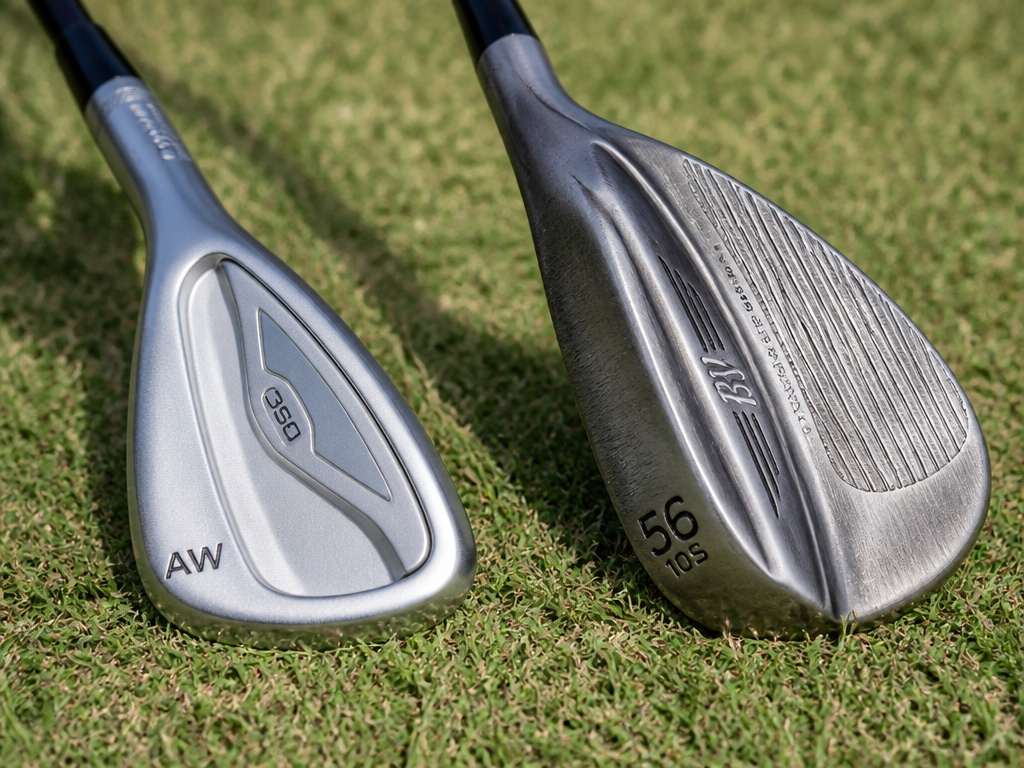
The gap wedge is the translator between your strong-lofted irons and your traditional sand wedge. It lives in the 48°–54° range, with 50° and 52° being most common. But there are two distinct types, and picking the wrong one hurts your game.
A set gap wedge (often stamped “AW” or “GW”) comes with your irons. It shares the same shaft, swing weight, and sole design. Its job is to make your 110-yard full swing feel exactly like your 9-iron. It’s for distance gapping, not short-game creativity.
A specialty gap wedge (like a Titleist Vokey SM10 or TaylorMade Hi-Toe 3) is sold separately. It has sharper, deeper grooves for more spin, multiple grind options for different turf interactions, and a shape designed for shots inside 100 yards. It’s a scoring tool.
| Feature | Set Gap Wedge | Specialty Gap Wedge |
|---|---|---|
| Primary Use | Full-swing distance gapping | Full swings, pitches, chips, bunker shots |
| Feel | Matches your iron set | Often heavier, more feedback |
| Grooves | Standard iron grooves | Aggressive, spin-milled grooves |
| Versatility | Low | High |
| Best For | Golfers who only use it for full swings | Golfers who want one club for 70-110 yards |
The Wikipedia gap wedge entry points out that critics see the club as a fix for a manufactured problem. But the yardage gap is real. If your PW is 44° and your SW is 56°, a 52° specialty wedge isn’t a luxury—it’s your 95-yard club, your chipping club, and your escape-from-light-rough club. That’s three shots you no longer have to manipulate.
Bounce & Grind: The Hidden Fit That Beats Brand
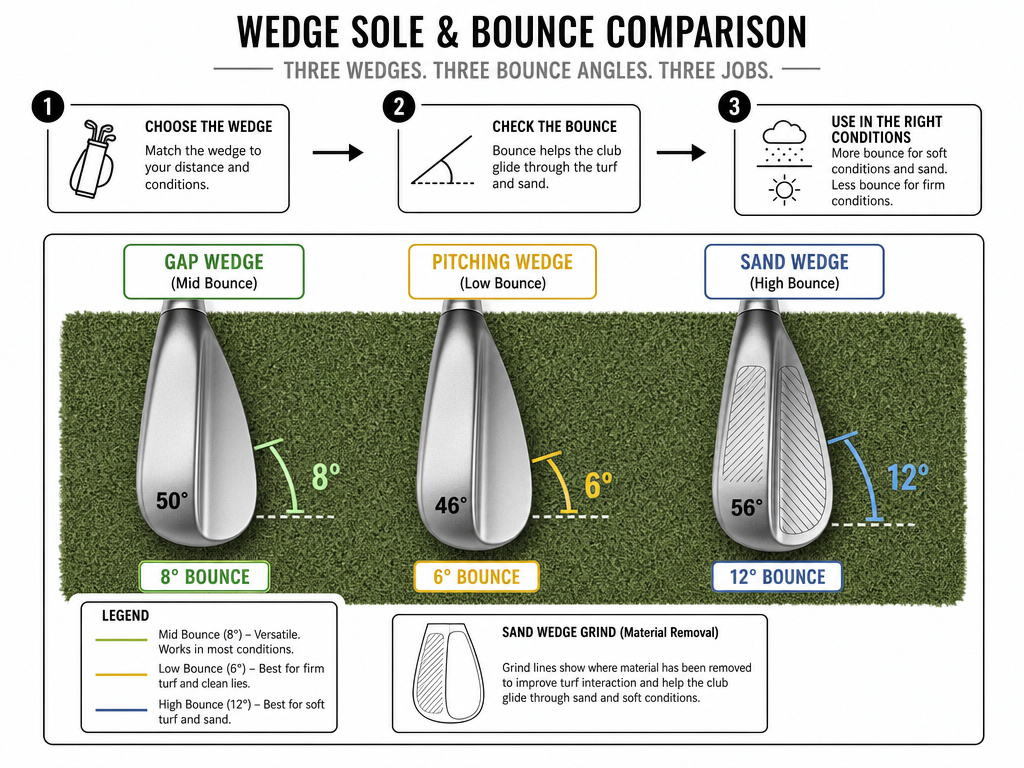
Bounce is the angle between the leading edge and the lowest point of the sole. It’s the club’s built-in resistance to digging. Think of it as turf insurance. Grind is how the manufacturer shapes and removes material from the sole to change how the bounce works when you open the face.
Ignoring bounce is why you fat some chips and blade others. Your wedge’s performance changes with the ground under it.
Common mistake: Buying a wedge for its brand or look without checking the bounce. A 60° lob wedge with 4° of bounce is a scalpel for firm conditions. The same loft with 12° of bounce is a shovel for soft sand. They are different tools.
A full explanation of wedge bounce and grind is its own topic, but use this cheat sheet: * Low Bounce (4°–8°): For firm turf, tight lies, and golfers with a shallow, sweeping swing. Digs in soft conditions. * Mid Bounce (8°–12°): The most versatile. Works in average conditions for most swing types. * High Bounce (12°+): For soft turf, fluffy sand, deep rough, and golfers who take steep divots. Bounces on hard ground.
Your gap wedge often works best with mid-bounce (8°–10°). Your sand wedge needs high bounce (10°–14°) for its bunker duty. Your lob wedge, if you carry one, typically uses low bounce (4°–8°) for precision around the green.
How to Build Your 3-Wedge or 4-Wedge Setup
You have 14 club slots. Driver, woods, hybrids, irons 5-9, putter. That leaves 3-4 spots for wedges. Most players should start with three: Pitching Wedge, Gap Wedge, Sand Wedge. Add a lob wedge later.
The 3-Wedge System (PW + GW + SW)
This is the simplest and most effective for golfers up to a 10 handicap. 1. Pitching Wedge: Your iron set’s PW (e.g., 44°). 2. Gap Wedge: A 50° specialty wedge. This creates a 6° gap to the PW and a 6° gap to the SW. 3. Sand Wedge: A 56° wedge with 12° bounce.
This gives you full-swing gaps of roughly 15 yards each (e.g., 120 yds, 105 yds, 90 yds). It covers almost all shots inside 120 yards. You chip with the GW or SW, and use the SW for bunkers.
The 4-Wedge System (PW + GW + SW + LW)
Better players add a lob wedge (58° or 60°) for short-sided shots and high flops. The key is tightening the loft gaps. * Example: PW 46° / GW 50° / SW 54° / LW 58°. * Example for strong lofts: PW 44° / GW 48° / GW 52° / SW 56°.
The fourth wedge is a specialty club. It requires practice. If you don’t spend time on your short game, the fourth wedge just complicates decisions. Start with three, master the clock system for wedge distances, then add the lob when you need more shot options.
When to Replace Your Wedges (It’s Not When You Think)
Wedges wear out from the inside. The grooves, not the finish, are the consumable part. After 75-125 rounds of regular play, the sharp edges round off. Spin drops by 20-30%. Your 90-yard gap wedge that used to stop dead now releases 15 feet.
You won’t see this wear easily. Run your fingernail across a groove. If it doesn’t catch, the groove is gone. The ball will feel harder at impact, and your check-up shots will turn into runners.
Replace wedges every two to three seasons if you play 30-40 rounds a year. That’s the cycle. Waiting for the chrome to wear through means you’ve played 50 rounds with dead grooves.
This is why buying a premium wedge like a Vokey or a Callaway Jaws is an investment in spin, not just aesthetics. It’s also why value-focused wedge sets from brands like Kirkland or Maltby make sense—you can replace them on schedule without a major cost.
Frequently Asked Questions
Is a 52-degree wedge a gap wedge or a sand wedge?
52-degree wedge is almost always a gap wedge. Traditional sand wedges start at 54 degrees. The loft defines the category. A 52-degree club fills the gap between a modern pitching wedge (44°-48°) and a sand wedge (54°-56°).
Can I use my gap wedge out of bunkers?
You can, but you shouldn’t default to it. A gap wedge has less bounce than a sand wedge. It will dig in soft sand. Use it only for firm, wet sand or very shallow bunkers where you need more roll. For standard greenside bunkers, the sand wedge’s design is superior.
My irons came with an “A” wedge. Is that a gap wedge?
Yes. “A” stands for Approach Wedge, which is another name for a gap wedge. It’s the same club category, just different marketing. If it matches your iron set, it’s a set gap wedge designed primarily for full swings.
How far should I hit each wedge?
Distances vary wildly with swing speed. A better metric is the gap between them. Your full-swing yardage gap between each wedge should be 10-15 yards. If your PW goes 120, your GW should go 105-110, and your SW 90-95. If the gap is 20+ yards, your lofts are too far apart.
Do my wedges need to match my iron brand?
No. Your wedges need to match your needs, not your bag’s logo. It’s common and often beneficial to play specialty wedges from a different brand than your irons. Focus on getting the right loft, bounce, and grind for your game, whether that’s from a comprehensive wedge buying guide or a fitter’s recommendation.
Before You Go
Stop trying to manufacture 85-yard shots with a 100-yard sand wedge. The gap wedge exists because modern equipment demands it. Find your pitching wedge loft, apply the 4-degree rule, and choose a bounce that matches your common course conditions. A specialty 50° or 52° wedge from Titleist, Cleveland, or Callaway will do more for your scoring than a new driver.
Then, practice your technique for partial wedge shots. Distance control with these three clubs turns awkward yardages into confident swings. Replace them when the grooves go, not when the shine wears off. Your short game relies on having the right tool for the distance in front of you, not on feel.
