
What Are Penalty Strokes in Golf? A Simple Rules Explanation
This post contains affiliate links. As an Amazon Associate, we earn from qualifying purchases.
This post contains affiliate links. As an Amazon Associate, we earn from qualifying purchases.
Penalty strokes in golf are applied for specific rule breaches, not as a general fine. The most common penalty is one stroke, which you take when using relief options from a penalty area or for a lost ball under stroke-and-distance. A two-stroke penalty (or loss of hole) is the general penalty for more serious breaches, like playing from a wrong place.
That one-stroke cost is the price of moving your ball from a bad spot to a playable one. It’s a trade, not a punishment. You exchange a stroke for a better lie.
What follows is the breakdown of when that trade is available, when it isn’t, and the specific situations where the penalty can double. We’ll cover the three official penalty levels, walk through penalty area relief step-by-step, and untangle the edge cases that cost weekend players the most strokes.
Key Takeaways
- The standard penalty for taking relief from a penalty area (water, red/yellow stakes) is one stroke.
- A lost ball or a ball out of bounds requires stroke-and-distance relief, which also costs one penalty stroke plus the distance.
- The general penalty is two strokes in stroke play (loss of hole in match play) for serious breaches like playing from a wrong place.
- If you take relief in a penalty area and then want out, you can—but it costs a second penalty stroke, for two total.
- There is no free relief for anything when your ball is inside a penalty area, not even for an embedded ball or an immovable obstruction.
The 3 Main Penalty Levels (And When You Get One)
The rulebook organizes penalties by the potential advantage of the breach. It’s a sliding scale.
One-Stroke Penalty: Applies when the player takes penalty relief from a different place than the original ball, such as from a penalty area or for a lost ball. The potential advantage is minor—you’re just trying to get back into play.
This is the penalty you’ll use most often. It’s the cost of doing business when your ball finds a hazard. You’re not being punished for a mistake; you’re paying a fee to use the relief rules.
The general penalty is two strokes in stroke play. This applies when the potential advantage is more significant, like playing from a spot you shouldn’t have. If you play from a wrong place—say, you drop in the wrong relief area and hit the ball—you’ve likely earned the general penalty. In match play, it’s loss of the hole.
Disqualification is reserved for the most serious issues, like signing for a wrong scorecard or serious misconduct.
| Penalty Level | Stroke Play | Match Play | Common Trigger |
|---|---|---|---|
| One-Stroke Penalty | +1 stroke | No loss of hole | Taking relief from a penalty area or under stroke-and-distance. |
| General Penalty | +2 strokes | Loss of hole | Playing from a wrong place, or a serious breach of a rule. |
| Disqualification | DQ | DQ | Signing for a score lower than actually made, serious misconduct. |
The system is rigid. You don’t get to choose your penalty. The rule you break dictates the cost.
The Penalty Area Penalty: One Stroke
This is the core of penalty strokes in golf. When your ball is in any area marked with red or yellow stakes or lines, you have two choices: play it as it lies, or take one penalty stroke for relief.
Your ball is in a penalty area if any part of it touches the ground or anything else inside the edge. That includes grass, water, or a rock.
To take relief from a penalty area for one penalty stroke, you have three options, depending on the stake color and your chosen reference point.
The process is mechanical. First, identify the point where your ball last crossed the edge of the penalty area. That’s your reference point. For a yellow penalty area, your relief options are more limited than for a red one.
Option 1: Stroke-and-Distance
Go back to where you last played from and hit again. This always costs one penalty stroke. It’s your escape hatch for any penalty area, but you lose all the distance.
Option 2: Back-on-the-Line Relief
Draw an imaginary line straight back from the hole through your reference point. You can drop a ball anywhere on that line, no closer to the hole. Your relief area is one club-length in any direction from where the dropped ball first touches the ground.
Option 3: Lateral Relief (Red Stakes Only)
This is why red stakes exist. For a red penalty area, you get a third option. Using the same reference point, you can drop within two club-lengths of that spot, no closer to the hole. This often gives you the best angle to the green.
The one-stroke fee is the same for all three options. You’re buying a new lie.
When One Stroke Becomes Two: The Double-Penalty Trap
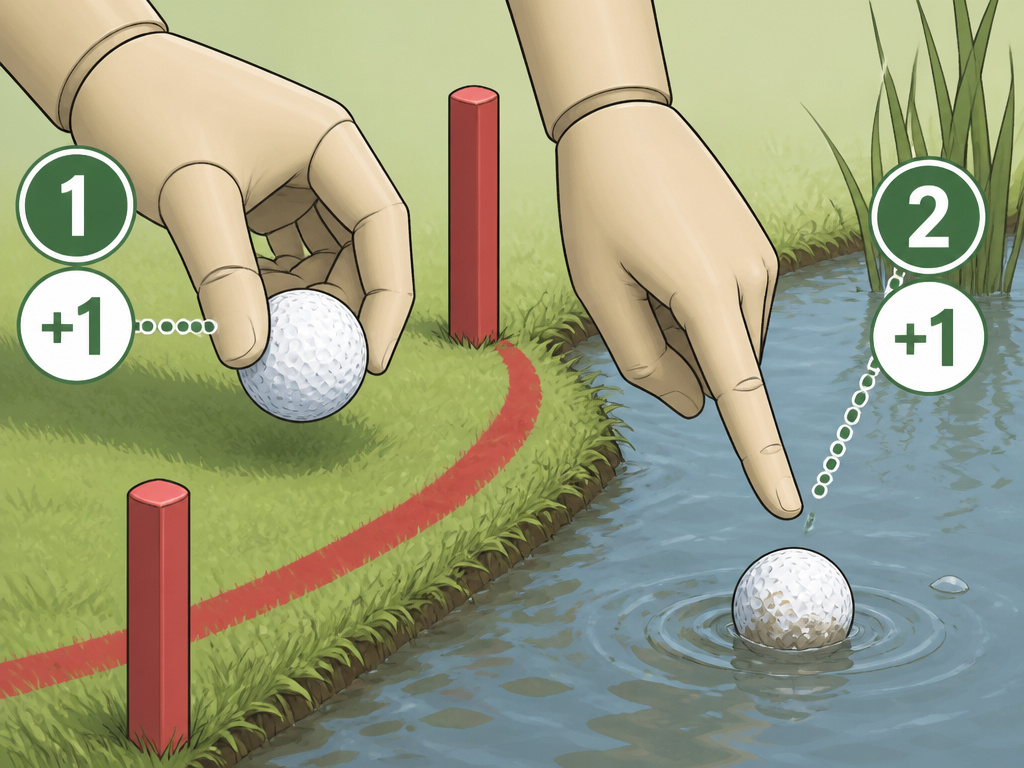
This is where casual rounds fall apart. The rules allow you to change your mind, but the meter keeps running.
Say you hit into a red penalty area. You take stroke-and-distance relief, dropping a new ball inside the penalty area as your option. You then walk up and realize the lie is still terrible, submerged in water. You can now take further relief outside the penalty area using back-on-the-line or lateral relief.
Where this goes sideways: Taking further relief after stroke-and-distance in a penalty area. If a player drops a ball in the penalty area and then decides not to play it, they can take relief outside. This incurs one more penalty stroke, for a total of two penalty strokes.
You started with one penalty stroke for the initial relief. Adding the second relief option tacks on another. You’re now hitting your fourth shot from the fairway.
The same logic applies if your ball, played from a penalty area, lands in the same or another penalty area. You can play it, or take relief again for another penalty stroke.
The fix is simple. If your ball is in a penalty area and you don’t want to play it, take your one-stroke relief directly to a spot outside the hazard. Don’t use the penalty area as a stepping stone. That intermediate drop is a stroke trap.
No Free Lunch: What You Can’t Do in a Penalty Area

This is a non-negotiable rule. When your ball lies in a penalty area, the normal free relief rules vanish.
Rule 17.3 is explicit: there is no relief under other rules for a ball in a penalty area. That means: * No free relief from an abnormal course condition (like ground under repair or an immovable obstruction). * No free relief for an embedded ball. * You cannot declare your ball unplayable under Rule 19.
Your only options are to play it or use the one-stroke penalty relief under Rule 17. This includes a no play zone within a penalty area. If your ball is in a no play zone (like an environmentally protected area marked within the hazard), you must take penalty relief. You cannot play it at all.
It’s a locked room. The only key is that one penalty stroke.
Lost Balls and Out of Bounds: The Stroke-and-Distance Standard
This penalty feels brutal because it costs both a stroke and all your distance. A lost ball (not found within three minutes) or a ball out of bounds (OB) requires you to return to the spot of your previous stroke and play again.
This is stroke-and-distance relief under Rule 18. It costs one penalty stroke.
So, if you hit your tee shot OB, your next shot is your third: one for the original stroke, one penalty stroke, and you’re hitting again from the tee.
The official USGA Rule 18 interpretations clarify that even if water in a penalty area carries your ball out of bounds, stroke-and-distance is still the rule. Water is a natural force, not an outside influence.
The smart play here is the provisional ball. If you think your ball may be lost or OB, announce and hit a provisional before you go forward. If your original is indeed gone, you play the provisional under penalty of stroke-and-distance, saving a long walk back.
| Situation | Rule | Penalty | Relief Procedure |
|---|---|---|---|
| Ball in Penalty Area | Rule 17 | One Stroke | Play as lies, or take back-on-the-line/lateral/stroke-and-distance relief. |
| Ball Lost (General Area) | Rule 18 | One Stroke | Stroke-and-distance: return to previous spot. |
| Ball Out of Bounds | Rule 18 | One Stroke | Stroke-and-distance: return to previous spot. |
| Ball Unplayable (General Area) | Rule 19 | One Stroke | Three options: stroke-and-distance, back-on-the-line, or lateral relief (two club-lengths). |
Notice the pattern? Moving your ball from a bad spot to a playable one almost always costs a single stroke. The difference is in the procedure.
The General Penalty: Two Strokes and How to Avoid It
The one-stroke penalty is a fee. The general penalty (two strokes) is a fine. You get it for breaking a rule where you might gain a significant advantage.
The most common way to earn it is by playing from a wrong place. This doesn’t mean being in the rough instead of the fairway. It means taking relief incorrectly and then making a stroke.
Example: You take back-on-the-line relief from a penalty area. The rule says you must drop on the line. You drop a foot to the side of the line because the ground looks better. If you play that ball, you’ve played from a wrong place. That’s a two-stroke penalty.
The rule is strict to prevent players from manufacturing a good lie. The relief area is the relief area.
Other common general penalty offenses include: * Improving your lie, line of play, or area of intended stance (e.g., breaking a branch in your backswing). * Touching sand in a bunker with your club before the stroke when testing the condition or grounding the club. * Playing a wrong ball (except in a hazard).
Easy to miss: The penalty for accidentally moving your ball during a search was removed in the 2019 rule change. You now replace it with no penalty. Getting this wrong and assuming a one-stroke penalty is how players give away strokes they don’t owe.
The way to avoid the general penalty is precision. Know your reference points, measure your club-lengths, and drop in the right area. When in doubt, take the more conservative relief option.
Frequently Asked Questions
What’s the difference between a one-stroke and a two-stroke penalty?
One-stroke penalty is the specific cost for using a relief rule, like getting out of a penalty area or replaying a lost ball. A two-stroke penalty (general penalty) is for breaking other rules, like playing from a spot you’re not allowed to, which could give you an unfair advantage.
Do you get a free drop from a penalty area?
No. There is no free relief from anything when your ball is in a penalty area. Your only options are to play it as it lies or take one penalty stroke for relief under Rule 17. This includes no relief for embedded balls or immovable obstructions.
Is a lost ball a one-stroke or two-stroke penalty?
Lost ball is a one-stroke penalty, but it is combined with stroke-and-distance. You add one penalty stroke and must return to play from your previous spot. So, if your tee shot is lost, your next shot from the tee is your third shot.
What happens if my ball crosses a red stake and then goes out of bounds?
If any part of your ball is outside the penalty area boundary and out of bounds, the OB rule takes precedence. You must take stroke-and-distance relief (one penalty stroke) under Rule 18, not penalty area relief. The water or hazard is irrelevant once the ball is OB.
Can I declare my ball unplayable in a penalty area?
No. Rule 19 (Unplayable Ball) does not apply when your ball is in a penalty area. Your only choices are to play it or take penalty relief under Rule 17 for one stroke. You cannot use the unplayable ball relief options inside a hazard.
The Bottom Line
Penalty strokes aren’t a mystery. A one-stroke penalty is your tool for escaping trouble—pay the stroke, take your relief, and move on. The two-stroke penalty is what you get for misusing that tool or breaking other fundamental rules.
Memorize this: penalty area relief is one stroke. Lost ball or OB is one stroke plus the walk back. Anything involving playing from the wrong spot is likely two strokes. Get the reference point right, drop in the correct area, and that one-stroke cost is just part of the game. It’s the price of a second chance.
