
Understanding the Provisional Ball Rule in Golf Explained
This post contains affiliate links. As an Amazon Associate, we earn from qualifying purchases.
This post contains affiliate links. As an Amazon Associate, we earn from qualifying purchases.
The provisional ball rule (Rule 18.3) lets you play a second ball from your previous spot if your original might be lost outside a penalty area or be out of bounds. You must announce “provisional” before hitting it. This saves the walk back if the original is lost or OB, but if you find the original in bounds within three minutes, you abandon the provisional with no penalty.
That “might be lost outside a penalty area” clause is the whole game. It’s not a blanket do-over for any bad shot. The rule exists for one reason: pace of play. Walking forward 250 yards, searching for three minutes, confirming the ball is gone, and walking 250 yards back is a round-killer for everyone behind you.
What follows is a breakdown of the three conditions that allow a provisional, the three-word announcement you cannot skip, and the two specific moments when that second ball becomes your only option, along with the penalty you’ve just accepted.
Key Takeaways
- You can only play a provisional if your ball might be lost in the general area (rough, bushes) or be out of bounds. If it might only be in a red or yellow penalty area, you cannot.
- The announcement is non-negotiable. Say “provisional” or reference Rule 18.3 before you swing. “I’ll reload” doesn’t cut it and costs you the original ball.
- A provisional becomes your ball in play under stroke and distance (adding one penalty stroke) if the original is lost/OB, or if you play the provisional from a spot nearer to the hole than where the original is estimated to be.
- You have three minutes to search for your original ball. Finding it in bounds means you pick up the provisional and play on.
- If your original is found in a penalty area, you must abandon the provisional and use the penalty area relief options under Rule 17.
When Can You Play a Provisional Ball?
The rule gives you permission under one specific condition: uncertainty about a ball being lost outside a penalty area or out of bounds. This is a narrow lane. If you know your ball is in a penalty area, or if it’s the only possible place it could be, a provisional is off the table.
Common mistake: Hitting a “provisional” for a ball you saw splash. If the only place the ball can be is that water hazard, your second shot from the tee is not a provisional, it’s your ball in play under stroke and distance. You’ve just taken a penalty without the option to find and play the original.
The R&A rule on when a provisional is allowed draws this line clearly. Use this checklist before you tee up another ball:
- Is it possibly lost in the general area? Think thick rough, fescue, woods, or deep leaves where a ball can hide.
- Is it possibly out of bounds? Did it head toward a white-staked fence, a road, or private property?
- Is a penalty area the ONLY possible location? If you watched it clearly splash into a pond, or it’s impossible for it to be anywhere but that creek, the answer is no.
This distinction matters because the out of bounds rule and the lost ball rule both mandate a stroke-and-distance penalty. The provisional is a time-saver for those two outcomes. Penalty areas (Rule 17) offer different relief options, like dropping from where the ball last crossed the margin.
The Announcement That Actually Counts
This is where most weekend players get it wrong. Your intention must be verbalized, and the wording is specific. According to the rules, you must announce you are playing a “provisional ball” or otherwise clearly indicate it’s under Rule 18.3.
Statements like “I’m hitting another” or “I’ll reload” are legally insufficient. If you say that and hit, that second ball is now your ball in play under penalty of stroke and distance. Your original ball is dead, even if you find it sitting pretty in the fairway five seconds later.
Where this goes sideways: Mumbling “provisional” to yourself doesn’t count. The announcement must be made to an opponent, fellow competitor, or even your caddie, someone can corroborate it. If no one is nearby, play the shot and inform the first person you can.
The rule is strict for a reason. It prevents ambiguity and stops players from getting two looks at a shot from the same spot and then picking the better outcome. You declare your intent, then you live with the consequences of both balls.
How to Play a Provisional: The Step-by-Step Order
Once you’ve confirmed the situation and made the proper announcement, follow this sequence. Getting the order wrong can change the status of your balls.
- Announce clearly. Say “I’m playing a provisional ball” or “Provisional under Rule 18.3” before you address the ball.
- Play from the previous spot. You must hit from exactly where you played your last stroke. For a lost tee shot, that’s the teeing area.
- Play the provisional until you reach the area. You can keep hitting your provisional until you reach the place where your original ball is likely to be. If you duff it only 50 yards, you can hit it again.
- Search for up to three minutes. Once at the area, you and your partners have three minutes to find the original ball. The clock starts when you begin searching.
- Decide the outcome. What you find (or don’t find) determines your next move.
| What You Find | What Happens to Provisional Ball | Your Next Play |
|---|---|---|
| Original ball is found in bounds within 3 minutes. | Abandoned. Pick it up. | Play the original ball from where it lies. |
| Original ball is not found within 3 minutes (lost). | Becomes ball in play. | Continue with provisional, adding a stroke and distance penalty. |
| Original ball is found in a penalty area. | Abandoned. Pick it up. | Proceed under Rule 17 (penalty area rules) with the original ball. |
| Original ball is found out of bounds. | Becomes ball in play. | Continue with provisional, adding a stroke and distance penalty. |
When Your Provisional Becomes the Ball in Play
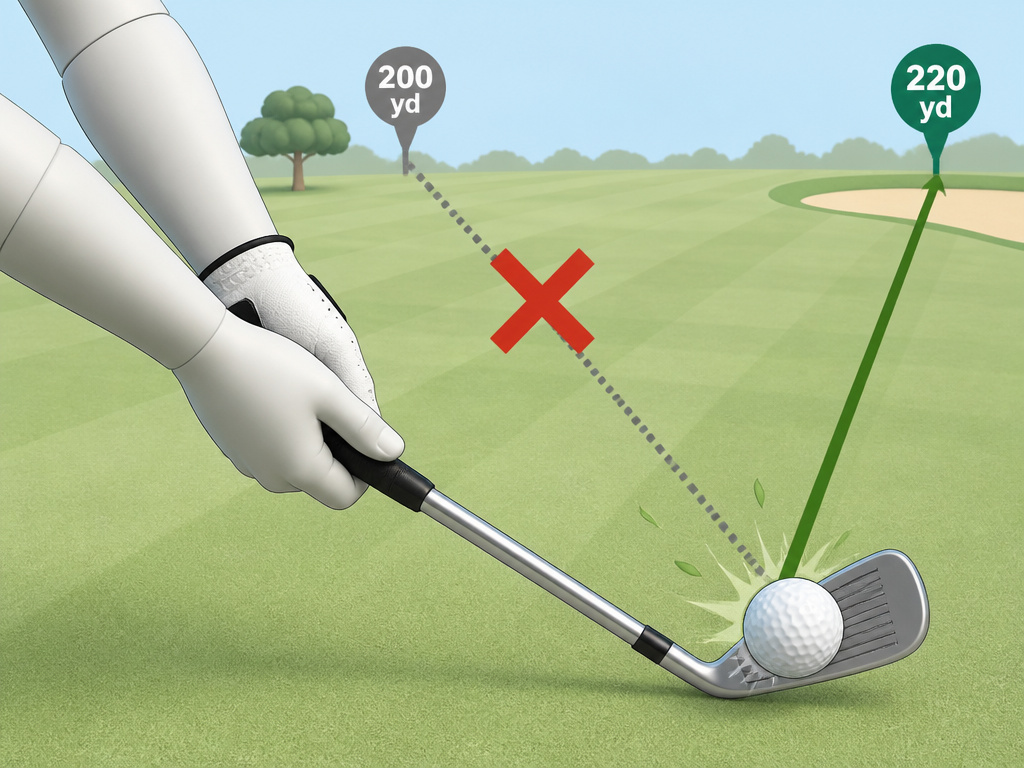
The provisional shifts from being a “maybe” to being your official ball under two scenarios. The first is obvious: the original is lost or OB. The second is a sneaky trap that catches even experienced players.
The R&A rule on provisional becoming ball in play states it clearly: if you play your provisional ball from a spot nearer to the hole than where your original ball is estimated to be, the provisional immediately becomes your ball in play under penalty of stroke and distance.
Imagine your original is estimated to be 200 yards out, near some trees. You hit a provisional that sails 220 yards down the fairway, past that tree line. If you now play that provisional from its new spot (which is nearer the hole than your original’s estimated location), it’s no longer a provisional. You’ve just taken stroke and distance.
This rule prevents you from using a provisional to effectively get a free, better-positioned shot. You must always be conscious of relative distance to the hole.
What You Absolutely Cannot Do
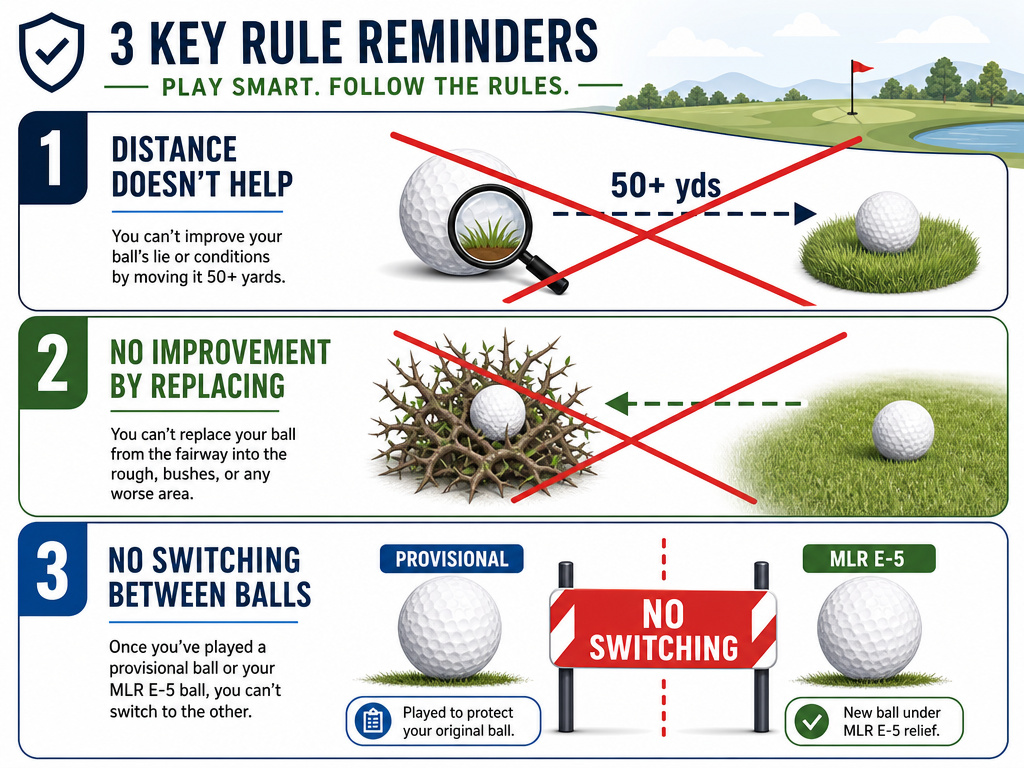
The provisional ball rule has hard boundaries. Cross them, and you’re looking at penalty strokes for playing a wrong ball or taking incorrect relief.
- You cannot play a provisional after searching. If you walk forward, typically more than 50 yards, to look for your ball, you forfeit the right to go back and hit a provisional. Your only options are to find it or declare it lost and proceed under stroke and distance.
- You cannot use a provisional if you find your original but declare it unplayable. If you find your ball in bounds but in a bush, you cannot opt for your nicely placed provisional. You must deal with the original under the unplayable lie rule.
- You cannot use the “Alternative to Stroke and Distance” local rule if you hit a provisional. This local rule (Model Local Rule E-5) allows a two-stroke drop in the fairway for a lost or OB ball. If you’ve hit a provisional, you’re locked into that procedure. You can’t switch to the local rule later.
These limits reinforce that a provisional is a procedural shortcut for one specific rules outcome, not a strategic mulligan. It’s a core part of golf etiquette to apply it correctly and keep pace.
Provisional vs. Other Rules: A Quick Guide
It’s easy to confuse a provisional with relief from other situations. Here’s how to keep them straight.
| Situation | Correct Rule | Key Difference from Provisional |
|---|---|---|
| Ball in a red or yellow penalty area. | Rule 17 (Penalty Areas) | Relief options include dropping from where the ball last crossed the margin. No need to go back. |
| Ball embedded in its own pitch mark in the general area. | Rule 16.3 (Embedded Ball) | Free relief. Take a drop near where it’s embedded. The embedded ball rule is separate. |
| Ball in ground under repair (GUR). | Rule 16.1 (Abnormal Course Conditions) | Free relief. The ground under repair rule grants relief without penalty. |
| Ball is found but you decide not to play it. | Rule 19 (Unplayable Ball) | You take relief with a one-stroke penalty, but you don’t lose distance by going back to your previous spot. |
Tips for Using a Provisional Effectively
A provisional should be a routine part of your game when doubt exists. These habits make it seamless and mistake-proof.
- Use a different ball. Mark your provisional with a distinct number, brand, or personalized golf ball stamps. If both balls end up in the same area, you must be able to identify which is which. Proper marking your golf ball is essential.
- Announce first, then play. Don’t even tee the ball up until you’ve said the words. Make it a ritual.
- Know your local rules. Confirm with your committee or playing group if the Alternative to Stroke and Distance local rule is in effect. If it is, you have a strategic choice: hit a provisional (one penalty stroke, but risk a bad shot) or use the local rule later (two penalty strokes, but a guaranteed fairway drop).
- Search smartly. Use your three minutes. If you’re struggling, a pair of ball finding glasses can help locate a ball in deep rough, preserving your right to play it.
Bottom line: The provisional is a tool for pace and penalty management, not a get-out-of-jail-free card. Use it when the conditions are right, announce it perfectly, and understand the moment it commits you to a penalty stroke.
Frequently Asked Questions
Can you play a provisional from the fairway?
Yes. The rule applies anywhere on the course. If your second shot from the fairway might be lost or OB, you can announce and play a provisional from that spot in the fairway. The same rules apply.
What if my provisional ball goes out of bounds?
You can play a second provisional ball for your first provisional. Announce it again. The strokes add up quickly: your first shot (original) is stroke 1, the penalty for the lost original is stroke 2, your first provisional shot is stroke 3, the penalty for that ball being OB is stroke 4, and your second provisional shot is stroke 5. This is why hitting a provisional is sometimes riskier than using a local rule.
Do I have to look for my original ball?
The rules don’t force you to search, but it’s almost always in your interest. If you don’t look, your original is deemed lost and your provisional is in play with a penalty. If there’s any chance your original is playable, a quick search is worth it. Remember the fundamental principle to play it as it lies if you can.
Can my partner look for my ball while I go back to hit a provisional?
No. Once you or your partner go forward to search, generally past the 50-yard mark, you cannot return to play a provisional. The provisional must be played before anyone goes forward to search.
Is a provisional ball the same as a “breakfast ball”?
No. A “breakfast ball” is a casual, non-rule practice of taking a second tee shot on the first hole without penalty. It’s not recognized in the rules. A provisional is a specific rules procedure with strict requirements and consequences.
Before You Go
The provisional ball rule is one of the best pace-of-play tools in golf. Use it when you have genuine doubt about a ball being lost outside a penalty area or OB. Announce it with the word “provisional,” play it from your previous spot, and remember the three-minute search clock. If you find your original in bounds, you get a reprieve. If not, you’ve saved everyone the long walk back. Keep a distinct ball for provisionals in your bag, and when in doubt, declare it. It keeps the game moving and your scorecard honest. For the definitive source, always consult the USGA rules hub on provisional balls.
