
Master Golf’s Teeing Area Rules & Avoid Penalty Strokes
This post contains affiliate links. As an Amazon Associate, we earn from qualifying purchases.
The teeing area rules in golf define a two-club-length deep rectangle behind the tee markers. You must start each hole from inside this rectangle, but you can stand outside it. Playing a stroke from outside this area in stroke play costs two penalty strokes and you must replay from the correct spot. In match play, your opponent can make you replay the shot with no penalty to you.
That rectangle is the only place on the course where you get to improve your lie before you even swing. You can tee the ball up, build a mound of dirt, or break off attached grass. The rules give you that freedom.
What follows is a breakdown of where that rectangle actually is, what you can and cannot do inside it, and the exact penalties for getting it wrong. We’ll cover the difference between stroke and match play, what happens if your ball comes back, and why moving a tee marker is a two-stroke mistake.
Key Takeaways
- The teeing area is a two-club-length deep rectangle defined by the outside front edges of the tee markers. You can use any club except your putter to measure it.
- In stroke play, playing from outside the teeing area gets you a two-stroke penalty and you must replay from the correct spot. Fail to correct it before the next tee and you’re disqualified.
- In match play, there’s no penalty for playing outside the area, but your opponent can cancel your stroke and make you hit again from the correct spot.
- Within the teeing area, you can improve your conditions: tee the ball, alter the ground, break grass, or remove dew. You cannot improve conditions outside the rectangle that affect your stroke.
- If your ball falls off the tee or is accidentally moved before your stroke, you can re-tee it with no penalty. If your shot hits something and comes back into the teeing area, you can also re-tee it.
What Exactly Is the Teeing Area?
Look at the tee box. You see two markers. The teeing area is not the entire box of short grass. It is a specific rectangle that is two club-lengths deep, measured from the front and outside edge of those two markers. The width is the distance between the markers themselves.
You can use any club in your bag to measure those two lengths, except your putter. Most players use their driver. This rectangle extends backward, not forward. If your ball is even a fraction of an inch in front of the imaginary line connecting the front of the markers, you are outside the teeing area.
The teeing area is defined as the rectangle two club-lengths deep from the front outside edges of the tee markers. A player may use any club except a putter to measure this distance. The ball must be played from within this rectangle to start the hole correctly.
This definition is your first piece of golf rules literacy. Getting it wrong changes everything that follows on that hole. The rectangle is a fixed space for that round—moving the markers to create a better angle is a violation with its own penalty.
Where you place your feet is a different story. Your feet can be outside the rectangle. You can stand in the long grass, in a bunker if one is nearby, or on the other side of the markers. Only the ball must start within the defined space.
Your Rights Within the Rectangle
This is the most permissive spot on the golf course. The rules allow you to create a perfect lie before your first shot. You are not required to play the ball as it lies when you are still in the teeing area.
You can tee the ball on a manufactured tee. A conforming tee must be no longer than four inches. You can also place the ball directly on the ground. If you want to get creative, you can build a little mound of sand or soil and balance the ball on it. You can bend or break grass, weeds, or other natural objects that are attached to the ground within the rectangle. You can remove dew, frost, or water.
The key limit is that your improvements must stay inside the teeing area. You cannot break a tree branch that is outside the rectangle just because it’s in your swing path. That branch is now part of the general area and is protected.
| Allowed Inside Teeing Area | Not Allowed (Improves Conditions Outside) |
|---|---|
| Tee the ball (on a peg or natural material) | Breaking a branch outside the rectangle |
| Pressing down or removing soil | Moving a loose impediment outside the rectangle to clear swing path |
| Bending/breaking attached grass | Creating a stance platform that extends outside the rectangle |
| Removing dew, frost, water | Kicking down a clump of grass outside the rectangle |
This freedom ends the moment your ball leaves the teeing area. Your next shot will be played from the general area, a penalty area, a bunker, or the putting green, where the rules tighten significantly.
Playing from Outside the Teeing Area: The Cost
This is where form of play changes everything. The penalty for playing from outside the teeing area is one of the clearest differences between stroke play and match play in the entire rule book.
In stroke play, it’s a hard penalty. If you play a stroke from outside the teeing area, you get the general penalty: two strokes. But that’s not all. You must correct your mistake. You must play a ball from inside the correct teeing area. The stroke you made from outside and any subsequent strokes before you correct the error do not count.
Where this goes sideways: Not correcting the error before teeing off on the next hole. If you play from outside the teeing area on hole 4 and don’t realize it until hole 6, you are disqualified. The correction must happen before you start the next hole.
In match play, there is no penalty. However, your opponent has the option to cancel your stroke. They can say, “That didn’t count, replay it from the correct spot.” If they cancel it, you must play a ball from inside the teeing area. If they don’t cancel it, the ball is in play as it lies, even if it’s in a terrible spot. This strategic element is pure match play.
The mistake is easy to make. You might be playing from a different set of markers than your group, or you might not realize your ball is just ahead of the line. It’s your responsibility to check.
Common Teeing Area Scenarios and Rulings
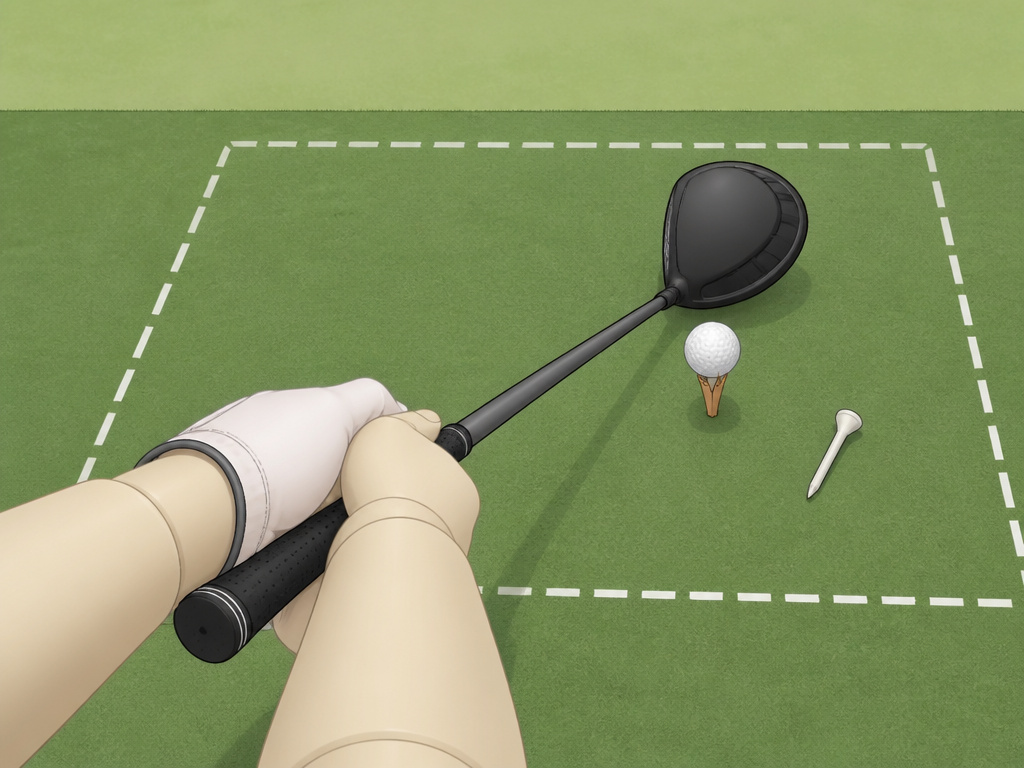
Golf doesn’t happen in a vacuum. Balls get knocked off tees. Shots ricochet back. Here’s how the rules handle the messy reality.
Ball Falls Off the Tee Before the Stroke
You address the ball and it tumbles off the peg. No penalty. You may re-tee the ball anywhere within the teeing area. You can even move to a different spot within the rectangle. This is true even if you accidentally whiff and knock the ball off with your club before making a stroke.
Ball Returns to the Teeing Area After a Stroke
You hit a low liner that smacks the forward tee marker and bounces back behind you, still within the teeing area rectangle. This is a lucky break. You may lift that ball and re-tee it anywhere within the teeing area, with no penalty. You are not required to play it as it lies in the divot it just created. This is a specific allowance under Rule 6.2b(6).
Using a Borrowed or Broken Tee
You break your last tee. Can you use one left behind by a previous group? Yes. The rule on tee length (max four inches) applies to the tee you use, not one you find. A broken tee is legal as long as the remaining portion is not longer than four inches. You can also use a tee you find outside the teeing area.
Moving Tee-Markers
Tee-markers are fixed objects. You cannot move them because they are in your way or because you want a better angle. Doing so to gain an advantage will get you the general penalty (two strokes in stroke play). The only exception is that you may lift a marker if your ball is at rest outside the teeing area and the marker interferes with your stance or swing for your next shot.
Teeing Area Rules vs. Other Critical Rules
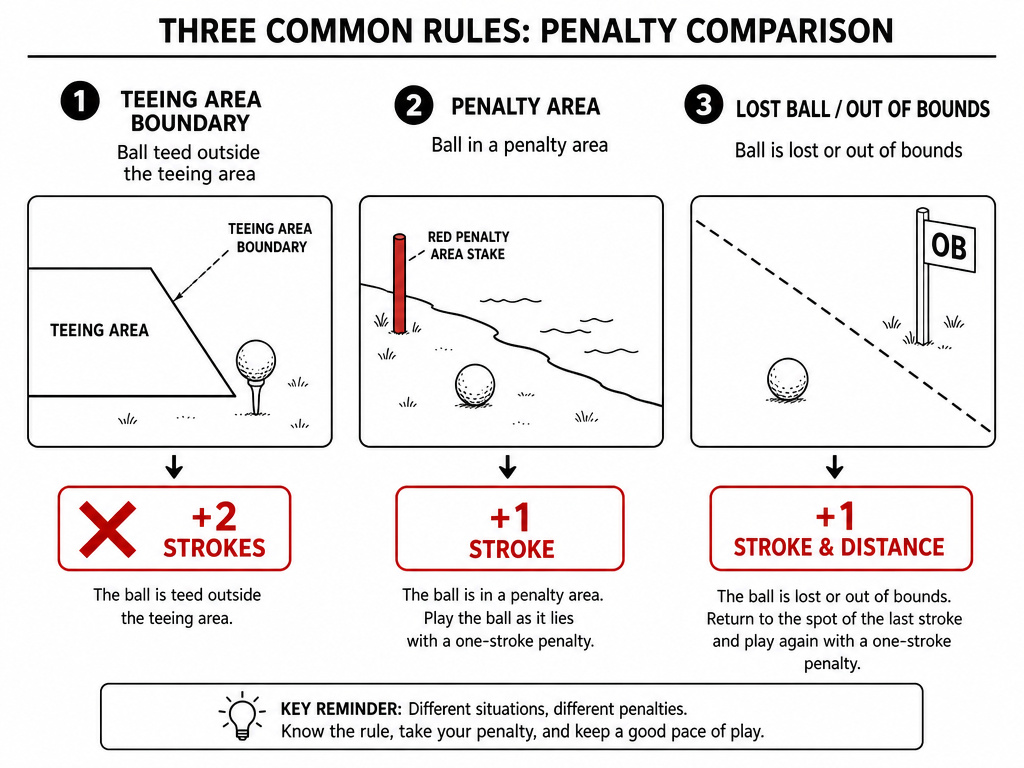
Understanding the teeing area is a foundation. It connects directly to other major rules you’ll encounter.
The penalty for playing outside the teeing area is a penalty stroke addition, similar to the one-stroke penalty for taking relief from a penalty area. However, the procedures are different. Getting relief from a red or yellow penalty area involves specific reference points and dropping zones. The teeing area mistake is simpler: go back and do it right.
It also differs from the lost ball or out of bounds rule. Those are stroke-and-distance penalties (one stroke plus distance). You go back to where you last played. With a teeing area violation in stroke play, you also go back, but you add two strokes, not one. And you must go back to the correct teeing area, not necessarily where you just played from.
This is why a solid grasp of the basic rules pays off. It helps you navigate the course correctly and avoid compounding errors. Knowing you have free relief from ground under repair but only penalty relief from a red stake starts with knowing where your hole legally begins.
Frequently Asked Questions
Do both feet have to be in the teeing area?
No. Only the ball must be within the two-club-length deep rectangle when you make your stroke. You can stand anywhere, even outside the tee box entirely, as long as you don’t improve your conditions outside the teeing area (like building a stance platform in a bush).
Can I move the tee markers if they are in my way?
No. Tee-markers are fixed objects. You cannot move them to gain an advantage for your tee shot. If you do, it’s a two-stroke penalty in stroke play. You may only move a marker if your ball is already outside the teeing area and the marker interferes with your stance or swing for your next shot.
What if I play from the wrong tee box entirely?
This is a specific case of playing from outside the correct teeing area. The penalty is the same: two strokes in stroke play and you must replay from the correct tee box. If you’re playing a competition from the blue markers and you tee off from the white markers, you’ve violated this rule.
Is there a maximum height I can tee my ball?
The rules do not specify a maximum tee height. The only limit is that the tee itself cannot be longer than four inches. You can tee the ball as high as the top of that four-inch tee allows. How high you tee it is a matter of personal strategy and club selection.
Can I clean my ball on the tee?
Yes. Before your first stroke on a hole, you may lift, clean, and place your ball on a tee or on the ground within the teeing area. This is another right you have only in this specific rectangle.
The Bottom Line
The teeing area is a defined sanctuary. It gives you control over your lie before the chaos of the hole begins. Use that two-club-length rectangle correctly.
Measure from the front outside edges of the markers. Keep your ball inside that space. Know that a mistake in stroke play is a two-stroke penalty with a mandatory do-over, while in match play it’s a strategic decision for your opponent.
Remember the freedoms: tee it, build it, clean it. And remember the limits: your improvements stop at the edge of the rectangle. This rule, like all fundamental golf etiquette, is about fairness and maintaining the challenge of the course as you find it. Get this first step right, and you’re playing by the book from the opening shot.
