
Your Guide to the Armlock Putter Explained & How It Works
This post contains affiliate links. As an Amazon Associate, we earn from qualifying purchases.
This post contains affiliate links. As an Amazon Associate, we earn from qualifying purchases.
An armlock putter is a longer putter (typically 39-42 inches) designed to be braced against the lead forearm, creating a single unit from elbow to clubhead to eliminate wrist hinge. It is legal under USGA rules, reduces putter face rotation by up to 50%, and requires specific equipment adjustments, notably higher static loft (5-8 degrees) and a specialized long grip, to compensate for the inherent forward shaft lean of the setup.
That reduction in face rotation is measured. Dr.Paul Hurrion’s Quintic Ball Roll research put a number on it: a standard putting stroke shows a face rotation closer rate of -44°/sec. A standard armlock setup drops that to between -31 and -24°/sec. The EvnRoll Midlock grip pushes it down to -22°/sec. That’s a 50% cut. For a player whose miss is a handsy flick on short putts, that number changes everything.
What follows is a breakdown of the mechanics, the mandatory specs, and the real-world trade-offs. We’ll cover why you can’t just lengthen your current gamer, how tour pros like Matt Kuchar and Webb Simpson use it, and the one setup mistake that sends the ball hopping across the green every time.
Key Takeaways
- Armlock putting is explicitly legal under USGA Rule 14-1b because the grip contacts the forearm of the gripping hand, not an independent anchor point on the body.
- The technique can reduce putter face rotation by up to 50%, transforming a wrist‑hinge stroke into a shoulder‑rocking pendulum.
- You must use a dedicated armlock putter with higher static loft (5‑8 degrees) and a longer shaft (39‑42 inches). Converting a standard 35‑inch putter fails because the dynamic loft plummets, causing skidding putts.
- Two distinct equipment philosophies exist: traditional armlock putters require forward press and high loft, while systems like the Arm‑Lock Golf AL Series grips are designed to be held nearly vertical, claiming to auto‑correct the loft.
- The primary trade‑off is potential loss of feel on long lag putts in exchange for robotic stability on short‑range putts and in pressure situations.
How an Armlock Putter Actually Works (The Mechanics)
A conventional putter swings like a hinge on your wrists. Even a quiet stroke has micro‑hinges, and under pressure, those hinges can become violent. The armlock method changes the pivot point. By bracing the shaft against your lead forearm, you physically cannot hinge your lead wrist. The stroke’s lever moves from your hands to your shoulders.
The arm lock (AL) putting style has the putter remaining “locked” to the golfer’s lead forearm throughout the entire putting stroke. This reduced the movement (distance travelled) of the pivot point when using AL method. – Quintic Ball Roll Research Paper
This focuses on narrowing the window of error at impact. When the clubface can only rotate within a range of, say, -22 to -24 degrees per second instead of -44, it presents a squarer face to the ball more consistently.The result is better starting line consistency, which is everything inside ten feet.
Why it quiets the hands: The grip isn’t just resting against the forearm; your trail hand applies pressure to the butt of the grip, pinning it in place. This creates a bracing effect. Your hands become clamps, not actuators. The stroke is driven by a shoulder turn around a steady spine, which is a larger, more repeatable motor pattern for most golfers.
This mechanical shift has a direct, measurable impact on your putter loft and lie at impact, which is why the equipment specs are non‑negotiable.
The Armlock Putter Specs That Matter (It’s Not Just Longer)
You cannot Frankenstein an armlock putter from your current gamer. This is the most common failed experiment. Taking a 35‑inch putter with 3 degrees of loft and gripping down to lock it creates two immediate problems: the length forces a hunched posture, and the forward shaft lean delofts the face into negative territory. The ball gets driven into the turf and hops.
A real armlock putter is built from the ground up to match the geometry of the stroke. Three specs are critical.
1. Length (39‑42 inches): This isn’t a random range. The butt of the grip should sit 2‑3 inches above the crook of your lead elbow when you’re in your natural, athletic putting posture. For an average‑height male, that’s usually 40‑42 inches. For a taller player, it might be 42‑44. The goal is a straight line from your elbow to the putter head. A proper putter length fitting is essential here; an inch too long and the grip pokes your bicep, an inch too short and you lose contact.
2. Static Loft (5‑8 degrees): Because the shaft is leaned forward in the setup, the dynamic loft at impact is reduced by about four degrees. A standard putter at 3 degrees of loft would deliver about -1 degree at impact in an armlock setup, you’re hitting down on the ball. Manufacturers add loft so the delivered loft is back in the optimal 2‑3 degree window for a smooth roll. Brands like Bettinardi and Odyssey ship armlock models in this loft range.
3. The Grip (Long & Flat‑Fronted): A standard pistol or round grip allows rotation. Armlock grips from SuperStroke or Lamkin are 7‑10 inches longer and have a flat front panel. This panel seats squarely against your forearm, preventing the shaft from twisting in your hands. The grip is part of the structure.
| Spec | Conventional Putter | Armlock Putter | What Happens If You Mix Them |
|---|---|---|---|
| Length | 33‑35 inches | 39‑42 inches | Poor posture, grip loses contact with forearm |
| Static Loft | 2‑4 degrees | 5‑8 degrees | Ball skids, hops, never gets on top roll |
| Grip Style | Pistol, Round | Long, Flat‑Fronted | Shaft rotates, brace fails, wrists re‑engage |
| Head Weight | ~350‑360g | ~400‑410g | Counterbalances longer shaft for proper swing weight |
Common mistake: Trying an armlock setup with a conventional‑length putter. The ball will jump off the face for the first few feet, killing your distance control and making you abandon the technique before it ever gets a fair trial.
How to Grip and Stroke an Armlock Putter
The setup dictates everything. Get this wrong, and the equipment won’t save you.
1. The Lock: Grip the putter low with your lead hand so the extended grip runs up the inside of your forearm. The top should not extend past your elbow. Apply firm pressure to seat the flat front of the grip against your forearm. Your trail hand then grasps the grip, often in a conventional or claw style. Webb Simpson uses a claw; Matt Kuchar uses a traditional right‑hand placement.
2. The Posture: Stand slightly closer to the ball than usual so your lead arm can hang naturally, creating that straight elbow‑to‑club line. Your eyes should still be over the ball or just inside it. There will be more forward bend from the hips, this is normal.
3. The Stroke: This is a shoulder‑rock, not a stroke. Think of your lead arm and the putter as a single, rigid unit. There is no back‑swing wrist hinge and no release through impact. The key feel is maintaining the same forward shaft lean you established at address throughout the entire motion. A good drill is to place a headcover under your lead armpit and keep it there; if it drops, you’ve let the arm separate from the body.
The Two‑Philosophy Split: Here’s where it gets interesting. Traditional armlock instruction, for putters like Matt Kuchar’s Bettinardi, emphasizes that forward shaft lean. However, Arm‑Lock Golf Grips (AL Series) states their design accounts for the loft change internally. They advise not to forward press, but to hold the putter nearly vertical. This is a major fork in the road. If you forward press a system designed to be vertical, you’ll deloft it and hit the ground.
Armlock vs. Conventional: Which Stroke Wins for You?
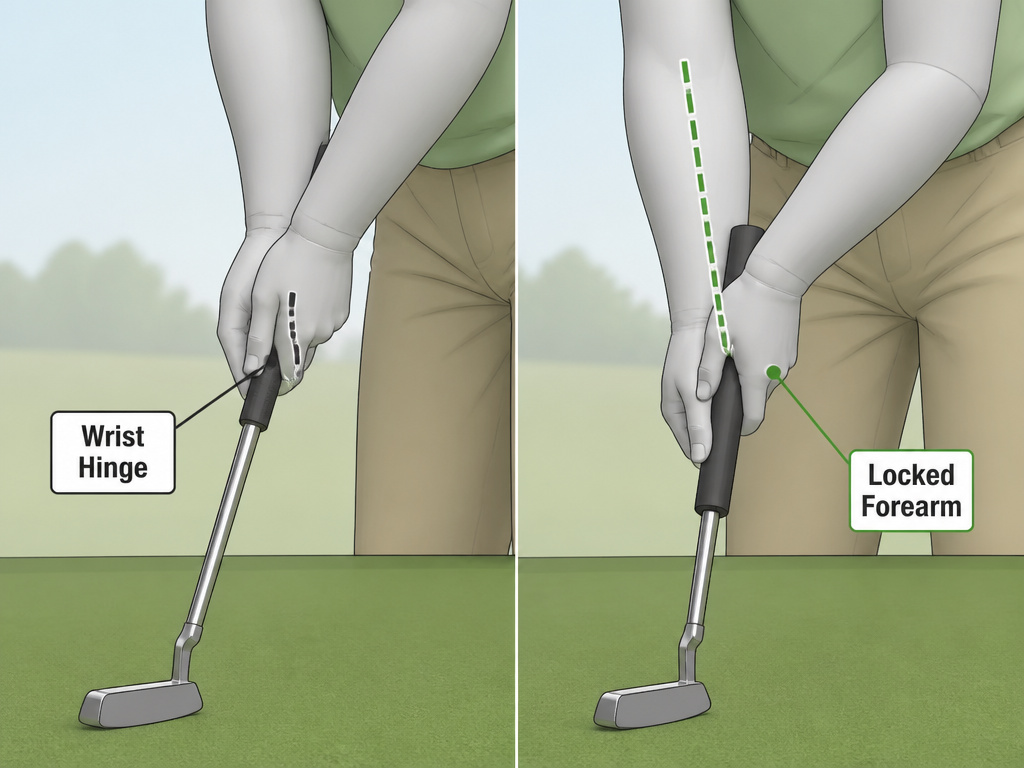
This is a fundamental rewiring of your putting engine. The benefits are stark, but so are the trade‑offs.
Choose Armlock If:
- You fight “handsy” strokes or the yips on short putts.
- You already have a shoulder‑dominant stroke and want to double down on that stability.
- You struggle with consistent face rotation at impact (a putter fitting with launch monitor data can show this).
- Your primary need is automatic stability inside eight feet.
Stick with Conventional If:
- Your strength is feel and distance control on long lag putts (30+ feet).
- You play on wildly undulating greens where you need maximum wrist‑hinge for touch.
- You’re not prepared to invest in a proper fitting and dedicated club. Half measures fail.
The tour data is telling. After the 2016 anchoring ban, players like Webb Simpson (174th in Strokes Gained: Putting) and Bryson DeChambeau adopted armlock. Simpson jumped to 5th within two years. The method gave them a legal, repeatable structure. But note: elite feel players like Jordan Spieth haven’t touched it. The potential loss of touch is real.
Where this goes sideways: Using armlock for a season then switching back and forth with a conventional putter. The motor patterns conflict. Pick one method, commit to it for at least a full season, and learn its nuances.
Frequently Asked Questions
Is an armlock putter legal?
Yes. USGA Rule 14‑1b prohibits anchoring the club directly or creating an “anchor point” against the body. The armlock is legal because the grip is held against the forearm of the hand that is gripping the club, which the rules explicitly permit. It is a brace, not an anchor.
What length armlock putter do I need?
Stand in your natural putting posture with your lead arm hanging relaxed. Measure from the point where the putter head rests on the ground to a spot 2‑3 inches above the crease of your lead elbow. That’s your length. For most men, it’s 40‑42 inches. A putter length and fitting session is the only way to be sure.
Can I use any putter head shape?
Yes, the armlock principle works with both blade and mallet putters. The choice comes down to your preference for alignment aids and feel. Mallet heads are more common because their higher moment of inertia (MOI) complements the stability-focused design. The head’s toe hang balance should still be fit to your stroke arc.
Do I need a special ball position?
Often, yes. Because the shaft is leaned forward, the effective low point of the stroke moves forward. Many players move the ball position slightly forward in their stance (closer to the lead foot) to ensure a slight upward strike, which promotes better topspin.
Why does my armlock putt feel so heavy?
The longer shaft and heavier head (often 400g+) increase the club’s overall swing weight. This is intentional. The extra mass helps stabilize the longer lever during the shoulder‑rock stroke and provides more pendulum‑like momentum. It can feel top‑heavy at first, but that sensation is part of the stability.
Before You Go
An armlock putter is a tool for a specific job: eliminating variables. It trades wrist‑hinge artistry for shoulder‑driven robotics. The payoff is measurable, repeatable stability on the putts that cause the most anxiety.
If you’re considering it, understand the commitment. Buy a dedicated club, get fit for length and loft, and accept the 30‑day learning curve. Don’t try to build one from spare parts. The physics of dynamic loft and shaft torque won’t bend to a DIY project.
For the player haunted by a twitchy short stroke, it’s not a gimmick, it’s a structural solution. Just make sure you’re solving the right problem.
