
Putter Length and Fitting | Why 34 Inches Is Usually Wrong
This post contains affiliate links. As an Amazon Associate, we earn from qualifying purchases.
This post contains affiliate links. As an Amazon Associate, we earn from qualifying purchases.
The correct putter length matches your unique posture, not your height. It’s the distance that lets your arms hang naturally with eyes over the ball, and it’s most accurately found using a wrist-to-floor measurement in your stance. Forget the 34-inch “standard”—fitting data shows the average male golfer fits best between 33.5 and 34 inches, and many players use a putter that’s an inch too long.
That gap between the rack and reality is where strokes disappear. A putter that’s just one inch too long forces your eyes inside the target line and your stroke off its natural path. The compensation feels small at first. By the 15th green, your back is tight and your speed control is gone.
What follows is the breakdown most fitting guides skip: the two ways the industry measures length (and why they disagree), the single at-home test that works, and how a proper lie angle adjustment can make a 35-inch putter feel like a 33. We’ll walk through the specs that actually move the needle.
Key Takeaways
- The USGA minimum putter length is 18 inches, but there is no maximum. The common retail range is 32 to 35 inches.
- Most golfers use a putter that is too long. Off-the-rack “standard” lengths (34″-35″) often mismatch a player’s actual posture and arm length.
- Your true length is determined dynamically by your wrist-to-floor measurement in your putting stance, not by a static height chart.
- Putter lie angle is inextricably linked to length. Changing a putter’s length alters its effective lie angle, requiring a bending adjustment to keep the sole flat.
- A professional putter fitting analyzes length, loft, and lie together using a launch monitor to measure actual impact conditions, which is the only way to optimize all three.
Putter length is measured from the top of the grip along the axis of the shaft to the sole, per USGA rules. However, the industry standard for retail measurement places the sole flat and measures from the heel to the grip top. This methodological difference can create a discrepancy of up to half an inch between a club’s stated length and its rule-measured length.
Why Putter Length Isn’t About Your Height
You see it on every retail chart: a golfer’s height matched to a putter length. Six feet tall equals 35 inches. The logic seems sound, but it ignores how people actually stand to the ball. Your torso length, arm length, and knee flex vary wildly from another person of the same height.
The proof is on tour. The average height of a PGA Tour player is about six feet. The average putter length they use? 33.5 inches. That’s a full 1.5 inches shorter than the retail chart would recommend. They aren’t hunched over. They’ve been fit into a length that gets their eyes directly over the ball and their arms hanging freely, which for an athletic, forward-press stance, is almost always shorter than you’d think.
A putter that’s too long creates a chain of bad mechanics. You stand too upright. Your eyes drift inside the ball. To compensate, you either choke down on the grip—changing the club’s balance and feel—or you bend your elbows, creating tension in your forearms. That tension kills the pendulum stroke. Your backswing gets short and jerky, and distance control becomes a guess.
Common mistake: Choosing length by height alone. A 6’2″ player with long arms and an upright posture might need a 34-inch putter, while a 6’2″ player with a short torso and bent-knee stance might need a 33-inch putter. The static number tells you nothing.
The Odyssey Putter Fitting System, used by fitters worldwide, doesn’t start with a chart. Its first step is a “pre-fit interview” and then having the player address the ball to see where their arms hang. The goal is a repeatable setup where the eyes are over or just inside the ball. The length that gets you there is your length. Everything else is noise.
The Two Ways to Measure a Putter (And Why It Matters)
Before you can find your length, you need to know how length is defined. There are two methods, and they don’t always agree.
The USGA method is the legal standard. As defined in the Equipment Rules, length is measured from the top of the grip down the axis of the shaft (or a straight-line extension of it) to the sole of the club. This is the measurement that matters for conformity.
The industry retail method is what you see on the tag. The putter is placed with its sole flat on a horizontal surface. A ruler is held at the back of the heel, and measurement is taken straight up to the top of the grip. For most putters, this yields a number roughly half an inch longer than the USGA method would produce.
| Measurement Method | How It’s Done | Typical Result for a “34-inch” Putter | Purpose |
|---|---|---|---|
| USGA Rules | Top of grip, down shaft axis, to sole. | ~33.5 inches | Determines club conformity for competition. |
| Industry Retail | Sole flat, ruler at heel, to top of grip. | 34 inches | Standard labeling for consumer purchase. |
Why does this matter? If you order a custom putter at 34 inches, you need to know which standard the builder uses. If you cut down a 35-inch retail putter to 34 inches using the industry method, you might be bringing it closer to a 33.5-inch USGA length. This isn’t a trick—it’s a calibration. Always ask which standard is being used for custom work.
The Wrist-to-Floor Measurement Method
This is the most reliable DIY method to find your baseline length. It measures you in your dynamic putting posture, not standing at attention.
What you need: A tape measure and a golf buddy.
- Assume your natural putting stance. Wear your golf shoes. Hold a club or just get into your athletic address position over a ball marker. Your knees should be flexed, your back straight, and your arms hanging relaxed.
- Have your friend measure. They will measure from the crease of your wrist (where your hand meets your forearm) straight down to the ground.
- Record the number. This wrist-to-floor measurement is your golden number.
That measurement is the starting point. Many fitters then subtract an inch or two to account for the putter head and the natural hand position on the grip. A common rule of thumb: your ideal putter length is roughly your wrist-to-floor measurement minus 1 to 2 inches. A 35-inch wrist-to-floor measurement often points to a 33.5 or 34-inch putter.
Where this goes sideways: Measuring while standing straight up. That gives you your iron fitting measurement, which has no relation to your bent-over putting posture. You must be in your stance.
This method explains why two golfers of the same height need different lengths. One might have a 34-inch wrist-to-floor measurement; the other, with longer arms or a more bent posture, might measure 32 inches. Their putters should be different. This is the core of a dynamic fitting, and it’s why the club fitting process is so valuable for dialing in every club in your bag, especially the one you use the most.
How Lie Angle Changes Everything
Lie angle is the angle between the shaft and the ground when the putter’s sole rests flat. If length is about posture, lie angle is about accuracy. Get it wrong, and the putter head won’t sit properly at address.
Here’s the interaction most golfers miss: length and lie angle are directly connected. When you change a putter’s length, you automatically change its effective lie angle.
- Cutting a putter down makes it more upright. The shorter shaft brings your hands lower, which raises the toe of the putter off the ground if the lie angle isn’t adjusted.
- Extending a putter makes it flatter. The longer shaft lowers the hands, which can lift the heel off the ground.
A putter that doesn’t sit flat will twist on impact. If the toe is up, the face tends to close, pulling putts left (for a right-handed golfer). If the heel is up, the face tends to open, pushing putts right.
Worth knowing before you start: If you cut down your putter, you must have the lie angle bent back to its proper position. Most metal putters, like an Odyssey White Hot, can be bent up to 2 degrees upright or flat by a competent club fitter. This is a non-negotiable follow-up step.
The proper sequence is critical: First, find your correct length using the dynamic method. Second, with the putter at that length, check the lie. The sole should be flush with the ground in your natural stance. If it’s not, that’s when you get it bent. This ensures your putter loft and lie are working in harmony from a correct foundation.
Inside a Professional Putter Fitting
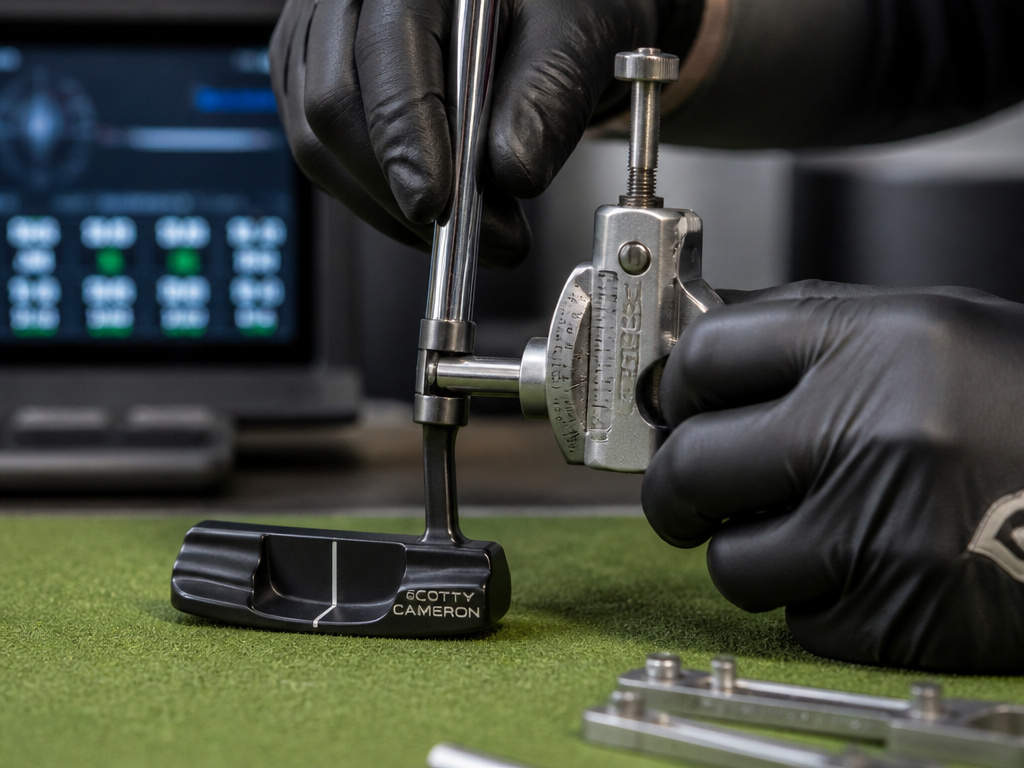
A DIY measurement gets you close. A professional fitting with a launch monitor gets it exact. Here’s what a comprehensive fitting, like the Odyssey system, actually looks at.
The fitter starts by observing your stroke with a putter close to your estimated length. They use impact tape or a launch monitor to answer three questions:
- Are you striking the center of the face? Consistent center-face contact is the primary check for proper length. If you’re hitting toward the heel or toe, length or lie is off.
- What is your dynamic loft at impact? This is the actual loft delivered to the ball, which is a combination of the putter’s static loft and your forward or backward shaft lean. The ideal launch angle for a pure roll is 1 to 2 degrees.
- What is your face angle at impact? This is the biggest determinant of starting direction. The fitter will analyze whether you have a left or right miss bias.
This data informs every other decision. A consistent right miss might lead the fitter toward a more face-balanced mallet. A left miss might suggest a putter with more toe hang. They will also test different head shapes (blade vs. Mallet) and alignment aids to see what you aim best.
The fitter will swap shaft sections to dial in length millimeter by millimeter, then adjust loft and lie based on the monitor’s feedback. It’s a holistic process where each spec influences the others. This is why adjusting one thing in isolation often fails.
Putter Length FAQs
What is the standard putter length?
The common retail “standard” is 34 inches for men and 33 inches for women, measured by the industry heel-to-grip method. However, true fitting standards are personal. The USGA’s only rule is that a putter must be at least 18 inches long; there is no maximum length.
Can a putter be too short?
Yes. A putter that’s too short forces excessive bending from the waist, creating tension in the lower back and shoulders. It also brings your eyes outside the ball, which can distort your perception of the target line. The stroke becomes armsy and disconnected.
How does putter length affect putter head weight?
Changing length alters the club’s swingweight (feel of head weight). Cutting a putter down makes it feel lighter in the head; extending it makes it feel heavier. This can be counteracted by adding weight to the head (via ports or lead tape) or using a heavier grip, which is another variable a good fitter manages.
Should I get fit for a putter before buying?
Absolutely. It is the most-used club in your bag. Many specialty golf shops and club manufacturers offer free basic fittings with a putter purchase. This service lets you test different putter types and head technologies at your correct length and lie, ensuring you buy a club that fits your stroke, not just your eye.
Can I adjust the length of my current putter?
Yes. A club fitter can shorten a putter by cutting the shaft and regripping it, or lengthen it using a shaft extension. As discussed, a length change must be followed by a lie angle adjustment to keep the sole flat. This is a routine and relatively inexpensive alteration.
The Bottom Line
Stop looking for your height on a chart. Your putter length is a function of your posture, not your stature. Grab a tape measure, get into your stance, and find your wrist-to-floor number. That’s your starting line.
If you take one thing from this, let it be this: length and lie are a package deal. Changing one without adjusting the other is like aligning your car’s wheels but ignoring the tire pressure. The job is half done.
For the vast majority of amateur golfers, the move is toward a shorter putter—somewhere between 33 and 34 inches. It promotes better posture, cleaner contact, and a tension-free stroke. Get the length right, flatten the lie, and watch how many more putts start on your intended line. The hole looks bigger from there.
