
Putter Loft and Lie Explained – How They Control Ball Roll
This post contains affiliate links. As an Amazon Associate, we earn from qualifying purchases.
This post contains affiliate links. As an Amazon Associate, we earn from qualifying purchases.
Putter loft and lie angle are the measurable angles that control how the ball starts rolling and whether the putter face is square at impact. Standard loft is 3–4 degrees to lift the ball from its depression in the grass. Standard lie is about 70 degrees, ensuring the sole sits flat. If these specs are wrong for your stroke, the ball bounces, skids, or misses left/right regardless of your read.
Most golfers buy a putter based on look and feel. They never check the two numbers printed on the spec sheet or measured by a fitter. That’s the whole problem. A degree of loft or two of lie might seem trivial next to a driver’s 10.5 degrees, but on a 15-foot putt, that small error is the difference between the ball dying at the hole and lipping out.
The rest of this guide breaks down loft and lie into plain physics. You’ll learn what each spec does, how your own stroke changes them, and the one adjustment that can’t be fixed after purchase.
Key Takeaways
- Loft lifts, it doesn’t launch. Standard putter loft of 3–4 degrees exists solely to get the ball out of its tiny grass depression and onto a smooth roll. More loft is needed for slower greens or putters with significant offset.
- Your hands change the loft. A forward press delofts the putter by the same amount. If you forward press 2 degrees and your putter has 3 degrees of loft, you’re effectively putting with 1 degree, a recipe for a hop and skid.
- Lie angle dictates face angle. If the putter’s lie is too upright, the toe lifts, closing the face and pulling putts left for a right-handed player. Too flat, and the heel lifts, opening the face for a push.
- Length changes lie. Cutting down a putter makes it more upright; adding an extension makes it flatter. Always check lie angle after a length adjustment.
- Toe hang is permanent. Unlike loft and lie, a putter’s toe hang or face balance is built into the head design. It must match your stroke’s arc, and it cannot be adjusted later.
What Putter Loft Actually Does (And Why It’s Not 0)
A putter face looks flat. It isn’t.
Putters have loft, typically between about 2.5 and 4 degrees, and that loft is important. When a golf ball sits on a putting green, its weight creates a tiny depression in the turf. If a putter had no loft, the ball would hop and bounce before it started rolling smoothly because it is sitting down in that tiny depression.
That’s the technical snippet. The loft lifts the ball just enough to get it rolling on top of the grass, not digging into it. Research from the Scotty Cameron Putter Studio pins the ideal number at 3.5 degrees for a smooth roll off a typical green.
But that’s static loft, the angle built into the club. Your stroke delivers dynamic loft.
If your hands are ahead of the ball at impact (a forward press), you subtract loft. Hands behind adds it. The Mitchell Golf Putter Angle Machine manual gives the math: a putter with 5 degrees of loft and a 2-degree forward press delivers an effective 3 degrees at impact. Get this wrong, and the ball either hops or gets scooped.
| Condition | Effect on Loft | Resulting Ball Roll |
|---|---|---|
| Standard (3–4°) | Ball lifts from depression | Smooth, immediate roll |
| Too Little / Delofted | Ball driven into turf | Hop, then skid, inconsistent speed |
| Too Much / Added Loft | Ball launches upward | Scooped feel, skid, poor distance control |
The more offset in the putter the more loft needed. That’s the first guideline from the Mitchell manual. An offset hosel positions the hands ahead, effectively delofting the club. Manufacturers compensate by adding more static loft. Slower greens also demand more loft to help the ball climb out of longer grass.
Where does this leave you? If you naturally forward press, you likely need a putter with 4 degrees of loft or more. If your hands are neutral or behind, a standard 3-degree loft might work. This is why a basic putter fitting session starts with measuring your delivery, not just the club.
The Lie Angle Truth: Your Silent Directional Controller
Lie angle is the angle between the shaft and the ground when the sole rests flat. For putters, it’s usually around 70 degrees. The USGA and R&A’s Equipment Rules dictate that the shaft must diverge from the vertical by at least 10 degrees, preventing a 90-degree “straight up and down” design.
Why does this matter? Lie angle determines whether the putter head sits flat at address. If it doesn’t, the face tilts.
For a right-handed golfer: – Too upright (lie angle > 70°): The toe lifts. The face points left. Putts pull left. – Too flat (lie angle < 70°): The heel lifts. The face points right. Putts push right.
The error is subtle but cumulative. A lie angle just 2 degrees off can cause a 28-foot putt to miss by nearly two inches. You’ll blame your stroke or your read. The real culprit is geometry.
Common mistake: Assuming lie angle is only about height. Your posture, arm length, and how close you stand to the ball are bigger factors. Two golfers the same height can need lie angles 4 degrees apart.
Your putter length directly changes lie. Shortening a putter makes it more upright; lengthening it makes it flatter. If you cut down a 35-inch putter to 33 inches and don’t have the lie adjusted, the toe will be in the air. This is why understanding golf club lie is as important for your putter as it is for your irons.
Most standard putters can be bent. Odyssey states most of its putters can be bent 2 degrees upright or flat. A certified club fitter does this in minutes with a bending bar. But there’s a catch.
When Adjustments Get Complicated (Or Impossible)
Not every putter is bendable. This is the critical fine print most buyers miss.
Zero-torque putters are the main concern. Brands like LAB Golf design them with the shaft axis aligned directly over the center of gravity to eliminate twisting. Bending the hosel to adjust lie can misalign this precise relationship, killing the technology’s benefit. Manufacturers often require you to send these putters back for adjustment.
Graphite shafts don’t bend. They snap. Any putter fitted with a graphite shaft, common in high-end or custom models, cannot be adjusted for lie or loft by traditional means.
Some hosel designs are non-adjustable. If the hosel is a single, thick piece of steel, it’s likely bendable. If it’s a complex, multi-material neck, it might not be. Always check the manufacturer’s specs.
The armlock putter design, with its extreme lie angles and anchored grip, is almost always a custom-order spec. Trying to bend a standard putter into an armlock lie is a good way to break it.
Where this goes sideways: Trying to adjust a zero-torque putter yourself. You’ll spend $30 at a local shop to have it bent, ruin the lie, and then pay the manufacturer $80 plus shipping to fix it. Know your putter’s design before you seek adjustments.
How to Check Your Specs (And What to Do Next)
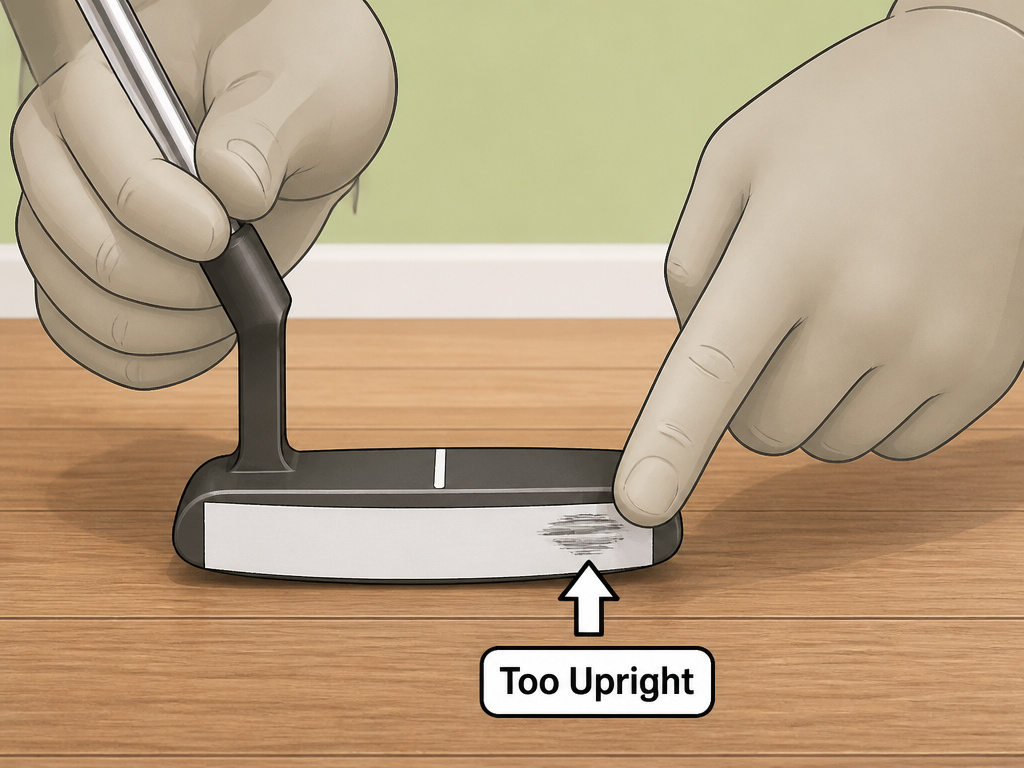
You don’t need a $5,000 fitting studio to diagnose major loft and lie issues. A simple home check can tell you if you’re in the ballpark or need professional help.
-
The Lie Angle Tape Test. Put a 2-inch strip of electrical tape on the sole’s center. Hit ten putts off a firm, clean surface (a hardwood floor or a high-quality putting mat). Check the wear mark on the tape.
- Center wear: Your lie angle is correct.
- Wear toward the toe: Lie is too upright.
- Wear toward the heel: Lie is too flat. Skip this, and you’re guessing. The tape doesn’t lie.
-
The Dynamic Loft Check. Film your putting stroke from the side (down-the-line view). Pause at impact. Draw a line along the shaft. Is it leaning toward the target (hands ahead), vertical (neutral), or leaning away (hands behind)? This shows if you’re adding or subtracting loft.
-
The Putter Balance Test. Balance the putter shaft on your finger. Does the face point to the sky (face-balanced)? Or does the toe point to the ground (toe hang)? This tells you if the putter toe hang matches your stroke arc. You can’t change this.
| Symptom | Likely Cause | Fix |
|---|---|---|
| Putts hop, then skid | Effective loft too low (forward press) | Increase static loft (bend or new putter) |
| Consistent pulls (RH golfer) | Lie angle too upright | Bend putter flatter (if possible) |
| Consistent pushes (RH golfer) | Lie angle too flat | Bend putter more upright (if possible) |
| Face feels unstable through stroke | Toe hang doesn’t match stroke arc | Try a more face-balanced or toe-hang model |
If your checks reveal a mismatch, your next step depends on the putter. For a traditional, steel-shafted blade or mallet, a club fitter can adjust loft and lie. For a modern, high-tech model, you may need a new fitting. This decision point is where knowing the different types of golf clubs and their adjustability pays off.
Frequently Asked Questions
What is the standard loft and lie on a putter?
Standard putter loft is between 3 and 4 degrees. Standard lie angle is approximately 70 degrees. These are starting points, but the correct specs for you depend on your stroke, posture, and the green conditions you play.
Can you adjust the loft and lie on any putter?
No. Traditional putters with steel shafts and bendable hosels can be adjusted. Zero-torque putters, putters with graphite shafts, or those with non-standard hosel designs often cannot be adjusted after purchase, or must be sent back to the manufacturer. Always check the manufacturer’s specifications.
How does putter length affect lie angle?
Putter length and lie angle are directly linked. Shortening a putter makes the lie angle more upright (a higher number). Lengthening a putter makes the lie angle flatter (a lower number). If you change the length, you must check and likely adjust the lie.
Do I need a putter fitting?
If you use your putter 30 times a round and have never had your loft, lie, and length measured, yes. A basic fitting identifies if your equipment is fighting your stroke. It’s the fastest way to eliminate a variable that causes missed putts. A good fitter will also assess your need for specific alignment aids based on your setup.
The Bottom Line
Loft and lie aren’t marketing jargon. They are the engineering inputs that determine whether your ball rolls smoothly and starts on line. You can have the perfect read and the purest stroke, but if your putter has 1 degree of effective loft, the ball will hop. If the lie is 3 degrees upright, it will pull.
Start with the tape test. Film your stroke. Know your numbers. For most golfers playing standard equipment, a quick loft and lie adjustment at a competent club fitter is the single most cost-effective equipment change they can make. It turns a club you bought into a putter that fits. Everything else, the putter face insert, the grip, the alignment lines, works on top of that foundation. Get the foundation right first.
