
Understanding Putter Alignment Aids: How They Work & Help
This post contains affiliate links. As an Amazon Associate, we earn from qualifying purchases.
This post contains affiliate links. As an Amazon Associate, we earn from qualifying purchases.
Putter alignment aids are visual features on a putter head designed to help you aim the face squarely at your target. They work by providing a reference point, like a line, dot, or shape, that you match to your intended start line or the ball itself. The most effective aid for you depends on your eye dominance, head shape preference, and how your brain processes visual information.
That reference point is more than paint. It’s a engineered visual cue, and its placement is backed by patents and fitting data that show a measurable impact on setup consistency and face angle at impact.
What follows is a breakdown of the four main aid categories, the science behind why a simple line can look crooked, and the step-by-step process a professional fitter uses to match you with the right one. By the end, you’ll know exactly what to look for on the top of a putter.
Key Takeaways
- Vertical alignment aids, like a pin on the back of the putter, target impact height and face angle control, a feature covered in Callaway’s patent US 9914040 B2.
- Your dominant eye can make a perpendicular alignment line appear skewed, which is why some patents design lines at a slight angle (0.75 to 1.25 degrees) to compensate.
- Odyssey’s fitting guide prioritizes testing alignment features (2-Ball, Versa, flange lines) with a laser device before discussing head shape or toe hang.
- Avoid choosing an aid based on looks alone. A busy triple-line system can overwhelm some players, leading to worse aim than a clean topline.
- The most important factor in a fitting isn’t the aid itself, but the resulting face angle at impact, the aid is just the tool to get you there consistently.
How Putter Alignment Aids Actually Work
They bridge the gap between your brain’s intention and the putter’s physical position. Your eyes gather information, your brain processes the relationship between the aid, the ball, and the target, and your hands adjust the club. A good aid simplifies this loop. A bad one adds noise.
The goal is repeatable squareness. Not “looks square,” but geometrically square, where the putter face is perpendicular to your intended start line. Every aid, from a single line to a complex optical system, is trying to solve the same problem: human perception is flawed.
Common mistake: Choosing an alignment aid because it looks “high-tech” or is popular on tour. The best aid is the one you set up squarely, without thought, ten times in a row. For many, that’s a simple line.
The 4 Main Types of Putter Alignment Aids
You’ll find endless variations, but they all fall into a few core families. Understanding these categories helps you cut through the marketing.
| Type | What It Looks Like | Best For | A Known Example |
|---|---|---|---|
| Single Line | A straight line on the flange or topline, often perpendicular to the face. | Players who prefer a minimalist look and aim with the leading edge. The classic. | Most blade putters; Scotty Cameron Newport. |
| Multiple Lines / Rails | Two or three parallel lines, sometimes framing the ball. | Golfers who struggle with alignment parallax; creates a “gate” for the ball. | Odyssey Triple Track, TaylorMade Spider. |
| Geometric Shapes | Distinct shapes like circles, squares, or bars placed behind the ball. | Visual learners who need a bold, unmistakable reference point. | Odyssey 2-Ball, White Hot OG #7. |
| Contrasting Color Schemes | High-contrast patterns (like black/white/black) on the flange to emphasize face angle. | Players whose aim improves with clear “open” vs. “closed” visual feedback. | Odyssey Versa, Ping Heppler Fetch. |
A single line is the baseline. It’s what most other aids are reacting to or trying to improve upon. Multiple lines work by creating a railway track, if the ball sits centered within the tracks, and the tracks point at the target, the face is square. Geometric shapes, like the iconic 2-Ball, use the outer edges of the shapes as your alignment reference, effectively widening your sight line.
The contrasting-color systems, such as Odyssey’s Versa, are clever. They use your brain’s sensitivity to pattern disruption. If the black-white-black sequence looks broken or uneven at address, your face is visibly open or closed.
Your choice in putter types heavily influences which aids are available. Mallets offer a large canvas for multiple lines and shapes, while blades often keep it simple with a single line.
Why Your Eyes Lie to You (The Eye Dominance Problem)
You can draw a perfect line on a putter, and it can still look crooked. This isn’t a manufacturing defect. It’s your biology. About half of all golfers instinctively ignore the alignment line on their putter and use the leading edge to aim instead. Patent US 6949028 B1 explains why: eye predominance.
If you’re right-eye dominant, your brain may perceive a truly perpendicular line as angled slightly “above” perpendicular, making the putter look open. You’ll then subconsciously close the face to make the line look “right,” and now you’re aimed left. The reverse happens for left-eye dominant players.
Where this goes sideways: Ignoring this effect. You might spend a year fighting a pull, never realizing your dominant eye is tricking you into closing the face at setup. The miss feels like a stroke issue, but it started before you took the club back.
The patent’s proposed fix is ingenious. Instead of a line at 90 degrees, it suggests an alignment line angled between 0.75 and 1.25 degrees off perpendicular. To your dominant eye, this intentionally “wrong” line appears perfectly straight, tricking your brain into setting the face square. It’s a calibration for your hardware.
This is why a professional fitting for proper putting alignment is so valuable. A fitter with a laser can see your aim bias instantly. Without that data, you’re guessing.
The Vertical Alignment Patent Most Golfers Never See
Everyone focuses on horizontal aim. But what about where you strike the ball on the face vertically? Hitting it too high or too low on the face affects roll and distance control.
Callaway’s patent US 9914040 B2 addresses this with a vertical alignment aid. Imagine a pin or a vertical bar on the back of the putter, directly in line with the center of the face between the top and bottom. This pin is visible at address and during the stroke.
The patent claims test subjects showed “statistically significant improvement in putting control, vertical impact height, face angle at address, and horizontal address position” with this vertical reference. It gives you a check point for the z-axis, not just the y-axis. You won’t find this on every putter, but it highlights how deep the engineering goes. True alignment at address is a three-dimensional puzzle.
How the Pros Get Fitted for Alignment (The OEM Protocol)
This isn’t guesswork. Companies like Odyssey (Callaway) have a formal, step-by-step fitting guide. The process reveals what matters most.
First, the fitter interviews you but doesn’t just talk about preferred looks. They discuss recent performance, misses, and review on-course data if available. Then, with the player warmed up, they move to the head selection phase.
The critical step: Using a laser device, the fitter has you aim at a target from 8-10 feet. They say nothing at first. They need to see your natural aim with your current putter. Only after recording this baseline do they start swapping heads.
They test different alignment features, 2-Ball, Versa, a single flange line, multiple lines, to see which one you naturally set up square with. The Odyssey fitting guide explicitly warns fitters not to immediately say “you’re aiming 3 cups right,” as the player will consciously correct and ruin the test.
From the Odyssey Putter Fitting Guide: “Face angle at impact is the most important factor in dynamic putter fitting… Use the putter head fitting chart for center of gravity (CG) and toe hang data.”
The alignment aid is the steering wheel. Face angle at impact is the destination. The fitter’s job is to give you the wheel that drives you straightest. Once the best aid is identified, then they fine-tune with lie angle, grip size, and head weighting (toe hang, MOI) to lock in that square impact. This systematic approach is why investing in a fitting with quality putting aids and tools beats buying off the rack.
Training Your Alignment at Home
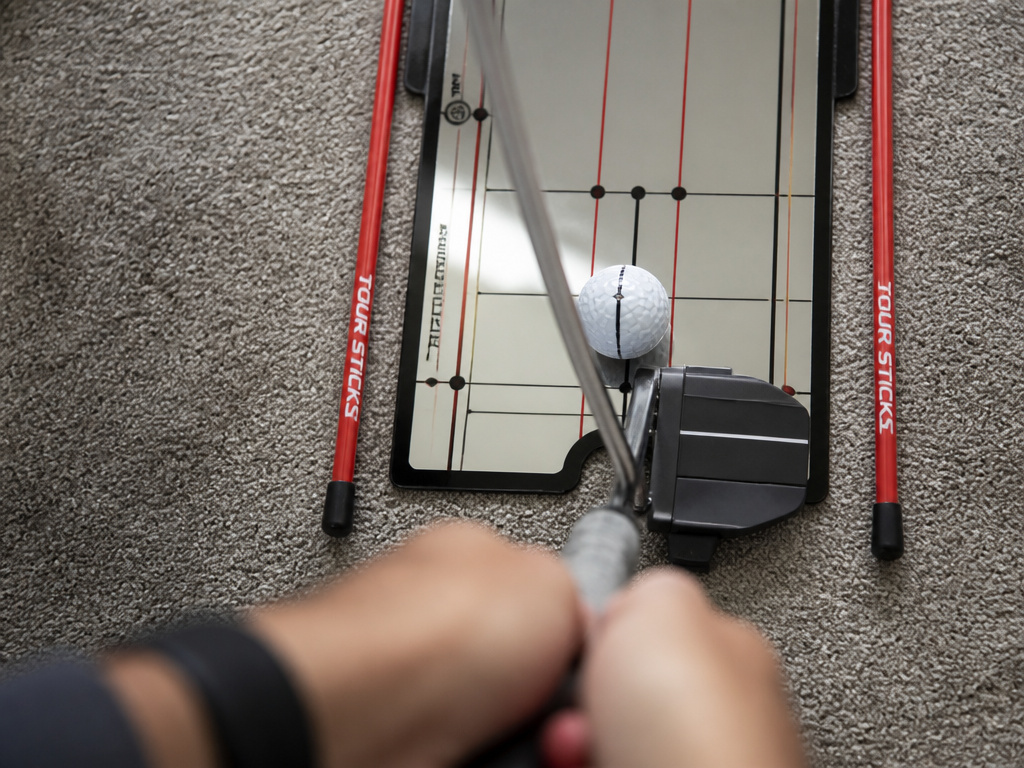
You don’t need a $500 fitting to improve. You need feedback. Your eyes are unreliable witnesses; you need evidence.
- The Putting Mirror Drill. This is non-negotiable. Place a putting mirror on the ground. Set your ball on the marker, take your stance, and look down. The mirror shows two things: Are your eyes over the target line? And is your putter face square to the grid lines? Do this for five minutes a day. It trains the two fundamentals of golf alignment fundamentals simultaneously.
- The Gate Drill with Alignment Sticks. Lay two alignment sticks on the ground, parallel and just wider than your putter head. Place the ball in the center. Make strokes ensuring the putter doesn’t touch the sticks on the backswing or follow-through. This trains a square path, which supports a square face.
- The String Line Test. Tie a string between two stakes and pull it taut just above the ground, aligned at a target. Place your ball underneath it. If your putter’s alignment line points directly down the string, you’re square. If it points left or right, you’re seeing your aim bias in real time. This is the best way to test which new putters for average golfers might work for you.
These drills provide the objective feedback your brain needs to recalibrate. They move alignment from an abstract concept to a tangible, repeatable position. Consistent use of these practice tools will do more for your putting than any new club alone.
Frequently Asked Questions
What is the most common mistake golfers make when selecting an alignment aid?
Many players choose an aid based solely on its appearance or tour popularity, rather than its actual performance for their own eyes. A visually complex system, like multiple lines, can create confusion and hinder aim for someone who needs simplicity. The correct choice is the one that allows for a consistently square setup without requiring conscious adjustment.
How does eye dominance affect how I see an alignment line?
Your dominant eye can cause a perfectly straight, perpendicular line on the putter to appear tilted or skewed at address. This optical illusion is why some manufacturers design lines at a slight angle, as patented, to counteract this perception. A fitting that tests different lines with a laser can reveal which configuration looks straight and true to your specific vision.
Can the wrong alignment aid actually hurt my putting?
Yes, an unsuitable aid can negatively impact performance by adding visual noise and reducing setup consistency. If the feature is too busy or doesn’t match your visual processing style, you may struggle to aim reliably, leading to more compensations in your stroke. The aid should simplify the aiming process, not complicate it.
Why is face angle at impact more important than the aid itself during a fitting?
The alignment aid is merely a tool to achieve a repeatable, square face at impact, which is the ultimate determinant of starting line. A professional fitting uses technology to measure this impact condition, ensuring the chosen visual feature genuinely improves your mechanics. The best aid is the one that delivers the best measurable results, regardless of its design.
The Bottom Line
Putter alignment aids are functional tools, not decorations. The right one acts as a translator between your eyes and the clubface, correcting for perceptual errors like eye dominance. The wrong one adds visual clutter and hurts your consistency.
Ignore the marketing hype. The best aid is the one that, under the objective test of a laser or string line, you can set square ten times in a row without conscious effort. For many, a bold geometric shape like a 2-Ball mallet provides that clarity. For others, it’s the simplicity of a single line on a blade.
Before you buy, test with feedback. Use a mirror, a string, or better yet, a basic fitting. Your scorecard doesn’t care how high-tech the aid looks. It only cares if the ball starts on line. Find the tool that makes that happen, and stick with it. The confidence of knowing your aim is true is worth more than any gadget.
