
Understanding Putter Toe Hang & Its Effect on Face Rotation
This post contains affiliate links. As an Amazon Associate, we earn from qualifying purchases.
This post contains affiliate links. As an Amazon Associate, we earn from qualifying purchases.
Putter toe hang is the angle the putter’s toe points toward the ground when the shaft is balanced horizontally. It’s determined by where the head’s center of gravity sits relative to the shaft axis. This design feature directly influences how much the putter face wants to rotate open and closed during your stroke, which is why matching it to your natural path is the single biggest factor in a dynamic putter fitting.
Forget blade versus mallet as your first filter. The head shape you see at address matters less than the hidden weight distribution you feel during the stroke. Toe hang is that hidden engine. Getting it wrong means your hands fight the putter’s natural inertia on every swing. Getting it right lets the club do the work.
What follows is the mechanics of why toe hang exists, how to measure what you have, and the concrete data on which stroke arc pairs with which hang. We’ll also cover the putter models that break the old rules and the one fitting step you cannot skip.
Key Takeaways
- Toe hang is a product of center of gravity placement. Weight toward the toe creates more hang and promotes face rotation.
- The common plumber’s neck blade averages about 35 degrees of toe hang, fitting a moderate arc.
- Face-balanced putters (0° hang) resist rotation and suit straight-back, straight-through strokes. High toe hang (45°+) assists closing for strong arcs.
- A mismatch causes a predictable miss: too little hang for an arcing stroke leads to pushes; too much hang for a straight stroke leads to pulls.
- You can identify your stroke with a phone video or a simple gate drill, then test putters within the corresponding toe-hang category.
The Physics of a Hanging Toe
Balance any putter shaft across your finger. The head will settle in one of three positions: face pointing straight up, toe pointing down at an angle, or, rarely, toe pointing up. This isn’t magic. It’s simple leverage.
The putter head has a center of gravity (CG), a single point where its mass is balanced. The shaft enters the head at the hosel. If you drew a line straight down the center of the shaft, where does it land relative to the CG? That relationship decides everything.
When the shaft axis passes directly through the center of gravity, the head has no tendency to rotate around that axis. The face stays square to the sky, this is a face-balanced putter. When the CG is out in the toe, the head wants to rotate around the shaft, pulling the toe downward. That’s toe hang.
Hosel design is the primary architect. A center-shafted mallet often lines up the shaft with the CG. A plumber’s neck on a blade moves the shaft axis toward the heel, leaving the CG out toward the toe. A flow neck or heel-shafted design moves the axis even further heel-ward, creating maximal toe hang, sometimes 60 degrees or more.
This isn’t just a static measurement. That off-center CG creates inertia during the stroke. On the backswing, the toe-heavy mass lags, allowing the face to open slightly. On the through-stroke, it swings down, helping the face close back to square. A face-balanced putter resists this rotation; it wants to stay square throughout.
How Toe Hang Affects Your Putting Stroke
The goal is harmony. You want the putter’s natural rotational tendency to match your stroke’s innate path. A mismatch forces your hands to actively manipulate the face, killing consistency.
Research using systems like SAM PuttLab quantifies stroke arcs by the closing angle, how many degrees the putter face closes from the start of the forward stroke to impact. This number, not a feeling, tells you what you need.
| Stroke Type | Closing Angle | Best Toe Hang Match | Common Putter Style |
|---|---|---|---|
| Straight | 0° – 3.5° | Face Balanced (0°) | Center-shafted mallets |
| Slight Arc | 3.5° – 7.5° | Mid-Hang (20° – 45°) | Plumber’s neck blades |
| Strong Arc | 7.5°+ | Full Toe Hang (45°+) | Flow neck, heel-shafted blades |
Where this goes sideways: Choosing a face-balanced mallet because you like the look, but having a strong arc. Your hands must hold the face open through impact, often resulting in a weak push miss to the right (for a right-handed golfer). The correction feels forced and changes from day to day.
The data from putter companies like PING supports this. They use colored shaft bands as a quick-fit guide: blue for face-balanced, green for mid-hang, red for full toe hang. It’s a recognition that this one spec often outweighs all others in finding a putter you can aim and swing consistently.
How To Measure Your Putter’s Toe Hang
You need a steady finger and a putter. No special tools.
- Hold the putter near the head. Grip the shaft about three-quarters of the way down toward the head.
- Balance it horizontally. Rest the shaft across your extended index finger, letting the putter head dangle freely. Let it settle completely.
- Observe the face. Look directly at the putter face from the front. What position is it in?
The finger test is the quick version. Balance the shaft horizontally on one finger near the head, let the putter settle, and read the toe. If the face points straight up, the putter is face balanced. If the toe sinks toward the floor, the putter has toe hang, and the further it drops, the more it has.
Here’s how to interpret what you see:
- Face points to the sky: Face balanced (0° hang). Suits a straight stroke.
- Toe points to 4:30 / 5 o’clock: About 25-35° of hang. The sweet spot for a slight arc.
- Toe points to 6 o’clock: 45°+ of hang. Designed for a pronounced arcing stroke.
This simple test is why understanding your putter loft and lie is also critical, a putter that’s too upright or flat at address changes how you deliver it, which can mask your true stroke type.
Matching Toe Hang to Your Stroke
You can’t guess your stroke type. You have to see it. Two methods work without expensive technology.
The Gate Drill: Set two alignment sticks or clubs on the ground parallel to your target line, just wider than your putter head. Make strokes. Does your putter head brush the inside stick on the backswing and the outside stick on the follow-through? That’s an arc. The more it brushes, the stronger the arc.
The Phone Video: This is the most revealing. Set your phone on the ground directly behind you, filming down the target line. Hit five putts. Watch in slow motion. Trace the path of the putter head. Is it straight back and through? Does it move inside on the backswing and release out? That visual proof is worth a thousand feels.
Once you know your arc, the putter selection narrows dramatically.
- Straight Strokes: Look for face-balanced mallets like an Odyssey 2-Ball or a TaylorMade Spider. Their high MOI and resistance to rotation are your allies. The counterbalanced putter design also falls here, adding stability.
- Slight Arc: This is the most common category. You want a mid-hang putter. This includes most classic blade putters with a plumber’s neck, like a Scotty Cameron Newport or a PING Anser. The differences between blade and mallet putters blur here, as some mallets like the Odyssey Toe Up are engineered for this arc.
- Strong Arc: Seek out blades with flow necks or heel-shafted designs. These have clear, full toe hang. The mass in the toe actively helps you square the face. This is where a proper putter fitting that assesses your lie angle is non-negotiable.
Common Myths and Exceptions
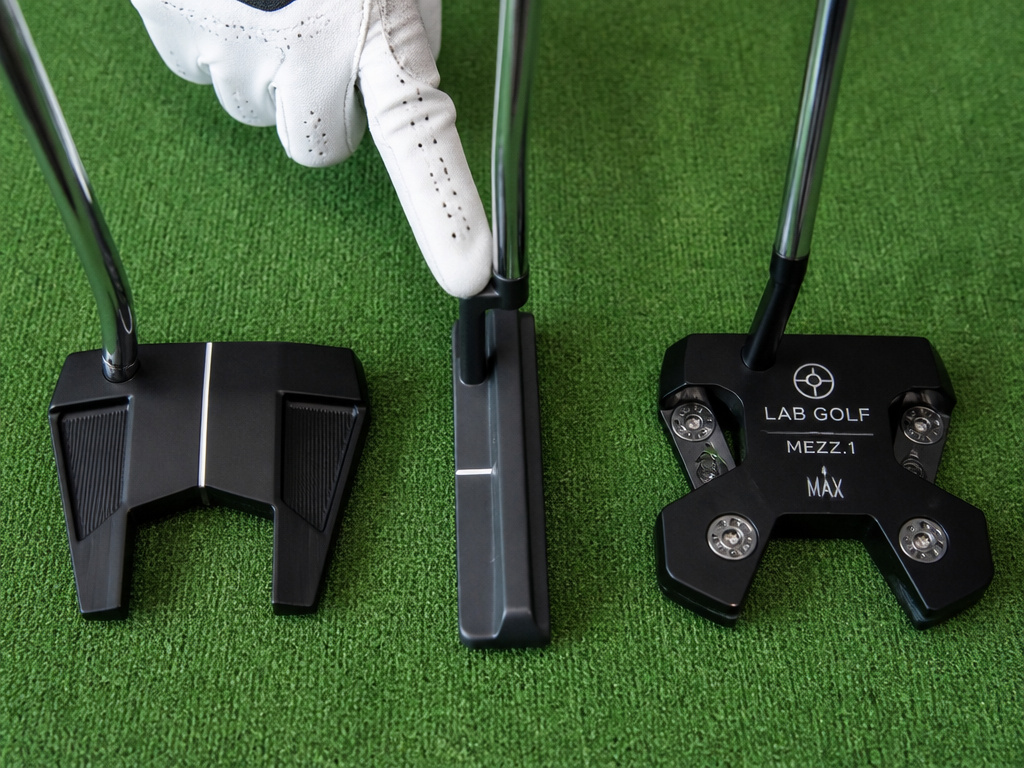 The old saying “blades have toe hang, mallets are face balanced” is a decent starting point but a terrible finish line. Exceptions are everywhere.
Toe-Hang Mallets: The TaylorMade Spider series offers several models with significant toe hang. The Odyssey Toe Up #1 is a mallet built specifically to combat face rotation for arcing strokes. They prove head shape and weight distribution are separate decisions.
Face-Balanced Blades: Yes, they exist. A center-shafted blade, or one with a precisely positioned hosel, can be face balanced. It’s all about that CG-to-shaft alignment.
The Lie-Angle Balanced Exception: Companies like L.A.B. Golf ignore toe hang entirely. Their putters are balanced on the lie angle, meaning the head has no tendency to rotate open or closed regardless of how you move it. It’s a different philosophy altogether, aimed at removing torque completely.
Easy to miss: Toe hang influences face rotation, but it doesn’t work in isolation. Grip size acts as a partner. A larger grip can slow rotation, subtly altering how a putter with a given toe hang behaves. This is why a full fitting that includes your putter length and fitting and grip selection is the final step.
Another exception is face insert technology. While a putter face insert primarily affects feel and forward roll, a softer insert can slightly deaden impact, which some players feel allows them to control rotation better. It’s a fine-tuning adjustment, not a primary fitting parameter.
Frequently Asked Questions
Does more toe hang help if I always push putts?
Probably not, and it might make it worse. A persistent push (right for RH golfers) often means the face is staying open at impact. More toe hang encourages closure, which seems like the fix. However, if your stroke is very straight, the extra toe-hang inertia can actually cause the head to lag and stay open longer. The real fix might be a face-balanced putter to resist rotation, or a larger grip to quiet your hands. Diagnose your stroke first.
Can I change the toe hang on my current putter?
No. Toe hang is a fixed design characteristic determined by the head’s internal weight distribution and hosel placement. You cannot bend, drill, or adjust a putter to change its toe hang. You’d need to select a new head design. This is different from adjusting loft and lie angles, which can be bent.
What’s the difference between toe hang and swing weight?
They are related but distinct. Toe hang is about where the weight is, specifically the lateral (heel-to-toe) balance point relative to the shaft. Swing weight is a measure of how heavy the head feels when you swing the club, determined by the weight distribution along the entire club’s length. A putter can have a high swing weight but be face-balanced, or a low swing weight with lots of toe hang.
Do armlock putters have toe hang?
Armlock putters typically have very little to no toe hang. The armlock technique locks the putter against the lead forearm, intentionally minimizing wrist hinge and face rotation. The putter design supports this with a face-balanced or torque-balanced profile to keep the face stable throughout the rigid, pendulum-style stroke.
How important is toe hang compared to alignment aids?
It’s more fundamental. Putter alignment aids, lines, dots, wings, help you aim the face correctly at address. Toe hang influences what that face does during the swing. You can have perfect alignment with a terrible toe-hang match and still miss every putt because the face rotates offline. First, match the toe hang to your stroke. Then, choose the alignment visual that gives you the most confidence. The putter alignment aids are the steering wheel; toe hang is the engine’s alignment.
Before You Go
Toe hang isn’t a marketing gimmick. It’s the mechanical translation of your putting stroke into a putter design. Ignoring it means you’re likely playing a club that fights your natural move on every single putt.
Find your stroke on video. Balance your current gamer on your finger. See where the disconnect is. When you test new putters, let the toe-hang category guide your first filter, not the brand or the polish. The right match won’t magically make every putt, but it will make your stroke feel effortless and your misses predictable. And in putting, predictable is fixable. For the full context of where your putter fits among all the types of clubs in your bag, that’s a lesson in itself.
